
Category FAQs

Find answers to common questions about cosmetic tube packaging, materials, printing, MOQ, customization, production, shipping, and sustainable packaging solutions.

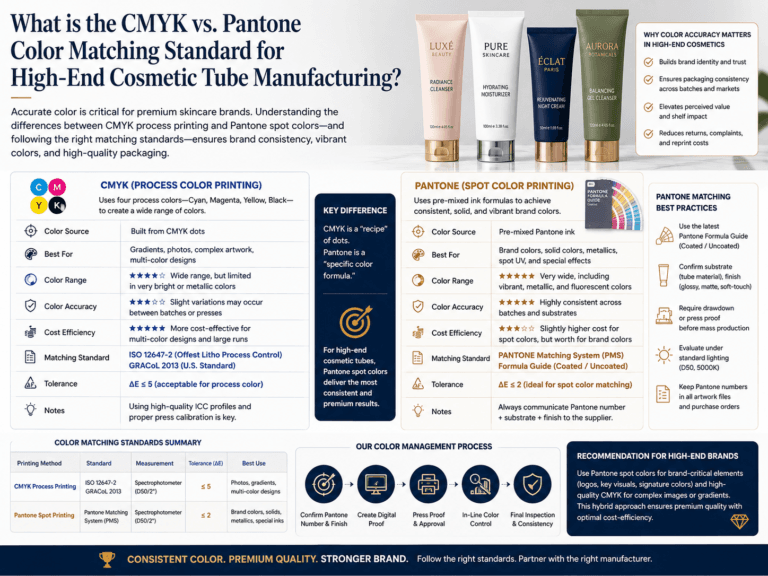
What is the CMYK vs. Pantone color matching standard for high-end cosmetic tube manufacturing

What is the CMYK vs. Pantone color matching standard for high-end cosmetic tube manufacturing? 

In high-end cosmetic tube manufacturing, CMYK and Pantone are not competing “standards” in the sense that one replaces the other. They are two different color production approaches used for different goals. CMYK is the standard four-color process system used for…

Read MoreWhat is the CMYK vs. Pantone color matching standard for high-end cosmetic tube manufacturing? 
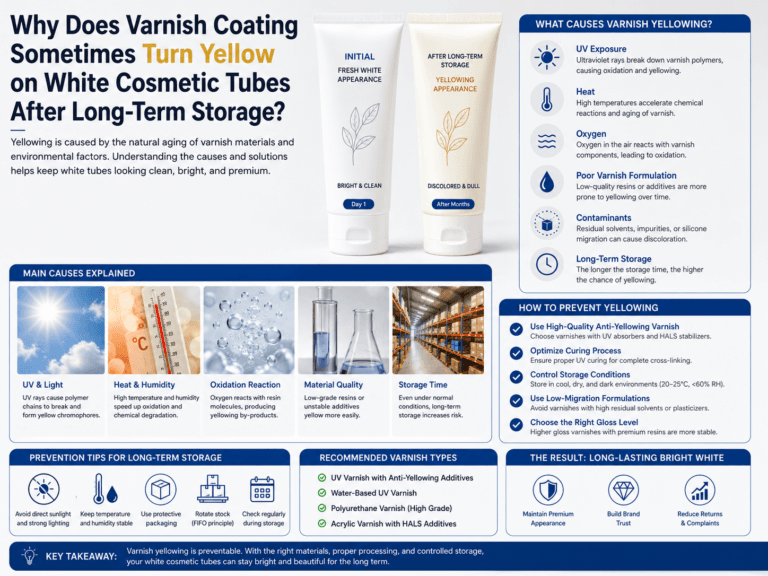
Why does varnish coating sometimes turn yellow on white cosmetic tubes after long-term storage

Why does varnish coating sometimes turn yellow on white cosmetic tubes after long-term storage?

Varnish coating on white cosmetic tubes can turn yellow after long-term storage because the clear protective layer slowly ages under light, oxygen, heat, humidity, and chemical exposure. In many cases, the yellowing does not come from the white tube body…

Read MoreWhy does varnish coating sometimes turn yellow on white cosmetic tubes after long-term storage?
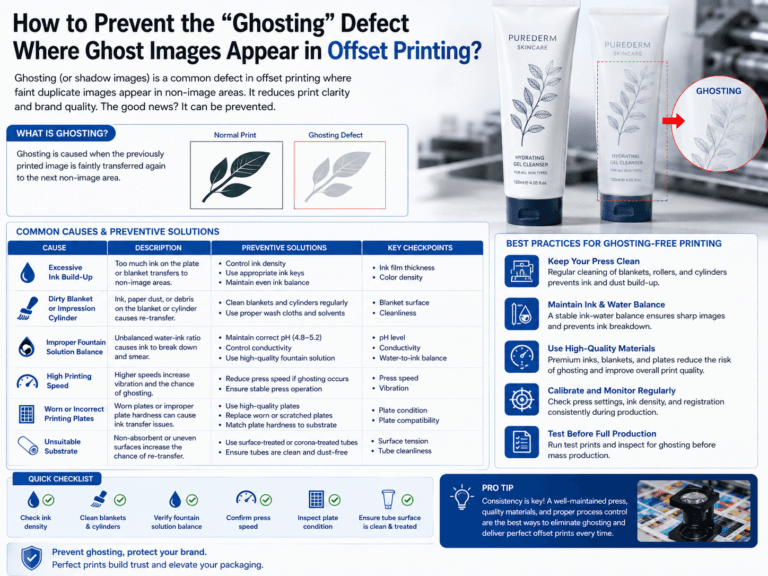
How to prevent the ghosting defect where ghost images appear in offset printing

How to prevent the “ghosting” defect where ghost images appear in offset printing? 

To prevent the “ghosting” defect in offset printing, factories usually focus on stabilizing ink supply, roller settings, and ink-water balance. Ghosting typically appears as a faint repeated image or uneven tonal echo near heavy solid areas. In practical production, it…

Read MoreHow to prevent the “ghosting” defect where ghost images appear in offset printing? 
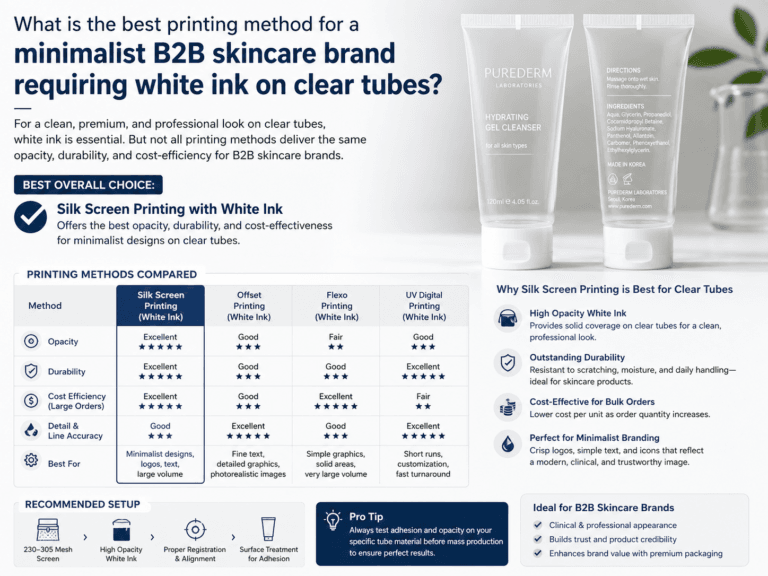
What is the best printing method for a minimalist B2B skincare brand requiring white ink on clear tubes

What is the best printing method for a minimalist B2B skincare brand requiring white ink on clear tubes?

For a minimalist B2B skincare brand that needs white ink on clear cosmetic tubes, silk screen printing is usually the best printing method. The main reason is opacity. On clear tubes, white ink must look solid, clean, and premium. Silk…

Read MoreWhat is the best printing method for a minimalist B2B skincare brand requiring white ink on clear tubes?
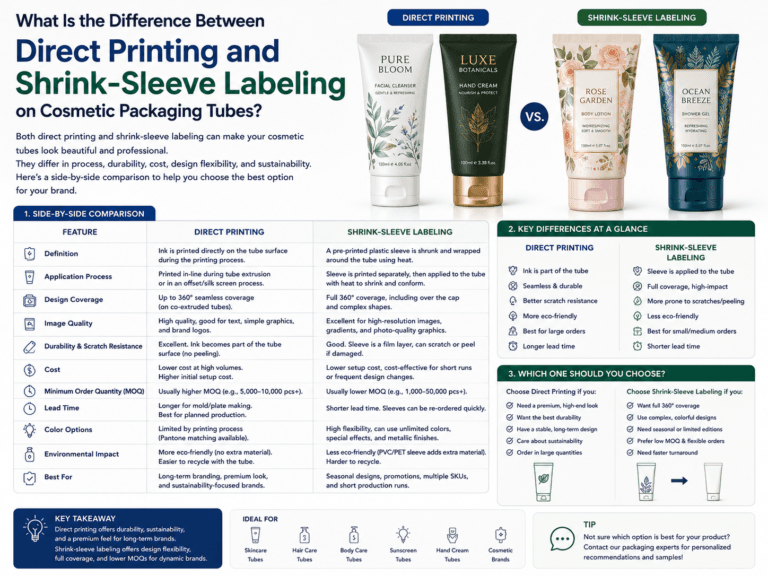
What is the difference between direct printing and shrink-sleeve labeling on cosmetic packaging tubes?

What is the difference between direct printing and labeling on cosmetic packaging tubes?

The main difference between direct printing and labeling on cosmetic packaging tubes is where the decoration is applied. Direct printing places the artwork directly onto the tube surface using methods such as silk screen printing, offset printing, or other tube-printing…

Read MoreWhat is the difference between direct printing and labeling on cosmetic packaging tubes?
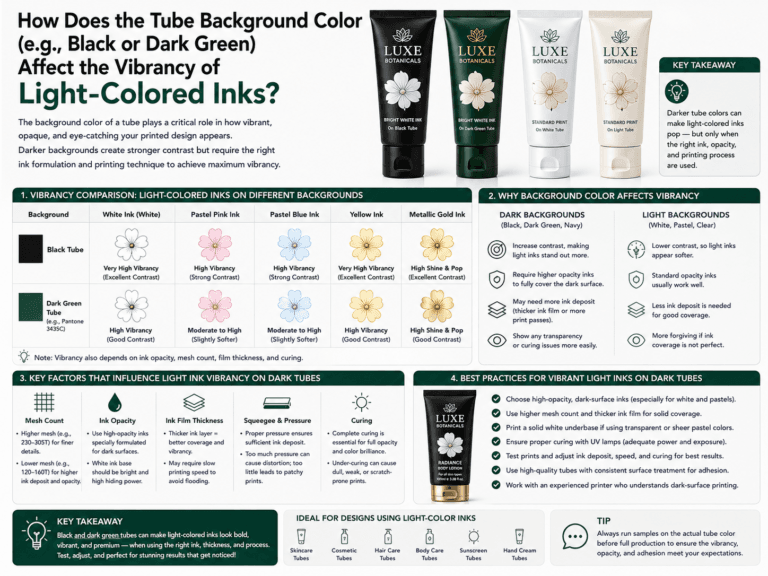
How does the tube background color (e.g., black or dark green) affect the vibrancy of light-colored inks

How does the tube background color (e.g., black or dark green) affect the vibrancy of light-colored inks?

The background color of a cosmetic tube has a major impact on how vibrant light-colored inks appear. On black, dark green, navy, or other deep-colored tubes, light inks such as white, pale pink, pastel beige, light yellow, mint, or soft…

Read MoreHow does the tube background color (e.g., black or dark green) affect the vibrancy of light-colored inks?
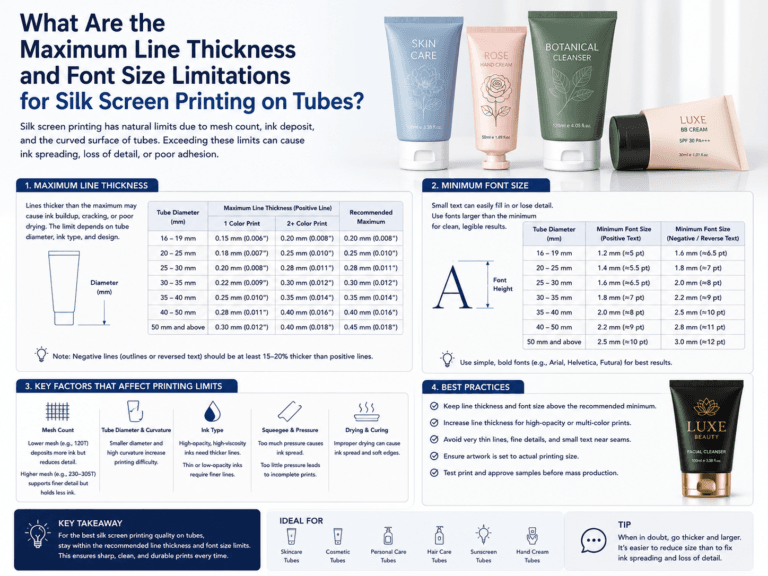
What are the maximum line thickness and font size limitations for silk screen printing on tubes

What are the maximum line thickness and font size limitations for silk screen printing on tubes?

For silk screen printing on cosmetic tubes, there is usually no strict “maximum line thickness” limit in normal artwork. Thick lines and large fonts are generally easy to print. The real technical limitation is the minimum line thickness and minimum…

Read MoreWhat are the maximum line thickness and font size limitations for silk screen printing on tubes?