
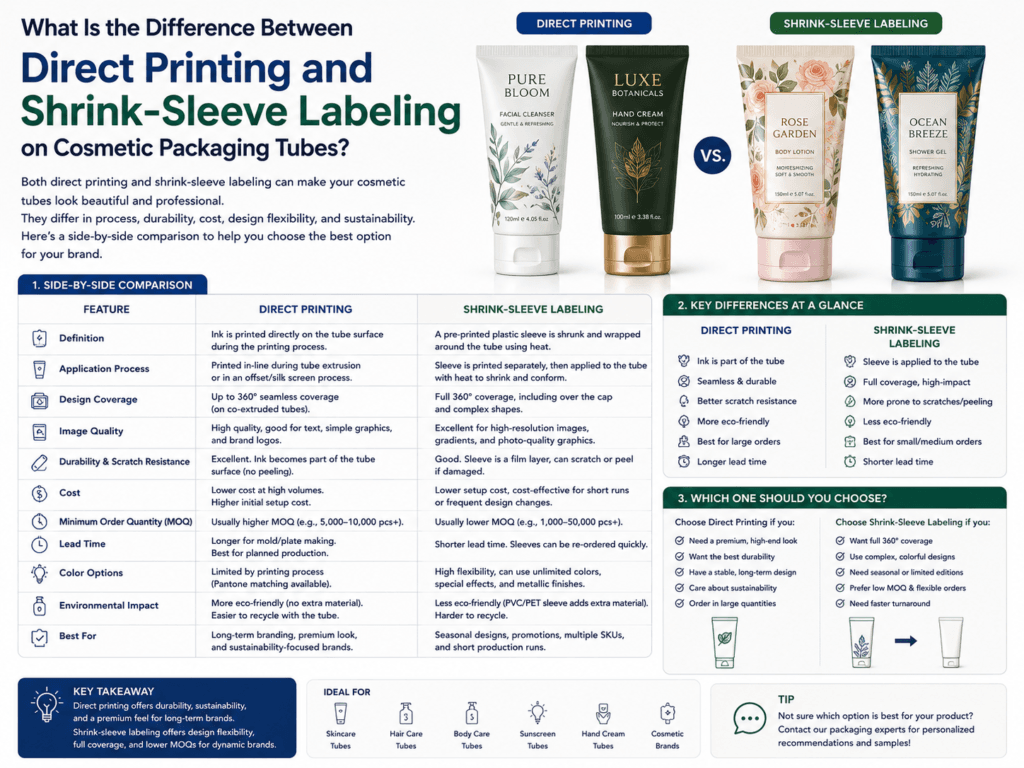
The main difference between direct printing and labeling on cosmetic packaging tubes is where the decoration is applied. Direct printing places the artwork directly onto the tube surface using methods such as silk screen printing, offset printing, or other tube-printing processes. Labeling applies a printed label or sticker onto the tube after the tube body is made.
Both methods can work well for cosmetic tubes, but they serve different business goals. Direct printing is usually better for a cleaner integrated look and stronger long-term brand appearance, while labeling is often better for smaller runs, faster design changes, and more flexible SKU management.
Quick Comparison: Direct Printing vs Labeling
| Factor | Direct Printing | Labeling |
|---|---|---|
| Decoration method | Printed directly on the tube body | Printed label applied to tube surface |
| Visual effect | More integrated and premium | More flexible but may show label edges |
| Small batch flexibility | Less flexible | More flexible |
| Durability | Usually stronger if process is well controlled | Depends on label material and adhesive quality |
| SKU changes | Harder to change quickly | Easier to update for multiple versions |
What Is Direct Printing on Cosmetic Tubes?
Direct printing means the design is printed directly onto the tube surface during production. Common methods include silk screen printing for bold spot colors and offset printing for more detailed, multi-color artwork.
- Creates a cleaner, more built-in packaging look
- Usually better for premium branding
- No label edge lifting risk
- Good for medium to large volume production
What Is Labeling on Cosmetic Tubes?
Labeling means a pre-printed label is applied to the finished tube body. The label may be paper, film, or another flexible label material designed for squeezable packaging.
- Useful for smaller runs and multiple SKUs
- Allows easier late-stage artwork updates
- Can reduce risk when brands want quick design changes
- Works well when production flexibility matters more than integrated decoration
Main Advantages of Direct Printing
| Advantage | Why Brands Choose It |
|---|---|
| Premium appearance | Artwork looks integrated into the tube rather than added afterward |
| Better visual finish | No visible label edge or label overlap line |
| Good long-term branding | Suitable for established products with stable artwork |
| Decoration variety | Can combine with hot stamping, matte finish, or other tube effects |
Main Advantages of Labeling
| Advantage | Why Brands Choose It |
|---|---|
| More flexible for short runs | Useful for testing products or many SKU versions |
| Faster artwork changes | Better for seasonal launches, trial batches, or market-specific labeling |
| Can simplify inventory strategy | One base tube can support multiple label versions |
| Useful for lower-volume tube labeling | Often practical for flexible production planning |
Main Limitations of Each Method
| Method | Typical Limitation |
|---|---|
| Direct printing | Less flexible for frequent artwork changes or many small batch variations |
| Labeling | May show label edge, lifting risk, or less integrated luxury appearance |
Which Method Is Better for Premium Cosmetic Tubes?
For most premium skincare, makeup, and beauty packaging, direct printing is usually the stronger choice because it creates a cleaner and more professional appearance. It looks more like part of the tube itself and usually supports better brand perception.
However, for brands that need small MOQ, multiple SKUs, frequent artwork changes, or late-stage market customization, labeling can be the smarter commercial solution.
Best Choice by Project Type
| Project Need | Better Option | Reason |
|---|---|---|
| Luxury product appearance | Direct printing | Cleaner and more integrated look |
| Frequent artwork updates | Labeling | Easier to change without remaking printed tubes |
| Many SKU versions | Labeling | More flexible for variation management |
| Stable large-volume product line | Direct printing | Better for long-term branded production |
Summary
The difference between direct printing and labeling on cosmetic packaging tubes is that direct printing decorates the tube body itself, while labeling applies a separate printed label onto the tube. Direct printing is usually better for premium appearance and integrated branding, while labeling is usually better for flexibility, shorter runs, and faster artwork changes.
In simple terms, direct printing is best for premium consistency, and labeling is best for operational flexibility.
Learn more: Labeling vs Direct Tube Printing, Printing Options, Tube Decoration, Customize Cosmetic Tubes, Silk Screen Printing Tubes, Offset Printing Tubes.
Need the Right Decoration Method for Your Cosmetic Tubes?
Xinfly Packaging helps brands choose between direct printing and labeling based on MOQ, SKU count, premium appearance goals, and production flexibility.