
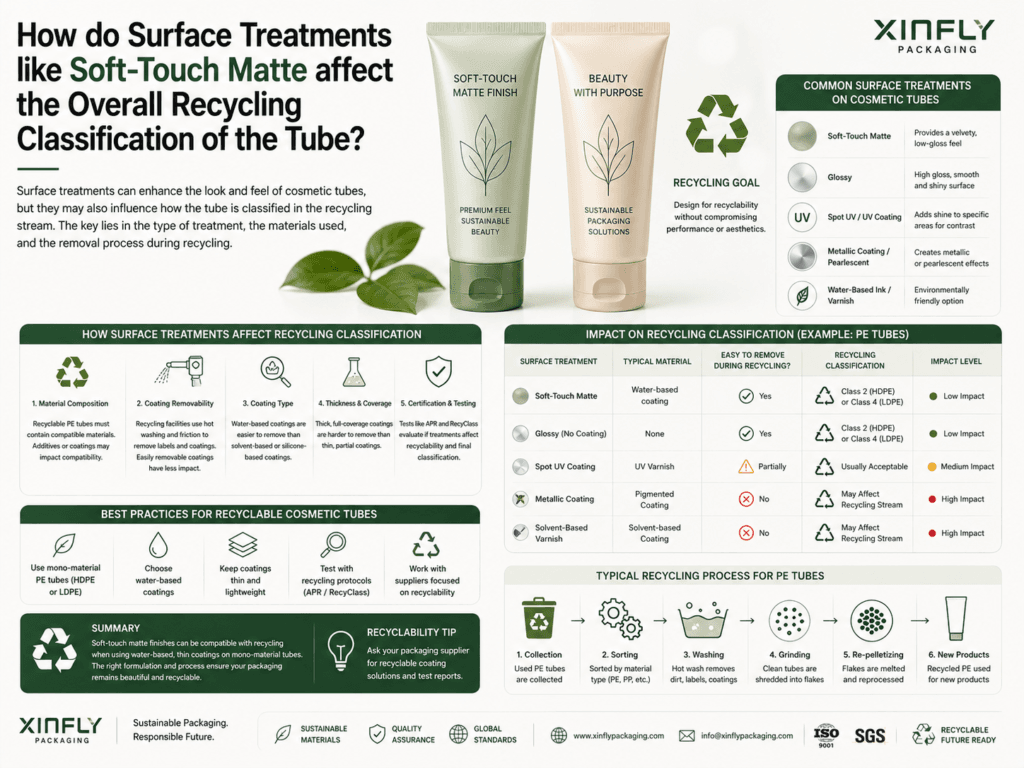
Surface treatments such as soft-touch matte do not automatically change the base recycling classification of a cosmetic tube, but they can affect the final recyclability assessment. In most cases, the tube is still classified first by its main body material, such as PE or PP. However, the surface coating, lacquer, ink, or decorative layer can reduce recyclability performance if it adds too much non-compatible material, interferes with sorting, or makes the pack harder to recycle in practice.
In simple terms, a PE tube with a soft-touch matte finish does not stop being a PE tube just because of the surface feel. But the overall recycling result may become less favorable if the coating system is too heavy, uses problematic chemistry, or negatively affects NIR detection, washing, or reprocessing.
What Determines the Final Recycling Classification?
| Factor | Why It Matters | Possible Impact |
|---|---|---|
| Main tube material | The body resin usually defines the primary recycling stream | PE tube stays in the PE family, PP tube stays in the PP family |
| Coating type | Some surface treatments are more compatible than others | Can improve or reduce recyclability compatibility |
| Coating weight or coverage | Heavier decoration adds more non-base material | High loading may trigger testing or downgrade concerns |
| NIR detectability | Sorting systems must still recognize the base polymer | If detection is blocked, sortability can suffer |
| Chemical compatibility | The coating should not create problems in washing or recycling | Incompatible layers may reduce final recyclability rating |
How Soft-Touch Matte Finishes Usually Affect Recyclability
- They are usually treated as an added decoration layer, not a new packaging material category.
- Light, compatible coatings may have limited impact if they do not interfere with sorting or recycling.
- Heavy or incompatible coatings can become a recyclability issue, especially if they exceed practical design-for-recycling thresholds.
- The key question is not “matte or glossy” alone, but what chemistry and loading level the finish adds to the tube.
Why Sorting Performance Matters So Much
For tubes intended for PE or PP recycling streams, the package must still be recognized by sorting equipment. If a soft-touch matte coating changes the optical response too much, or if the decoration system becomes too heavy or too dark, the package may become harder to detect correctly. That is why many recyclability guidelines focus not only on the tube material itself, but also on whether coatings, inks, and decorations hinder NIR recognition.
Direct Printing, Lacquer, and Surface Treatment Limits
| Decoration Condition | Typical Recyclability Logic |
|---|---|
| Low-weight direct printing / lacquer | Often acceptable if it remains a small fraction of total packaging weight |
| Heavier coating systems | May require further evaluation or testing |
| Coatings that hinder NIR detection | Higher recyclability risk even if the base tube is PE or PP |
| Compatible decoration technologies | Can preserve better recyclability outcomes if properly designed |
When Soft-Touch Matte Is More Likely to Create a Recycling Issue
- When the coating is thick and represents a meaningful share of the total package weight
- When the lacquer chemistry is not compatible with the intended recycling stream
- When the finish makes NIR sorting less reliable
- When multiple decorative layers are combined and the total decorative burden becomes too high
Best Practice for Brands That Want Both Premium Feel and Better Recyclability
| Brand Goal | Recommended Approach |
|---|---|
| Keep PE or PP recyclability as strong as possible | Use lightweight, compatible surface treatments |
| Keep sortability reliable | Validate that coatings do not interfere with NIR detection |
| Use premium finishes responsibly | Limit decorative burden and avoid unnecessary complex layers |
| Support recycling claims credibly | Check the full tube structure against current DfR guidance or testing |
Practical Summary
A soft-touch matte finish usually does not change the basic resin family of the tube. A PE tube is still fundamentally a PE tube. However, it can affect the final recycling classification or recyclability rating if the surface treatment adds too much incompatible material, reduces NIR sortability, or creates problems during recycling.
So the real answer is: surface treatments affect recyclability performance more than they change base material identity. For premium cosmetic tubes, the best approach is to keep the decorative layer light, compatible, and validated against the intended recycling stream.
Learn more: Surface Finishing, Soft-Touch Tubes, Sustainable Materials, Recyclable Cosmetic Tubes Manufacturer, Eco-Friendly Cosmetic Tubes Manufacturer, How to Choose Sustainable Cosmetic Tubes.
Need Premium Tube Decoration Without Hurting Recyclability?
Xinfly Packaging helps brands compare soft-touch, matte, glossy, and other surface treatments while balancing luxury appearance, sorting performance, and recyclability goals.