
Category FAQs

Find answers to common questions about cosmetic tube packaging, materials, printing, MOQ, customization, production, shipping, and sustainable packaging solutions.

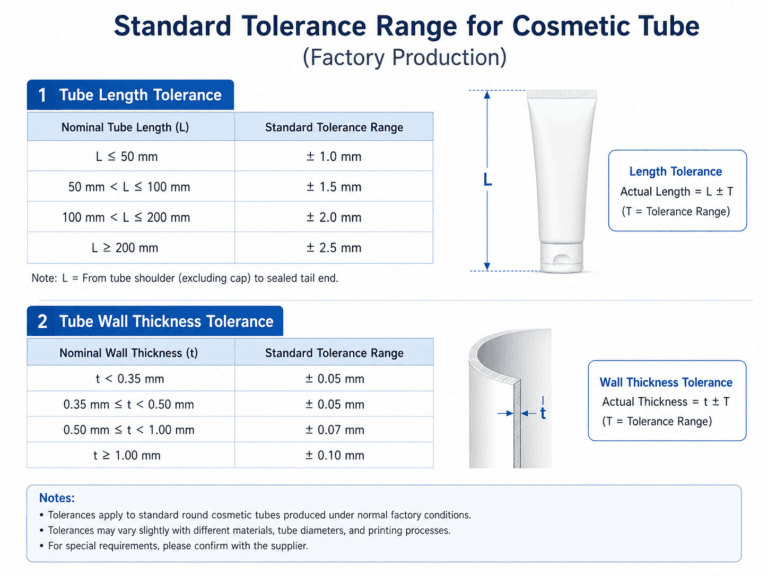
What is the standard tolerance range for cosmetic tube length and wall thickness in factory production

What is the standard tolerance range for cosmetic tube length and wall thickness in factory production?

In cosmetic tube factory production, a practical tolerance range is commonly around ±1mm to ±2mm for tube length and around ±0.03mm to ±0.08mm for wall thickness, depending on tube diameter, material structure, production process, and customer quality requirements. For high-precision…

Read MoreWhat is the standard tolerance range for cosmetic tube length and wall thickness in factory production?
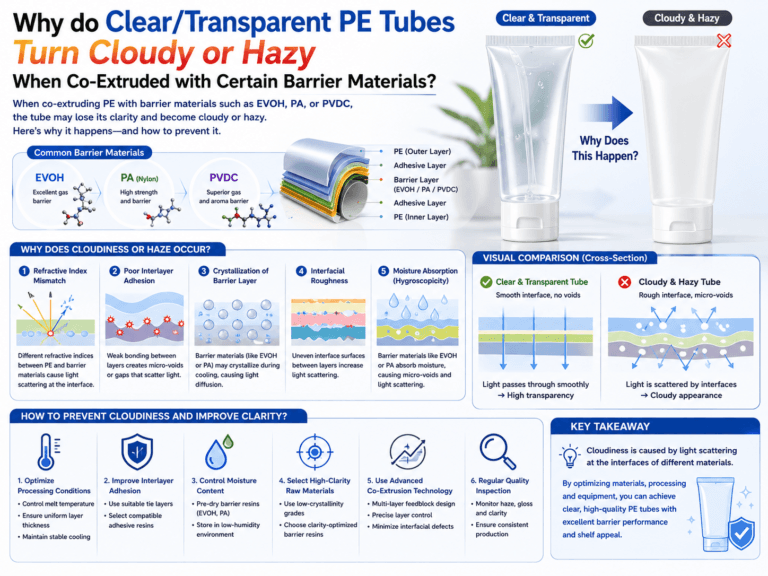
Why do clear:transparent PE tubes turn cloudy or hazy when co-extruded with certain barrier materials

Why do clear/transparent PE tubes turn cloudy or hazy when co-extruded with certain barrier materials?

Clear or transparent PE tubes may turn cloudy or hazy when co-extruded with certain barrier materials because each layer has different optical properties, crystallinity, refractive index, melting behavior, and cooling shrinkage. Even if the outer PE layer looks transparent, the…

Read MoreWhy do clear/transparent PE tubes turn cloudy or hazy when co-extruded with certain barrier materials?
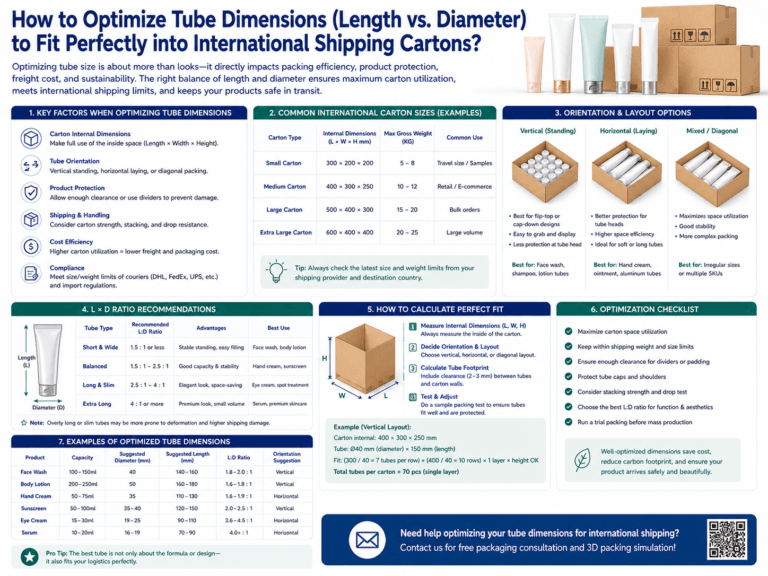
How to optimize tube dimensions (length vs. diameter) to fit perfectly into international shipping cartons?

How to optimize tube dimensions (length vs. diameter) to fit perfectly into international shipping cartons?

To optimize tube dimensions for international shipping cartons, brands should design tube length and diameter together with carton size, inner packing layout, product weight, cap height, and pallet loading efficiency. A tube that looks good on the shelf may still…

Read MoreHow to optimize tube dimensions (length vs. diameter) to fit perfectly into international shipping cartons?
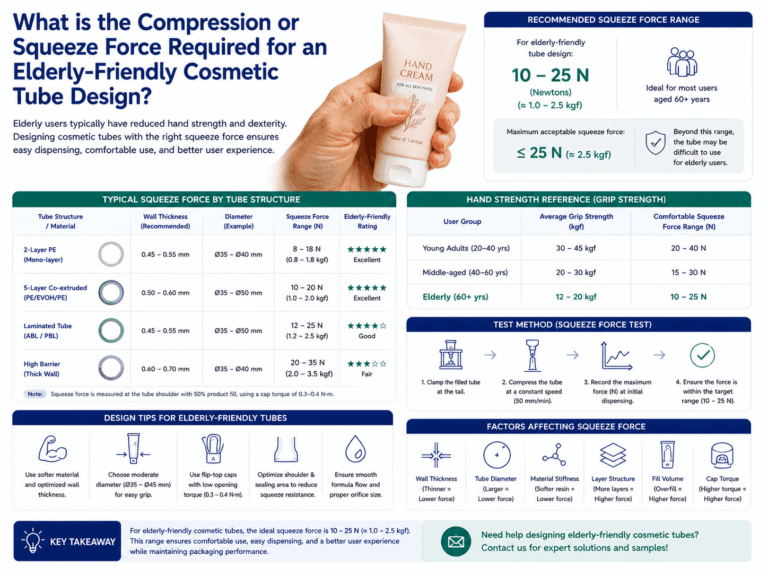
What is the compression or squeeze force required for an elderly-friendly cosmetic tube design?

What is the compression or squeeze force required for an elderly-friendly cosmetic tube design?

For an elderly-friendly cosmetic tube, the compression or squeeze force should be low enough for users with reduced hand strength to dispense the product comfortably, repeatedly, and without pain. In practical packaging development, many brands should target a soft squeeze…

Read MoreWhat is the compression or squeeze force required for an elderly-friendly cosmetic tube design?
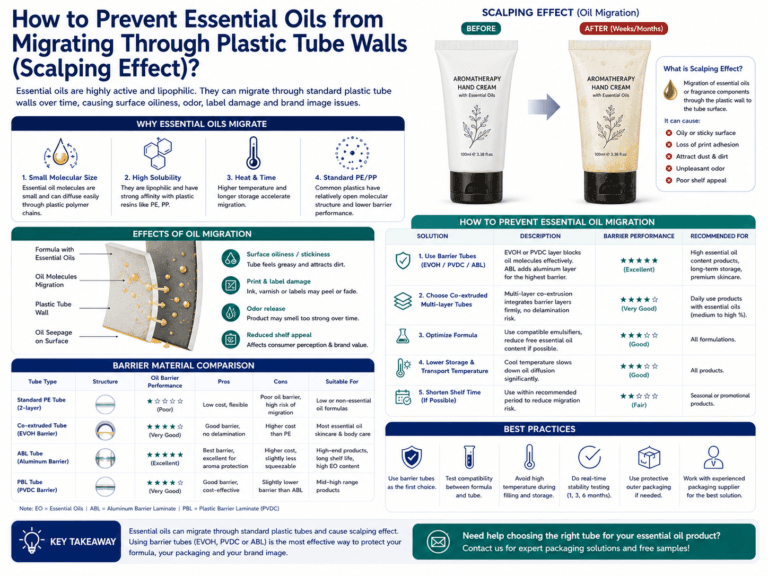
How to prevent essential oils from migrating through plastic tube walls (scalping effect)?

How to prevent essential oils from migrating through plastic tube walls (scalping effect)?

To prevent essential oils from migrating through plastic tube walls, brands should use a stronger barrier tube structure, choose the right inner contact layer, reduce direct interaction between volatile oil molecules and polyolefin plastics, and run real compatibility tests before…

Read MoreHow to prevent essential oils from migrating through plastic tube walls (scalping effect)?
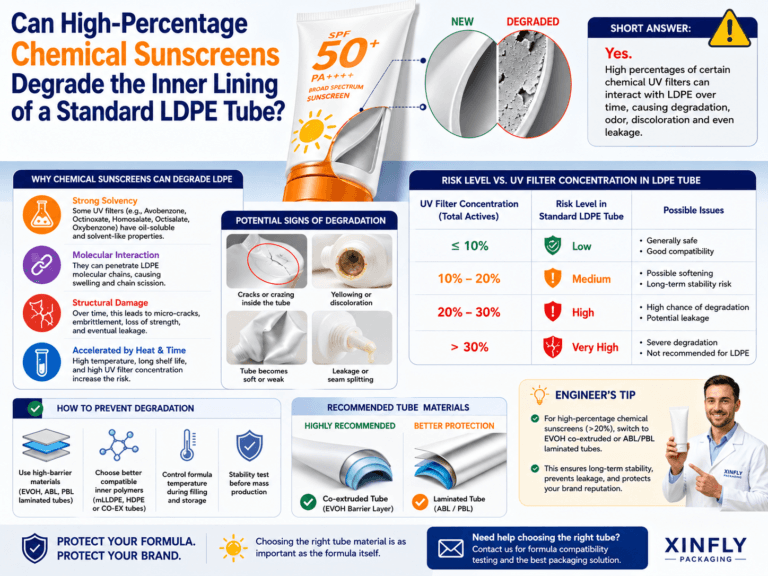
Can high-percentage chemical sunscreens degrade the inner lining of a standard LDPE tube

Can high-percentage chemical sunscreens degrade the inner lining of a standard LDPE tube?

High-percentage chemical sunscreens can create compatibility risks with the inner lining of a standard LDPE tube, but they do not always directly “degrade” the tube. The real concern is whether the sunscreen formula causes swelling, softening, migration, absorption, stress cracking,…

Read MoreCan high-percentage chemical sunscreens degrade the inner lining of a standard LDPE tube?
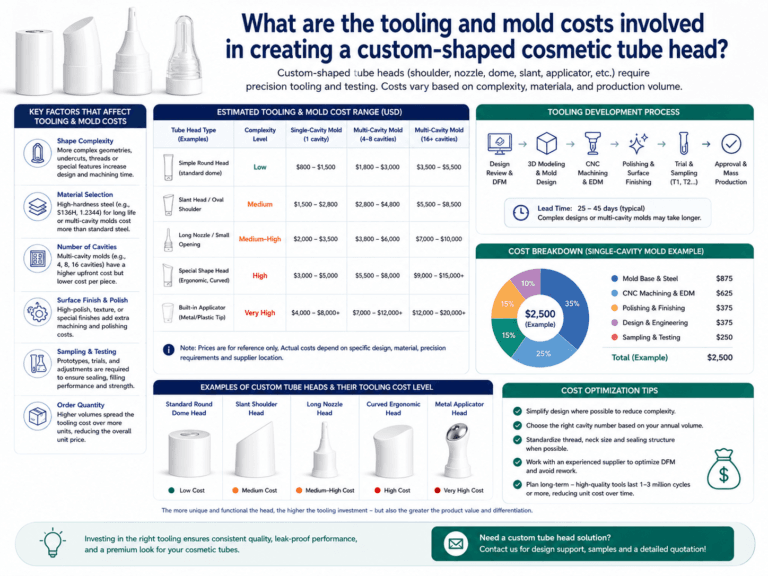
What are the tooling and mold costs involved in creating a custom-shaped cosmetic tube head?

What are the tooling and mold costs involved in creating a custom-shaped cosmetic tube head?

Creating a custom-shaped cosmetic tube head usually involves tooling and mold costs for the tube shoulder/head, cap matching, thread structure, sealing surface, and sometimes filling-machine compatibility. The cost depends on whether the brand only modifies an existing head style or…

Read MoreWhat are the tooling and mold costs involved in creating a custom-shaped cosmetic tube head?
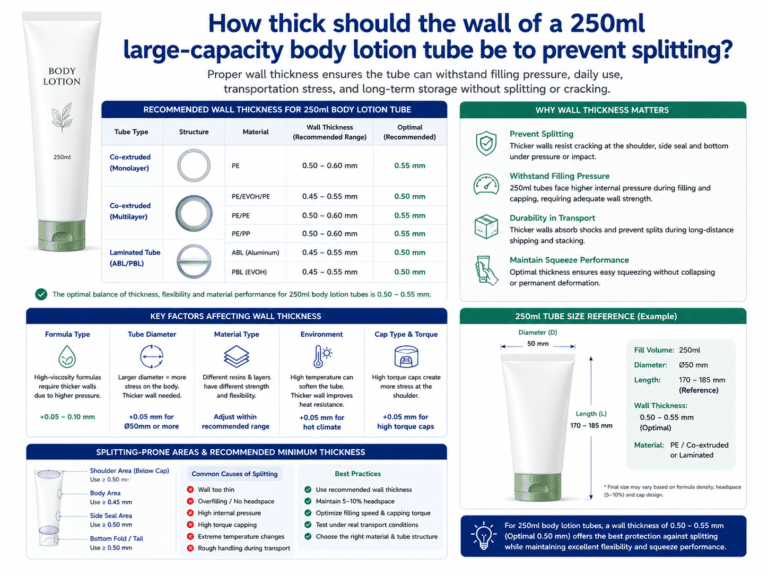
How thick should the wall of a 250ml large-capacity body lotion tube be to prevent splitting?

How thick should the wall of a 250ml large-capacity body lotion tube be to prevent splitting?

For a 250ml large-capacity body lotion tube, the wall thickness is commonly recommended around 0.55mm to 0.75mm, depending on the tube diameter, PE structure, formula density, shoulder design, and transport requirements. If the formula is heavy, the tube is long,…

Read MoreHow thick should the wall of a 250ml large-capacity body lotion tube be to prevent splitting?
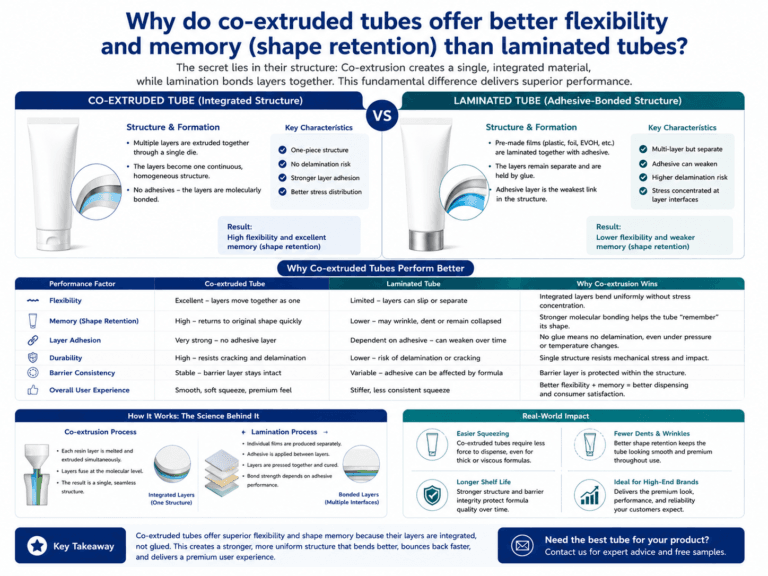
Why do co-extruded tubes offer better flexibility and memory (shape retention) than laminated tubes

Why do co-extruded tubes offer better flexibility and memory (shape retention) than laminated tubes?

Co-extruded tubes often offer better flexibility and memory, or shape retention, because their tube body is made from continuous extruded plastic layers rather than a flat laminate sheet that is rolled and side-welded. This gives co-extruded tubes a more integrated…

Read MoreWhy do co-extruded tubes offer better flexibility and memory (shape retention) than laminated tubes?
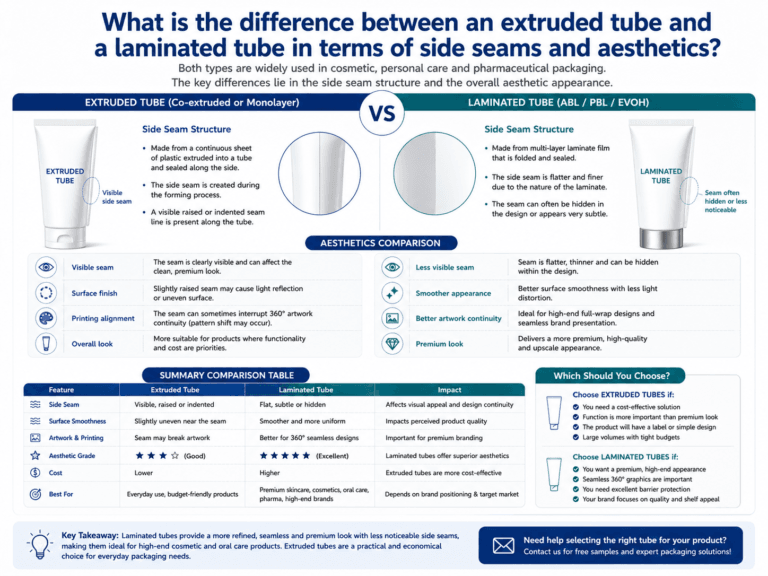
What is the difference between an extruded tube and a laminated tube in terms of side seams and aesthetics

What is the difference between an extruded tube and a laminated tube in terms of side seams and aesthetics?

The main difference between an extruded tube and a laminated tube is that an extruded tube usually has a seamless tube body, while a laminated tube normally has a visible or semi-visible side seam. This structural difference affects the overall…

Read MoreWhat is the difference between an extruded tube and a laminated tube in terms of side seams and aesthetics?
How to choose between ABL (Aluminum Barrier Laminate) and PBL (Plastic Barrier Laminate) for toothpaste or functional skincare

How to choose between ABL (Aluminum Barrier Laminate) and PBL (Plastic Barrier Laminate) for toothpaste or functional skincare?

To choose between ABL (Aluminum Barrier Laminate) and PBL (Plastic Barrier Laminate) tubes for toothpaste or functional skincare, brands should compare barrier requirement, product sensitivity, squeeze recovery, appearance, recyclability positioning, and cost. In simple terms, ABL is usually better when…

Read MoreHow to choose between ABL (Aluminum Barrier Laminate) and PBL (Plastic Barrier Laminate) for toothpaste or functional skincare?
What are the industry-standard diameters (e.g., 16mm, 19mm, 35mm, 40mm, 50mm) for hand cream and lotions?

What are the industry-standard diameters (e.g., 16mm, 19mm, 35mm, 40mm, 50mm) for hand cream and lotions?

Industry-standard cosmetic tube diameters for hand cream and lotions commonly include 16mm, 19mm, 22mm, 25mm, 30mm, 35mm, 40mm, and 50mm. Among these, 30mm to 35mm are widely used for hand cream, while 40mm to 50mm are more common for body…

Read MoreWhat are the industry-standard diameters (e.g., 16mm, 19mm, 35mm, 40mm, 50mm) for hand cream and lotions?