
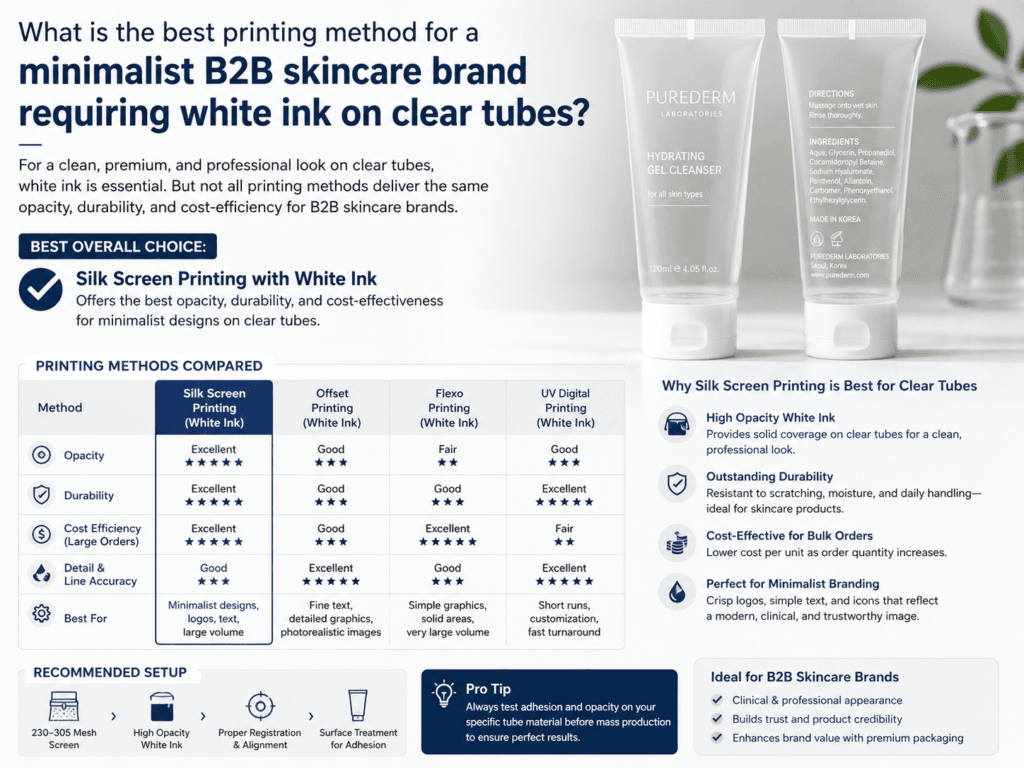
For a minimalist B2B skincare brand that needs white ink on clear cosmetic tubes, silk screen printing is usually the best printing method. The main reason is opacity. On clear tubes, white ink must look solid, clean, and premium. Silk screen printing is generally the strongest choice when the artwork is simple and brand-driven, because it can lay down a thicker, more opaque white layer than many other standard tube-printing methods.
For minimalist skincare packaging, the design usually depends on crisp white logos, clean text, generous empty space, and a high-end “quiet luxury” look. In that context, the most important print qualities are white opacity, edge sharpness, durability, and consistency on transparent plastic rather than photo-like detail or complex gradients.
Quick Answer: Which Printing Method Is Best?
| Printing Method | Performance for White Ink on Clear Tubes | Best Use Case |
|---|---|---|
| Silk screen printing | Best overall for strong opaque white | Minimalist logos, bold text, premium B2B skincare branding |
| Offset printing | Possible, but usually better for multi-color detail | Complex artwork rather than simple white-only branding |
| Digital printing | Useful in some short-run cases, but white opacity depends on system | Sampling, multiple SKUs, lower-volume flexibility |
| Flexo printing | Less commonly the first choice for premium white-only minimalist tube branding | More production-driven applications than luxury minimalism |
Why Silk Screen Printing Is Usually Best
- Better white opacity: White ink on clear tubes usually needs a heavier ink deposit to avoid looking weak or grayish.
- Cleaner minimalist look: Screen printing is excellent for bold logos, brand names, and simple text layouts.
- Strong premium contrast: The white print stands out well against the transparent tube body and visible formula inside.
- Good durability: Well-controlled screen printing can offer strong abrasion resistance for skincare packaging.
Why Not Always Offset Printing?
Offset printing is often excellent for detailed multi-color artwork, gradients, and fine images. But for a minimalist brand that mainly wants solid white branding on a clear tube, offset is not always the first recommendation. The visual success of the design depends more on white density and clean contrast than on photographic detail.
In simple terms, offset is usually better when the design is complex, while silk screen is usually better when the brand wants a simple, strong, opaque white statement.
What Makes White Ink on Clear Tubes Difficult?
| Challenge | Why It Matters | Visual Risk |
|---|---|---|
| Low opacity | Clear substrate allows light through | White looks weak, thin, or translucent |
| Formula show-through | The product inside affects visual contrast | White branding may look less clean if not opaque enough |
| Edge clarity | Minimalist artwork depends on precision | Any spreading or softness is easy to notice |
| Surface adhesion | Clear PE or plastic tubes still need proper treatment | Peeling or weak durability if process control is poor |
Best Design Rules for a Minimalist White-on-Clear Tube
- Use simple white logos and typography rather than delicate overcomplicated details.
- Make sure the white ink has enough density to separate clearly from the product inside the tube.
- Keep the layout clean and spacious so the clear tube becomes part of the design language.
- Use real production samples to check how the actual formula color affects the final appearance behind the print.
When Another Method May Be Better
| Scenario | Better Alternative | Why |
|---|---|---|
| Complex CMYK artwork | Offset printing | Better for gradients, photos, and multi-color designs |
| Short runs with many versions | Digital printing | More flexible for SKU variation and quick updates |
| Simple white-only premium branding | Silk screen printing | Best for bold opacity and minimalist contrast |
Best Practical Recommendation
For most B2B skincare brands with a minimalist visual strategy, the safest and most commercially effective choice is silk screen printing with well-controlled opaque white ink. It supports the clean, clinical, premium style that many modern skincare brands want, especially when the packaging relies on transparency and formula visibility as part of the product story.
Summary
The best printing method for a minimalist B2B skincare brand requiring white ink on clear tubes is usually silk screen printing. It is generally the strongest option for achieving opaque white coverage, clean contrast, durable print, and a premium minimalist appearance on transparent tube packaging.
If the artwork is mainly white logo + simple typography + clear tube body, silk screen printing is usually the most suitable choice. If the design becomes more image-heavy or multi-color, then offset or digital methods may be worth comparing.
Learn more: Silk Screen Printing Tubes, Offset Printing Tubes, Printing Options, Custom Skincare Tubes Manufacturer, Premium Skincare Packaging Tubes, Customize Cosmetic Tubes.
Need White Ink Printing on Clear Skincare Tubes?
Xinfly Packaging helps skincare brands select the right printing method for clear tubes, including high-opacity white ink decoration for minimalist, premium, and B2B-focused packaging projects.