
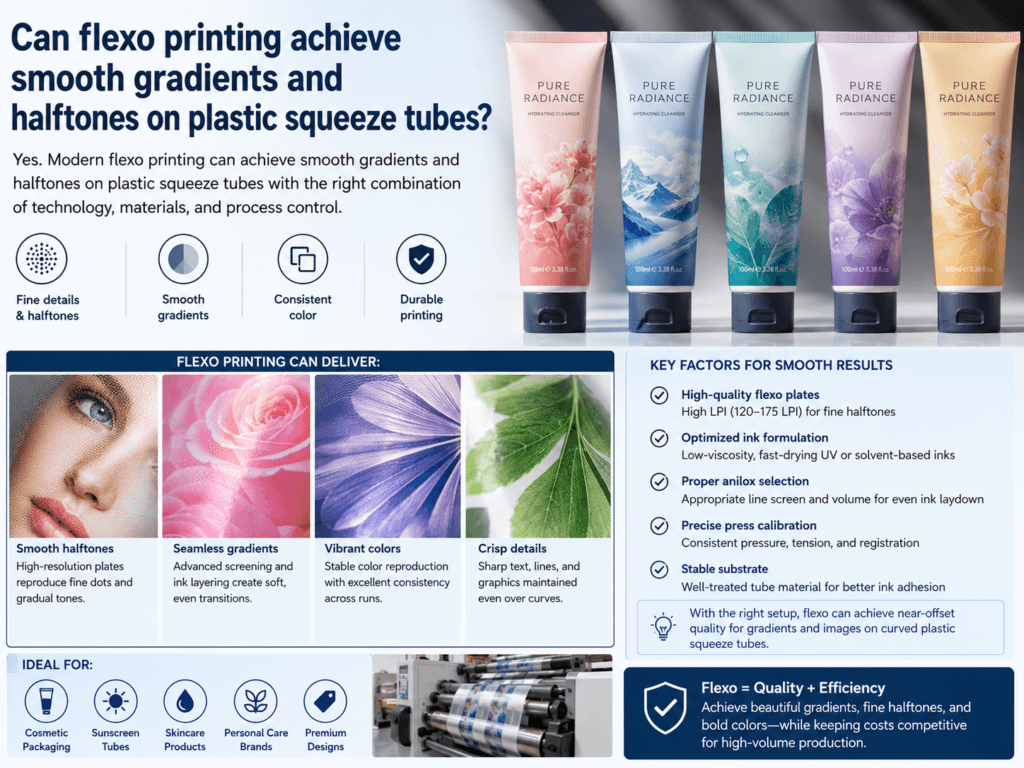
Yes, flexo printing can achieve gradients and halftones on plastic squeeze tubes, but the result is usually only as smooth as the full print system allows. In real tube production, flexographic printing can reproduce tonal transitions, shadows, and screened images, but it is generally more sensitive than some other decoration methods to dot gain, plate behavior, anilox selection, ink control, tube curvature, and registration stability.
That means flexo can work well for gradients and halftones on plastic squeeze tubes, especially with modern plate technology and controlled screening, but it is not automatically the best choice for every design. Very soft fades, photo-like imagery, and extremely delicate highlight transitions usually require tighter process control than simple logos or solid colors.
Quick Answer: Can Flexo Handle Gradients and Halftones?
| Artwork Type | Can Flexo Print It? | Typical Result |
|---|---|---|
| Basic tonal gradients | Yes | Usually achievable with good process control |
| Halftone images | Yes | Can print well if screening and dot control are stable |
| Soft fades to zero | Possible, but more demanding | May show hard edge or tonal jump if not optimized |
| Photo-realistic artwork | Possible in some cases | Often depends on advanced flexo setup and sample approval |
Why Flexo Can Produce Good Gradients and Halftones
- Modern flexo screening is much better than older systems: Advanced plate technologies and hybrid screening can improve highlight and shadow performance.
- Halftone control has improved: Better plate surface patterns and screening strategies help reduce visible dots and abrupt tonal jumps.
- Direct-to-tube flexo can perform well in production: With the right setup, factories can achieve strong commercial print quality on tubes.
What Limits Smoothness on Plastic Squeeze Tubes?
| Limitation | How It Affects the Print |
|---|---|
| Dot gain | Halftone dots spread and make gradients look heavier or less clean |
| Tube curvature | Curved surfaces make tonal consistency harder than flat packaging |
| Highlight control | Very light fades may break, jump, or disappear unevenly |
| Ink transfer variation | Can create mottling or less uniform tonal transitions |
| Registration sensitivity | Multi-color halftones become more demanding on curved tube bodies |
When Gradients and Halftones Usually Look Best in Flexo
- When the artwork uses controlled tonal transitions instead of extreme photo realism
- When the plate, screening, and anilox are optimized for high-definition flexo
- When the tube diameter and print area are suitable for the artwork complexity
- When the brand approves real printed samples instead of relying only on screen proofs
When Flexo May Struggle More
| Design Condition | Typical Risk |
|---|---|
| Very soft drop shadows | May show a visible hard edge instead of a perfectly smooth fade |
| Tiny highlight details | May disappear or look uneven |
| Complex multi-color photo art | Needs tighter control of registration and tonal consistency |
| Very small-diameter tubes | Curvature and reduced print area make halftones harder to control |
How Manufacturers Improve Flexo Gradient Quality on Tubes
- Use higher-quality flexo plates and optimized screening
- Control dot gain through plate, ink, and pressure settings
- Match anilox volume and line screen to the artwork requirement
- Reduce unnecessary tonal complexity in the design file
- Run physical tube proofs before mass production
Best Practical Advice for Beauty Brands
If your plastic squeeze tube artwork uses moderate gradients, soft tonal backgrounds, or controlled halftone imagery, flexo can be a workable and commercially efficient solution. But if your design depends on ultra-smooth fades, very fine highlight detail, or photo-realistic cosmetics artwork, you should ask for sample validation early and compare flexo with other printing options before approval.
Summary
Flexo printing can achieve gradients and halftones on plastic squeeze tubes, but the smoothness depends heavily on screening technology, plate quality, dot-gain control, and the geometry of the tube. It works well for many commercial tonal effects, but very soft fades and high-end photo-like imagery are more demanding and may require stronger process optimization.
In short, flexo can print gradients and halftones, but it performs best when the artwork is designed with flexo limitations in mind and approved through real production samples.
Learn more: Printing Options, Tube Decoration, Flexographic Printing Limitations on Small Lip Gloss Tubes, Silk Screen Printing vs. Offset Printing, Digital Printing Artwork Guide, Customize Cosmetic Tubes.
Need the Right Printing Method for Gradient Tube Artwork?
Xinfly Packaging helps brands evaluate flexo, offset, screen, and digital tube decoration based on artwork complexity, tonal smoothness, tube size, and production goals.