
Category FAQs

Find answers to common questions about cosmetic tube packaging, materials, printing, MOQ, customization, production, shipping, and sustainable packaging solutions.

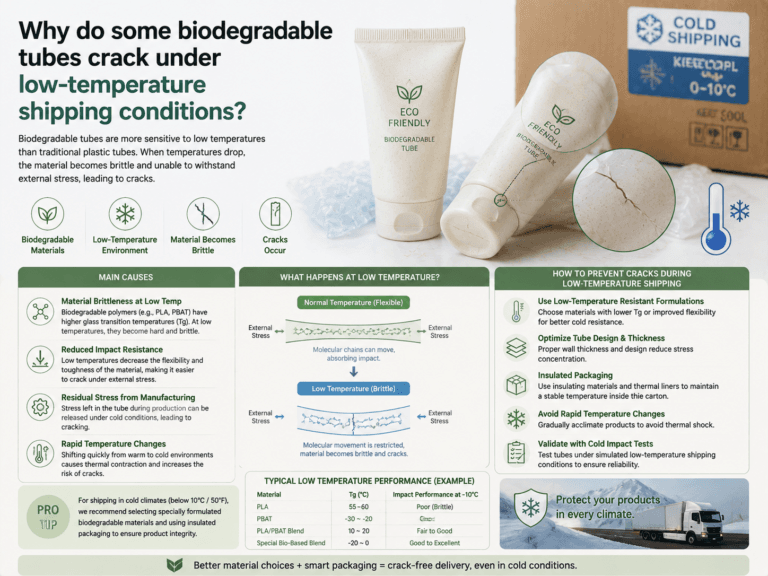
Why do some biodegradable tubes crack under low-temperature shipping conditions

Why do some biodegradable tubes crack under low-temperature shipping conditions?

Some biodegradable cosmetic tubes may crack under low-temperature shipping conditions because many biodegradable polymers become more brittle when exposed to cold environments. This issue is mainly related to material glass-transition behavior, reduced flexibility at low temperatures, and differences in molecular…

Read MoreWhy do some biodegradable tubes crack under low-temperature shipping conditions?
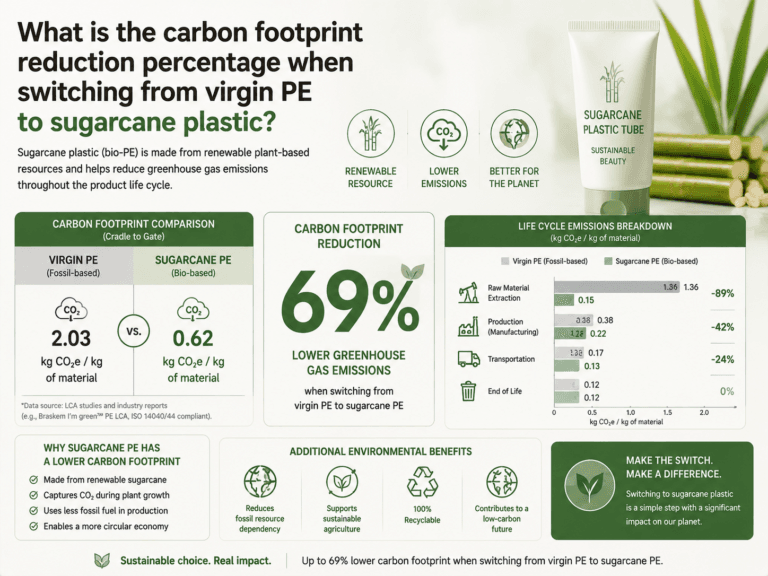
What is the carbon footprint reduction percentage when switching from virgin PE to sugarcane plastic

What is the carbon footprint reduction percentage when switching from virgin PE to sugarcane plastic?

The carbon footprint reduction when switching from virgin PE to sugarcane-based PE typically ranges from 50% to 80%, depending on the production process, energy mix, and supply chain conditions. This reduction is mainly achieved because sugarcane PE is a bio-based…

Read MoreWhat is the carbon footprint reduction percentage when switching from virgin PE to sugarcane plastic?
Do eco-friendly cosmetic tubes yellow or discolor faster when exposed to UV light

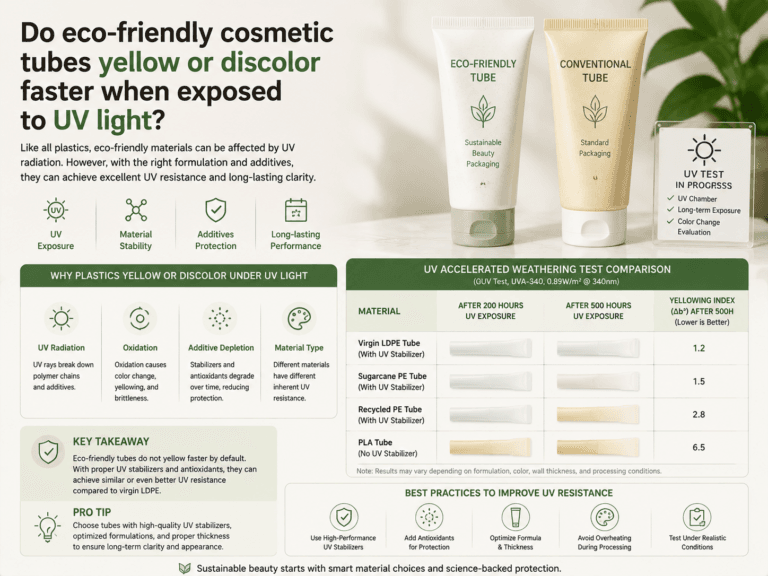
Do eco-friendly cosmetic tubes yellow or discolor faster when exposed to UV light?

Eco-friendly cosmetic tubes do not inherently yellow or discolor faster under UV exposure than traditional plastic tubes. However, their UV stability depends on the specific material system used—such as PCR, sugarcane-based PE, wheat straw composites, or biodegradable plastics. In most…

Read MoreDo eco-friendly cosmetic tubes yellow or discolor faster when exposed to UV light?
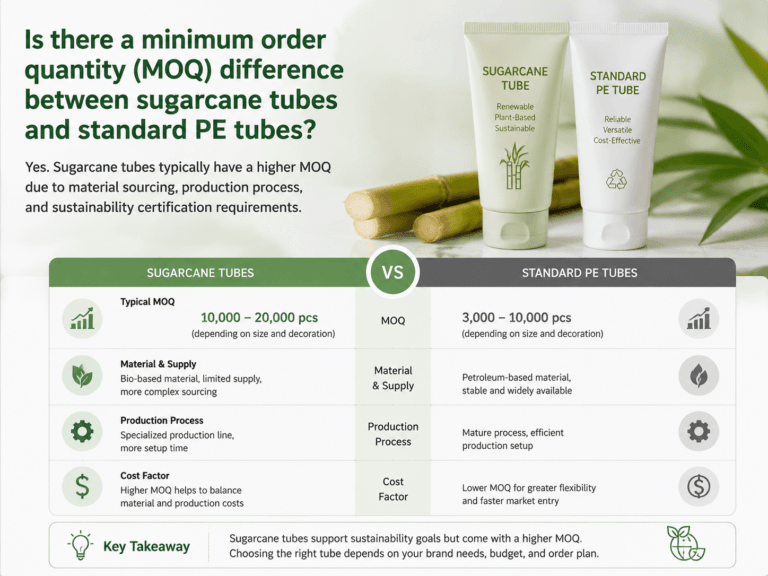
Is there a minimum order quantity (MOQ) difference between sugarcane tubes and standard PE tubes

Is there a minimum order quantity (MOQ) difference between sugarcane tubes and standard PE tubes?

Yes, there is usually a difference in MOQ between sugarcane tubes and standard PE tubes, but it is generally small. In most cosmetic packaging factories, both materials share similar production lines, so MOQ is driven more by material sourcing and…

Read MoreIs there a minimum order quantity (MOQ) difference between sugarcane tubes and standard PE tubes?
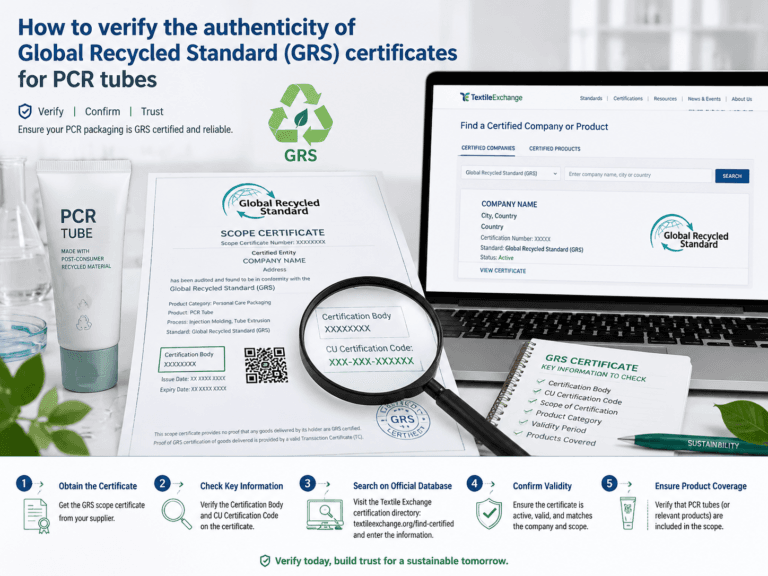
How to verify the authenticity of Global Recycled Standard (GRS) certificates for PCR tubes

How to verify the authenticity of Global Recycled Standard (GRS) certificates for PCR tubes?

Verifying the authenticity of Global Recycled Standard (GRS) certificates for PCR tubes requires checking both the Scope Certificate (SC) and Transaction Certificate (TC) through official databases and certification bodies. Because GRS is a chain-of-custody system, a document alone is not…

Read MoreHow to verify the authenticity of Global Recycled Standard (GRS) certificates for PCR tubes?
Can PCR materials be applied to the inner layer of a multi-layer (5-layer) co-extruded tube

Can PCR materials be applied to the inner layer of a multi-layer (5-layer) co-extruded tube?

PCR materials can be used in multi-layer (5-layer) co-extruded cosmetic tubes, but they are generally not recommended for the inner layer in most high-performance applications. In modern tube structures, PCR is more commonly used in outer or middle layers, while…

Read MoreCan PCR materials be applied to the inner layer of a multi-layer (5-layer) co-extruded tube?
What are the mechanical strength limitations of 100% bio-plastic tubes during high-speed filling

What are the mechanical strength limitations of 100% bio-plastic tubes during high-speed filling?

100% bio-plastic cosmetic tubes can face mechanical strength limitations during high-speed filling, especially when compared with conventional PE or multi-layer laminated tubes. These limitations are mainly related to material stiffness, heat resistance, and dimensional stability under rapid mechanical stress. High-speed…

Read MoreWhat are the mechanical strength limitations of 100% bio-plastic tubes during high-speed filling?