
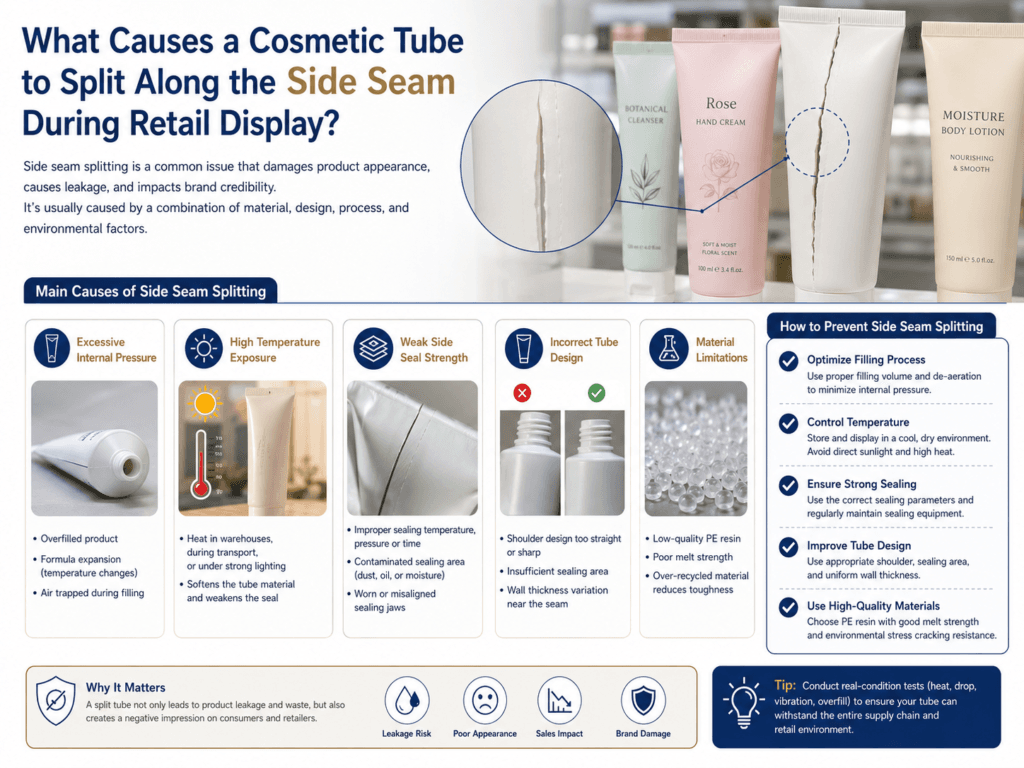
A cosmetic tube may split along the side seam during retail display when the seam area is weakened by poor welding, excessive internal pressure, formula-package incompatibility, overfilling, heat exposure, or repeated mechanical stress. This problem is more common in laminated tubes because they are made from flat laminate web material that is formed into a tube and sealed along the side.
Side seam splitting is not only a visual defect. It can lead to leakage, product contamination, poor shelf appearance, customer complaints, and retailer rejection. The cause is usually a combination of material structure, seam-sealing quality, filling conditions, formula behavior, and storage environment.
What Is Side Seam Splitting?
Side seam splitting happens when the longitudinal seam of a laminated cosmetic tube opens, cracks, peels, or separates during storage, transport, or retail display. The split may appear as a small line at first, but it can expand when the tube is squeezed, stacked, exposed to heat, or filled with a high-pressure or aggressive formula.
Practical note: If a tube splits only after filling and retail display, the root cause may not be the empty tube alone. The real issue may involve the formula, filling volume, sealing strength, temperature exposure, and carton compression together.
Main Causes of Side Seam Splitting
| Cause | What Happens | Typical Result |
|---|---|---|
| Poor side seam welding | The laminate edges are not bonded strongly enough | Seam peeling, cracking, or opening under pressure |
| Excessive internal pressure | Overfilling, formula expansion, or gas generation pushes against the tube wall | Side seam becomes the weakest failure point |
| Formula incompatibility | Oils, solvents, fragrance, or actives weaken the inner layer or adhesive interface | Softening, delamination, leakage, seam split |
| Heat exposure | Retail lighting, warehouse heat, or transport temperature increases pressure and softens materials | Seam stress increases during display |
| Carton or shelf compression | Tubes are squeezed during transport, storage, or display stacking | Stress concentrates along the seam line |
Why the Side Seam Is a Sensitive Area
In laminated tubes, the body is formed by sealing two edges of a laminate sheet together. This welded area may have different thickness, stiffness, and stress behavior compared with the rest of the tube wall. If the seam is not properly bonded, or if the formula creates pressure inside the tube, the side seam can become the first area to fail.
- Different material overlap: The seam area may be thicker or stiffer than the surrounding body.
- Welding dependency: Seam strength depends on sealing temperature, pressure, speed, and material cleanliness.
- Stress concentration: Internal pressure and external squeezing often focus stress along the seam line.
- Formula contact: The inner seam edge must resist oils, actives, fragrance, and solvents.
Production Factors That Can Cause Seam Failure
| Production Factor | Failure Mechanism | Control Method |
|---|---|---|
| Low sealing temperature | Laminate layers do not fully bond | Optimize welding temperature and dwell time |
| Excessive sealing temperature | Material becomes brittle, distorted, or burned | Set controlled temperature window |
| Insufficient pressure | Weak bonding between overlap layers | Adjust sealing pressure and roller condition |
| Contamination on seam area | Dust, oil, ink, or coating reduces adhesion | Keep seam area clean and avoid printing into weld zone |
| Poor laminate tension control | Uneven stress remains in the tube body | Control web tension and forming stability |
Formula Factors That Increase Side Seam Risk
Some formulas are more likely to challenge the side seam during long-term storage. Oil-rich creams, essential-oil formulas, high-fragrance products, solvent-like emollients, chemical sunscreens, exfoliating acids, or highly active skincare systems may interact with the inner layer or adhesive structure. This can reduce seam strength over time.
| Formula Type | Risk | Recommended Packaging Direction |
|---|---|---|
| High-fragrance cream | Fragrance oils may migrate into plastic or seam area | Use barrier structure and compatibility testing |
| Essential-oil skincare | Terpenes and natural oils may soften or swell plastic layers | Use EVOH, PBL, or ABL after testing |
| Chemical sunscreen | Oil-soluble UV filters and emollients may create compatibility risk | Use high-barrier tube and aging test |
| Thick paste or dense cream | Higher squeeze pressure during use | Optimize orifice size, wall strength, and seam strength |
| Gas-generating or unstable formula | Internal pressure increases during storage | Improve formula stability and avoid overfilling |
Display and Storage Conditions That Trigger Splitting
- Retail lighting heat: Shelf lights can warm tubes and increase internal pressure.
- Direct sunlight: UV and heat exposure may weaken material and formula stability.
- Warehouse temperature fluctuation: Repeated hot/cold cycles create expansion and contraction stress.
- Stacking pressure: Tubes placed under heavy cartons or display trays may deform.
- Consumer squeezing on shelf: Testers or retail handling can stress the side seam before purchase.
How to Prevent Side Seam Splitting
| Prevention Method | How It Helps |
|---|---|
| Optimize side seam welding | Improves bonding strength and reduces peeling risk |
| Keep artwork away from seam weld area | Prevents ink, coating, or varnish from weakening the seam |
| Choose compatible laminate structure | Ensures the inner layer and adhesive system match the formula |
| Control filling volume and headspace | Reduces internal pressure after filling and storage |
| Run filled aging tests | Checks whether seam strength remains stable over time |
| Improve carton and display protection | Reduces compression stress before and during retail display |
Recommended Tests Before Mass Production
| Test | Purpose | What to Check |
|---|---|---|
| Side seam peel test | Measures seam bonding strength | Peeling, weak bonding, inconsistent weld |
| Burst pressure test | Checks whether the tube can handle internal pressure | Side seam split, shoulder failure, tail seal failure |
| Filled aging test | Checks formula-package compatibility over time | Softening, delamination, leakage, seam opening |
| Heat storage test | Simulates retail and transport heat exposure | Expansion, pressure buildup, seam weakness |
| Drop and compression test | Checks transport and retail handling durability | Cracking, leakage, display deformation |
Extruded Tubes vs. Laminated Tubes
If side seam appearance or seam splitting risk is a major concern, brands may consider an extruded tube or co-extruded tube instead of a laminated tube. Extruded tubes usually have a seamless body, which removes the longitudinal side seam as a failure point. However, laminated tubes may still be the better choice when the formula needs ABL or PBL barrier protection.
| Tube Type | Side Seam Risk | Best Use |
|---|---|---|
| Extruded PE tube | Lower side seam risk because body is usually seamless | Skincare, hand cream, lotion, cleanser, premium cosmetics |
| 5-layer co-extruded EVOH tube | Lower side seam risk with added barrier performance | Sunscreen, fragrance-rich creams, active skincare |
| PBL laminated tube | Has side seam, but can offer good plastic-based barrier | Functional skincare, oral care, personal care |
| ABL laminated tube | Has side seam, but offers very high barrier | Toothpaste, high-barrier formulas, aggressive paste products |
Common Misunderstandings
| Misunderstanding | Correct Explanation |
|---|---|
| “The seam split means the tube material is always bad.” | Not always. The issue may come from welding settings, formula pressure, heat exposure, or overfilling. |
| “If the empty tube passes inspection, the filled product will be safe.” | Not necessarily. Formula contact and storage conditions may weaken the seam after filling. |
| “Only laminated tubes can leak.” | Any tube can leak if the material, sealing, filling, or cap system is not suitable, but laminated side seams require special control. |
| “More glue or stronger sealing always solves the problem.” | The correct solution depends on material compatibility, weld temperature, pressure, laminate structure, and formula behavior. |
Best Practical Recommendation
If a cosmetic tube splits along the side seam during retail display, check the issue from four directions: seam welding strength, formula compatibility, internal pressure, and display/storage stress. Do not judge the problem only by appearance. A full root-cause analysis should include filled samples, aged samples, seam peel testing, burst testing, and heat-storage evaluation.
For formulas with high fragrance, essential oils, chemical sunscreens, strong actives, or high internal pressure risk, consider upgrading to a better barrier laminate, a 5-layer co-extruded EVOH tube, or a seamless extruded PE tube depending on the formula and brand positioning.
Summary
A cosmetic tube can split along the side seam during retail display because the seam is the stress-sensitive area of a laminated tube. The most common causes include weak side seam welding, formula incompatibility, overfilling, internal pressure buildup, heat exposure, carton compression, poor seam-area design, and insufficient aging testing.
To prevent this issue, brands should select the right tube structure, optimize seam welding, keep decoration away from the weld zone, control filling volume, test the real formula in filled tubes, and confirm retail-display stability before mass production.
Learn more: Extruded Tube vs. Laminated Tube Side Seams, PE Tubes vs Laminated Tubes, Laminate Tubes, ABL Tubes, PBL Tubes, Quality Assurance.
Need to Prevent Side Seam Splitting in Cosmetic Tubes?
Xinfly Packaging helps brands analyze seam strength, laminate structure, formula compatibility, filling pressure, heat aging, and retail-display performance to reduce leakage and side seam failure risks.