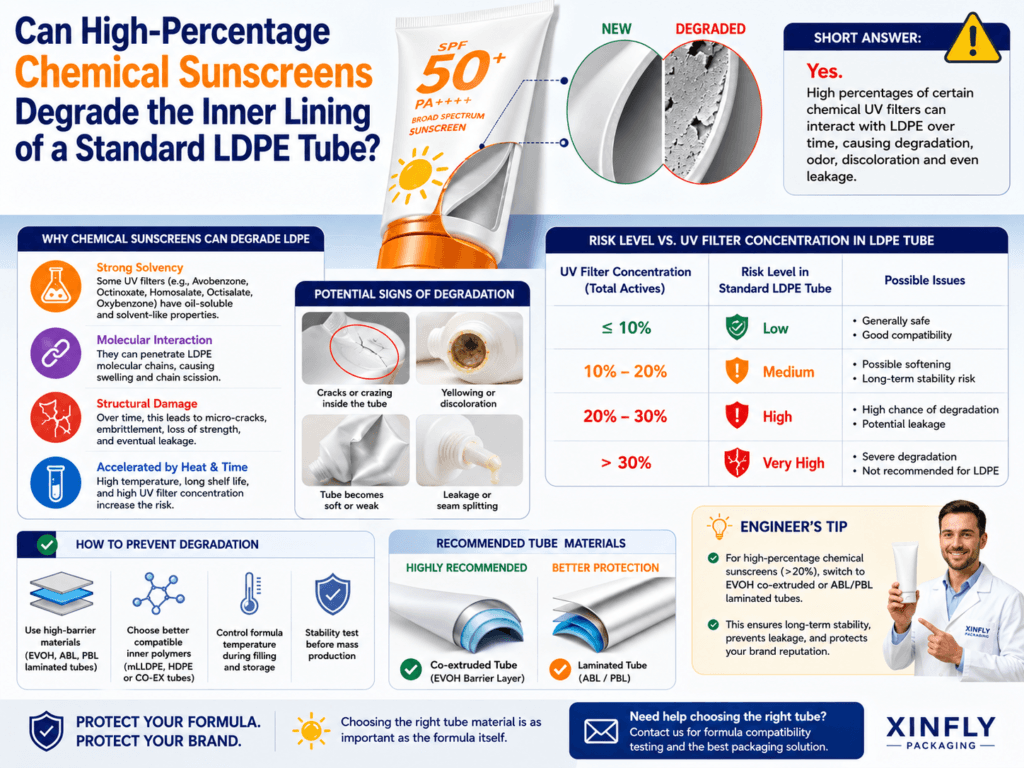
High-percentage chemical sunscreens can create compatibility risks with the inner lining of a standard LDPE tube, but they do not always directly “degrade” the tube. The real concern is whether the sunscreen formula causes swelling, softening, migration, absorption, stress cracking, odor change, barrier loss, or long-term deformation in the LDPE contact layer.
Many chemical sunscreen formulas contain oil-soluble UV filters, solvents, esters, emollients, fragrance, and stabilizers. When these ingredients are used at high levels, they may interact with a simple LDPE inner layer more strongly than a basic lotion or cleanser. That is why standard LDPE tubes may be acceptable for some sunscreen formulas, while high-active chemical sunscreen systems often require compatibility testing or a stronger multi-layer barrier tube.
Can Chemical Sunscreens Damage LDPE Tubes?
The answer is: possibly, depending on the formula. LDPE is widely used because it is flexible, squeezable, and chemically resistant to many cosmetic products. However, high levels of oil-soluble UV filters, solvent-like emollients, fragrance oils, or aggressive functional ingredients may affect the inner layer over time.
Important: The risk is usually not instant failure. Problems often appear after storage, heat exposure, transport, or aging tests.
Common Compatibility Risks
| Risk | What Happens | Possible Result |
|---|---|---|
| Swelling | Formula ingredients penetrate or soften the LDPE layer | Tube feels softer, swollen, or distorted |
| Softening | Oil-rich or solvent-like ingredients reduce wall stiffness | Poor squeeze recovery, paneling, deformation |
| Ingredient absorption | UV filters, oils, or fragrance components are absorbed into the plastic | Formula performance or scent may change over time |
| Migration | Small molecules move between formula and packaging layer | Compatibility, odor, or regulatory concerns |
| Stress cracking | Formula weakens stressed areas of the tube body or shoulder | Cracks, leaks, or splitting after storage or squeezing |
Why High-Percentage Chemical Sunscreens Are More Challenging
- Higher active load: More UV filters mean stronger contact between active ingredients and the inner tube layer.
- Oil-soluble systems: Many chemical UV filters are carried in oily or ester-based phases.
- Solvent-like emollients: Some emollients can increase interaction with plastic surfaces.
- Long shelf-life requirement: Sunscreen products often need stable performance over extended storage.
- Heat exposure risk: Sunscreen is often stored in bathrooms, cars, beach bags, and outdoor conditions.
Which Formula Ingredients Increase Risk?
| Ingredient Type | Why It Matters | Packaging Concern |
|---|---|---|
| Chemical UV filters | Often oil-soluble and used at meaningful concentration | Potential absorption or compatibility interaction |
| Ester emollients | Can behave like plastic-interacting solvents in some systems | Possible softening or swelling risk |
| Fragrance oils | Small aromatic molecules may migrate or be absorbed | Odor loss or inner-layer interaction |
| Essential oils | Some natural oils can be aggressive to packaging materials | Higher compatibility-test requirement |
| High oil phase | Increases long-term contact with plastic inner wall | Greater chance of softening or deformation |
Signs That LDPE May Not Be Compatible
- Inner wall becomes sticky, oily, or unusually soft
- Tube body shows swelling, denting, or paneling after storage
- Tail seal becomes weak or leaks after aging
- Formula smell changes or fragrance fades quickly
- Tube color or inner layer changes after heat exposure
- Formula weight changes due to ingredient loss or permeation
- Cracks appear near the shoulder, sidewall, or tail seal
Standard LDPE vs. Barrier Tube Options
| Tube Structure | Compatibility Level | Best Use |
|---|---|---|
| Standard LDPE inner layer | Good for many stable formulas, but may be limited for aggressive sunscreen systems | Basic lotions, cleansers, simple skincare, lower-risk sunscreen formulas |
| 2-layer PE tube | Better structural balance than simple mono-layer tubes | Daily skincare and moderate sunscreen formulas |
| 5-layer EVOH tube | Stronger barrier against oxygen and aroma transmission | Premium sunscreen, active skincare, fragrance-sensitive formulas |
| PBL tube | Good plastic-based barrier protection | Functional skincare and sunscreen needing better protection and appearance |
| ABL tube | Very high barrier with aluminum layer | Highly sensitive or aggressive formulas where maximum barrier is needed |
When a Standard LDPE Tube May Be Acceptable
A standard LDPE tube may work when the sunscreen formula is mild, stable, not highly oil-loaded, and has already passed compatibility testing. It may also be acceptable for short shelf-life products, lower-risk formulas, or projects where the formula does not contain aggressive solvent-like ingredients.
- Low to moderate chemical filter level
- Stable emulsion system
- Low fragrance or essential oil content
- No visible softening or swelling after aging tests
- No formula odor, color, or performance change after storage
When a Barrier Tube Is Recommended
A stronger barrier tube is usually recommended when the formula contains a high percentage of chemical UV filters, strong oil phase, high fragrance load, volatile ingredients, or oxidation-sensitive components. In these cases, a standard LDPE tube may not provide enough protection or long-term compatibility margin.
| Formula Situation | Recommended Packaging Direction |
|---|---|
| High-percentage chemical UV filters | Consider 5-layer EVOH, PBL, or ABL depending on barrier target |
| Oil-rich sunscreen lotion | Use barrier structure and run aging compatibility tests |
| Fragrance-sensitive sunscreen | Use EVOH or laminate barrier structure to reduce aroma loss |
| Premium long-shelf-life sunscreen | Choose stronger barrier and validated inner layer compatibility |
| Formula shows LDPE swelling in trial | Do not proceed with standard LDPE; upgrade material structure |
Compatibility Tests Before Mass Production
| Test | Purpose | What to Check |
|---|---|---|
| Accelerated aging test | Simulates longer storage in shorter time | Tube swelling, softening, leakage, formula change |
| High-temperature storage test | Checks heat-related compatibility risk | Wall deformation, odor change, tail seal failure |
| Weight-loss test | Checks permeation or volatile loss | Formula weight change over time |
| Migration / absorption evaluation | Checks ingredient movement into or from packaging | Active level, fragrance retention, plastic interaction |
| Filled squeeze test | Checks tube strength after formula contact | Cracking, stress whitening, splitting, recovery |
Common Misunderstandings
| Misunderstanding | Correct Explanation |
|---|---|
| “LDPE is plastic, so it can hold any sunscreen.” | LDPE works for many formulas, but high-active chemical sunscreen systems still need compatibility testing. |
| “If the tube looks fine after filling, it is safe.” | Many compatibility problems appear only after heat aging, storage, or transport. |
| “Degradation always means the tube melts or cracks immediately.” | Early signs may be softening, swelling, odor change, paneling, or formula absorption. |
| “Barrier tubes are only for oxygen protection.” | Barrier structures can also help with aroma retention, ingredient migration, and formula stability. |
Best Practical Recommendation
If the sunscreen formula contains a high percentage of chemical UV filters, do not assume a standard LDPE tube is automatically safe. Start with formula compatibility testing. If any softening, swelling, fragrance loss, active loss, paneling, or leakage appears, move to a stronger structure such as a 5-layer EVOH tube, PBL tube, or ABL tube.
For premium chemical sunscreen, outdoor sunscreen, oil-rich sunscreen, or long-shelf-life SPF products, a barrier tube is often a safer choice than standard LDPE because it gives the brand more protection margin during storage, shipping, and consumer use.
Summary
High-percentage chemical sunscreens can potentially affect the inner lining of a standard LDPE tube, especially when the formula contains strong oil-soluble UV filters, ester emollients, fragrance oils, or other plastic-interacting ingredients. The risk may appear as softening, swelling, paneling, migration, odor change, active loss, or leakage rather than obvious immediate degradation.
The safest approach is to test the real sunscreen formula in filled tubes under aging and heat conditions. If LDPE compatibility is uncertain, choose a stronger barrier structure such as EVOH, PBL, or ABL for better long-term formula protection.
Learn more: Sunscreen Tubes, Sunscreen Tube Manufacturer, EVOH Sunscreen Tubes Manufacturer, 5-Layer Plastic Tubes, PBL Tubes, Quality Assurance.
Need the Right Tube for Chemical Sunscreen Formulas?
Xinfly Packaging helps sunscreen brands compare standard LDPE, 2-layer PE, 5-layer EVOH, PBL, and ABL tube structures based on formula compatibility, barrier needs, aging tests, and long-term packaging stability.