
To optimize tube dimensions for international shipping cartons, brands should design tube length and diameter together with carton size, inner packing layout, product weight, cap height, and pallet loading efficiency. A tube that looks good on the shelf may still waste carton space, increase freight cost, or suffer compression damage if its length-to-diameter ratio does not match the master carton layout.
For cosmetic tube packaging, the best size is not only the size that holds the formula. It should also fit efficiently into inner boxes, trays, dividers, export cartons, and pallets. This is especially important for global B2B orders, e-commerce distribution, and high-volume private label projects where shipping cost and carton utilization directly affect landed cost.
Why Tube Dimensions Affect Shipping Cost
International shipping cost is affected by both actual weight and volumetric space. If the tube is too long, too wide, or packed inefficiently, the carton may contain too much empty space. This increases shipping volume, reduces pallet efficiency, and raises the cost per unit. A well-optimized tube dimension helps improve carton loading while still protecting the product.
| Dimension Factor | Shipping Impact | Packaging Risk |
|---|---|---|
| Tube length | Controls how many rows fit inside the carton | Too long may force a larger carton or reduce pieces per box |
| Tube diameter | Controls how many tubes fit per layer | Too wide may reduce carton count and increase freight volume |
| Cap height | Adds to total tube length or stacking height | Large caps may create wasted space or pressure points |
| Tube shape | Round, oval, and flat oval tubes pack differently | Poor shape matching can reduce carton utilization |
| Inner packing method | Affects protection and carton efficiency | Too much protection increases carton size; too little increases damage risk |
Length vs. Diameter: Which Should Be Adjusted First?
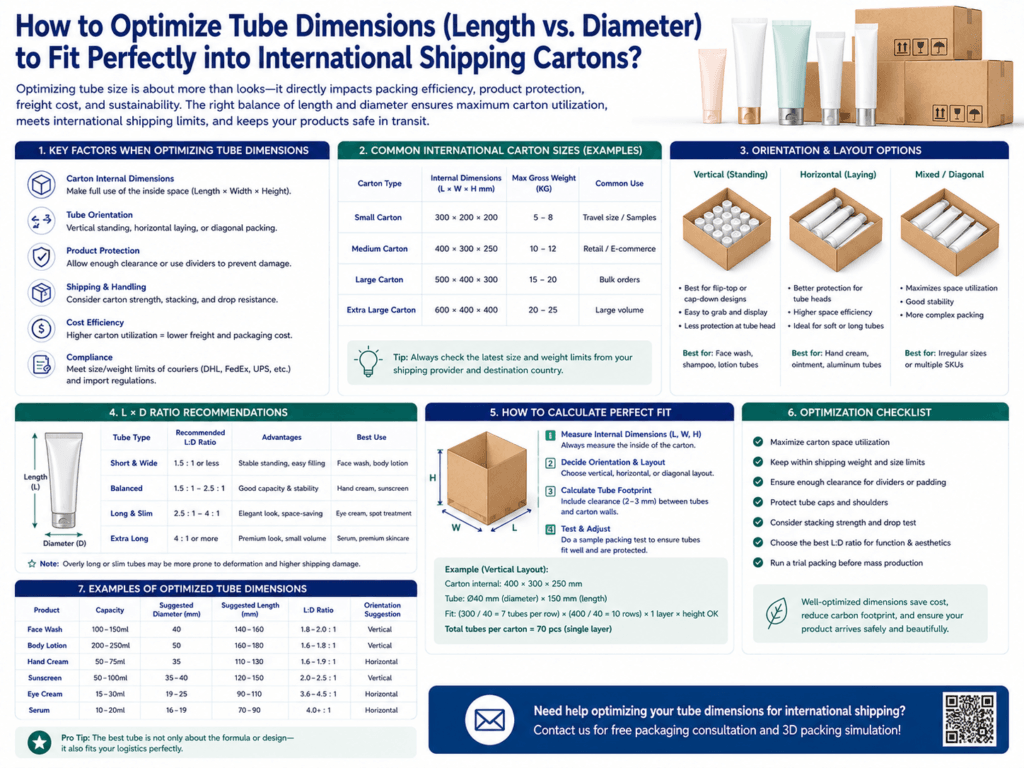
For the same fill volume, a smaller diameter usually requires a longer tube, while a larger diameter allows a shorter tube. The best choice depends on how the tubes will be packed. If carton height is limited, a shorter and wider tube may fit better. If the carton width is the limiting factor, a slimmer and longer tube may allow more pieces per layer.
| Design Choice | Advantage | Possible Problem |
|---|---|---|
| Longer, smaller-diameter tube | Slim appearance, portable feel, good for smaller hands | May waste carton length or increase bending risk |
| Shorter, larger-diameter tube | Better shelf presence and easier squeezing for thick formulas | May reduce the number of tubes per carton layer |
| Balanced length and diameter | Usually best for carton loading, appearance, and usability | Requires early coordination between packaging and logistics |
Recommended Optimization Workflow
| Step | What to Check | Why It Matters |
|---|---|---|
| 1 | Confirm fill volume and formula density | Defines the minimum tube capacity needed |
| 2 | Select 2–3 possible tube diameter options | Allows comparison of different length and packing layouts |
| 3 | Calculate tube length including shoulder and cap | Prevents carton-fit surprises after final cap selection |
| 4 | Create carton loading layout | Shows how many tubes fit per row, layer, and carton |
| 5 | Check carton gross weight | Prevents cartons from becoming too heavy for handling |
| 6 | Run drop, compression, and transport simulation tests | Confirms that the optimized layout still protects the tubes |
Practical note: A tube size should not be finalized from fill volume alone. The final dimension should also be checked against carton count, pallet layout, carton weight, cap protection, and export handling conditions.
Common Tube Sizes and Carton-Fit Considerations
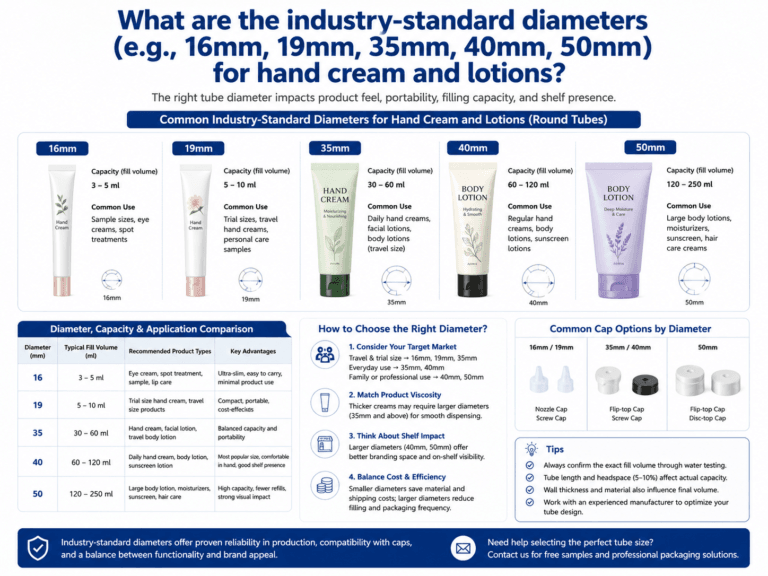
| Tube Diameter | Typical Application | Carton-Fit Consideration |
|---|---|---|
| 19mm – 25mm | Samples, travel tubes, mini hand cream, hotel amenities | High pieces per carton, but small tubes may need inner bags or dividers to avoid disorder |
| 30mm – 35mm | Hand cream, sunscreen, facial cream, medium skincare | Usually efficient for retail cartons and export cartons |
| 40mm | Face wash, body lotion, sunscreen, hair care | Good balance of capacity and carton utilization for many 100ml–150ml products |
| 50mm | Large body lotion, shampoo, conditioner, 200ml+ products | Requires stronger carton and careful layer arrangement due to higher product weight |
| 55mm – 60mm | Large-capacity family or salon-size products | Lower pieces per carton; carton strength and pallet loading become more important |
How to Improve Carton Utilization
- Compare multiple diameters: A 35mm tube and a 40mm tube may hold similar volume with different carton efficiency.
- Include cap size early: Cap height and width can change the actual packing footprint.
- Avoid awkward tube lengths: A few extra millimeters may force a bigger carton.
- Use consistent SKU dimensions when possible: Similar tube sizes across product lines simplify packing and warehousing.
- Balance carton count and carton weight: More pieces per carton is not always better if the carton becomes too heavy.
- Design for pallet loading: Carton dimensions should fit efficiently on pallets and inside containers.
Carton Packing Layout Options
| Packing Layout | Best For | Pros and Cons |
|---|---|---|
| Horizontal layer packing | Medium and large cosmetic tubes | Efficient and stable, but cap protection must be considered |
| Vertical standing packing | Retail boxed tubes or tubes with strong caps | Clean arrangement, but may require taller cartons |
| Head-to-tail alternating layout | Tubes with wider caps or shoulders | Improves space use by balancing cap and tail thickness |
| Inner box or tray packing | Premium tubes, decorated tubes, fragile finishes | Better protection but increases carton volume and cost |
How to Balance Shipping Efficiency and Tube Appearance
A tube should not be made too short and wide only to fit cartons, because it may no longer match the brand image or consumer hand feel. It should also not be made too slim and long only for appearance, because the carton may waste space or the tube may bend during transport. The best design usually balances three goals: product capacity, brand appearance, and logistics efficiency.
| Priority | Tube Design Direction | Shipping Impact |
|---|---|---|
| Premium shelf appearance | Use balanced diameter with enough front panel area | May require custom carton layout for best protection |
| Lowest shipping cost | Choose dimensions that improve pieces per carton and pallet utilization | Can reduce landed cost if product protection remains adequate |
| E-commerce durability | Use stronger tube body, cap protection, and tested carton structure | May slightly increase packaging volume but reduces damage claims |
| Multi-SKU product line | Standardize diameter and cap style across SKUs | Simplifies carton planning and inventory management |
Key Measurements to Confirm Before Production
- Total tube length including cap
- Maximum tube diameter including decoration or label thickness
- Cap width, cap height, and shoulder profile
- Filled tube weight, not only empty tube weight
- Number of tubes per inner box, tray, or export carton
- Carton gross weight and carton compression strength
- Pallet pattern and container loading efficiency
Common Mistakes That Increase Shipping Cost
| Mistake | What Happens | Better Approach |
|---|---|---|
| Finalizing tube size before carton layout | The selected tube may waste carton space | Check carton loading before confirming final tube length |
| Ignoring cap dimensions | Carton count may be lower than expected | Measure total assembled tube, not only tube body |
| Maximizing pieces per carton only | Carton may become too heavy or tubes may deform | Balance carton count, gross weight, and protection |
| Using too much empty inner space | Higher volumetric freight cost and more movement inside the carton | Use optimized layout, dividers, or adjusted tube dimensions |
| Skipping transport tests | Tubes may arrive dented, leaking, or scratched | Run drop, vibration, and compression tests before shipment |
Best Practical Recommendation
For international shipping, choose tube dimensions by comparing several diameter and length combinations before final tooling or mass production. For each option, calculate fill capacity, assembled tube size, pieces per carton, carton gross weight, pallet loading, and shipping volume. The best option is usually the one that keeps the tube attractive and functional while reducing empty carton space and protecting the package during long-distance transport.
Summary
To optimize tube dimensions for international shipping cartons, brands should not look at tube capacity alone. The tube diameter, length, cap height, filled weight, carton layout, inner packing, pallet pattern, and transport strength must be considered together.
A well-designed tube size improves carton utilization, lowers volumetric freight cost, reduces movement inside the carton, protects decorated surfaces, and improves export efficiency. The final tube dimension should always be confirmed with carton-fit planning and transport testing before mass production.
Learn more: Tube Capacity, Diameter, Length & Thickness, Match Cosmetic Tube Diameter and Fill Volume, Industry-Standard Tube Diameters, Quality Assurance, Customize Cosmetic Tubes, Services.
Need Tube Dimensions Optimized for Export Cartons?
Xinfly Packaging helps brands optimize tube diameter, length, cap size, carton layout, pallet loading, and transport protection to reduce shipping cost and improve international delivery performance.