
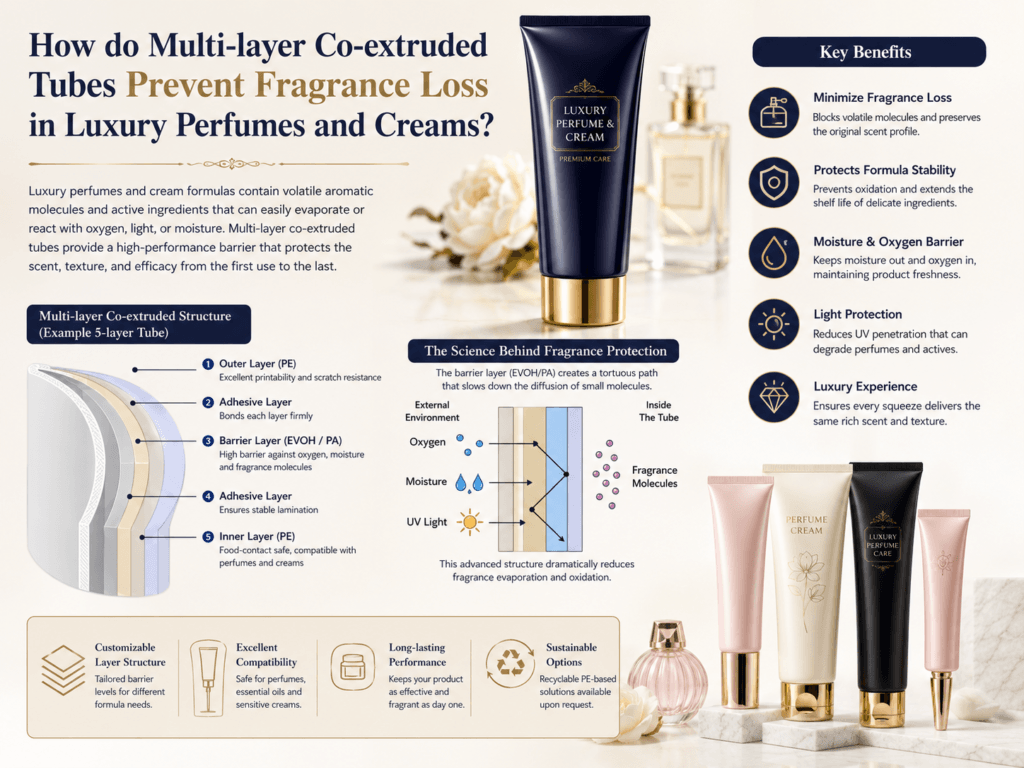
Multi-layer co-extruded tubes help prevent fragrance loss in luxury perfumes and creams by using barrier layers that slow the migration of volatile aroma molecules through the tube wall. Instead of relying on a single PE layer, a multi-layer structure can combine flexible PE layers, adhesive tie layers, and a barrier layer such as EVOH to improve aroma retention, oxygen protection, and formula stability.
Luxury fragranced creams, perfumed lotions, essential-oil skincare, and high-end scented body care products often contain volatile fragrance components. These molecules can be absorbed by standard plastic packaging or slowly diffuse through the tube wall, causing the scent to become weaker, unbalanced, or different from the original formula. Multi-layer co-extruded tubes are designed to reduce this risk.
Why Fragrance Loss Happens in Standard Plastic Tubes
| Cause | What Happens | Product Risk |
|---|---|---|
| Fragrance scalping | Aroma molecules are absorbed into the plastic wall | Scent becomes weaker or less accurate |
| Permeation | Volatile fragrance components slowly pass through the tube wall | Long-term fragrance loss |
| Oxidation | Oxygen enters the package and affects fragrance or oil components | Odor change, rancidity, color shift |
| Heat exposure | High temperature accelerates diffusion and evaporation | Faster scent fading during storage or transport |
| Formula-package interaction | Fragrance oils interact with the inner PE layer | Tube softening, swelling, or scent imbalance |
How Multi-Layer Co-Extruded Tubes Work
A multi-layer co-extruded tube is made by extruding several plastic layers together into one seamless tube body. Each layer has a different function. The outer PE layer provides printability and appearance, the inner PE layer contacts the formula, tie layers hold the structure together, and the barrier layer helps block oxygen, aroma, and volatile ingredient movement.
| Layer | Main Function | Benefit for Luxury Fragranced Products |
|---|---|---|
| Outer PE layer | Decoration, color, touch feel, surface finish | Supports premium matte, glossy, soft-touch, or printed appearance |
| Tie layer | Adhesion between PE and barrier material | Keeps the structure stable and prevents delamination |
| EVOH barrier layer | Reduces oxygen and aroma transmission | Helps preserve fragrance profile and formula freshness |
| Inner PE layer | Direct formula contact and squeeze performance | Provides compatibility and smooth dispensing |
Why EVOH Helps Prevent Fragrance Loss
EVOH is commonly used as a barrier layer in high-performance cosmetic tubes. It helps reduce oxygen transmission and aroma permeation compared with standard PE-only structures. For luxury perfumes and creams, this means the fragrance has less chance to escape through the tube wall and the formula has better protection against oxidation-related odor changes.
- Better aroma retention: Helps keep the original fragrance intensity and balance.
- Lower oxygen exposure: Helps protect fragrance oils, botanical extracts, and sensitive actives.
- Reduced scalping risk: Less fragrance is lost into or through the tube wall.
- Longer shelf-life support: Helps maintain a more stable sensory experience over time.
Standard PE Tube vs. Multi-Layer Barrier Tube
| Feature | Standard PE Tube | Multi-Layer Co-Extruded Barrier Tube |
|---|---|---|
| Fragrance retention | Basic protection; higher scalping risk | Better aroma retention with barrier structure |
| Oxygen barrier | Limited | Stronger with EVOH or other barrier layer |
| Formula stability | Suitable for low-risk formulas | Better for fragrance-rich and active formulas |
| Tube appearance | Flexible and customizable | Still flexible and customizable, with added barrier performance |
| Best use | Simple lotions, cleansers, basic creams | Luxury creams, perfumed lotions, essential-oil formulas, premium skincare |
Which Luxury Products Benefit Most?
- Perfumed body creams: Helps maintain fragrance strength during storage.
- Luxury hand creams: Protects delicate scent notes and premium sensory experience.
- Essential-oil skincare: Reduces volatile oil migration and aroma loss.
- High-end body lotions: Supports longer fragrance stability in larger-volume tubes.
- Fragranced sunscreen or after-sun creams: Helps protect both scent and functional ingredients.
- Botanical creams: Helps slow oxidation and aroma profile changes.
How Layer Structure Affects Fragrance Protection
| Structure Choice | Barrier Performance | Recommended Use |
|---|---|---|
| Single-layer PE | Low to moderate | Low-fragrance, low-risk formulas |
| 2-layer PE | Moderate structural improvement | Daily skincare with mild fragrance |
| 5-layer EVOH co-extruded tube | High aroma and oxygen barrier | Luxury perfumed creams, essential-oil products, active skincare |
| PBL tube | Good to high plastic-based barrier | Functional skincare and premium personal care |
| ABL tube | Very high barrier with aluminum layer | Maximum protection when appearance and recyclability positioning are secondary |
Why Fragrance Profile Can Still Change
Even with a barrier tube, fragrance stability depends on the full formula and storage condition. Some fragrance components are more volatile than others. Top notes may fade faster, citrus oils may migrate more easily, and heat can accelerate both evaporation and packaging interaction. A barrier tube greatly reduces risk, but real filled-tube testing is still necessary.
| Variable | Why It Matters | Control Method |
|---|---|---|
| Fragrance composition | Small volatile molecules migrate more easily | Review fragrance system with packaging supplier |
| Essential-oil content | Terpenes and natural oils may interact with plastics | Use barrier tubes and compatibility testing |
| Formula oil phase | Oil-rich systems can increase plastic interaction | Check inner layer compatibility |
| Storage temperature | Heat accelerates diffusion and fragrance loss | Run heat-aging and transport simulation tests |
| Tube wall thickness | Wall structure affects permeation path | Optimize total thickness and barrier layer ratio |
Testing for Fragrance Retention
Before mass production, luxury perfume and cream brands should test the real formula in the selected tube structure. Empty-tube material data is helpful, but the final decision should be based on filled samples stored under realistic and accelerated conditions.
| Test | Purpose | What to Check |
|---|---|---|
| Accelerated aging test | Predicts long-term fragrance stability | Scent intensity, scent balance, color, viscosity, tube condition |
| High-temperature storage test | Checks heat-driven fragrance loss | Odor change, tube swelling, paneling, leakage |
| Weight-loss test | Checks volatile loss through packaging | Filled tube weight change over time |
| Fragrance profile analysis | Compares original and aged scent composition | Loss of key aroma notes or selective scalping |
| Compatibility test | Checks formula-package interaction | Softening, swelling, migration, delamination, color change |
Design Tips for Luxury Fragrance-Rich Tubes
- Use a 5-layer EVOH structure: Recommended when fragrance retention is a key selling point.
- Choose a compatible inner layer: Reduces absorption, swelling, and formula-package interaction.
- Avoid overly thin walls: A stronger wall can help improve mechanical stability and barrier path length.
- Use opaque or tinted tubes when needed: Light protection can help preserve sensitive fragrance and botanical ingredients.
- Test with the real fragrance system: Different perfume oils behave differently with the same tube material.
- Confirm cap and seal integrity: Fragrance can also escape through poor closure sealing, not only tube walls.
Common Mistakes to Avoid
| Mistake | Why It Is a Problem | Better Approach |
|---|---|---|
| Using standard PE for high-fragrance luxury creams | Higher risk of fragrance scalping and aroma loss | Use EVOH, PBL, or another barrier structure |
| Testing only visual appearance | The tube may look normal while scent profile changes | Check fragrance retention and formula stability |
| Ignoring cap leakage path | Fragrance may escape through the closure system | Test cap seal, liner, thread, and orifice design |
| Assuming all perfumes behave the same | Different aroma molecules migrate at different rates | Test the exact fragrance formula |
| Choosing transparency over protection | Clear structures may have weaker light and aroma protection | Balance visual design with barrier performance |
When ABL or PBL May Be Better Than Co-Extruded EVOH
Multi-layer co-extruded EVOH tubes are often a good balance of flexibility, appearance, and barrier performance. However, if the formula is extremely volatile, highly aggressive, or requires maximum protection, PBL or ABL laminated tubes may also be considered. ABL offers very strong barrier protection, while PBL may provide a cleaner plastic-based barrier direction for premium personal care.
| Formula Requirement | Recommended Tube Direction |
|---|---|
| Luxury cream with moderate fragrance | 5-layer EVOH co-extruded tube |
| Essential-oil-rich skincare | 5-layer EVOH or PBL tube with compatibility testing |
| Highly volatile perfume concentrate cream | PBL or ABL may be evaluated |
| Premium appearance and squeeze recovery are important | Co-extruded EVOH tube |
| Maximum barrier is more important than tube recovery | ABL tube |
Best Practical Recommendation
For luxury perfumes, fragranced creams, and essential-oil skincare, do not rely only on standard PE tubes. Start with a 5-layer EVOH co-extruded tube when the product needs better fragrance retention, oxygen protection, and premium squeeze feel. If the fragrance load is very high or the formula is aggressive, also compare PBL or ABL structures.
The final choice should be confirmed through filled-tube fragrance retention testing, heat aging, weight-loss measurement, cap-seal testing, and formula compatibility evaluation.
Summary
Multi-layer co-extruded tubes prevent fragrance loss by using a barrier layer, such as EVOH, inside the tube wall to slow aroma permeation, reduce oxygen transmission, and limit fragrance scalping into the plastic structure. This helps luxury creams and perfumed skincare maintain a more stable scent profile, better formula freshness, and a premium user experience over time.
However, fragrance loss can also be affected by formula composition, essential-oil percentage, storage temperature, wall thickness, cap seal, and inner-layer compatibility. For high-value luxury products, real filled-tube testing is essential before mass production.
Learn more: What Is EVOH Barrier Material?, EVOH Barrier Tubes Manufacturer, 5-Layer Plastic Tubes, Multi-Layer Cosmetic Tubes, Premium Skincare Packaging Tubes, Quality Assurance.
Need Better Fragrance Retention for Luxury Cream Tubes?
Xinfly Packaging helps beauty brands compare standard PE, 5-layer EVOH, PBL, and ABL tube structures to reduce fragrance loss, improve aroma retention, and protect premium perfume-rich cosmetic formulas.