
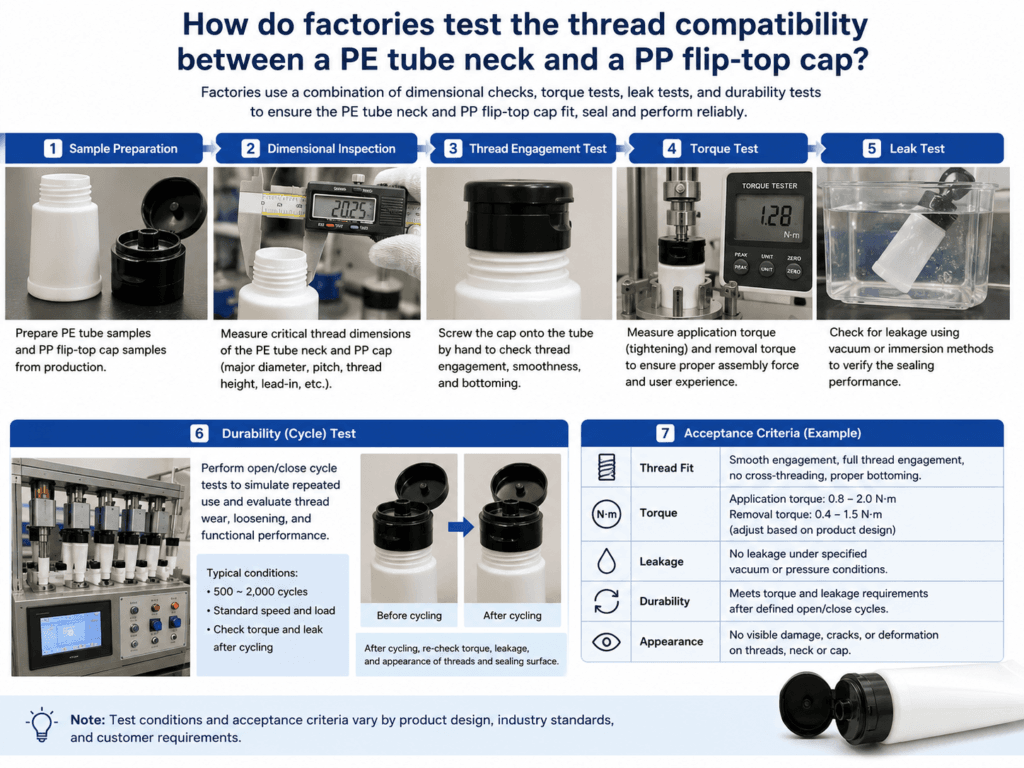
Factories test thread compatibility between a PE tube neck and a PP flip-top cap by checking dimensional fit, thread engagement, application torque, removal torque, sealing performance, leakage resistance, cap snap function, and repeated-use durability. The goal is to confirm that the cap can be assembled smoothly, seal tightly, open comfortably, and stay stable during filling, shipping, retail display, and consumer use.
Although PE tube necks and PP flip-top caps are commonly used together, they have different stiffness, shrinkage behavior, and tolerance ranges. If the thread, plug seal, neck diameter, or cap tolerance is not matched correctly, the package may leak, cross-thread, overtighten, strip threads, crack, or feel difficult for consumers to open.
Quick Answer
The most important tests are go/no-go gauge inspection, cap fit test, application torque test, removal torque test, thread engagement inspection, leakage test, compression test, drop test, and repeated open-close test. For skincare, cleanser, sunscreen, and lotion tubes, factories should always test the actual PE tube neck and actual PP flip-top cap together, not separately.
| Test Item | What It Checks | Why It Matters |
|---|---|---|
| Dimensional inspection | Neck diameter, thread pitch, thread height, cap inner diameter | Confirms the cap and neck are physically compatible |
| Cap fit test | Whether the cap screws on smoothly and seats correctly | Prevents cross-threading, tilting, and poor closure alignment |
| Torque test | Application and removal torque | Controls assembly stability and consumer opening comfort |
| Leakage test | Seal around orifice, plug, neck, and cap | Prevents formula leakage during storage and transport |
| Repeated-use test | Flip hinge, snap closure, thread wear, plug deformation | Confirms daily-use durability |
Why PE Tube Neck and PP Flip-Top Cap Matching Is Important
PE is softer and more flexible than PP, while PP caps are usually stiffer and more dimensionally rigid. This combination can work very well, but the cap thread and tube neck must be engineered as one closure system. If the PP cap is too tight, it may deform the PE neck. If it is too loose, the cap may leak or wobble.
- PE neck flexibility: PE can deform under excessive cap torque or compression.
- PP cap stiffness: PP provides strong cap shape but can stress the softer PE thread.
- Thread tolerance: Small dimensional differences can change sealing and opening performance.
- Plug seal fit: The inner plug must seal the orifice without damaging the neck.
- Flip-top function: The hinge and snap closure must remain stable after repeated use.
Dimensional Parameters Factories Check First
| Dimension | PE Tube Neck | PP Flip-Top Cap | Risk If Incorrect |
|---|---|---|---|
| Neck outer diameter | Measured at the thread and sealing area | Matched to cap inner thread diameter | Too tight, too loose, cross-threading |
| Thread pitch | Distance between thread turns | Must match cap thread pitch | Thread stripping or poor engagement |
| Thread height / depth | Determines holding strength | Must provide enough bite without binding | Loose cap, overtightening, damaged thread |
| Sealing land | Flat area where the cap or plug seals | Must contact evenly | Leakage even if cap feels tight |
| Orifice diameter | Formula outlet size | Must match plug or insert design | Leakage, dripping, clogging, poor dosage |
| Shoulder height | Affects cap seating and appearance | Cap skirt must clear shoulder correctly | Gap, interference, tilted cap |
Go / No-Go Gauge Inspection
Factories often use gauges or calibrated measuring tools to check whether the tube neck and cap fall within tolerance. A “go” gauge confirms that the cap can assemble smoothly, while a “no-go” gauge helps detect oversized, undersized, or out-of-tolerance parts.
| Inspection Tool | Purpose | What It Helps Prevent |
|---|---|---|
| Caliper | Measures neck diameter, cap diameter, cap height, and shoulder dimensions | Basic size mismatch |
| Thread gauge | Checks thread pitch and engagement | Cross-threading and poor thread fit |
| Go / no-go gauge | Quickly screens production parts against tolerance limits | Batch variation and assembly problems |
| Optical inspection | Checks thread shape, flash, deformation, or molding defects | Cap defects and tube-neck defects |
Engineer’s note: A cap can feel tight but still leak if the sealing land or plug contact is wrong. Thread fit and sealing fit must be checked separately.
Application Torque and Removal Torque Testing
Torque testing is one of the most important compatibility checks. Application torque measures how much force is needed to assemble the cap onto the tube. Removal torque measures how much force consumers need to open it. The cap should be tight enough to seal, but not so tight that it damages the PE neck or becomes difficult to open.
| Torque Test | What It Means | Failure Signal |
|---|---|---|
| Low application torque | Cap may not be fully seated or sealed | Loose cap, wobbling, leakage |
| Correct application torque | Cap closes securely without damaging threads | Stable seal and smooth assembly |
| High application torque | Cap is too tight or thread friction is too high | Stripped PE neck, cap stress, difficult opening |
| Unstable removal torque | Opening force varies between samples | Consumer complaints, inconsistent cap fit, tolerance problem |
Thread Engagement Inspection
After the cap is applied, factories inspect whether the PP cap thread fully and evenly engages with the PE tube neck thread. Poor engagement can cause leakage, tilted caps, cap loosening, or thread damage during automated assembly.
- Full seating: The cap should reach the designed stop position.
- No tilt: The cap should sit straight and level on the shoulder.
- No cross-threading: Threads should engage smoothly from the start.
- No stripping: PE neck threads should not show shaving, flattening, or deformation.
- No excessive gap: Cap skirt and shoulder should have consistent visual spacing.
Plug Seal and Orifice Fit Test
For flip-top caps, the inner plug is often the main leakage-control feature. It must enter the orifice or sealing area accurately. If the plug is too small, the tube may leak. If the plug is too large, it may damage the PE neck, make the cap difficult to close, or create stress around the orifice.
| Plug Seal Condition | Result | Corrective Direction |
|---|---|---|
| Plug too small | Poor sealing and possible leakage | Increase plug diameter or redesign sealing land |
| Plug too large | Hard closing, neck deformation, stress cracking | Reduce plug interference and check PE neck strength |
| Plug misaligned | Uneven closure, product residue, cap popping | Improve cap mold tolerance and hinge alignment |
| Correct plug fit | Clean dispensing and strong leakage protection | Approve after filled leakage and repeated-use testing |
Leakage Testing With Real Formula
Thread compatibility is not complete until the package passes leakage testing with the real product or a close simulation. Facial cleanser, lotion, sunscreen, toothpaste, and gel formulas behave differently. Some formulas flow easily, some trap air, and some leave residue around the orifice.
| Leakage Test | Purpose | What to Check |
|---|---|---|
| Inverted storage test | Checks cap sealing under gravity | Leakage at orifice, cap thread, plug area |
| Compression test | Simulates carton pressure and consumer squeezing | Cap popping, product overflow, neck leakage |
| Vacuum / pressure test | Checks travel or air-shipment pressure changes | Formula oozing, plug failure, cap loosening |
| Drop test | Checks impact resistance during shipping | Cap cracking, hinge damage, shoulder leakage |
| Temperature cycling test | Checks hot/cold expansion and contraction | Seal loosening, formula thinning, leakage |
Flip-Top Hinge and Snap-Closure Testing
A PP flip-top cap includes more than the screw-on thread. The hinge, lid, snap lock, plug, and cap base all affect performance. Even if the cap fits the PE tube neck correctly, the flip lid may still fail if the hinge cracks, the snap becomes loose, or the plug deforms after repeated use.
| Flip-Top Part | Test Focus | Failure Risk |
|---|---|---|
| Hinge | Repeated open-close cycles | Hinge cracking or fatigue |
| Snap lock | Opening and closing force | Too loose, too tight, accidental opening |
| Inner plug | Seal fit and deformation after use | Leakage, residue, hard closing |
| Cap base | Thread fit and standing stability | Loose cap, wobble, poor shelf display |
Automated Assembly Compatibility
If the tubes will run on an automated filling and capping line, factories must test cap compatibility under real machine conditions. A cap that works by hand may fail at high speed because machine torque, cap feeding, tube holder alignment, and chuck pressure create different stresses.
| Machine Parameter | Compatibility Risk | Test Requirement |
|---|---|---|
| Capping torque | Overtightening or loose caps | Set application torque window |
| Cap feeding angle | Cross-threading or tilted caps | Test cap feeder and pick-up consistency |
| Tube holder alignment | Cap cannot seat evenly | Check tube cup and neck centering |
| Chuck grip pressure | Cap scratching or deformation | Adjust chuck liner and grip force |
| Line speed | Thread may not engage smoothly | Run pilot batch at production speed |
Material and Tolerance Considerations
PE tube necks and PP caps can shrink differently during production. Cap color, masterbatch, PCR content, mold temperature, and cooling time may also affect final dimensions. For this reason, factories should not approve compatibility based on one perfect sample only. Batch consistency must be checked.
- PE neck softness: Too soft may deform under PP cap pressure.
- PP cap stiffness: Too stiff may stress the neck or plug area.
- Color masterbatch: May influence cap shrinkage and tolerance.
- PCR material: Needs additional consistency and torque testing if used.
- Mold wear: Long production runs may change thread details over time.
- Temperature variation: Hot and cold storage can change cap fit and removal torque.
Common Compatibility Problems
| Problem | Likely Cause | Adjustment Direction |
|---|---|---|
| Cap leaks even when fully closed | Plug seal mismatch or sealing land issue | Adjust plug diameter, orifice design, or sealing surface |
| Cap is hard to screw on | Thread interference too high | Review thread pitch, neck diameter, and cap shrinkage |
| Cap strips PE neck thread | Torque too high or PE neck too soft | Reduce torque, strengthen neck, or adjust thread profile |
| Flip lid pops open | Weak snap lock or internal pressure | Improve snap strength, headspace, and plug seal |
| Cap cracks after drop test | PP material too brittle or cap wall too thin | Improve cap material, wall thickness, or impact resistance |
| Removal torque is inconsistent | Batch tolerance variation | Improve mold control and incoming QC standards |
Recommended Factory Test Process
- Step 1: Review PE tube neck drawing and PP cap drawing before mold approval.
- Step 2: Measure neck diameter, thread pitch, thread height, sealing land, orifice, and cap inner dimensions.
- Step 3: Assemble caps manually to check smooth fit, seating position, visual gap, and thread engagement.
- Step 4: Measure application torque and removal torque using actual production samples.
- Step 5: Fill real formula and test leakage, compression, drop, pressure change, and temperature cycling.
- Step 6: Run repeated open-close and automated capping tests before mass production approval.
Common Mistakes to Avoid
- Testing the cap and tube separately: Compatibility must be checked as a complete closure system.
- Approving based only on hand feel: Torque and leakage data are needed.
- Ignoring the plug seal: Thread fit alone does not guarantee airtight performance.
- Skipping filled-tube tests: Real formula viscosity, residue, and pressure affect leakage.
- Using one sample to approve all batches: Cap and neck tolerance variation must be monitored.
- Not testing automated capping speed: Manual assembly does not represent machine conditions.
Best Practical Recommendation
For PE tube necks and PP flip-top caps, the best practice is to define a complete compatibility standard before mass production. This should include neck and cap dimensions, thread engagement, plug seal fit, application torque, removal torque, leakage resistance, hinge durability, snap strength, and automated assembly performance.
If the product is a facial cleanser, sunscreen, lotion, hand cream, or travel-size skincare tube, always test with the real formula and real filling condition. This helps prevent leakage, cap popping, thread stripping, difficult opening, and poor consumer experience.
Summary
Factories test thread compatibility between a PE tube neck and a PP flip-top cap by measuring dimensions, checking thread engagement, testing application and removal torque, inspecting plug seal fit, and validating leakage resistance with filled samples. Because PE is softer and PP is stiffer, the cap and tube neck must be matched carefully to avoid thread damage, leakage, overtightening, or loose closures.
The final approval should include dimensional inspection, torque testing, leakage testing, compression, drop, pressure-cycle, temperature cycling, repeated open-close testing, and automated capping validation before mass production.
Learn more: PE Tubes, Caps & Closures, Flip Cap Tubes, Screw Caps vs Flip-Top Caps, Screw Cap Thread Stripping, Quality Assurance.
Need PE Tubes and PP Flip-Top Caps That Fit Correctly?
Xinfly Packaging helps beauty brands match PE tube necks, PP flip-top caps, thread design, plug seals, torque windows, cap orifice sizes, automated assembly conditions, and leakage testing for stable cosmetic tube production.