
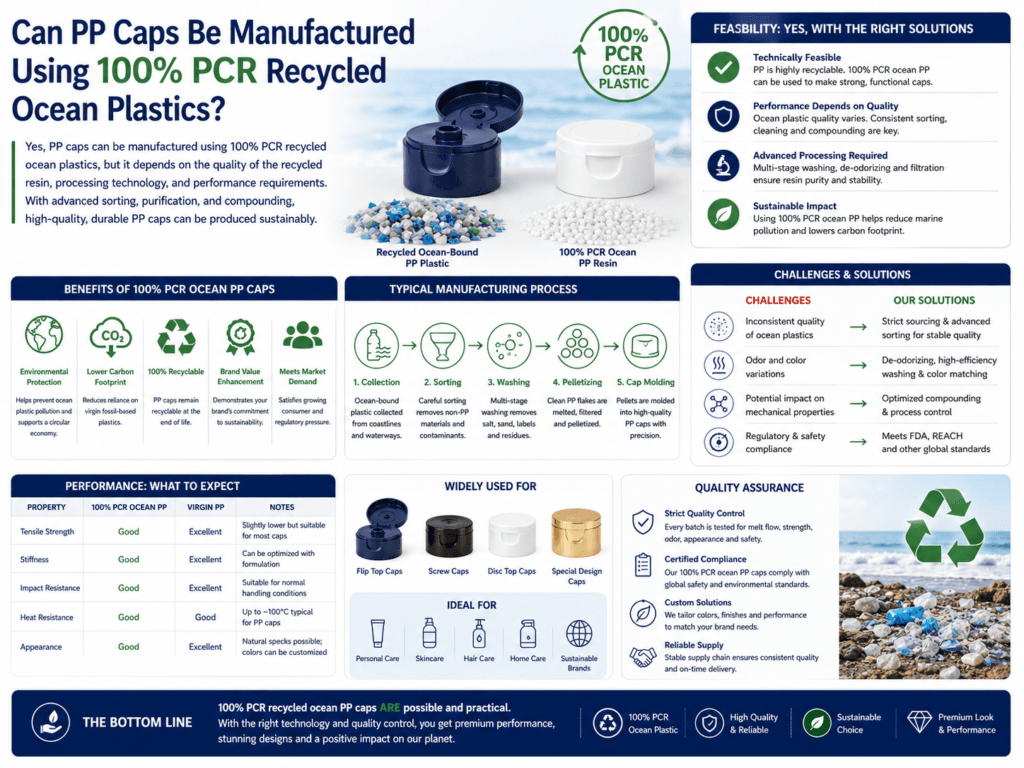
PP caps can technically be manufactured using 100% PCR recycled ocean plastics, but it is not always recommended for cosmetic tube caps that require stable color, strong hinge performance, precise thread fit, reliable snap force, and consistent leakage protection. For most beauty packaging projects, a controlled PCR blend such as 30%–70% PCR PP is often more practical than 100% PCR, especially for flip-top caps, screw caps, and premium cosmetic closures.
The answer depends on the quality of the recycled PP source, whether the material is truly post-consumer recycled, whether it is ocean-bound or ocean-recovered plastic, the required certification, cap structure, mold design, color requirement, mechanical performance, odor control, and brand claim strategy.
Quick Answer
Yes, 100% PCR ocean-plastic PP caps are possible in some cases, but they require strict material sorting, compounding, deodorization, filtration, certification, and mechanical testing. For functional cosmetic tube caps, especially flip-top caps with living hinges, 100% PCR may create higher risk of brittleness, color variation, odor, dimensional instability, weak snap force, hinge failure, and thread inconsistency.
| Option | Feasibility | Main Advantage | Main Risk |
|---|---|---|---|
| 100% PCR ocean-plastic PP cap | Possible, but high-risk and project-specific | Strong sustainability claim | Color, odor, strength, hinge, and tolerance variation |
| 50%–70% PCR PP cap | More practical for many projects | Good recycled-content story with better stability | Still needs testing and color control |
| 30% PCR PP cap | Common starting point | Better balance of sustainability and performance | Lower recycled-content claim than 100% |
| Virgin PP + PCR color story | Most stable technically | Best mechanical consistency | Weaker sustainability positioning |
What Does “PCR Ocean Plastic” Mean?
PCR means post-consumer recycled plastic: plastic that has already been used by consumers and then collected, sorted, cleaned, and recycled. “Ocean plastic” is often used in marketing, but brands must be careful. It may refer to ocean-bound plastic collected before entering the ocean, coastal plastic waste, recovered fishing gear, or plastic collected from marine environments. These are not always the same claim.
| Term | Meaning | Claim Risk |
|---|---|---|
| PCR plastic | Post-consumer recycled material collected after consumer use | Requires recycled-content verification |
| Ocean-bound plastic | Plastic waste at risk of entering the ocean | Needs traceability and certification support |
| Ocean-recovered plastic | Plastic actually collected from marine or water environments | May have higher contamination and quality challenges |
| Recycled ocean plastic | Broad marketing term | Must be defined clearly to avoid greenwashing claims |
Why 100% PCR PP Caps Are Difficult
Cosmetic tube caps are precision parts. They must fit the tube neck, seal the orifice, open smoothly, close repeatedly, resist cracking, and maintain appearance. 100% PCR PP can have more variation than virgin PP because recycled feedstock may include different PP grades, pigments, additives, contaminants, aging history, and previous processing damage.
| Challenge | Why It Happens | Cap Quality Risk |
|---|---|---|
| Color variation | PCR feedstock often has mixed original colors | Unstable white, pastel, or luxury brand colors |
| Odor | Recycled plastics may retain previous-use smell | Unacceptable for skincare and personal care packaging |
| Lower toughness | Material may degrade during previous use and recycling | Cap cracking, hinge failure, weak snap force |
| Dimensional variation | Mixed melt flow and shrinkage behavior | Poor thread fit, leakage, inconsistent torque |
| Contamination | Mixed waste streams may include non-PP materials or impurities | Black spots, weak points, poor molding stability |
Which PP Cap Types Are Most Sensitive?
| Cap Type | 100% PCR Risk Level | Reason |
|---|---|---|
| Simple screw cap | Medium | Needs thread strength and stable torque, but no living hinge |
| Flip-top cap | High | Living hinge and snap lock require excellent PP fatigue resistance |
| Disc-top cap | Medium to high | Moving parts and snap action need stable stiffness |
| Luxury decorative cap | High | Color, surface finish, dimensional stability, and appearance are critical |
| Inner plug or sealing insert | High | Needs tight tolerance and clean formula contact performance |
Why Flip-Top Caps Are Especially Challenging
Flip-top caps often use a living hinge. Living hinges require PP with excellent flex fatigue resistance. If 100% PCR PP is brittle, contaminated, over-processed, or inconsistent, the hinge may whiten, weaken, or snap after repeated opening and closing. This makes 100% PCR more difficult for flip-top caps than for simple screw caps.
- Hinge fatigue: Recycled PP must survive repeated bending without cracking.
- Snap force: The lid must close securely without becoming too brittle or too loose.
- Plug seal fit: The inner plug must maintain dimensional accuracy.
- Opening force: The cap must remain comfortable for consumers.
- Batch consistency: Every PCR batch must perform similarly on the same mold.
Color and Aesthetic Limitations
100% PCR ocean-plastic PP usually performs better in darker or natural recycled colors. White, transparent, pastel, pearlized, metallic, and luxury gold colors are much harder to achieve consistently because recycled PP already has a base color and may contain small impurities.
| Color Requirement | 100% PCR Suitability | Recommendation |
|---|---|---|
| Black or dark gray | Better | Good option for recycled-content cap projects |
| Natural recycled color | Good if brand accepts variation | Use as part of eco-friendly positioning |
| White | Difficult | Use lower PCR ratio or special compounded PCR |
| Pastel colors | Difficult | Blend with virgin PP or use controlled PCR source |
| Luxury metallic or gold effect | High difficulty | Consider virgin outer decoration or lower PCR cap base |
Odor Control for Cosmetic Caps
Odor is one of the biggest concerns for skincare and cosmetic packaging. Even if the cap does not directly hold the formula, odor from PCR material can affect customer perception. Ocean-bound or post-consumer recycled plastic may need deodorization, washing, filtration, and controlled compounding before it is suitable for cosmetic closure production.
| Odor Source | Impact | Control Method |
|---|---|---|
| Previous product residue | Unpleasant smell in final cap | Use high-quality washed and deodorized PCR resin |
| Mixed waste stream | Inconsistent odor between batches | Use traceable, controlled feedstock |
| Reprocessing degradation | Burnt or plastic smell | Optimize processing temperature and stabilizers |
| Fragrance absorption | Cap may retain or transfer odor | Run odor and formula compatibility tests |
Certification and Traceability Requirements
If a brand wants to claim “100% PCR,” “ocean-bound plastic,” “recycled ocean plastic,” or “made from recycled ocean plastics,” the claim should be supported by documentation. This may include recycled-content certification, chain-of-custody records, supplier declarations, batch traceability, transaction certificates, and material test reports.
| Documentation | Purpose | Why It Matters |
|---|---|---|
| GRS or recycled-content certification | Supports recycled material claim | Helps avoid unverified PCR marketing claims |
| OBP or ocean-bound plastic certification | Supports ocean-bound material origin claim | Shows traceability of plastic collected before ocean entry |
| Transaction certificate | Links certified material to a specific batch | Important for brand and retailer audits |
| Material safety report | Checks heavy metals, restricted substances, and contaminants | Important for cosmetic packaging safety |
| Mechanical test report | Verifies cap strength and functionality | Prevents cracking, leakage, and hinge failure |
Engineer’s note: “100% PCR” and “ocean plastic” are marketing-sensitive claims. Always confirm the exact definition, certification scope, batch traceability, and local claim rules before printing them on cosmetic packaging.
Mechanical Tests Required for 100% PCR PP Caps
| Test | Purpose | What to Check |
|---|---|---|
| Torque test | Checks screw-on and opening performance | Thread stripping, overtightening, removal torque consistency |
| Hinge cycle test | Checks flip-top durability | Stress whitening, hinge cracking, snap failure |
| Drop test | Checks impact resistance | Cap cracking, lid popping, shoulder damage |
| Compression test | Simulates shipping and e-commerce pressure | Cap deformation, leakage, snap loosening |
| Leakage test | Confirms closure sealing performance | Cap leakage, plug seal failure, thread leakage |
| Temperature cycling test | Checks hot and cold storage stability | Brittleness, warpage, shrinkage, torque change |
| Odor test | Checks cosmetic-grade sensory acceptance | Unwanted smell or batch odor variation |
Formula Compatibility Considerations
Although caps are not always in direct continuous contact with the formula, they may contact product residue around the orifice, thread, hinge, or plug seal. Skincare oils, sunscreen filters, fragrance, essential oils, surfactants, and alcohol-containing formulas may affect recycled PP differently from virgin PP.
| Formula Type | Risk for PCR PP Caps | Recommended Test |
|---|---|---|
| Oil-rich skincare | Stress cracking, swelling, odor absorption | Formula contact and aging test |
| Sunscreen | UV filters and oils may affect cap material | Heat aging, leakage, and compatibility test |
| Facial cleanser | Surfactant residue may affect snap and hinge areas | Repeated-use and wet-residue test |
| Fragrance-rich products | Odor absorption or stress cracking | Odor, migration, and cap-aging test |
| Alcohol-containing formulas | Possible material stress or drying effect | Compatibility and stress-crack test |
Best PCR Ratio by Cap Application
| Cap Application | Recommended PCR Direction | Reason |
|---|---|---|
| Basic screw cap | 30%–100% PCR possible after testing | Simpler structure with lower hinge risk |
| Flip-top cap | 30%–70% PCR is usually safer | Living hinge needs stable fatigue resistance |
| Premium decorative cap | Lower PCR ratio or hidden PCR layer may be better | Color and surface finish requirements are stricter |
| Hotel amenity cap | High PCR ratio may be possible | Short-use cycle and eco-positioning may support recycled appearance |
| Travel-size tube cap | Project-specific | Needs leakage, drop, and pressure-cycle testing |
How to Improve 100% PCR PP Cap Performance
- Use high-quality sorted PCR PP: Avoid mixed plastic contamination and unstable melt flow.
- Choose darker colors: Black, gray, or natural recycled colors hide PCR color variation better.
- Use deodorized material: Cosmetic packaging needs low-odor recycled resin.
- Add stabilizers if allowed: Proper compounding can improve processing and durability.
- Modify mold design: Thicker stress areas, smoother radii, and better gate design can reduce cracking.
- Run pilot production: Test cap performance under real injection molding and assembly conditions.
Common Mistakes to Avoid
| Mistake | Problem | Better Approach |
|---|---|---|
| Assuming 100% PCR performs like virgin PP | Mechanical and dimensional stability may differ | Run full cap function and molding tests |
| Using 100% PCR for living hinges without testing | Flip-top hinge may crack or weaken | Perform repeated open-close cycle testing |
| Promising “ocean plastic” without traceability | Greenwashing and retailer audit risk | Use certified, traceable OBP or PCR documentation |
| Requesting pure white 100% PCR caps | Color control can be very difficult | Use lower PCR ratio or accept recycled natural shade |
| Skipping odor testing | Customers may reject packaging even if function is acceptable | Use deodorized PCR and sensory QC |
| Approving only lab samples | Mass production may behave differently | Approve pilot production and batch consistency |
Best Practical Recommendation
For cosmetic tube caps, 100% PCR recycled ocean-plastic PP is possible only when the recycled material is high quality, well sorted, deodorized, compounded, certified, and validated through production testing. It is more suitable for simple screw caps, dark colors, natural recycled aesthetics, and eco-focused packaging where slight color variation is acceptable.
For flip-top caps, luxury caps, precise color caps, white caps, or caps requiring strong hinge performance, a 30%–70% PCR PP blend is often safer. This gives brands a strong sustainability story while maintaining better cap strength, dimensional stability, snap force, hinge durability, and consumer experience.
Summary
PP caps can be made from 100% PCR recycled ocean plastics, but this is not automatically the best choice for every cosmetic tube project. The main challenges are color variation, odor, contamination, brittleness, dimensional instability, hinge fatigue, thread fit, snap force, and leakage performance.
Before using 100% PCR ocean-plastic PP caps, brands should confirm recycled-content certification, ocean-bound or ocean-plastic traceability, material safety, odor control, molding stability, torque performance, hinge durability, leakage resistance, formula compatibility, drop performance, compression resistance, and batch consistency.
Learn more: PCR Tubes, PCR Cosmetic Tubes, PCR Plastic Tubes, Caps & Closures, Sustainable Materials, Quality Assurance.
Need PCR PP Caps for Sustainable Cosmetic Tubes?
Xinfly Packaging helps beauty brands evaluate PCR PP caps, ocean-bound plastic claims, recycled-content ratios, cap color, hinge strength, thread fit, leakage performance, odor control, certification documents, and sustainable cosmetic tube packaging solutions.