
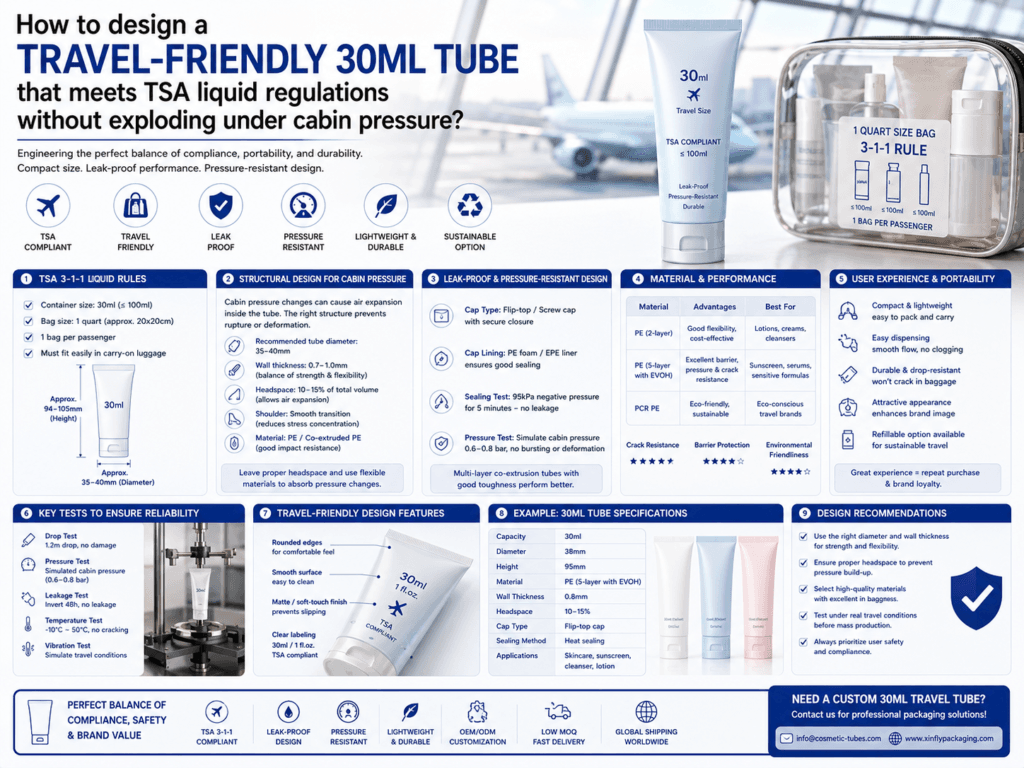
To design a travel-friendly 30ml cosmetic tube that meets TSA liquid regulations and does not leak or burst under cabin pressure, brands should control tube capacity, headspace, cap sealing, wall thickness, material flexibility, tail-seal strength, and pressure-cycle testing together. A 30ml tube is well within the common 100ml travel-size limit, but travel safety depends on packaging engineering, not only volume.
During air travel, tubes may experience pressure change, temperature fluctuation, baggage compression, and repeated handling. If the tube is overfilled, sealed poorly, too rigid, too thin, or paired with a weak cap, the formula may leak from the cap, tail seal, shoulder, or applicator opening.
Quick Answer
A travel-friendly 30ml tube should use a safe fill volume, enough headspace, a reliable cap seal, a flexible but strong PE structure, stable tail sealing, and pressure-resistance testing. For most skincare, sunscreen, hand cream, lip care, and cleanser travel tubes, the safest direction is a 30ml nominal tube with controlled filling, 5%–10% headspace, leak-proof cap design, and filled pressure-cycle testing.
| Design Item | Recommended Direction | Why It Matters |
|---|---|---|
| Nominal capacity | 30ml travel size | Fits travel-size positioning and stays below common 100ml carry-on limit |
| Headspace | About 5%–10% depending on formula | Allows formula and air expansion without forcing product out |
| Cap system | Leak-proof screw cap or secure flip-top cap | Prevents leakage under pressure and baggage compression |
| Tube material | Flexible PE, 2-layer PE, or 5-layer EVOH if barrier is needed | Balances squeeze comfort, recovery, and pressure resistance |
| Testing | Filled pressure, drop, compression, and leakage tests | Confirms real travel performance before mass production |
Why 30ml Is a Good Travel Tube Size
30ml is a practical travel capacity for cosmetic products because it is small enough for carry-on bags, lightweight for travel kits, and large enough for several days of use. It is commonly used for sunscreen, hand cream, facial cleanser, moisturizer, eye cream, hair treatment, hotel amenities, and sample-size skincare.
- TSA-friendly size: 30ml is far below the common 100ml carry-on container limit.
- Portable and lightweight: Easy to carry in handbags, toiletry kits, and travel pouches.
- Good trial size: Suitable for mini skincare sets, promotional kits, and hotel amenities.
- Lower pressure risk: Smaller internal volume usually reduces stress compared with large tubes.
- Retail appeal: Travel-size tubes are useful for airport retail, e-commerce bundles, and gift sets.
TSA Liquid Regulation Consideration
For U.S. air travel, cosmetic liquids, gels, creams, lotions, and pastes in carry-on luggage must follow the travel-size container rule. A 30ml tube is well below the common 3.4 oz / 100ml container size limit, making it suitable for travel-size cosmetic packaging. However, brands should still clearly mark the net content on the tube and carton to avoid consumer confusion.
| Travel Requirement | 30ml Tube Design Response | Brand Benefit |
|---|---|---|
| Container size limit | Use 30ml clearly printed on tube body | Easy for consumers to identify as travel size |
| Liquids, gels, creams, and pastes | Design for skincare, sunscreen, cleanser, lotion, and cream formulas | Suitable for common travel cosmetic categories |
| Clear toiletry bag packing | Keep tube compact and slim | Fits better into travel pouches and quart-size bags |
| Airport retail and travel kits | Use clean “30ml / 1.0 fl oz” labeling | Improves consumer trust and shelf clarity |
Important: TSA compliance is about container size and travel rules, while leak prevention is about tube engineering. A 30ml tube can still leak if the cap, tail seal, headspace, or material structure is not properly designed.
Why Tubes Leak or “Explode” During Flights
When aircraft altitude changes, air pressure around the package can change. If there is trapped air inside the tube, that air can expand and push product toward the weakest exit point. The issue is usually not a dramatic explosion, but leakage, cap popping, formula oozing, tail seal stress, or product contamination around the closure.
| Cause | What Happens | Visible Problem |
|---|---|---|
| Too little headspace | No room for pressure or temperature expansion | Product forced into cap or tail seal |
| Weak cap seal | Pressure pushes formula through the closure path | Leakage around cap or orifice |
| Poor tail sealing | Seal cannot resist internal stress | Tail leakage or seal opening |
| Air bubbles in formula | Trapped air expands during pressure change | Product spitting, swelling, or overflow |
| Rigid tube body | Package cannot absorb pressure change flexibly | Cap leakage or body stress |
| Baggage compression | External force squeezes filled tube | Formula leakage inside toiletry bag |
Headspace Design for a 30ml Travel Tube
Headspace is the empty volume left inside the tube after filling and before tail sealing. It gives the formula and trapped air room to respond to pressure and temperature changes. For travel tubes, headspace is critical because the product may be carried in airplanes, cars, backpacks, hotels, and hot environments.
| Formula Type | Headspace Direction | Reason |
|---|---|---|
| Light lotion or cleanser | Moderate headspace | Low viscosity formula can move easily toward the cap |
| Medium cream | Standard 5%–10% headspace | Good balance for most travel skincare tubes |
| Thick sunscreen or paste | Slightly more headspace may be needed | Higher filling pressure and air pockets may increase leakage risk |
| Foaming or air-sensitive formula | More headspace and deaeration recommended | Air expansion can cause overflow or spitting |
| Warm-filled formula | More headspace and cooling validation | Thermal expansion and cooling shrinkage must be controlled |
Cap and Closure Design
The cap is often the first leakage point in travel-size tubes. A small amount of formula can escape through the orifice, thread, hinge, or flip-top opening if the cap does not seal properly. For travel-friendly packaging, cap matching is as important as the tube body.
| Cap Type | Travel Performance | Design Recommendation |
|---|---|---|
| Screw cap | Usually strong for travel if thread and liner are well matched | Good for creams, sunscreen, and higher-value skincare |
| Flip-top cap | Convenient but must have strong snap and plug seal | Use secure hinge, inner plug, and leakage test |
| Nozzle cap | Good for controlled dosage but may need extra protection | Use tight cap cover and anti-drip orifice |
| Applicator head | Premium but more leakage paths | Validate insert fit, cap seal, and pressure resistance |
Tube Body Structure for Cabin Pressure Resistance
The tube body should be flexible enough to absorb pressure changes but strong enough to resist compression, tail cracking, and transport deformation. For a 30ml travel tube, a balanced PE structure is usually preferred. If the formula is oxygen-sensitive, fragrance-rich, or active skincare, a 5-layer EVOH barrier tube can be considered.
| Tube Structure | Travel Benefit | Best Use |
|---|---|---|
| Single-layer PE tube | Soft, simple, easy to squeeze | Basic creams, lotions, and low-risk formulas |
| 2-layer PE tube | Better body stability and squeeze recovery | Most travel skincare and personal care products |
| 5-layer EVOH tube | Better barrier plus flexible body | Sunscreen, fragrance-rich cream, active skincare |
| HDPE-rich rigid tube | Better standing stability but less pressure absorption | Use carefully; test squeeze and pressure behavior |
Recommended 30ml Tube Dimension Direction
The exact tube diameter and length depend on formula density, shoulder design, cap height, artwork layout, and desired shelf appearance. For 30ml cosmetic tubes, compact diameters such as 25mm or 30mm are commonly practical starting points, but the final size should be confirmed by internal capacity and filling tests.
| Design Direction | Benefit | Engineering Note |
|---|---|---|
| 25mm diameter | Slim, portable, easy to fit in travel pouch | Longer body may be needed for 30ml capacity |
| 30mm diameter | Balanced capacity, squeeze feel, and front artwork area | Often a practical option for 30ml skincare and sunscreen tubes |
| Short wide design | More stable shelf appearance | Check cap base and toiletry bag fit |
| Slim tall design | Good for travel kits and sample sets | Check standing stability and carton packing |
How to Prevent Leakage Under Cabin Pressure
- Reserve enough headspace: Do not fill the tube to its full theoretical capacity.
- Use a reliable cap seal: Screw caps or strong flip-top plug seals are better for travel.
- Control filling accuracy: Overfilling increases pressure and leakage risk.
- Reduce trapped air: Deaeration and bottom-up filling can help air-sensitive formulas.
- Optimize tube flexibility: The body should absorb pressure changes without cracking or paneling.
- Strengthen tail sealing: Tail seal must resist internal pressure, baggage compression, and temperature cycling.
- Test with real filled samples: Empty-tube testing cannot prove cabin-pressure performance.
Testing Plan for Travel-Friendly 30ml Tubes
| Test | Purpose | What to Check |
|---|---|---|
| Vacuum / low-pressure test | Simulates pressure reduction during air travel | Cap leakage, tail seal leakage, tube swelling, product oozing |
| Pressure-cycle test | Checks repeated pressure changes | Seal fatigue, cap looseness, formula movement |
| Drop test | Simulates baggage handling and travel impact | Cap cracking, shoulder failure, leakage |
| Compression test | Simulates toiletry bag and suitcase pressure | Formula leakage, cap popping, tail stress |
| Temperature cycling test | Checks hot/cold travel environment effects | Expansion, contraction, paneling, leakage |
| Filled storage test | Checks long-term formula-package compatibility | Softening, swelling, fragrance loss, delamination, leakage |
Formula Factors That Increase Travel Leakage Risk
| Formula Factor | Risk | Packaging Adjustment |
|---|---|---|
| Low viscosity | Flows easily into cap area | Use tighter orifice, stronger cap seal, controlled filling speed |
| High viscosity | Requires stronger squeeze and may trap air | Use softer tube body, larger outlet, and deaeration |
| Foaming formula | Air expansion may push product outward | Increase headspace and reduce trapped air |
| Oil-rich cream | May migrate into cap or tube material | Use compatible PE or barrier structure |
| Fragrance-rich formula | Volatile components may expand or migrate | Use EVOH barrier and cap-seal testing |
Artwork and Labeling for Travel Tubes
Travel-size packaging should communicate capacity clearly. If the tube is designed for U.S. travel retail or carry-on use, printing “30ml / 1.0 fl oz” on the front or back panel can help customers quickly recognize it as a travel-friendly product. Important regulatory and product information should remain readable despite the small tube size.
- Print net content clearly: Use “30ml” and optional “1.0 fl oz” depending on target market.
- Keep claims simple: Small tubes have limited artwork space.
- Use high-contrast text: Improves readability on compact packaging.
- Leave tail-seal safe zone: Do not place critical text too close to the sealing area.
- Consider travel-kit design: Match colors and caps across mini product sets.
Common Mistakes to Avoid
| Mistake | Why It Causes Problems | Better Approach |
|---|---|---|
| Filling exactly 30ml into a tube with no safety margin | Insufficient headspace increases leakage risk | Use a tube with enough usable capacity for 30ml fill plus headspace |
| Using a weak flip-top cap | Cap may open or leak under pressure and compression | Use strong snap, plug seal, and cap leakage testing |
| Ignoring trapped air | Air expands during pressure change | Use deaeration, controlled filling, and correct nozzle depth |
| Making the tube too rigid | Rigid body cannot absorb pressure changes well | Use balanced PE flexibility and tested wall thickness |
| Testing only at room temperature | Travel includes temperature and pressure changes | Run pressure, temperature cycling, compression, and drop tests |
Best Practical Recommendation
For a reliable travel-friendly 30ml cosmetic tube, use a 30ml nominal fill with sufficient headspace, leak-proof screw cap or secure flip-top cap, balanced flexible PE body, strong tail seal, and pressure-cycle validation. For active skincare, sunscreen, fragrance-rich cream, or essential-oil products, consider a 5-layer EVOH tube to improve barrier performance while maintaining squeeze flexibility.
The safest design is confirmed through real filled samples. Test the actual formula, actual cap, actual tail seal, and actual shipping conditions before approving mass production.
Summary
A 30ml cosmetic tube is a strong travel-size packaging option because it is compact, lightweight, and below the common 100ml carry-on container limit. However, preventing leakage under cabin pressure requires more than choosing the right capacity. Brands must control headspace, cap sealing, tube flexibility, tail-seal strength, formula air content, filling accuracy, and pressure-cycle performance.
To avoid leakage or product overflow during flights, the tube should be tested with real formula under vacuum or low-pressure conditions, compression, drop, temperature cycling, and filled storage before mass production.
Learn more: Travel Size Sunscreen Tubes, Hotel Amenities Tubes, Tube Capacity, Diameter, Length & Thickness, Calculate Tube Headspace for Tail Sealing, PE Tubes, Quality Assurance.
Need Travel-Friendly 30ml Cosmetic Tubes?
Xinfly Packaging helps brands design 30ml travel-size tubes with suitable PE material, barrier structure, cap sealing, headspace control, tail-seal strength, leakage testing, and premium decoration for skincare, sunscreen, hand cream, cleanser, and hotel amenity products.