
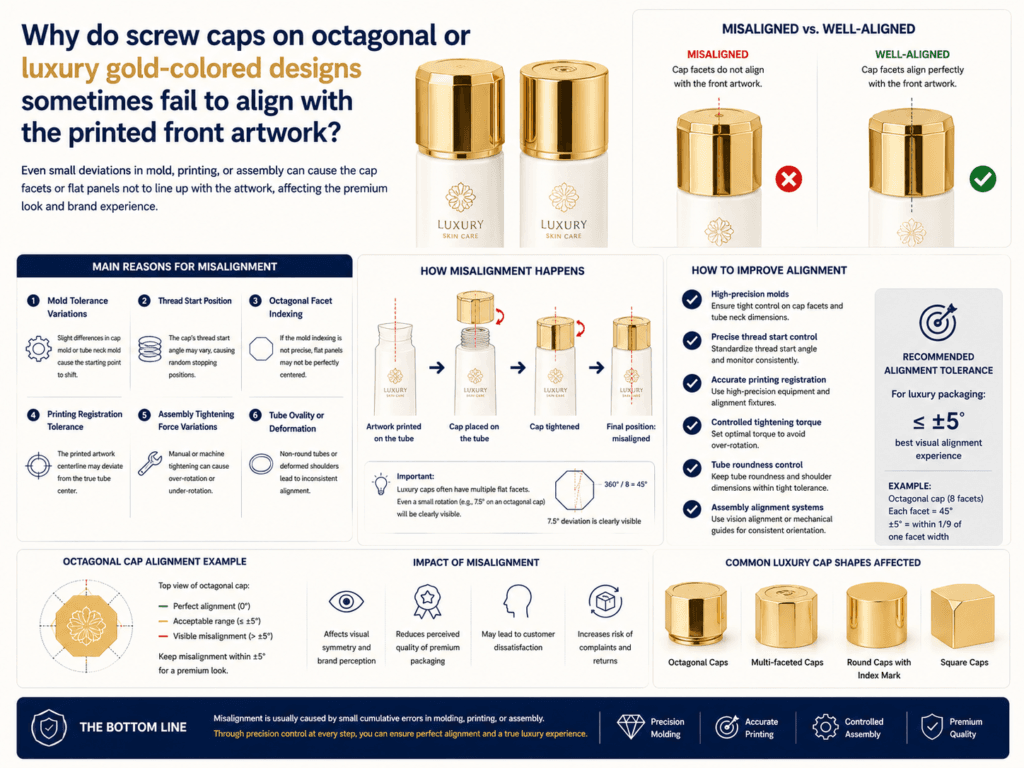
Screw caps on octagonal or luxury gold-colored cosmetic tube designs sometimes fail to align with the printed front artwork because the final cap orientation depends on thread start position, capping torque, cap tolerance, tube neck tolerance, shoulder molding variation, and assembly process control. Unlike a simple round cap, an octagonal or faceted cap has a visible “front direction,” so even a small rotational difference becomes obvious on the shelf.
This issue is especially noticeable on premium packaging such as gold caps, metallic caps, octagonal caps, square-look caps, acrylic-style caps, and luxury skincare tubes where the brand logo, cap edge, cap face, and printed front panel must look perfectly aligned. The problem is not only visual. Misalignment may also indicate unstable torque, thread mismatch, or inconsistent closure fit.
Quick Answer
Octagonal screw caps fail to align with front artwork mainly because screw caps stop at different rotational positions depending on thread start location, torque setting, cap-to-neck tolerance, sealing land compression, liner or plug interference, cap decoration orientation, and machine assembly variation. To solve it, factories must design the cap, tube neck, thread, artwork, and capping process as one matched system.
| Cause | What Happens | Visible Result |
|---|---|---|
| Thread start variation | Cap begins tightening from a different rotational point | Cap face stops left or right of printed front artwork |
| Torque variation | Some caps are tightened more or less than others | Different cap angles between samples |
| Cap and neck tolerance mismatch | Thread engagement changes from piece to piece | Random alignment and uneven cap height |
| Plug or liner compression | Inner seal changes the final stop position | Cap may stop early or overtighten past the desired front |
| Decorative cap orientation not controlled | Gold or octagonal cap has a visual direction but no mechanical indexing | Luxury cap does not line up with logo or front panel |
Why Round Caps Hide the Problem Better
Standard round caps do not have a clear front face, so small rotational differences are usually invisible. Octagonal, square, flat-sided, or metallic decorative caps have edges and faces that create a visible direction. When the cap stops at a slightly different angle, the customer immediately sees that the cap is not aligned with the printed logo or product name.
| Cap Shape | Visual Sensitivity | Alignment Requirement |
|---|---|---|
| Round screw cap | Low | Rotational angle usually does not matter |
| Oval cap | Medium | Needs reasonable front/back alignment |
| Octagonal cap | High | Faces and edges should align with printed artwork |
| Square or rectangular-look cap | Very high | Requires controlled orientation or indexed closure design |
| Gold or metallic luxury cap | High | Reflection and edges make misalignment more obvious |
Thread Start Position Is the Core Reason
A screw cap rotates along the tube neck thread until it reaches the sealing position. The final angle depends on where the thread starts on both the cap and the tube neck. If the cap thread start or tube neck thread start is not indexed to the printed front, the cap can stop at any rotational angle.
- Cap thread start: Determines where the cap begins engaging the tube neck.
- Tube neck thread start: Determines the rotational path before the cap reaches the sealing position.
- Final stop point: Depends on thread length, pitch, torque, and sealing compression.
- Artwork front: Printed tube artwork is usually positioned separately from the cap thread.
- Alignment issue: If these systems are not indexed together, the cap face may not match the printed front.
Capping Torque and Final Stop Position
Even if the cap and neck are well designed, torque variation can shift the final cap angle. A slightly higher torque may rotate the cap further. A slightly lower torque may stop the cap earlier. For round caps this is rarely noticed, but for octagonal or luxury caps, even a few degrees can look misaligned.
| Torque Condition | Effect on Cap Alignment | Risk |
|---|---|---|
| Torque too low | Cap stops before reaching intended position | Loose cap, leakage, visible angle mismatch |
| Correct torque window | Cap seals correctly and stops within acceptable angle range | Stable appearance and functional seal |
| Torque too high | Cap rotates too far or stresses the thread | Overtightening, thread stripping, cracked cap, misalignment |
| Unstable torque | Different samples stop at different angles | Inconsistent premium shelf appearance |
Engineer’s note: For octagonal or square-look screw caps, “tight enough” is not the only standard. The cap must meet both sealing torque and visual orientation requirements.
Why Gold-Colored and Metallic Caps Make Misalignment More Obvious
Gold-colored caps, electroplated caps, metal-jacketed caps, and glossy metallic finishes reflect light strongly. If the cap face is not parallel with the printed front panel, the misalignment becomes more visible under retail lighting. Luxury packaging also has higher visual expectations, so customers may judge small angle differences as poor quality.
| Luxury Cap Feature | Why It Highlights Misalignment | Quality Risk |
|---|---|---|
| Gold finish | High reflection makes edges more noticeable | Packaging looks less premium |
| Octagonal shape | Flat faces create a clear front direction | Logo and cap face do not visually match |
| Hot-stamped or printed cap logo | Cap decoration must align with tube artwork | Brand mark appears rotated |
| Metal jacket | Rigid sleeve may have fixed decorative orientation | Cap orientation error feels more obvious |
| Premium shelf display | Consumers compare multiple tubes side by side | Batch inconsistency becomes visible |
Tube Neck and Cap Tolerance Problems
Small dimensional differences can change the cap’s final stop angle. If the PE tube neck is slightly larger, smaller, softer, or more oval than expected, the cap may seat differently. If the cap thread, inner plug, or liner varies between batches, alignment also changes.
| Tolerance Factor | Effect on Alignment | Control Method |
|---|---|---|
| Tube neck outer diameter | Changes thread friction and cap seating | Measure neck diameter and ovality |
| Thread pitch and height | Changes rotational travel and stop position | Use thread gauge and go/no-go inspection |
| Cap inner thread | Affects engagement and final angle | Control cap mold tolerance and shrinkage |
| Plug seal interference | Can stop the cap earlier or create extra resistance | Match plug diameter to orifice and sealing land |
| Liner thickness | Changes compression and cap stop position | Validate liner type and cap torque together |
Artwork Registration and Cap Orientation Must Be Planned Together
Printed front artwork is usually aligned using tube body registration, artwork direction, and printing equipment setup. Cap orientation is controlled by the mechanical thread and capping process. If these two systems are designed independently, perfect alignment is difficult.
| Design Element | Controlled By | Alignment Risk |
|---|---|---|
| Printed front logo | Artwork file, printing registration, tube orientation | Front panel may be accurate while cap is rotated |
| Cap face direction | Cap shape, thread start, capping torque | Cap face may stop away from front artwork |
| Cap logo or top decoration | Cap printing, hot stamping, or molding orientation | Cap decoration may not align with tube logo |
| Tube shoulder and neck | Injection head mold and thread design | Thread start may not be indexed to tube body front |
How Factories Solve Cap Alignment Problems
| Solution | How It Helps | Best Use |
|---|---|---|
| Indexed thread design | Controls where the cap starts and stops | High-end octagonal or square-look caps |
| Controlled torque window | Reduces final angle variation | Automated capping and premium packaging |
| Orientation assembly jig | Helps cap be applied at a controlled angle | Small batches, luxury projects, special caps |
| Cap design tolerance adjustment | Improves repeatable stop position | Projects with slight angle inconsistency |
| Use non-directional cap decoration | Reduces visual sensitivity to rotation | When perfect indexing is not cost-effective |
| Switch to snap-on or oriented cap system | Allows more controlled front alignment than screw-only design | Very strict luxury display requirements |
Design Options to Reduce Misalignment Risk
- Use a round cap if alignment is not critical: Round caps hide rotational variation better than octagonal caps.
- Avoid directional cap logos: If the cap top has no logo direction, small rotation is less visible.
- Use a symmetrical octagonal design: Repeating patterns reduce the visual impact of angle variation.
- Plan thread start early: Cap mold and tube neck mold should be designed with orientation in mind.
- Define acceptable angle tolerance: Luxury projects should specify allowed rotational deviation.
- Approve filled assembly samples: Cap position may change after liner compression, formula residue, or production torque.
Quality Tests Before Mass Production
| Test | Purpose | What to Check |
|---|---|---|
| Cap orientation test | Checks final cap angle after tightening | Alignment with front artwork and logo |
| Application torque test | Confirms cap is tightened within the correct torque range | Overtightening, loose cap, angle drift |
| Removal torque test | Checks consumer opening comfort | Too tight, too loose, unstable opening force |
| Thread engagement inspection | Confirms cap and neck match correctly | Cross-threading, stripped threads, tilted cap |
| Artwork registration check | Confirms printed front panel position | Logo centering, front/back alignment, side seam orientation |
| Batch consistency test | Compares multiple caps and tubes from production batches | Angle variation, cap height variation, color and finish consistency |
| Leakage test | Confirms alignment solution does not reduce sealing performance | Cap leakage, neck leakage, formula residue |
Recommended Acceptance Standard
For luxury octagonal screw caps, the brand and factory should define a realistic visual tolerance before production. For example, the cap face should align with the printed front within an agreed angle range, and all samples should also meet torque, leakage, and opening-force requirements.
| Acceptance Item | Recommended Check | Why It Matters |
|---|---|---|
| Visual front alignment | Check cap face vs. printed logo direction | Protects premium shelf appearance |
| Cap height consistency | Check gap between cap and shoulder | Prevents tilted or uneven luxury look |
| Torque range | Check application and removal torque | Maintains seal and consumer usability |
| Thread condition | Inspect for stripping, shaving, or deformation | Prevents closure failure after assembly |
| Gold finish quality | Check scratches, color difference, plating defects | Maintains luxury brand perception |
When Perfect Alignment May Not Be Practical
For standard screw-thread designs, perfect front alignment on every unit may be difficult unless the cap and tube neck are specially engineered for orientation. If the brand requires very strict alignment, this should be discussed before mold development. It may require custom tooling, indexed threads, special assembly jigs, or a different closure structure.
Practical note: If the cap is octagonal, square-look, printed, hot-stamped, or has a directional metallic highlight, confirm orientation requirements at the design stage. Trying to correct alignment after mass production is much harder and more expensive.
Common Mistakes to Avoid
- Approving the cap shape without checking final assembly: The cap may look perfect alone but misalign on the tube.
- Ignoring thread start position: Thread geometry controls where a screw cap stops.
- Using ordinary screw threads for strict luxury alignment: Directional caps often need indexed design.
- Changing cap liner or plug seal after approval: Compression changes can shift final cap angle.
- Only testing by hand: Automated capping torque may produce different alignment results.
- Not defining visual tolerance: The factory and brand may judge “acceptable alignment” differently.
Best Practical Recommendation
For octagonal or luxury gold-colored screw caps, align the packaging strategy before mold approval. Confirm whether the cap face, cap logo, metallic reflection, tube logo, and printed front artwork must align exactly. If yes, use indexed thread design, controlled torque, strict cap-neck tolerance, and assembly orientation testing.
If the project budget or MOQ cannot support indexed tooling, reduce the visual risk by using a non-directional cap top, symmetrical decorative pattern, round cap, or artwork layout that does not rely on perfect cap-to-front alignment.
Summary
Screw caps on octagonal or luxury gold-colored cosmetic tube designs fail to align with printed front artwork because the final rotational position is controlled by thread start, torque, cap tolerance, tube neck tolerance, plug or liner compression, and assembly conditions. Directional cap shapes make this variation much more visible than round caps.
To prevent misalignment, brands should define orientation requirements early, design cap and tube neck threads together, control capping torque, inspect thread compatibility, test assembled samples, and set an acceptable cap-angle tolerance before mass production.
Learn more: Caps & Closures, Screw Cap Tubes, Screw Cap Thread Stripping and Overtightening, Cap and Tube Neck Compatibility Testing, Tube Decoration, Quality Assurance.
Need Luxury Caps That Align with Your Tube Artwork?
Xinfly Packaging helps beauty brands engineer octagonal caps, gold caps, screw caps, tube neck threads, artwork registration, capping torque, and visual alignment standards for premium cosmetic tube packaging.