
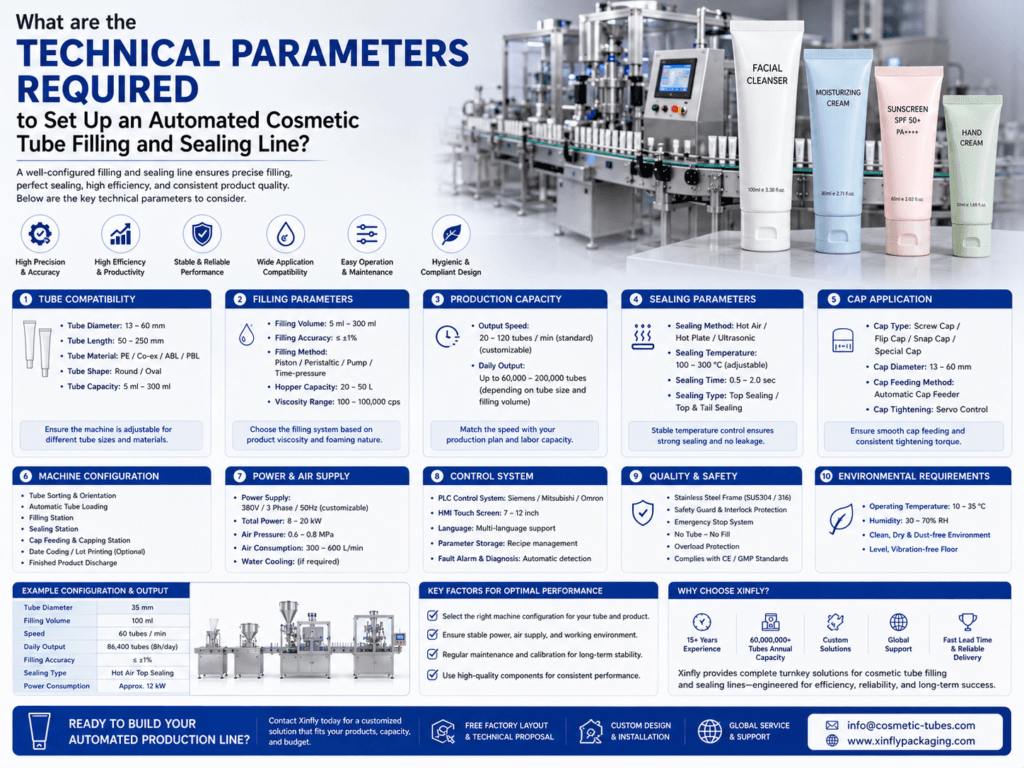
To set up an automated cosmetic tube filling and sealing line, the key technical parameters include tube diameter, tube length, fill volume, formula viscosity, filling temperature, filling accuracy, sealing method, tail-seal width, coding position, production speed, air pressure, power supply, tube orientation, cap type, and quality inspection standards. These parameters must be confirmed before mass production because small mismatches can cause overflow, weak tail sealing, leakage, poor coding, tube deformation, or unstable machine feeding.
An automated tube filling and sealing line is not only selected by speed. It must match the actual cosmetic tube structure, material, formula behavior, cap design, artwork direction, and factory production target. A machine that works well for a 30ml hand cream tube may need different settings for a 200ml body lotion tube, high-viscosity sunscreen, hair mask, toothpaste, or eye cream applicator tube.
Core Parameters Required Before Machine Setup
| Parameter | What to Confirm | Why It Matters |
|---|---|---|
| Tube diameter | For example 19mm, 25mm, 30mm, 35mm, 40mm, 50mm | Determines tube holder size, machine tooling, positioning, and sealing pressure |
| Tube length | Empty tube length before filling and sealed tube length after tail sealing | Affects loading, orientation, filling nozzle depth, and tail sealing position |
| Tube material | PE, PCR PE, EVOH co-extruded, ABL, PBL, aluminum, or laminated tube | Different materials require different sealing temperature, pressure, and dwell time |
| Fill volume | Net content in ml or grams | Controls pump stroke, dosage accuracy, headspace, and overflow prevention |
| Formula viscosity | Low-viscosity lotion, medium cream, thick paste, gel, balm, or toothpaste | Determines filling pump type, nozzle size, filling speed, and anti-drip design |
| Filling temperature | Room temperature, warm filling, or hot filling | Affects tube deformation, formula expansion, sealing timing, and cooling behavior |
Tube Dimension Parameters
Tube dimensions are the first parameters needed for automated filling and sealing. The machine must hold each tube accurately, align the print mark correctly, insert the filling nozzle to the right depth, and seal the tail at the correct position.
| Dimension Item | Recommended Information | Setup Impact |
|---|---|---|
| Outer diameter | Measured tube body diameter | Tube cup / holder matching |
| Total tube length | From shoulder/cap end to open tail before sealing | Filling nozzle height and sealing station adjustment |
| Tube wall thickness | Average and tolerance range | Sealing pressure, heat transfer, and tail strength |
| Tail opening width | Open tail shape before sealing | Tube loading and sealing jaw fit |
| Cap diameter / cap height | Flip-top, screw cap, acrylic cap, or special cap dimensions | Standing stability, machine clearance, and packing direction |
Formula Parameters Required for Filling
The formula strongly affects machine setup. A watery lotion may splash or drip if the nozzle is not controlled correctly. A thick sunscreen or toothpaste may need higher pressure, larger nozzle diameter, slower filling speed, or heated hopper support. The machine supplier and tube supplier should review the formula type before confirming final line settings.
| Formula Parameter | What to Check | Machine Setup Direction |
|---|---|---|
| Viscosity | Flow behavior at filling temperature | Select piston pump, servo pump, rotor pump, or special paste filling system |
| Density | Relationship between ml volume and gram weight | Ensures correct net content and fill-weight control |
| Air bubble tendency | Whether formula traps air during mixing or filling | May require vacuum deaeration, bottom-up filling, or slower speed |
| Filling temperature | Cold fill, room-temperature fill, or warm fill | Affects tube deformation and headspace safety |
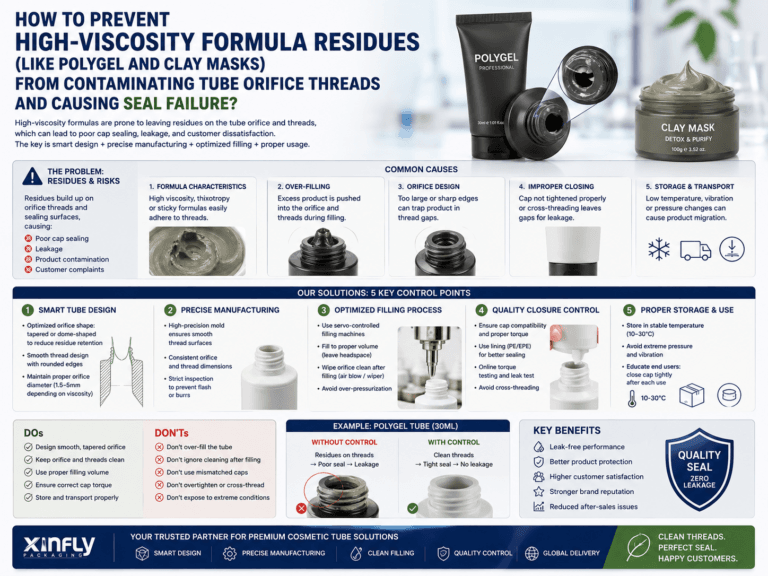
| Drip tendency | Whether formula strings, drips, or leaves residue | Requires anti-drip nozzle, suck-back system, or cut-off nozzle |
Filling Accuracy and Dosage Parameters
Filling accuracy must match the product claim and regulatory requirements in the target market. For cosmetic tubes, overfilling increases cost and overflow risk, while underfilling creates customer complaints and compliance risk.
| Filling Parameter | Typical Control Point | Why It Matters |
|---|---|---|
| Target fill volume | ml or grams per tube | Defines pump stroke and filling recipe |
| Fill tolerance | Project-specific; often controlled by weight check | Prevents underfill, overfill, and cost waste |
| Headspace | Empty space before tail sealing | Prevents product overflow and seal contamination |
| Nozzle insertion depth | Position inside the tube during filling | Reduces air bubbles, splashing, and wall contamination |
| Filling speed | Based on formula viscosity and line speed | Balances productivity, accuracy, and clean filling |
Engineer’s note: For thick creams, gels, sunscreen, toothpaste, or formulas with air bubbles, filling speed should be optimized carefully. Running the line too fast can cause splashing, trapped air, inaccurate fill weight, and weak tail seals.
Sealing Method and Tail-Seal Parameters
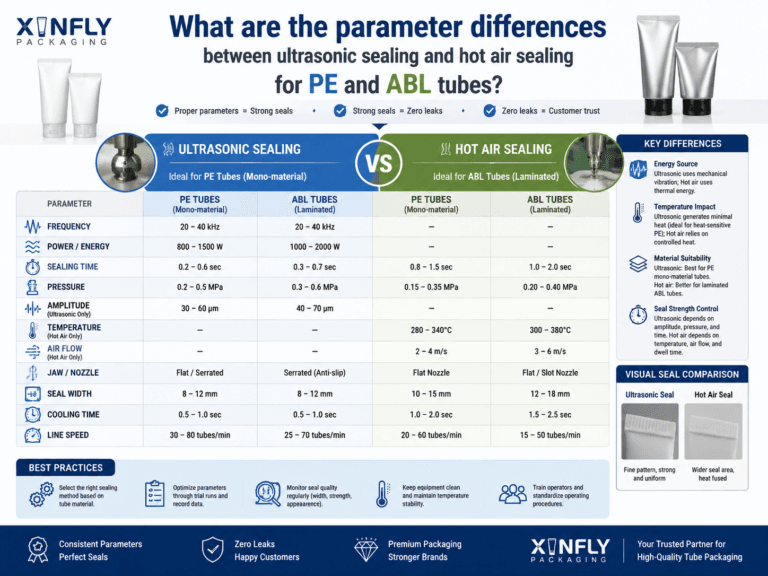
The sealing method must match the tube material. PE and co-extruded tubes are commonly heat sealed or hot-air sealed. Laminated ABL/PBL tubes may require specific sealing settings based on laminate structure. Aluminum tubes use a different folding or crimping method.
| Sealing Parameter | What to Confirm | Risk If Incorrect |
|---|---|---|
| Sealing method | Hot air, ultrasonic, heat jaw, folding, or crimping | Wrong method can cause weak seal or tube damage |
| Sealing temperature | Matched to PE, PCR, EVOH, ABL, PBL, or other material | Too low causes leakage; too high causes burning or warping |
| Sealing pressure | Jaw pressure applied during sealing | Too much pressure can deform the tail; too little causes poor bonding |
| Dwell time | How long heat and pressure are applied | Affects seal strength and production speed |
| Tail-seal width | Final sealed area width | Influences leakage resistance and artwork safe zone |
| Cooling time | Time for sealed tail to stabilize | Prevents seal deformation after cutting or handling |
Tube Orientation and Eye-Mark Detection
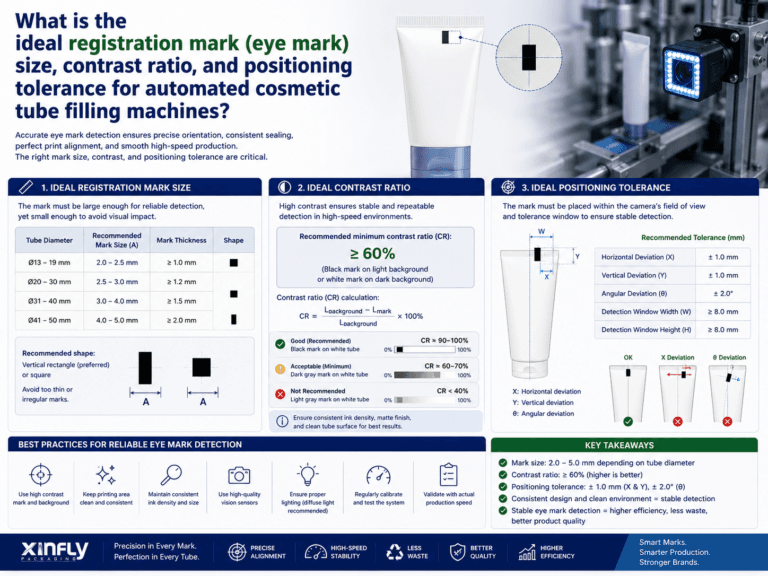
For printed tubes, orientation is very important. The machine must rotate the tube so the front artwork, tail seal, batch code, and registration mark are aligned correctly. If eye-mark detection is unstable, the tail seal or code may appear on the wrong side of the tube.
| Orientation Parameter | Setup Requirement | Quality Impact |
|---|---|---|
| Eye mark position | Clear contrast mark on artwork | Controls tube rotation and front/back alignment |
| Eye mark color | High contrast against tube background | Improves sensor detection accuracy |
| Artwork front direction | Logo and product name facing correct side | Prevents poor retail appearance |
| Tail seal direction | Horizontal, vertical, front-back, or side-aligned preference | Controls final package consistency |
| Batch code position | Printed on tail, shoulder, cap, or body | Ensures readability and compliance |
Production Speed and Line Capacity
Production speed should be set according to formula behavior, filling accuracy, sealing quality, and downstream packing capacity. A higher speed is not useful if it causes more rejects, unstable fill weight, poor seals, or messy nozzles.
| Line Type | Typical Use | Key Consideration |
|---|---|---|
| Semi-automatic line | Small batch, trial production, low MOQ projects | Flexible, lower speed, more operator involvement |
| Automatic intermittent line | Medium cosmetic production | Good balance of speed, accuracy, and flexibility |
| High-speed automatic line | Large-volume retail or contract manufacturing | Requires stable tubes, formula, coding, feeding, and QC process |
Utility and Factory Setup Parameters
The machine also needs the correct factory utilities. Before installation, the production team should confirm power supply, compressed air, cooling water if needed, exhaust requirement, room temperature, cleanroom level, operator space, maintenance clearance, and safety protection.
| Utility Parameter | What to Confirm | Why It Matters |
|---|---|---|
| Power supply | Voltage, phase, frequency, power capacity | Ensures stable machine operation |
| Compressed air | Air pressure, flow rate, dryness, cleanliness | Controls pneumatic cylinders, tube handling, and sealing systems |
| Cooling system | Air cooling, water cooling, or chilled water if required | Stabilizes sealing and prevents overheating |
| Exhaust / ventilation | Hot air, odor, or fume extraction | Improves operator safety and process stability |
| Cleanroom condition | Dust control and hygiene level | Important for skincare, eye cream, and sensitive formulas |
Quality Control Parameters
Automated filling and sealing should include in-process QC checks. These checks prevent large batches of defective tubes from continuing through the line. The QC plan should be confirmed before production starts.
| QC Item | What to Check | Failure Risk |
|---|---|---|
| Fill weight | Net content consistency | Underfill, overfill, customer complaints |
| Tail seal strength | Seal bonding and leakage resistance | Leakage during storage, shipping, or use |
| Seal appearance | Smooth tail, correct trim, no burns or wrinkles | Poor retail appearance or weak sealing |
| Tube orientation | Logo, tail seal, and code alignment | Incorrect front/back display |
| Batch coding | Readable lot number, expiry date, or production code | Traceability and compliance issues |
| Leak test | Pressure, vacuum, squeeze, or visual leakage check | Product loss and retailer rejection |
Common Problems From Incorrect Setup
| Problem | Possible Setup Cause | Adjustment Direction |
|---|---|---|
| Product overflow during sealing | Overfilling, insufficient headspace, wrong nozzle depth, high filling speed | Adjust fill volume, headspace, nozzle height, and filling speed |
| Weak tail seal | Low temperature, low pressure, short dwell time, contaminated seal zone | Optimize sealing window and keep tail area clean |
| Tube body deformation | Hot filling, high pressure, thin wall, excessive sealing heat | Reduce filling temperature, improve tube structure, adjust sealing settings |
| Inaccurate fill weight | Formula viscosity fluctuation, air bubbles, pump mismatch | Use correct pump, deaerate formula, stabilize temperature |
| Incorrect tube orientation | Weak eye mark, sensor misalignment, poor print contrast | Improve eye mark design and adjust sensor settings |
Technical Checklist Before Production
- Confirm tube diameter, length, wall thickness, material, cap type, and artwork direction.
- Confirm formula viscosity, density, filling temperature, air bubble tendency, and drip behavior.
- Confirm fill volume, fill tolerance, headspace, and nozzle insertion depth.
- Confirm sealing method, sealing temperature, pressure, dwell time, cooling time, and tail width.
- Confirm eye-mark position, batch code location, tail-seal direction, and print alignment.
- Confirm machine speed, tube holder size, compressed air, power supply, and operator workflow.
- Confirm QC standards for fill weight, leakage, seal strength, coding, appearance, and final packing.
Recommended Trial Run Process
| Trial Step | Purpose | What to Approve |
|---|---|---|
| Empty tube loading test | Checks tube holder, feeding, and orientation stability | No jamming, no scratching, correct rotation |
| Water or simulation fill test | Checks basic machine movement and fill accuracy | Volume control and nozzle movement |
| Real formula filling test | Checks actual viscosity, dripping, bubbles, and headspace | Stable fill weight and clean filling |
| Tail sealing test | Confirms sealing window for real tube material | Strong seal, clean appearance, no burns or leakage |
| Pilot batch test | Verifies continuous production stability | Reject rate, speed, QC results, packaging appearance |
Common Mistakes to Avoid
- Selecting the line only by speed: Speed is useless if filling accuracy and sealing quality are unstable.
- Ignoring formula viscosity: Thick formulas need different pumps, nozzles, and filling speeds.
- Using one sealing setting for all tube materials: PE, PCR, EVOH, ABL, and PBL require different sealing windows.
- Forgetting headspace: Too little headspace causes overflow and contaminated tail seals.
- Skipping eye-mark design: Poor eye marks cause incorrect tube orientation and coding errors.
- Testing only with empty tubes: Real formula and filled-tube testing are essential before mass production.
Best Practical Recommendation
Before setting up an automated cosmetic tube filling and sealing line, prepare a complete technical sheet covering the tube specification, formula properties, filling requirements, sealing parameters, coding position, production speed, factory utilities, and QC inspection standards. The most critical parameters are tube diameter, tube length, fill volume, formula viscosity, filling temperature, headspace, sealing temperature, sealing pressure, dwell time, and eye-mark orientation.
The final setup should always be approved through real formula filling, real tube sealing, leakage testing, fill-weight checks, coding inspection, and pilot-batch production before full-scale manufacturing.
Summary
To set up an automated cosmetic tube filling and sealing line, the factory needs complete technical parameters for the tube, formula, filling process, sealing process, orientation system, coding system, utilities, and quality control. Key details include tube size, material, cap type, formula viscosity, fill volume, filling temperature, headspace, nozzle depth, sealing temperature, pressure, dwell time, production speed, air pressure, power supply, and QC standards.
A successful automated line is not simply the fastest line. It is the line that can fill accurately, seal reliably, protect the tube appearance, reduce leakage, and maintain stable quality across long production runs.
Learn more: Tube Capacity, Diameter, Length & Thickness, Calculate Tube Headspace for Tail Sealing, Maximum Filling Temperature for PE Tubes, Tube Length and Wall Thickness Tolerance, Quality Assurance, Sample Development.
Need Tubes Suitable for Automated Filling and Sealing?
Xinfly Packaging helps cosmetic brands and filling factories confirm tube diameter, wall thickness, material structure, cap matching, headspace, filling temperature, sealing performance, and QC standards for stable automated production.