
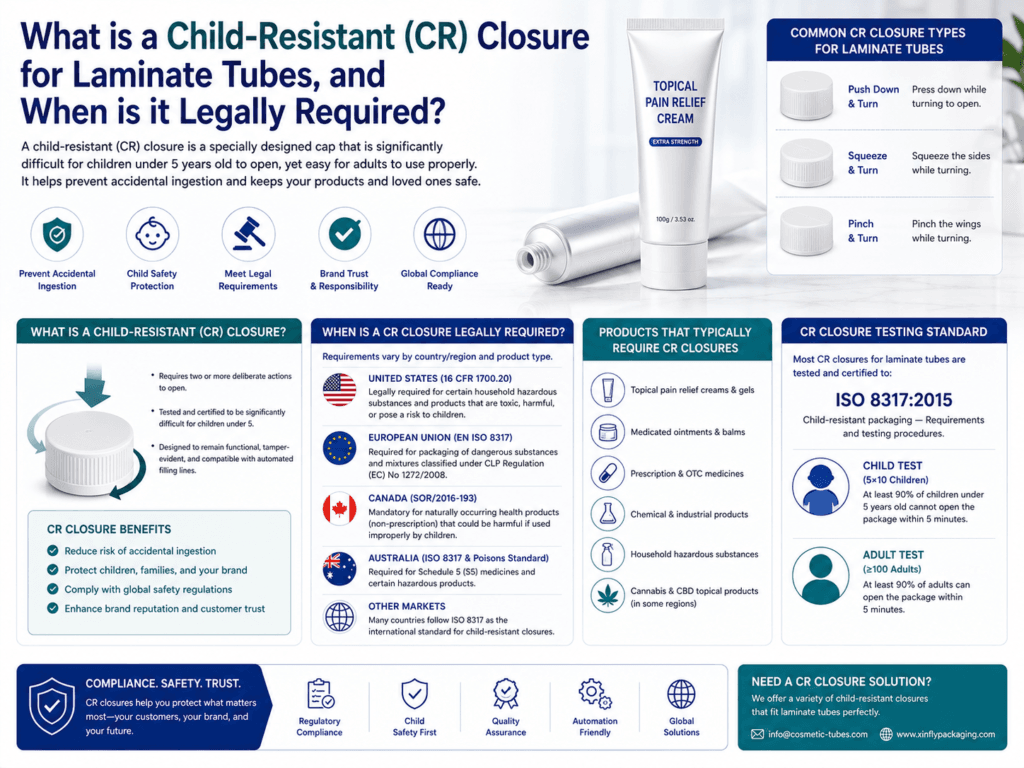
A child-resistant (CR) closure for laminate tubes is a safety closure designed to make the tube significantly difficult for children to open while remaining usable for adults. For laminate tubes such as ABL, PBL, and barrier toothpaste or functional skincare tubes, CR closures are usually designed as push-and-turn caps, squeeze-and-turn caps, two-piece safety caps, or special locking closures matched to the tube neck.
CR closures are not required for every cosmetic or personal care tube. They are legally required only when the product, formula, active ingredient, hazard classification, or target market regulation requires child-resistant packaging. Because laws differ by country and product category, brands should confirm requirements with a regulatory professional before launching products such as medicated toothpaste, OTC skincare, strong chemical formulas, hydrocarbon-containing products, or hazardous consumer products.
Quick Answer
For laminate tubes, a CR closure is usually needed when the formula could create poisoning, chemical injury, aspiration, or misuse risk if accessed by children. Ordinary facial cleanser, hand cream, toothpaste, or cosmetic cream usually does not automatically require a CR cap, but products with regulated drugs, hazardous ingredients, strong actives, solvents, hydrocarbons, nicotine, certain essential oils, or chemical classifications may require special packaging depending on the selling market.
| Product Type | CR Closure Usually Required? | Reason |
|---|---|---|
| Standard cosmetic cream | Usually no | Not normally treated as a high-risk product by packaging safety rules |
| Regular toothpaste | Usually no, unless special regulated ingredients apply | Depends on formula, market, and active ingredient classification |
| OTC medicated cream or drug product | May be required | Drug and active ingredient rules may trigger special packaging |
| Hydrocarbon-containing cosmetic or household product | May be required | Some hydrocarbon-containing products may fall under child-resistant packaging rules |
| Hazard-classified chemical product | Often required in some markets | Hazard classification can trigger CR packaging obligations |
What Does “Child-Resistant” Mean?
Child-resistant packaging is designed to be difficult for children under five to open, but still reasonably accessible for adults. In the U.S., the Consumer Product Safety Commission describes special packaging as packaging that is significantly difficult for children under five to open but not difficult for normal adults to use. CPSC FAQ materials state that child-resistant performance testing includes child and adult-use criteria, such as children not opening the package within specified test periods.
Important: “Child-resistant” does not mean “child-proof.” It reduces the chance of accidental opening, but adult supervision, correct labeling, and safe storage are still necessary.
Common CR Closure Structures for Laminate Tubes
| CR Closure Type | How It Works | Best Application |
|---|---|---|
| Push-and-turn cap | User must press down and rotate at the same time | Medicated creams, strong active formulas, chemical products |
| Squeeze-and-turn cap | User squeezes side panels while turning the cap | Small tubes, functional skincare, controlled-use products |
| Two-piece safety cap | Outer cap rotates separately unless pressure is applied correctly | Higher safety requirement and premium regulated packaging |
| Locking flip or snap mechanism | Requires an additional action before opening | Special projects where one-hand use is less important |
| Custom tube-neck CR system | Cap and laminate tube neck are engineered together | High-volume projects requiring tested CR certification |
How CR Closures Differ From Standard Screw Caps
A standard screw cap opens by rotating in one direction. A CR closure requires at least two coordinated actions, such as pushing and turning or squeezing and turning. This makes it more difficult for young children to open the package accidentally.
| Feature | Standard Screw Cap | Child-Resistant Closure |
|---|---|---|
| Opening action | Simple twist | Push-turn, squeeze-turn, or multi-step action |
| Consumer convenience | Higher convenience | Less convenient, but safer for regulated products |
| Tooling complexity | Lower | Higher due to locking structure |
| Testing requirement | Leakage and fit testing | Leakage, torque, child-resistance, and adult-use testing |
| Cost | Lower | Higher due to mold, assembly, testing, and compliance documentation |
When Is a CR Closure Legally Required?
A CR closure may be legally required when a product falls under specific child-resistant packaging regulations in the target market. In the United States, the Poison Prevention Packaging Act is administered by the CPSC and covers certain household substances and regulated products. CPSC materials also note that some cosmetics or household products containing hydrocarbons can be covered by CR packaging rules. In the EU and UK, child-resistant fastening requirements are commonly connected to hazardous substance or mixture classification under CLP-style rules for products sold to the general public.
| Trigger Factor | Why It May Require CR Packaging | What Brands Should Do |
|---|---|---|
| Regulated active ingredient | Some OTC, drug, or medicated products have special packaging requirements | Check product category and active ingredient rules in the target country |
| Hazard classification | Toxic, corrosive, aspiration hazard, or other classifications may trigger CR rules | Review SDS, CLP/GHS classification, and local packaging requirements |
| Hydrocarbon-containing formula | Certain hydrocarbon-containing products may require CR packaging | Confirm whether the ingredient level and product type fall under regulation |
| High-risk consumer product | Products that can harm children if swallowed or misused may need safety packaging | Ask a regulatory expert before choosing standard caps |
| Retailer or platform requirement | Some retailers may require CR packaging even beyond legal minimums | Confirm buyer, marketplace, and distributor packaging specifications |
Products That May Need Extra Review
Not every item in these categories automatically requires a CR closure, but they should be reviewed carefully before packaging selection. The final decision depends on formula composition, concentration, hazard classification, intended use, age group, claims, and selling market.
- Medicated toothpaste: Especially if regulated actives or special claims are involved.
- OTC acne cream or medicated skincare: May fall under drug or special packaging rules.
- Strong exfoliating or chemical peel formulas: Hazard and irritation classification should be checked.
- Hydrocarbon-containing oils or removers: Some products may trigger CR packaging requirements.
- Nail care or adhesive-related products: Solvent or chemical hazard classification may apply.
- Household chemical tubes: Cleaning, repair, or chemical products need regulatory review.
Why Laminate Tubes Need Special CR Closure Engineering
Laminate tubes such as ABL and PBL are often used for toothpaste, medicated creams, pharmaceutical creams, barrier-sensitive formulas, and chemical-resistant packaging. When adding a CR closure, the cap must be matched to the laminate tube head, neck thread, shoulder strength, sealing land, and torque requirement. If the tube neck is too soft or the cap torque is too high, the thread may strip or the shoulder may deform.
| Engineering Point | Why It Matters | Risk If Ignored |
|---|---|---|
| Neck thread design | CR caps often require stronger thread engagement | Cross-threading, stripping, poor closure function |
| Shoulder strength | Push-turn caps apply downward force | Shoulder deformation or leakage |
| Torque window | CR cap must open and close within a controlled force range | Too easy for children or too difficult for adults |
| Sealing land | Closure must still prevent leakage and formula drying | Leakage, evaporation, formula contamination |
| Filling compatibility | Formula residue on the neck affects cap function | Failed CR operation, poor seal, messy closure area |
CR Closure Testing Requirements
CR closures must be validated as a complete package system, not as a loose cap alone. The tested package should include the actual laminate tube, actual neck finish, actual cap, actual formula or filled simulation, actual label or instructions, and intended opening method.
| Test | Purpose | What to Check |
|---|---|---|
| Child-resistance test | Confirms that children cannot easily open the package | Opening success rate under required protocol |
| Adult-use test | Confirms adults can open and properly reclose the package | Senior-friendly or adult-friendly usability |
| Application torque test | Checks capping force during production | Overtightening, thread stripping, cap function |
| Removal torque test | Checks opening force after storage and transport | Too easy, too hard, unstable opening feel |
| Leakage test | Confirms closure seal performance | Cap leakage, neck leakage, tail-seal leakage |
| Repeated open-close test | Checks consumer-use durability | Locking failure, thread wear, cap loosening |
| Aging and compatibility test | Checks formula impact over time | Stress cracking, swelling, torque change, seal degradation |
CR Closure vs. Tamper-Evident Closure
Child-resistant and tamper-evident are not the same. A CR closure is designed to reduce child access. A tamper-evident feature shows whether the package has been opened or interfered with. Some regulated products may need one, the other, or both depending on market and product type.
| Feature | Child-Resistant Closure | Tamper-Evident Feature |
|---|---|---|
| Main purpose | Helps prevent children from opening the package | Shows whether the package has been opened |
| Opening method | Requires special action such as push-and-turn | May use seal, band, foil, label, or breakable ring |
| Regulatory trigger | Hazard, drug, poison prevention, or chemical safety rules | Often linked to OTC drugs, pharma, food, or retailer requirements |
| Can be combined? | Yes | Yes, CR + tamper-evident may be used together |
Impact on User Experience and Branding
CR closures improve safety but can reduce convenience. For cosmetic and personal care brands, this means the closure must be designed carefully so adults can still open it comfortably. Clear opening instructions, ergonomic cap shape, textured grip, and controlled torque are important for consumer satisfaction.
- Opening instruction: Add clear “Push Down & Turn” or similar directions if required.
- Grip texture: Ribbed or matte cap sides help adults operate the cap.
- Cap size: Very small caps may be harder for adults to open.
- Torque control: Too-tight caps may create complaints or product returns.
- Brand look: CR caps can still be customized with color, finish, and logo decoration.
Common Mistakes to Avoid
| Mistake | Problem | Better Approach |
|---|---|---|
| Assuming all cosmetics do not need CR packaging | Some cosmetics or personal care products may trigger CR rules because of ingredients or hazard classification | Review formula and market regulation before launch |
| Assuming a CR cap alone means compliance | CR performance applies to the complete package system | Test the actual cap and tube together |
| Using CR cap on a weak tube neck | Push-turn force may deform the laminate tube shoulder or strip threads | Engineer tube neck, shoulder, and cap as one system |
| Ignoring adult usability | Consumers may complain if the cap is too difficult to open | Validate adult-use performance and removal torque |
| Skipping documentation | Retailers or regulators may request proof | Keep testing reports, drawings, material specifications, and compliance files |
Best Practical Recommendation
If your laminate tube contains a standard cosmetic formula, a CR closure may not be necessary. If your product contains regulated actives, hazardous ingredients, hydrocarbons, strong chemicals, OTC drug claims, or high-risk formulations, the packaging should be reviewed for child-resistant requirements in the target market.
For products that need CR packaging, select the cap and laminate tube together. Confirm tube neck strength, shoulder design, thread engagement, sealing land, application torque, removal torque, leakage resistance, adult usability, child-resistance testing, and regulatory documentation before mass production.
Summary
A child-resistant closure for laminate tubes is a safety cap system designed to make the package difficult for children to open while still usable for adults. Common structures include push-and-turn, squeeze-and-turn, two-piece safety caps, and custom locking closures. They are used when the product’s formula, hazard classification, active ingredient, or target market regulation requires child-resistant packaging.
CR closures are legally required only for certain regulated or hazardous products, not for every cosmetic tube. Brands should verify requirements based on the product formula, selling country, SDS or hazard classification, claims, and retailer requirements before choosing a standard cap or CR cap.
Learn more: Laminate Tubes, ABL Tubes, PBL Tubes, Caps & Closures, Screw Cap Tubes, Quality Assurance.
Need CR Closures for Laminate Tubes?
Xinfly Packaging helps brands develop laminate tubes with matched screw caps, CR closure options, tube-neck engineering, sealing control, torque testing, leakage testing, and documentation support for regulated toothpaste, skincare, personal care, and functional tube packaging projects.