
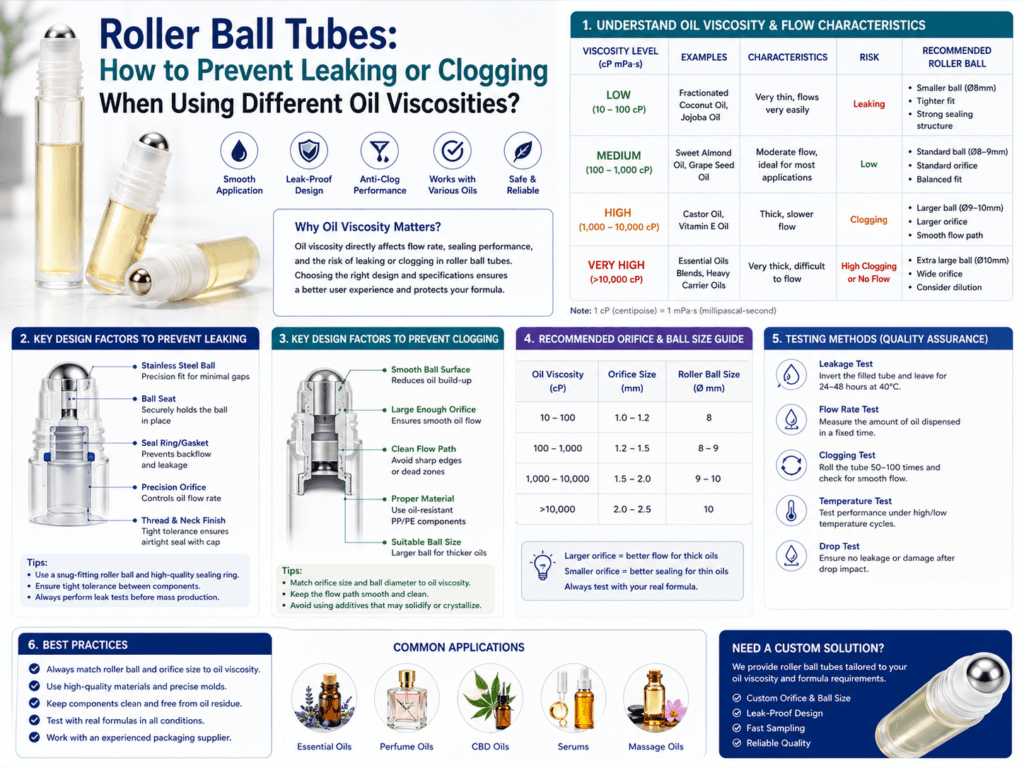
To prevent roller ball tubes from leaking or clogging with different oil viscosities, brands must match the roller ball size, ball-seat clearance, housing material, tube softness, formula flow behavior, filling volume, cap seal, and compatibility testing. A low-viscosity facial oil may leak if the clearance is too large, while a thick essential-oil blend or serum oil may clog or roll poorly if the clearance is too tight.
Roller ball tubes are often used for eye serum, lip oil, fragrance oil, essential oil blends, cuticle oil, cooling eye cream, treatment gel, and massage oil. Because the formula is dispensed by the rotation of the ball, the package must balance two opposite requirements: the ball must move freely enough to dispense product, but tightly enough to prevent uncontrolled leakage.
Quick Answer
For low-viscosity oils, use a tighter ball-seat fit, strong cap sealing, controlled filling volume, and leakage testing. For medium-viscosity oils, use a balanced roller clearance with smooth ball rotation. For high-viscosity oils, use a slightly larger flow gap, larger ball diameter, softer tube body, and clogging tests under cold-temperature conditions.
| Oil Viscosity | Main Risk | Roller Ball Design Direction |
|---|---|---|
| Low-viscosity oil | Leaking, dripping, excessive dosage | Tighter ball-seat clearance, better cap seal, smaller flow channel |
| Medium-viscosity oil | Unstable dosage if ball fit is not balanced | Standard roller fit with smooth rotation and moderate clearance |
| High-viscosity oil | Clogging, poor rolling, difficult dispensing | Larger ball or slightly larger clearance, softer tube, flow testing |
| Oil with particles or shimmer | Ball blockage, uneven rolling, residue buildup | Avoid large particles, test sedimentation, consider larger flow path |
Why Roller Ball Tubes Leak or Clog
Roller ball packaging depends on a precise relationship between the ball, seat, housing, formula, and cap. If the gap around the ball is too wide, thin oils can leak. If the gap is too narrow, thick oils cannot pass smoothly. If formula dries, crystallizes, separates, or contains particles, the roller may stop moving.
| Problem | Likely Cause | Visible Symptom |
|---|---|---|
| Leaking around roller ball | Clearance too large or formula too thin | Oil residue around ball, cap contamination, product loss |
| Leaking from cap area | Weak inner seal or oil migration into thread | Oil inside cap or on tube shoulder |
| Ball does not roll | Formula too thick, dried residue, poor ball-seat geometry | No product dispensing or rough rolling feel |
| Intermittent dispensing | Air lock, inconsistent viscosity, partial clogging | Product comes out unevenly |
| Formula oozes after use | Low viscosity, warm temperature, overfilling, poor cap seal | Messy applicator and leakage in travel bags |
Key Roller Ball Components to Control
| Component | Function | Compatibility Requirement |
|---|---|---|
| Roller ball | Transfers oil onto skin by rotation | Size, weight, surface smoothness, and material must match formula flow |
| Ball seat | Holds the ball and controls flow clearance | Must be tight enough to prevent leakage but loose enough for rolling |
| Housing / insert | Connects roller system to tube neck | Must fit tube neck securely without oil leakage |
| Inner cap seal | Protects roller ball during storage and travel | Must prevent oil migration and cap contamination |
| Tube body | Stores formula and supports squeezing if needed | Softness and barrier structure must suit oil formula |
Choosing Roller Ball Size by Formula Viscosity
Roller ball size affects dosage, rolling feel, application area, and leakage risk. A small ball gives more precise application, while a larger ball spreads product faster and may help thicker formulas move more smoothly. For eye serum or spot treatment, a small or medium ball is common. For body oil, massage oil, or cooling applicator tubes, a larger ball may feel more premium.
| Roller Ball Direction | Best Use | Risk to Check |
|---|---|---|
| Small roller ball | Eye serum, lip oil, spot treatment, precise dosage | May clog with thick oils or particles |
| Medium roller ball | Most facial oils, cuticle oils, essential-oil blends | Must balance leakage and smooth rolling |
| Large roller ball | Body oil, massage oil, cooling eye treatment, premium applicator | May over-dispense low-viscosity oils if clearance is not controlled |
Ball Material Selection
The roller ball material affects skin feel, weight, chemical resistance, and formula compatibility. Stainless steel feels cool and premium, while plastic balls are lightweight and cost-effective. Glass or ceramic balls can provide a smooth application feel but require careful impact and fit testing.
| Ball Material | Advantages | Compatibility Note |
|---|---|---|
| Stainless steel ball | Cooling sensation, premium feel, smooth rolling | Check corrosion resistance, fit tolerance, and formula compatibility |
| Plastic ball | Lightweight, lower cost, easier color matching | Must resist oils, fragrance, and deformation |
| Glass ball | Smooth surface and clean premium look | Needs drop and impact testing |
| Ceramic ball | Smooth touch and high-end sensory effect | Check dimensional tolerance and brittleness |
Low-Viscosity Oils: How to Prevent Leaking
Low-viscosity oils flow easily and can leak through small gaps. These formulas are common in facial oils, fragrance oils, light essential oil blends, and some lip oils. The roller system must create enough resistance to prevent product from escaping when the tube is stored upside down, squeezed, warmed, or carried in a bag.
- Use tighter ball-seat clearance: Reduces uncontrolled oil flow around the ball.
- Improve cap inner seal: Prevents oil from spreading into the cap or thread area.
- Avoid overfilling: Extra headspace reduces pressure-driven leakage.
- Control tube softness: Too soft a tube may squeeze oil out accidentally.
- Test warm storage: Thin oils may leak faster at high temperature.
- Run inverted storage tests: Confirms leakage resistance during shipping and consumer use.
Medium-Viscosity Oils: How to Balance Flow and Control
Medium-viscosity oils usually provide the best balance for roller ball tubes. They move through the ball-seat gap without excessive leakage and provide a smooth application feel. However, the final result still depends on formula stability, temperature changes, and applicator geometry.
| Design Focus | Why It Matters |
|---|---|
| Stable ball rotation | Ensures consistent product transfer to skin |
| Moderate flow gap | Prevents both dry rolling and over-dispensing |
| Good cap seal | Protects against leakage during transport |
| Formula stability | Prevents separation, sedimentation, or viscosity change |
High-Viscosity Oils: How to Prevent Clogging
High-viscosity oils, oil gels, thick serums, balms, and formulas with waxy or film-forming ingredients can clog around the roller ball. The consumer may need to press harder, roll repeatedly, or squeeze the tube, which can damage the applicator or create sudden product bursts.
- Use a larger ball or larger flow path: Helps thick formulas move more easily.
- Choose a softer tube body: Supports controlled squeeze assistance without excessive force.
- Avoid particles that exceed the flow gap: Large shimmer, beads, or wax crystals may block the ball.
- Test cold-temperature dispensing: Oils may become thicker in cold environments.
- Check residue drying: Formula left around the ball may thicken after repeated use.
- Review formula rheology: Some formulas thin under shear, while others remain difficult to dispense.
Formula Ingredients That Increase Leakage or Clogging Risk
| Formula Ingredient / Feature | Risk | Packaging Adjustment |
|---|---|---|
| Essential oils | Can migrate into plastics and affect seals | Use compatible tube, insert, and cap materials |
| Fragrance oils | May swell plastic or weaken cap components | Run formula compatibility and aging tests |
| High ester content | May behave like mild solvent toward some plastics | Check stress cracking and material resistance |
| Waxes or balms | Can solidify or clog around the ball | Use larger flow path and cold dispensing test |
| Shimmer or pigments | Can settle or block the roller seat | Control particle size and run sedimentation tests |
| Botanical extracts | May separate or leave residue | Test storage stability and repeated-use cleanliness |
Tube Material and Barrier Structure
Oil-based formulas can interact with plastic tube walls. For light oils, essential oil blends, fragrance-rich oils, or active oil serums, the tube material should be selected carefully. Standard PE may work for some formulas, while 5-layer EVOH or other barrier structures may be recommended when fragrance retention, oil migration, or formula protection is critical.
| Tube Structure | Best Use | Key Test |
|---|---|---|
| Standard PE tube | Basic oils and low-risk formulas | Oil compatibility, leakage, squeeze recovery |
| 2-layer PE tube | Better body stability and soft squeeze feel | Dispensing force and filled storage |
| 5-layer EVOH tube | Fragrance-rich oils, essential oil blends, active skincare oils | Barrier performance, formula stability, seal compatibility |
| Soft-touch decorative tube | Premium skincare and treatment oils | Oil resistance of surface coating and cap area |
Cap Seal and Travel Leakage Control
Roller ball tubes often fail not only at the ball, but also inside the cap. A good cap must protect the ball, prevent oil residue from spreading, and resist leakage during travel. For oil formulas, the cap should include a stable inner seal or contact surface that does not deform after repeated use.
| Cap Design Point | Function | Failure If Poorly Designed |
|---|---|---|
| Inner sealing plug | Helps block oil migration during storage | Oil accumulates inside cap |
| Thread fit | Holds cap securely on tube neck | Cap loosening and leakage |
| Cap clearance above ball | Prevents excessive pressure on roller ball | Ball deformation, poor rolling, leakage |
| Cap material | Must resist oil and fragrance exposure | Stress cracking, swelling, poor seal |
Filling Parameters for Roller Ball Tubes
Filling control is important because overfilling can increase internal pressure and leakage risk. Thick oils may trap air during filling, while thin oils may wet the neck and interfere with insert fitting. The roller insert should be assembled cleanly and consistently.
| Filling Parameter | Why It Matters | Recommended Control |
|---|---|---|
| Fill volume | Too much product increases leakage pressure | Maintain enough headspace |
| Air bubbles | Air expansion can push oil out | Use controlled filling and deaeration if needed |
| Neck cleanliness | Oil residue prevents insert or cap from sealing | Keep neck and seat area clean during filling |
| Insert assembly pressure | Too much pressure may deform the roller housing | Validate insertion force and alignment |
| Storage orientation | Some formulas leak when stored upside down | Run upright, horizontal, and inverted storage tests |
Recommended Testing Plan
| Test | Purpose | What to Check |
|---|---|---|
| Dispensing test | Checks whether the ball transfers formula smoothly | Dry rolling, over-dispensing, uneven flow |
| Inverted leakage test | Checks oil leakage during storage | Oil around ball, cap contamination, thread leakage |
| Temperature cycling test | Checks viscosity change under hot/cold conditions | Hot leakage, cold clogging, ball sticking |
| Low-temperature rolling test | Checks thickened oil performance in cold conditions | Hard rolling, no dispensing, clogging |
| High-temperature storage test | Accelerates oil migration and leakage risk | Leaking, swelling, cap seal failure |
| Repeated-use test | Simulates daily application | Ball wear, residue buildup, inconsistent dosage |
| Drop and compression test | Simulates shipping and travel handling | Insert looseness, cap cracking, leakage |
| Formula compatibility test | Checks oil interaction with tube, ball, insert, and cap | Swelling, discoloration, stress cracking, odor change |
Common Mistakes to Avoid
- Using the same roller insert for all oils: Thin oils and thick oils need different flow control.
- Ignoring temperature: Oils can thin at high temperature and thicken or clog at low temperature.
- Approving only empty components: The real formula must be tested inside the actual tube.
- Overfilling the tube: Too little headspace increases leakage pressure.
- Ignoring formula particles: Shimmer, wax crystals, or botanical particles may block the roller seat.
- Using incompatible plastics: Essential oils, fragrance oils, and esters can stress some cap or insert materials.
Best Practical Recommendation
For roller ball tubes, choose the applicator system after testing the real oil formula. Low-viscosity oils need tighter ball-seat control and stronger cap sealing. Medium-viscosity oils usually work best with a balanced standard roller system. High-viscosity oils need larger flow clearance, smoother ball movement, softer tube body, and cold-temperature clogging tests.
For essential-oil blends, fragrance oils, active skincare oils, and oil-rich serums, confirm material compatibility for the tube, roller ball, insert, cap, seal, and decoration. The final design should pass leakage, rolling, clogging, temperature cycling, high-temperature aging, drop, compression, and repeated-use tests before mass production.
Summary
Roller ball tubes leak when the ball-seat clearance is too large, the cap seal is weak, the oil is too thin, the tube is overfilled, or the package is exposed to heat and pressure. They clog when the oil is too thick, the ball gap is too tight, particles or waxes block the seat, or the formula thickens in cold conditions.
To prevent leaking and clogging, brands should match oil viscosity with roller ball size, ball-seat clearance, tube softness, insert design, cap seal, filling volume, and compatibility testing. Final approval should always be based on filled samples using the actual formula.
Learn more: Custom Eye Serum Tube with Steel Rollerball, Eye Cream Tubes, Eye Cream Tubes Manufacturer, Eye Cream Tube with Cooling Metal Applicator, Essential Oil Migration in Plastic Tubes, Quality Assurance.
Need Roller Ball Tubes for Oil-Based Skincare?
Xinfly Packaging helps beauty brands develop roller ball tubes with suitable ball size, ball material, insert fit, tube softness, cap seal, oil compatibility, leakage control, and clogging tests for eye serum, lip oil, fragrance oil, essential oil, cuticle oil, and treatment skincare packaging.