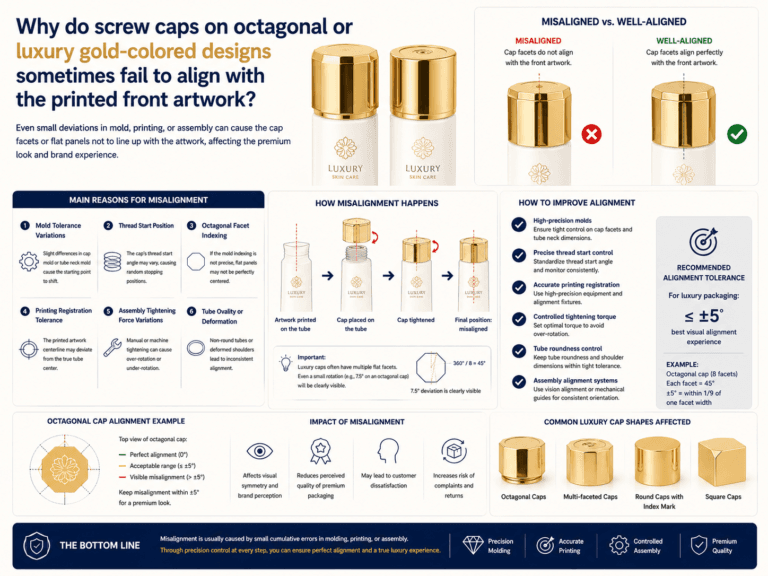
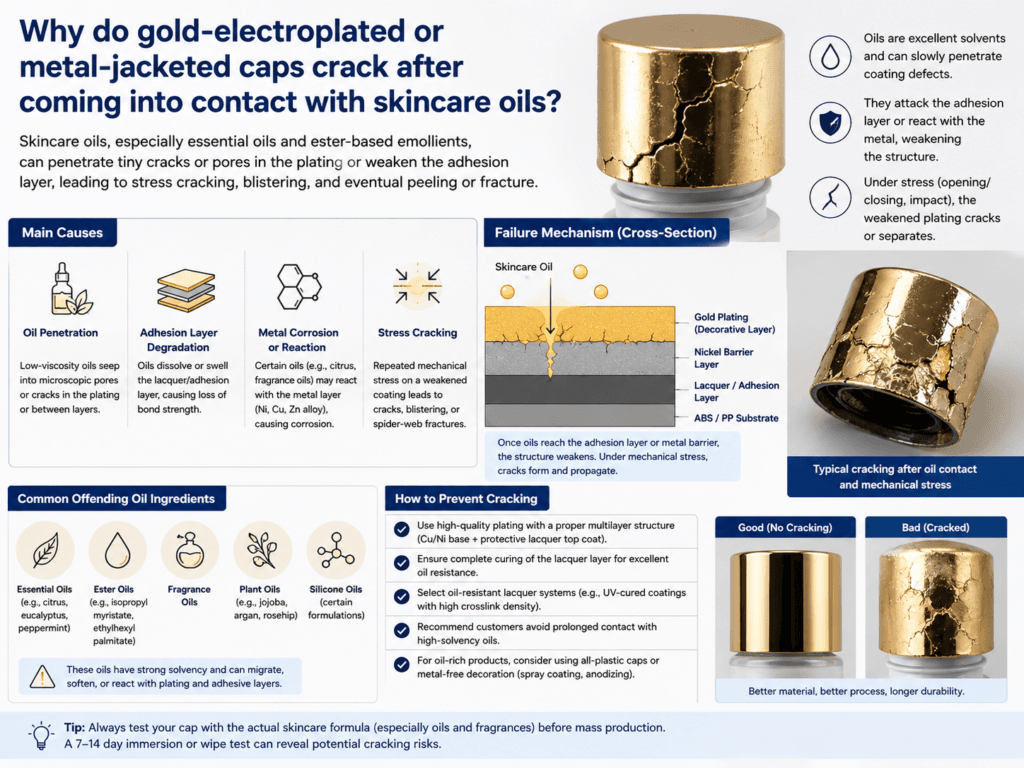
Gold-electroplated or metal-jacketed caps can crack after contact with skincare oils because oils, fragrance components, ester solvents, essential oils, or active ingredients may attack the plastic base, weaken adhesives, create stress cracking, or cause expansion mismatch between the metal layer and plastic cap body. The visible crack may appear on the outer metallic shell, plating layer, cap skirt, hinge area, thread area, or the plastic part underneath the metal decoration.
This problem is especially common when a luxury cap is designed with a rigid metal jacket over a PP, ABS, SAN, or other plastic inner cap. The metal surface looks premium, but the real closure performance still depends on the plastic substrate, adhesive system, cap structure, plating layer, formula compatibility, torque stress, and storage conditions.
Quick Answer
Metallic caps crack after contact with skincare oils mainly because of chemical stress cracking, plastic swelling, adhesive failure, coating brittleness, torque stress, and thermal expansion mismatch. Oil-rich formulas, essential oils, fragrance oils, sunscreens, retinol creams, cleansing balms, and massage oils should always be tested with the actual cap before mass production.
| Cause | What Happens | Visible Result |
|---|---|---|
| Oil attacks plastic substrate | Plastic cap body softens, swells, or loses mechanical strength | Cracks around thread, skirt, hinge, or cap edge |
| Stress cracking | Formula chemicals weaken plastic under tension | Fine hairline cracks or sudden cap splitting |
| Adhesive weakening | Oil migrates between metal jacket and plastic cap | Metal sleeve loosens, lifts, or cracks |
| Plating brittleness | Rigid metallic layer cannot flex with plastic movement | Plating cracks, flakes, or creates spider-web lines |
| Overtightening | Cap is already under high mechanical stress | Cracking appears faster after oil exposure |
Why Oils Are Risky for Decorative Caps
Many skincare oils are not just simple oils. They may contain fragrance, essential oils, esters, UV filters, botanical extracts, surfactants, or active ingredients. These components can migrate into plastic, soften the surface, reduce stress resistance, or weaken the bond between decorative layers.
| Formula Component | Risk to Cap | Possible Failure |
|---|---|---|
| Essential oils | Small volatile molecules can penetrate plastic or coating interfaces | Stress cracking, odor absorption, coating lifting |
| Fragrance oils | Can interact with plastic resin, lacquer, or adhesive | Cracks, whitening, peeling, loss of gloss |
| Ester emollients | May behave like mild solvents toward some plastics | Softening, swelling, cap deformation |
| Cleansing oils or balms | Long oil contact can attack cap surfaces and seals | Metal jacket looseness, cap cracking, leakage |
| Chemical UV filters | Some sunscreen ingredients can be aggressive to plastics and coatings | Stress cracking, discoloration, coating damage |
Cap Structure: Where Cracking Usually Starts
Gold-electroplated and metal-jacketed caps are multi-component decorative closures. They may include an inner plastic cap, an outer metal sleeve, adhesive or mechanical locking points, plated coating, lacquer, and sometimes an inner plug or liner. Cracking usually starts where stress and chemical contact meet.
| Cap Area | Why It Is Vulnerable | Common Symptom |
|---|---|---|
| Thread area | High torque stress during closing and opening | Thread cracking, stripped thread, cap looseness |
| Cap skirt | Thin wall plus metal sleeve pressure | Vertical cracks or split lines |
| Cap edge | Oil residue can collect at the edge | Peeling, lifting, plating cracks |
| Hinge area | Repeated flexing and stress concentration | Flip-top cracking or hinge failure |
| Metal jacket bonding area | Oil can weaken adhesive or interface bonding | Loose sleeve, rattling, jacket separation |
Chemical Stress Cracking Explained
Chemical stress cracking happens when a plastic part is under mechanical stress and exposed to a chemical that weakens its surface or internal structure. The cap may look perfect before filling, but after oil contact, storage, shipping, or repeated opening, small cracks can grow quickly.
- Stress source: Capping torque, thread pressure, metal sleeve pressure, shrinkage, or snap-fit stress.
- Chemical source: Oils, fragrance, solvents, ester emollients, UV filters, or active ingredients.
- Time factor: Cracks may appear after days, weeks, or months, not immediately.
- Heat factor: High temperature accelerates migration, softening, and crack growth.
- Result: Fine cracks, cap splitting, plating peeling, leakage, or poor opening performance.
Engineer’s note: A metallic cap failure may look like a plating problem, but the root cause is often the plastic substrate or adhesive system underneath the gold finish.
Electroplated Cap vs. Metal-Jacketed Cap
| Cap Type | Structure | Main Risk With Oils |
|---|---|---|
| Gold-electroplated plastic cap | Plastic cap with plated metallic decorative layer | Plating cracks if substrate swells, flexes, or stress cracks |
| Metal-jacketed cap | Plastic inner cap covered by aluminum or metal outer sleeve | Adhesive failure, sleeve loosening, expansion mismatch |
| Metallized cap with lacquer | Plastic cap with vacuum metallization and protective coating | Lacquer lifting, discoloration, oil penetration |
| Solid plastic metallic-color cap | Plastic cap with metallic masterbatch or coating | Usually lower cracking risk, but less premium metal effect |
Why Metal and Plastic Expansion Mismatch Matters
Plastic and metal expand and contract differently under heat and cold. If the product is stored in hot warehouses, shipped by sea container, exposed to bathroom humidity, or carried in travel bags, temperature cycling can create stress between the metal jacket and plastic inner cap. If oil also migrates into the interface, cracking or separation can happen faster.
| Condition | Effect on Cap | Possible Result |
|---|---|---|
| High temperature storage | Plastic softens and expands more than metal | Metal jacket stress, adhesive weakening, cracks |
| Cold-to-hot cycling | Repeated expansion and contraction | Plating microcracks or jacket loosening |
| Oil residue at cap edge | Oil migrates into bond line or coating edge | Peeling, edge cracks, discoloration |
| Overtightened cap | Plastic is already under high stress | Faster cracking after formula exposure |
Formula Types That Need Extra Compatibility Testing
| Formula Type | Why It Needs Extra Testing | Recommended Cap Direction |
|---|---|---|
| Cleansing oil / cleansing balm | Long-term oil contact and high solvent-like load | Avoid weak plating; use compatible PP cap or tested metal jacket |
| Essential-oil cream | Volatile molecules can migrate into plastic and coating layers | Use barrier tube and oil-resistant cap system |
| Sunscreen | UV filters and oils may stress plastics and coatings | Test cap material, torque, and coating stability |
| Retinol or active skincare | Often contains oils, solvents, or sensitive actives | Use tested cap resin and protective sealing design |
| Massage oil or body oil | High oil exposure around cap and thread | Prefer highly compatible closure with strong leakage control |
How to Prevent Metallic Cap Cracking
| Prevention Method | How It Helps |
|---|---|
| Choose oil-compatible cap resin | Reduces substrate swelling and stress cracking |
| Use tested plating or metallization system | Improves coating adhesion and flexibility |
| Improve adhesive or mechanical locking | Prevents metal jacket separation after oil contact |
| Control capping torque | Reduces mechanical stress before chemical exposure |
| Design better cap seal | Prevents oil from entering the thread, jacket edge, or coating interface |
| Run filled aging tests | Confirms real long-term performance with actual formula |
Recommended Compatibility Tests
The cap should be tested with the actual formula, actual tube, actual filling condition, and actual storage scenario. A visual sample approval is not enough for oil-rich skincare products because chemical stress cracking often appears after storage.
| Test | Purpose | What to Check |
|---|---|---|
| Formula contact test | Checks direct oil effect on cap material and coating | Cracking, swelling, discoloration, softening, peeling |
| Accelerated aging test | Predicts long-term storage risk | Hairline cracks, coating lift, metal jacket loosening |
| High-temperature storage test | Accelerates oil migration and stress cracking | Cap deformation, adhesive failure, plating cracks |
| Temperature cycling test | Checks expansion mismatch between plastic and metal | Microcracks, sleeve movement, edge peeling |
| Torque test | Checks cap stress during assembly and consumer use | Overtightening, thread stress, removal torque change |
| Drop and compression test | Checks shipping durability after formula exposure | Cap cracking, metal denting, sleeve separation, leakage |
| Repeated open-close test | Checks durability during consumer use | Thread wear, hinge cracks, coating flakes, cap loosening |
Cap Material Selection Guide
| Cap Material / Finish | Oil Compatibility Direction | Design Note |
|---|---|---|
| PP cap | Often good for many cosmetic oils, but must be tested | Good basic closure option for tubes |
| ABS plated cap | Premium look but may need careful compatibility review | Stress cracking risk depends on formula and plating process |
| Metal-jacketed plastic cap | Premium appearance but interface risk exists | Test adhesive, sleeve fit, and temperature cycling |
| Aluminum cap | Can be premium but may need inner liner or coating | Check corrosion, denting, thread fit, and formula contact |
| Metallic-color plastic cap | Lower cracking risk than real metal jacket in some projects | Good cost-effective alternative if true metal feel is not required |
Design Improvements for Oil-Rich Skincare Tubes
- Use a stronger seal path: Prevent formula from reaching the cap thread or jacket edge.
- Avoid excessive torque: High torque increases stress cracking risk.
- Choose rounded cap edges: Sharp corners concentrate stress and coating cracks.
- Improve wall thickness balance: Very thin cap skirts crack more easily under stress.
- Use compatible adhesive: Metal-jacketed caps need oil-resistant bonding systems.
- Test before approval: Metallic appearance should not be approved before formula contact testing.
Common Mistakes to Avoid
| Mistake | Problem | Better Approach |
|---|---|---|
| Approving metallic caps based only on appearance | Gold finish may look perfect but fail after oil contact | Run filled compatibility and aging tests |
| Using the same cap for all formulas | Oil-rich formulas behave differently from water-based creams | Test each formula-cap combination separately |
| Ignoring capping torque | Overtightening creates stress that accelerates cracking | Define application and removal torque windows |
| Letting formula residue stay around the cap | Oil residue attacks coating edges and thread areas | Improve filling cleanliness, orifice design, and plug seal |
| Skipping heat aging | Cap may pass room-temperature tests but fail in hot storage | Use high-temperature and temperature-cycling validation |
Best Practical Recommendation
For skincare oils, oil-rich creams, sunscreen, cleansing balms, and essential-oil formulas, do not choose gold-electroplated or metal-jacketed caps based only on premium appearance. First confirm cap resin compatibility, plating adhesion, metal jacket bonding, cap torque, seal design, oil resistance, and high-temperature aging performance.
If the formula is highly oil-rich or contains aggressive fragrance, essential oils, ester emollients, or UV filters, a simpler PP cap, oil-resistant coated cap, or metallic-color plastic cap may sometimes perform better than a decorative metal-jacketed closure. The final decision should be based on real filled-tube testing.
Summary
Gold-electroplated or metal-jacketed caps crack after contact with skincare oils because oils and related formula components can migrate into the plastic substrate, weaken adhesives, attack coating interfaces, cause chemical stress cracking, or create expansion mismatch between metal and plastic layers. Mechanical stress from overtightening, cap threads, snap fits, and shipping compression can make the problem worse.
To prevent cracking, brands should use compatible cap materials, oil-resistant decoration systems, proper torque settings, strong cap sealing, clean filling control, and full compatibility testing with the real formula under aging, heat, temperature cycling, drop, compression, and repeated-use conditions.
Learn more: Caps & Closures, Screw Cap Tubes, Surface Finishing, Why Metallic Ink Loses Shine, Essential Oil Migration in Plastic Tubes, Quality Assurance.
Need Oil-Compatible Metallic Caps for Skincare Tubes?
Xinfly Packaging helps beauty brands evaluate gold caps, metal-jacketed caps, PP caps, cap torque, plug seals, oil compatibility, coating adhesion, leakage performance, and aging tests for premium skincare tube packaging.