
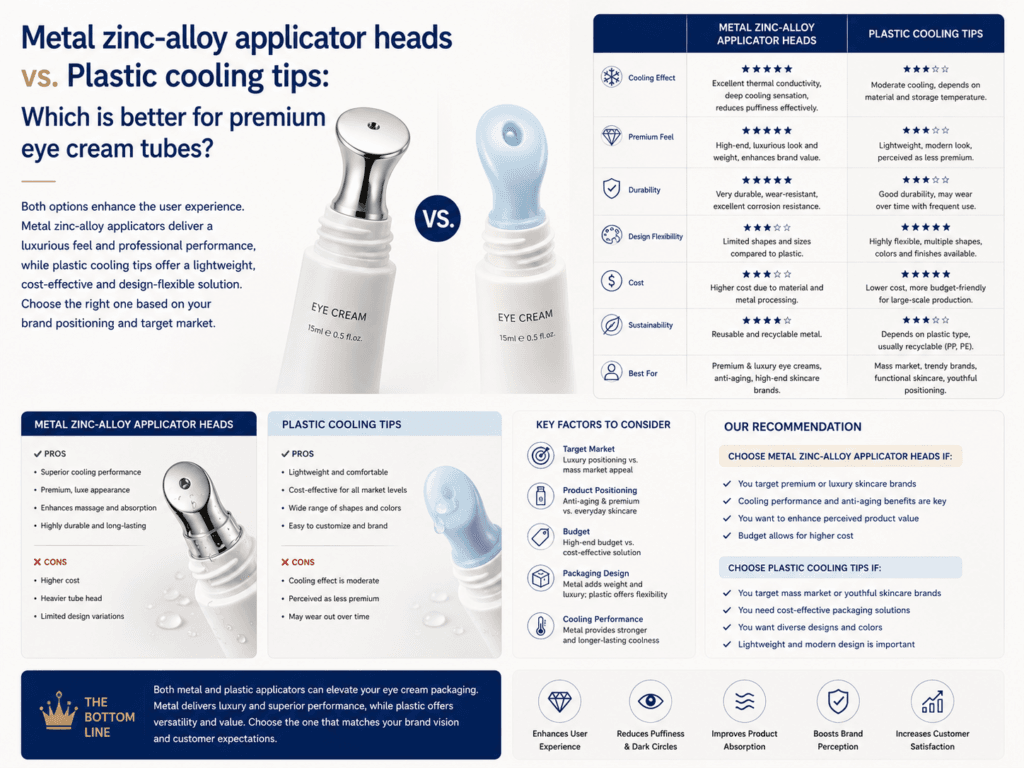
For premium eye cream tubes, metal zinc-alloy applicator heads usually create a stronger luxury feel and better instant cooling sensation than plastic cooling tips. However, plastic cooling tips are lighter, more cost-effective, easier to color-match, and often more suitable for large-volume or price-sensitive skincare lines.
The better choice depends on brand positioning, formula compatibility, target price, applicator shape, tube structure, decoration style, leakage risk, and consumer experience. A zinc-alloy applicator is ideal for high-end eye cream, eye serum, anti-aging cream, and cooling massage claims, while a plastic cooling tip may be more practical for mass-market eye care, travel-size tubes, and lightweight skincare packaging.
Quick Answer
Choose a metal zinc-alloy applicator head when the product needs premium texture, cooling massage, high perceived value, and a professional anti-aging image. Choose a plastic cooling tip when the project requires lower cost, lighter weight, easier customization, simpler recycling direction, or broader MOQ flexibility.
| Applicator Type | Best Advantage | Main Limitation | Best Use |
|---|---|---|---|
| Metal zinc-alloy applicator | Premium cold-touch feel and luxury appearance | Higher cost, heavier weight, needs compatibility testing | Luxury eye cream, anti-aging serum, premium skincare tube |
| Plastic cooling tip | Lightweight, cost-effective, flexible color customization | Cooling effect is weaker than metal | Mass-market eye cream, travel-size eye care, daily skincare |
What Is a Metal Zinc-Alloy Applicator Head?
A metal zinc-alloy applicator head is a molded or die-cast metal tip attached to the tube head or nozzle area. It is commonly used for eye cream tubes because metal feels naturally cool on the skin. This cooling sensation supports product claims such as depuffing, soothing, massage, firming, and premium eye treatment.
| Feature | Benefit for Eye Cream Tubes |
|---|---|
| Cold-touch surface | Creates instant cooling sensation around the eye area |
| Smooth curved shape | Supports gentle massage and controlled product spreading |
| Metallic appearance | Improves premium and clinical skincare positioning |
| Higher perceived value | Makes the tube feel more like a treatment device than simple packaging |
What Is a Plastic Cooling Tip?
A plastic cooling tip is usually made from PP, PE, ABS, or other suitable plastic materials. It can be molded into a smooth applicator shape, sometimes with a rounded tip, slanted nozzle, or small massage surface. It does not provide the same natural cooling sensation as metal, but it is lightweight, economical, and easier to customize in brand colors.
| Feature | Benefit for Eye Cream Tubes |
|---|---|
| Lightweight structure | Better for small tubes, travel-size tubes, and e-commerce shipping |
| Lower production cost | Suitable for larger volume and price-sensitive projects |
| Color customization | Can match tube body, cap, logo, or product line color |
| Flexible molding design | Can create long nozzles, soft shapes, or functional dispensing tips |
Premium Aesthetics Comparison
| Packaging Factor | Metal Zinc-Alloy Applicator | Plastic Cooling Tip |
|---|---|---|
| Luxury perception | Very strong; metallic touch feels premium | Moderate; depends on color, shape, and finish |
| Cooling effect | Strong natural cold-touch sensation | Weaker cooling feel, unless specially designed |
| Visual contrast | Metal finish creates a clear premium highlight | Can match brand color but less luxurious |
| Consumer ritual | Feels like a beauty tool or massage applicator | Feels more like a functional dispensing tip |
| Gift-set appeal | High | Medium |
Cooling Performance and Skin Feel
The main reason brands choose metal applicator heads is the cooling sensation. Metal transfers heat away from the skin faster than most plastics, so it feels cooler during application. This makes zinc-alloy applicators popular for products targeting tired eyes, puffiness, fine lines, and morning skincare routines.
| Skin-Feel Factor | Metal Applicator | Plastic Tip |
|---|---|---|
| Instant cooling | Stronger and more noticeable | Mild or limited |
| Massage effect | Smooth and weighted feel | Light and gentle feel |
| Pressure control | Better for premium massage positioning | Better for soft, simple application |
| Comfort around eye area | Excellent if edges are polished and rounded | Good if molding is smooth and burr-free |
Formula Compatibility Considerations
Eye cream formulas may contain peptides, caffeine, retinol derivatives, vitamin C derivatives, oils, fragrance, botanical extracts, preservatives, or acidic ingredients. The applicator head must not react with the formula, discolor, corrode, crack, or affect product stability.
| Formula Factor | Risk for Metal Applicator | Risk for Plastic Tip |
|---|---|---|
| Low pH or acidic formula | May need coating or compatibility confirmation | May stress some plastic materials over time |
| Oil-rich eye cream | May affect coating or adhesive if poorly designed | May cause swelling or stress cracking in unsuitable plastics |
| Fragrance or essential oil | May affect surface coating or bonding interface | May migrate into plastic and cause odor or cracking |
| Active skincare ingredients | Needs corrosion and stability testing | Needs extraction, swelling, and compatibility testing |
Engineer’s note: The applicator head should be tested with the real formula, not only with water or empty samples. Eye cream formulas can behave differently after heat aging, repeated use, and long-term contact with metal or plastic surfaces.
Leakage and Dispensing Control
Premium applicator heads must still dispense product cleanly. A beautiful metal tip can fail if the orifice is too large, the seal is weak, the cap does not protect the tip, or formula residue dries around the applicator. Plastic tips also need accurate molding and smooth flow paths to prevent clogging or messy dispensing.
| Design Point | Why It Matters | Recommended Control |
|---|---|---|
| Orifice size | Controls dosage and squeeze force | Match opening to formula viscosity and target application amount |
| Tip seal | Prevents leakage into the cap | Use tight cap fit, inner plug, or protective cap structure |
| Flow channel | Prevents clogging and uneven dispensing | Validate with real formula and repeated-use testing |
| Surface smoothness | Protects delicate eye-area skin | Polish metal tip or remove plastic burrs completely |
| Cap protection | Keeps applicator clean during storage and travel | Design cap clearance and inner sealing correctly |
Cost and MOQ Comparison
Metal zinc-alloy applicator heads usually require higher component cost, more complex assembly, surface finishing, polishing, coating, and compatibility testing. Plastic cooling tips are more cost-effective and easier to scale for large orders, especially when the brand needs multiple tube colors or smaller trial runs.
| Cost Factor | Metal Zinc-Alloy Applicator | Plastic Cooling Tip |
|---|---|---|
| Component cost | Higher | Lower |
| Tooling complexity | Medium to high | Low to medium |
| Assembly cost | Higher due to insert and fit control | Lower if molded as a simpler component |
| MOQ flexibility | Less flexible for custom shapes or finishes | More flexible for standard molds |
| Premium price support | Strong | Moderate |
Brand Positioning Guide
| Brand Positioning | Recommended Applicator | Reason |
|---|---|---|
| Luxury anti-aging eye cream | Metal zinc-alloy applicator | Supports premium claims, cooling massage, and high perceived value |
| Clinical eye serum | Metal or high-quality plastic tip | Metal feels professional; plastic can look clean and medical if designed well |
| Mass-market eye cream | Plastic cooling tip | Better cost control and easier large-volume production |
| Travel-size eye cream | Plastic tip or small metal applicator | Depends on weight, leakage, and target price |
| Gift set or premium skincare kit | Metal zinc-alloy applicator | Creates stronger unboxing and tactile experience |
Durability and User Safety
Eye-area packaging needs special attention because the applicator touches delicate skin. Both metal and plastic tips must be smooth, clean, stable, and safe during repeated use. Any sharp edge, burr, plating defect, corrosion point, or cracked plastic can damage consumer trust.
- Rounded surface: Applicator edges must be smooth and comfortable around the eye area.
- No burrs: Plastic tips must be free from molding flash and sharp edges.
- No plating defects: Metal tips should not peel, flake, discolor, or corrode.
- Secure assembly: Applicator head should not loosen during use or shipping.
- Clean cap protection: Cap should protect the applicator from dust and leakage.
- Repeated-use stability: Product should dispense smoothly over the full usage cycle.
Testing Before Mass Production
| Test | Purpose | What to Check |
|---|---|---|
| Formula compatibility test | Checks interaction between formula and applicator material | Corrosion, swelling, cracking, discoloration, odor change |
| Dispensing test | Confirms clean product flow through the applicator | Dosage, clogging, residue, squeeze force |
| Leakage test | Checks cap seal and applicator seal | Formula inside cap, tip leakage, shoulder leakage |
| Surface smoothness inspection | Protects eye-area user comfort | Burrs, sharp edges, plating defects, rough surface |
| Drop and compression test | Simulates shipping and consumer handling | Applicator loosening, cap cracking, leakage, deformation |
| Temperature cycling test | Checks hot/cold storage stability | Expansion mismatch, seal change, leakage, coating issues |
| Repeated-use test | Simulates daily application | Tip wear, clogging, cap fit, product residue buildup |
Common Mistakes to Avoid
- Choosing metal only for appearance: Metal applicators must pass formula compatibility and leakage tests.
- Ignoring tube weight balance: A heavy applicator can affect small tube handling and shipping cost.
- Using plastic tips without surface inspection: Burrs or rough edges are unacceptable for eye-area use.
- Forgetting cap clearance: The cap must protect the applicator without pressing too tightly on the tip.
- Skipping repeated-use testing: Formula residue can dry around the outlet and cause clogging.
- Approving empty samples only: Real formula flow and compatibility must be tested before production.
Best Practical Recommendation
For premium eye cream tubes, choose a metal zinc-alloy applicator head if the brand wants a strong cooling sensation, luxury tactile experience, anti-aging positioning, and higher perceived value. Choose a plastic cooling tip if the project prioritizes cost control, lightweight packaging, easier color matching, simpler structure, or large-volume production.
The final decision should be based on filled sample testing. Confirm formula compatibility, applicator smoothness, leakage resistance, cap protection, dispensing force, user comfort, drop performance, temperature cycling, and repeated-use stability before mass production.
Summary
Metal zinc-alloy applicator heads are generally better for premium eye cream tubes when cooling sensation, luxury appearance, and high-end brand positioning are important. Plastic cooling tips are better when the project needs lightweight structure, cost efficiency, flexible color customization, and simpler production.
Both options can work well if properly engineered. The best applicator should match the formula viscosity, eye-area application habit, tube size, cap protection, brand price point, compatibility requirements, and long-term quality testing.
Learn more: Eye Cream Tubes, Eye Cream Tubes Manufacturer, Eye Cream Tube with Cooling Metal Zinc Alloy Applicator, Eye Cream Tube Packaging with Applicator Head, Custom Eye Serum Tube with Steel Rollerball, Quality Assurance.
Need Premium Eye Cream Tubes with Applicator Heads?
Xinfly Packaging helps skincare brands develop eye cream tubes with zinc-alloy applicator heads, plastic cooling tips, rollerball applicators, long nozzles, controlled orifice sizes, cap protection, leakage testing, and premium decoration for high-end eye care products.