
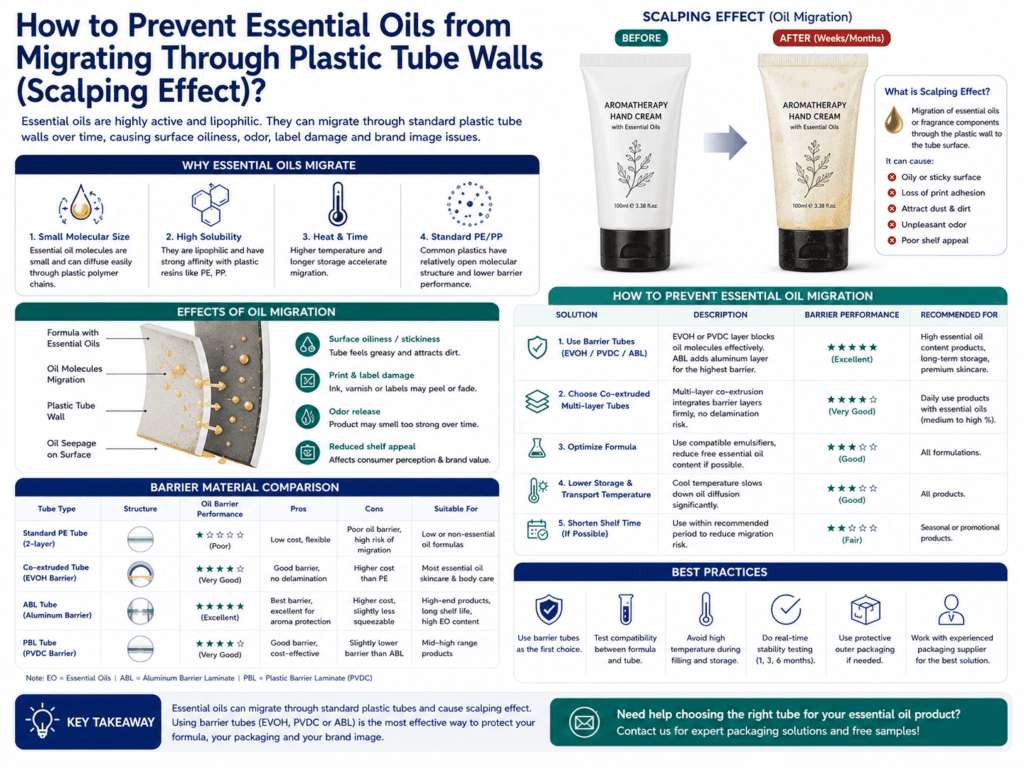
To prevent essential oils from migrating through plastic tube walls, brands should use a stronger barrier tube structure, choose the right inner contact layer, reduce direct interaction between volatile oil molecules and polyolefin plastics, and run real compatibility tests before mass production. This problem is often called the scalping effect, where fragrance, aroma, or essential-oil components are absorbed by the packaging material or slowly diffuse into the tube wall.
Essential oils contain many small volatile molecules, such as terpenes and aroma compounds. These molecules can interact with common plastic materials like PE or LDPE, especially when the formula has a high essential-oil percentage, strong fragrance load, or long shelf-life requirement. The result may be fragrance loss, formula imbalance, odor change, tube softening, paneling, or reduced product quality over time.
What Is the Scalping Effect?
The scalping effect means that volatile or aroma-active ingredients are removed from the formula by the packaging material. In cosmetic tube packaging, this usually happens when essential-oil components are absorbed into the inner plastic layer or diffuse through the tube wall. The formula may still look normal, but the scent profile, active balance, or sensory performance can gradually change.
Important: Scalping is usually a long-term compatibility issue. It may not appear immediately after filling, but it can become visible after storage, heat exposure, shipping, or aging tests.
Why Essential Oils Migrate Through Plastic Tubes
| Cause | What Happens | Packaging Risk |
|---|---|---|
| Small volatile molecules | Essential-oil components can move into plastic more easily than larger ingredients | Fragrance loss and aroma change |
| Affinity with PE or LDPE | Low-polarity oil molecules may be absorbed by polyolefin layers | Scalping, softening, or swelling |
| High essential-oil percentage | More volatile material contacts the inner tube wall | Higher migration and absorption risk |
| Long storage time | Migration increases with time | Scent and formula performance may drift |
| High temperature | Heat accelerates diffusion and plastic interaction | Faster scalping and compatibility failure |
Best Packaging Structures to Reduce Scalping
| Tube Structure | Scalping Resistance | Best Use |
|---|---|---|
| Standard single-layer PE / LDPE tube | Lowest protection | Low-risk formulas with minimal fragrance or essential oils |
| 2-layer PE tube | Better structural balance, but still limited barrier | Moderate-risk personal care formulas |
| 5-layer EVOH co-extruded tube | High barrier against oxygen and aroma transmission | Essential-oil skincare, sunscreen, active formulas, fragrance-sensitive products |
| PBL tube | Good plastic-based barrier protection | Functional skincare and premium personal care |
| ABL tube | Very high barrier with aluminum layer | Highly volatile, fragrance-rich, or aggressive formulas needing maximum protection |
Why EVOH Barrier Tubes Help
EVOH is often used as a barrier layer inside multi-layer cosmetic tubes. It helps reduce oxygen and aroma transmission compared with standard PE structures. For essential-oil formulas, a 5-layer EVOH tube can help slow fragrance loss and reduce the movement of volatile molecules through the package, especially when paired with the correct inner contact layer and proper formula testing.
- Better aroma retention: Helps preserve the intended scent profile for longer.
- Lower permeation risk: Reduces movement of volatile components through the tube wall.
- Better formula stability: Supports products sensitive to oxygen, fragrance loss, and ingredient migration.
- Premium packaging positioning: Suitable for high-value skincare and essential-oil products.
How to Reduce Essential-Oil Migration
| Prevention Method | How It Helps |
|---|---|
| Use EVOH, PBL, or ABL barrier tubes | Reduces aroma transmission and ingredient permeation compared with simple PE tubes |
| Choose a compatible inner layer | Minimizes absorption, swelling, and softening caused by essential-oil contact |
| Lower the free volatile oil load where possible | Reduces the amount of migratable material contacting the tube wall |
| Control storage temperature | Slows diffusion, evaporation, and plastic interaction |
| Run accelerated aging tests | Confirms whether the tube protects the formula over time |
Formula Factors That Increase Scalping Risk
- High essential-oil percentage: More volatile compounds increase packaging interaction.
- Citrus oils and terpene-rich oils: Small molecules such as limonene are especially migration-prone.
- Low-viscosity oil phase: More direct contact and mobility can increase absorption risk.
- Strong fragrance system: Aroma compounds can be selectively absorbed, changing the scent balance.
- Long shelf-life target: More time allows more diffusion and scalping.
Signs That Scalping Is Happening
| Sign | What It May Indicate |
|---|---|
| Fragrance becomes weaker | Aroma molecules may be absorbed by the tube wall or lost through permeation |
| Scent profile changes | Some volatile components may be lost faster than others |
| Tube wall softens or swells | Essential oils may be interacting with the plastic layer |
| Tube shows paneling or deformation | Formula-package interaction may be affecting wall stiffness |
| Formula performance changes | Active or sensory ingredients may no longer remain balanced |
Testing Before Mass Production
| Test | Purpose | What to Check |
|---|---|---|
| Accelerated aging test | Predicts long-term formula-package interaction | Scent loss, tube softening, formula change, leakage |
| High-temperature storage test | Checks heat-driven migration and diffusion | Fragrance loss, swelling, paneling, seal failure |
| Weight-loss test | Measures volatile loss or permeation | Change in filled tube weight over time |
| GC or fragrance profile check | Compares volatile component retention | Selective loss of key aroma molecules |
| Filled squeeze and drop test | Checks whether packaging remains mechanically stable | Cracking, softening, leakage, deformation |
When Standard PE Tubes May Still Work
Standard PE tubes may still be acceptable if the formula contains only a low fragrance load, minimal essential oil, short shelf-life requirement, and no visible compatibility issues after aging tests. They are often better suited for basic lotions, cleansers, or simple creams where volatile-oil migration is not a major risk.
When Barrier Tubes Are Strongly Recommended
Barrier tubes are strongly recommended when the formula contains high essential-oil content, citrus oils, terpene-rich botanicals, strong fragrance systems, oxidation-sensitive oils, or premium actives. In these cases, 5-layer EVOH, PBL, or ABL tubes can provide much better protection than standard PE tubes.
| Product Situation | Recommended Packaging Direction |
|---|---|
| Essential-oil-rich skincare cream | 5-layer EVOH or PBL tube |
| Citrus oil or terpene-rich formula | Barrier tube plus compatibility testing |
| High-value aromatherapy cosmetic product | Barrier structure with fragrance retention validation |
| Aggressive or highly volatile oil blend | ABL or high-barrier PBL depending on brand requirements |
| Basic low-fragrance lotion | Standard PE may be sufficient after testing |
Common Mistakes to Avoid
- Assuming “natural” oils are mild to packaging: Some essential oils can be very active toward plastics.
- Using standard PE without aging tests: Scalping may appear only after weeks or months.
- Testing only appearance: The tube may look normal while fragrance profile is already changing.
- Ignoring storage temperature: Heat can accelerate diffusion and absorption.
- Choosing packaging only by cost: Formula loss and scent change can cost more than a better barrier tube.
Best Practical Recommendation
For essential-oil cosmetic formulas, start by evaluating the percentage and type of volatile oils. If the formula contains citrus oil, limonene-rich oils, strong fragrance, or a high oil phase, avoid relying only on a standard PE tube. Use a barrier structure such as 5-layer EVOH, PBL, or ABL, and confirm the result with real filled-tube aging tests.
Summary
To prevent essential oils from migrating through plastic tube walls, brands should choose a compatible inner layer, use a stronger barrier structure, control the fragrance and essential-oil load, avoid excessive heat exposure, and run compatibility testing before mass production. Standard PE tubes may work for low-risk formulas, but high-essential-oil or fragrance-rich cosmetics usually need EVOH, PBL, or ABL barrier protection.
The safest packaging decision is based on real formula behavior, not only on tube material name. If scent retention, active stability, and premium user experience matter, barrier testing should be part of the tube development process.
Learn more: What Is EVOH Barrier Material?, EVOH Barrier Tubes Manufacturer, PBL Tubes, ABL Tubes, Sustainable Materials, Quality Assurance.
Need to Prevent Essential Oil Scalping in Cosmetic Tubes?
Xinfly Packaging helps brands compare standard PE, 5-layer EVOH, PBL, and ABL tube structures to improve fragrance retention, reduce migration risk, and protect essential-oil-rich cosmetic formulas.