
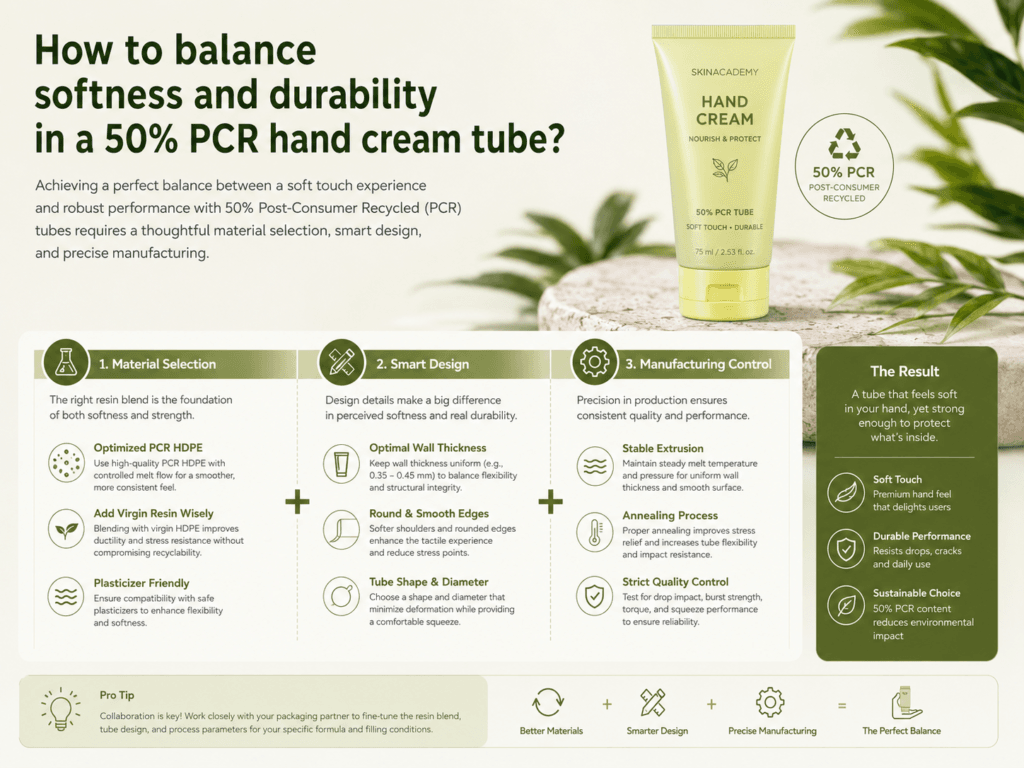
Balancing softness and durability in a 50% PCR hand cream tube requires the right combination of material ratio, wall structure, shoulder strength, and filling compatibility. A 50% PCR tube is often a practical midpoint for sustainable hand cream packaging because it can significantly reduce virgin plastic usage while still maintaining good squeeze feel, sealing performance, and shelf appearance.
For hand cream applications, the goal is not only to make the tube feel soft in the consumer’s hand, but also to ensure that it can resist deformation, cracking, leakage, and print damage during filling, transport, and repeated daily use.
Why 50% PCR Is a Common Balance Point
| Factor | Benefit at 50% PCR Level |
|---|---|
| Sustainability impact | Reduces virgin plastic use while keeping stable tube performance |
| Tube softness | Still allows comfortable squeeze feel for hand cream dispensing |
| Structural durability | Better stability than very high PCR ratios such as 70%–100% |
| Printing appearance | Easier to control color, gloss, and decoration consistency |
Main Design Factors That Affect Softness and Durability
- PCR and virgin PE balance: 50% PCR blended with quality PE helps maintain tube rebound and squeeze comfort.
- Wall thickness: A slightly optimized wall can prevent collapse without making the tube feel too hard.
- Tube diameter and volume: Larger hand cream tubes need stronger structure to avoid paneling or denting.
- Shoulder and cap design: Reinforced shoulder zones improve sealing strength and drop resistance.
- Hand cream viscosity: Thick formulas need a soft but stable body and properly matched orifice size.
How to Keep the Tube Soft Enough for Good Consumer Experience
| Optimization Method | Purpose |
|---|---|
| Use high-quality PCR resin | Improves flexibility and reduces brittleness variation |
| Control melt flow consistency | Keeps the tube body smooth and easy to squeeze |
| Adjust wall distribution | Makes the body softer while preserving shoulder strength |
| Match cap type to formula | Improves dispensing control for rich hand cream textures |
How to Improve Durability Without Making the Tube Too Hard
- Strengthen the shoulder and sealing area instead of simply increasing the whole wall thickness.
- Use stable PCR sourcing to reduce resin variability between batches.
- Optimize tube structure for transport compression and drop resistance.
- Test cap closure torque and leakage performance with the actual hand cream formula.
- Run repeated squeeze-cycle tests to check long-term user performance.
Recommended Performance Checkpoints for 50% PCR Hand Cream Tubes
| Test Item | Why It Matters |
|---|---|
| Squeeze and rebound test | Checks softness, usability, and shape recovery |
| Drop resistance test | Prevents cracking during shipping and handling |
| Leakage and seal test | Confirms closure and bottom seal reliability |
| Formula compatibility test | Ensures hand cream oils and fragrance do not affect tube performance |
| Decoration adhesion test | Protects printing quality during use and storage |
Best Practice for Hand Cream Brands
For most hand cream packaging projects, 50% PCR is a strong practical choice. It gives brands a visible sustainability claim while avoiding the higher risk of stiffness, color instability, or structural inconsistency that can happen at very high recycled-content ratios. In real production, softness and durability are balanced not by one number alone, but by the full tube engineering system: resin quality, extrusion control, wall structure, shoulder design, and formula matching.
Summary
To balance softness and durability in a 50% PCR hand cream tube, manufacturers should combine stable PCR resin, controlled wall thickness, reinforced structural zones, and formula-specific testing. This allows the tube to remain comfortable to squeeze while still performing well during filling, shipping, and repeated consumer use.
In short, 50% PCR is often one of the best balance points for brands that want both sustainable positioning and reliable hand cream tube performance.
Learn more: PCR Cosmetic Tubes, Hand Cream Tube Packaging, How to Choose Sustainable Cosmetic Tubes, PE vs PCR Tubes.
Need 50% PCR Hand Cream Tubes?
Xinfly Packaging helps brands develop 50% PCR hand cream tubes that balance squeeze softness, structural durability, decoration quality, and sustainable packaging goals.