
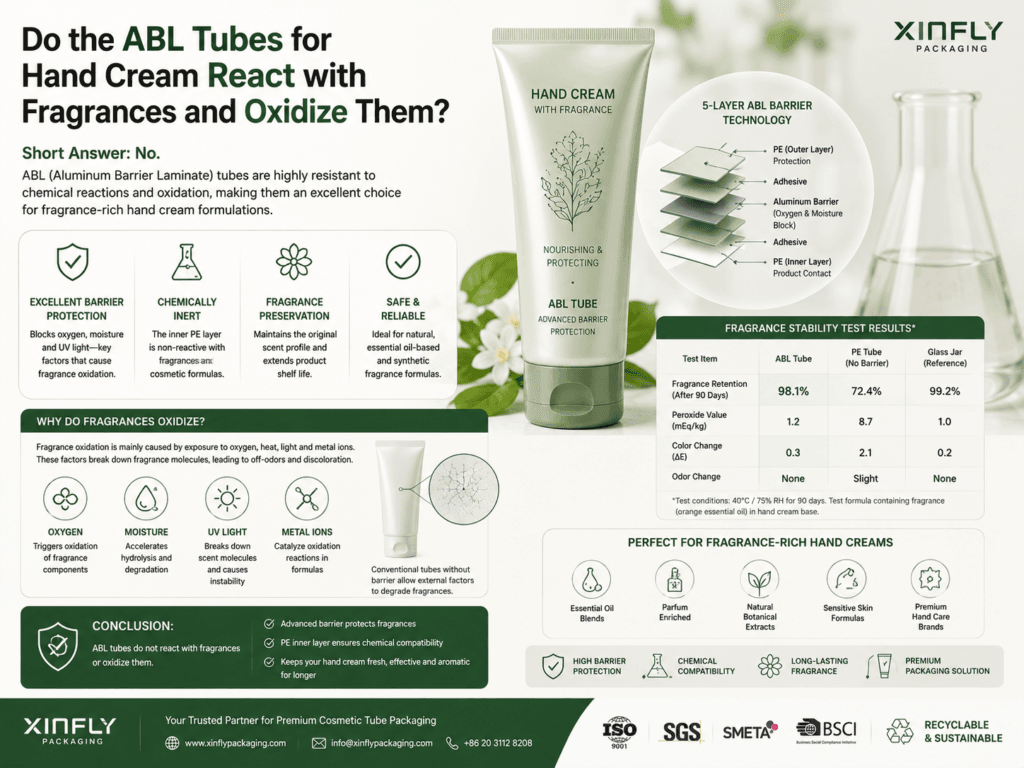
Normally, ABL tubes for hand cream do not react with fragrance oils or oxidize them by themselves. In most cases, ABL tubes are selected precisely because they offer stronger protection against oxygen, light, moisture, and chemical migration than standard plastic tubes. This helps preserve fragrance stability rather than damage it.
However, fragrance compatibility does not depend on the aluminum barrier layer alone. The real performance depends on the inner contact layer material, formula composition, essential oil level, solvent system, and storage conditions. If the hand cream contains aggressive perfume oils, citrus oils, high alcohol content, or unstable active ingredients, compatibility testing is still necessary before mass production.
Why ABL Tubes Are Commonly Used for Fragrance-Sensitive Formulas
| Feature | Benefit for Hand Cream |
|---|---|
| Aluminum barrier layer | Reduces oxygen ingress and helps limit oxidation of fragrance components |
| Light protection | Helps protect perfume oils and sensitive ingredients from UV-related degradation |
| Moisture barrier | Improves shelf stability of cream texture and fragrance balance |
| Migration resistance | Helps reduce interaction between external environment and the formula |
When Problems Can Still Happen
- Very aggressive fragrance systems: High essential-oil loads or solvent-rich perfume blends may challenge the inner contact layer.
- Poor inner layer compatibility: The formula touches the inner polymer layer, not bare aluminum, so inner-layer selection matters most.
- High-temperature storage: Heat can accelerate fragrance loss, phase shift, or odor change.
- Long shelf life without testing: Unverified formulas may show odor drift or slight performance change over time.
What Actually Contacts the Formula?
In an ABL tube, the product usually does not directly contact raw aluminum foil. It contacts the inner plastic layer, while the aluminum barrier layer sits inside the laminate structure to block oxygen, light, and external contamination. That is why compatibility testing focuses on the formula + inner layer + full laminate structure, not just “aluminum” as a single factor.
Best Practice for Fragranced Hand Cream in ABL Tubes
| Recommended Action | Why It Matters |
|---|---|
| Run formula compatibility testing | Checks odor stability, color shift, and wall interaction |
| Do accelerated aging tests | Simulates long-term storage under heat and light |
| Test migration and fragrance retention | Confirms whether scent profile remains stable |
| Evaluate cap sealing performance | Prevents fragrance loss caused by closure leakage |
ABL vs Standard PE for Fragranced Hand Cream
| Tube Type | Fragrance Protection | Oxidation Risk |
|---|---|---|
| Standard PE tube | Basic to moderate | Higher if formula is oxygen-sensitive |
| ABL tube | High | Lower due to stronger oxygen and light barrier |
| PBL tube | High | Good alternative depending on formula and sustainability target |
Summary
ABL tubes are usually a protective packaging choice for fragranced hand cream, not a source of oxidation. They are designed to reduce oxygen exposure, limit chemical migration, and improve fragrance preservation. If a fragranced hand cream shows odor change, the cause is usually related to formula chemistry, inner-layer compatibility, temperature exposure, or insufficient testing, not simply because the package is ABL.
For best results, fragrance-heavy hand cream formulas should always go through compatibility, aging, and leakage tests before production.
Learn more: ABL Tubes, ABL vs PBL Tubes, Hand Cream Tube Packaging, Quality Assurance.
Need ABL Tubes for Fragranced Hand Cream?
Xinfly Packaging helps brands choose the right laminate structure, inner-layer compatibility, and validation tests for hand cream tubes with fragrance oils, essential oils, and active formulas.