
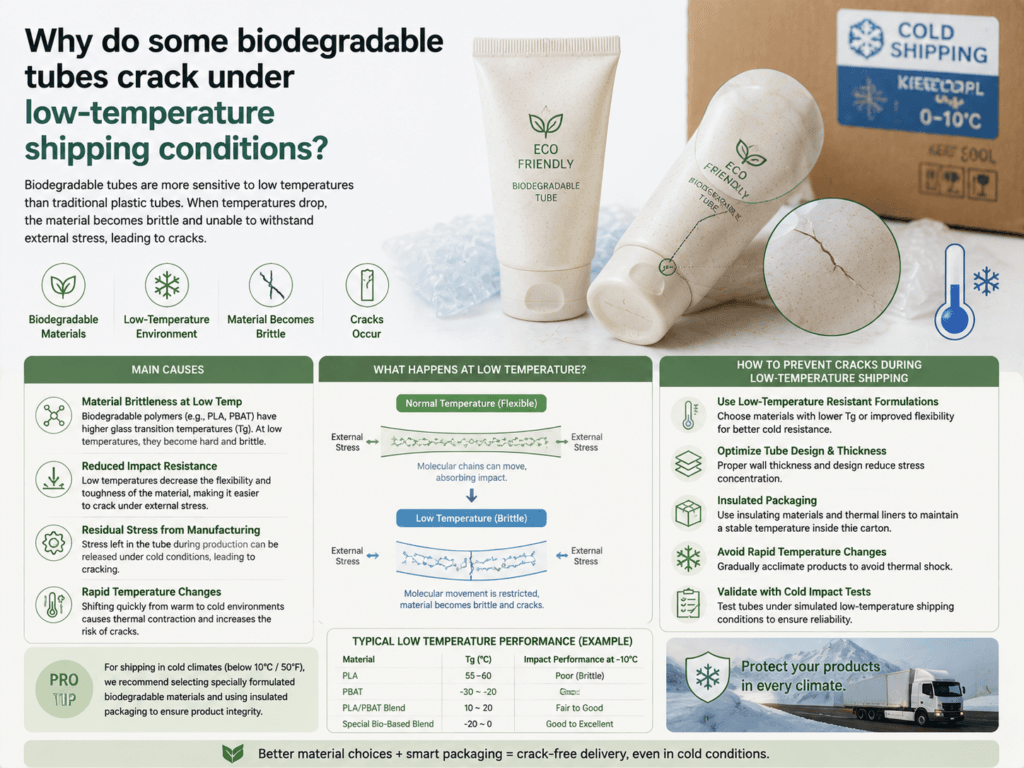
Some biodegradable cosmetic tubes may crack under low-temperature shipping conditions because many biodegradable polymers become more brittle when exposed to cold environments.
This issue is mainly related to material glass-transition behavior, reduced flexibility at low temperatures, and differences in molecular structure compared to conventional PE-based tubes.
Main Reasons for Cracking in Cold Conditions
| Cause | Explanation |
|---|---|
| Low glass transition temperature (Tg) | Biodegradable materials become rigid and lose flexibility in cold environments |
| Reduced impact resistance | Material cannot absorb shock during transport or dropping |
| Higher brittleness of biopolymers | PLA and similar materials are more rigid than PE-based plastics |
| Multi-layer stress mismatch | Different layers contract differently in cold temperatures |
What Happens During Low-Temperature Shipping?
- Tube body becomes stiff and less flexible
- Impact resistance drops significantly during handling
- Micro-cracks may form near shoulder or crimping areas
- Repeated vibration in transit increases crack propagation risk
Material Comparison in Cold Resistance
| Material Type | Cold Resistance | Cracking Risk |
|---|---|---|
| Virgin PE tubes | Excellent flexibility at low temperatures | Low |
| PCR PE tubes | Good (depends on recycling quality) | Low–Medium |
| Sugarcane-based PE | Similar to virgin PE | Low |
| PLA / biodegradable plastics | Reduced flexibility in cold environments | Medium–High |
Where Cracks Commonly Occur
- Tube shoulder (highest stress concentration point)
- Seal/crimping area after filling
- Cap-thread junction during impact
- Thin-wall decorative zones with heavy printing layers
How Manufacturers Reduce Cracking Risk
- Material blending: Mixing biodegradable resins with flexible PE improves toughness
- Wall thickness optimization: Reinforcing structural zones reduces stress failure
- Cold-resistance additives: Improve impact performance at low temperatures
- Layer design adjustment: Balancing rigidity between layers in multi-layer tubes
- Cold chain testing: Simulated -10°C to -20°C transport validation
Best Practices for Cold Shipping
- Avoid fully PLA-based tubes for frozen or winter logistics routes
- Use PE or sugarcane-based PE for cold-sensitive markets
- Increase cushioning in outer cartons
- Reduce drop height risk in automated logistics systems
- Conduct pre-shipment drop + temperature cycle testing
Summary
Biodegradable cosmetic tubes can crack under low-temperature shipping conditions because many bio-based polymers become brittle in cold environments. This is especially common with PLA and rigid bioplastics, which have lower impact resistance compared to PE-based materials.
To reduce cracking risk, manufacturers typically use material blending, structural reinforcement, and cold-chain testing, or switch to PE-based or sugarcane-based solutions for better durability.
Learn more: Biodegradable Tubes, Sugarcane Tubes, PCR Tubes, Sustainable Packaging.
Need Cold-Resistant Tube Solutions?
Xinfly Packaging helps brands design durable cosmetic tubes that withstand cold-chain logistics while maintaining sustainable material choices.