
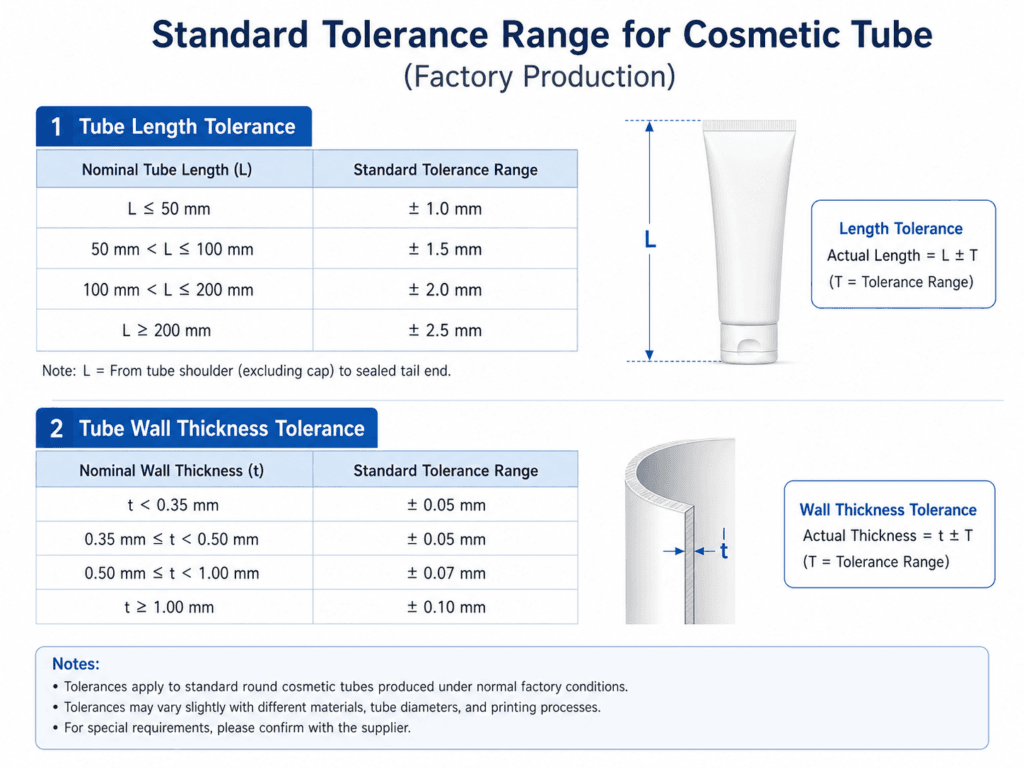
In cosmetic tube factory production, a practical tolerance range is commonly around ±1mm to ±2mm for tube length and around ±0.03mm to ±0.08mm for wall thickness, depending on tube diameter, material structure, production process, and customer quality requirements. For high-precision projects, the tolerance should be confirmed in the technical drawing or approved sample standard before mass production.
Cosmetic tubes are flexible packaging products, so minor variation is normal during extrusion, cutting, heading, printing, tail sealing, and cooling. However, if the tolerance is too large, it may affect filling volume, artwork position, cap fit, shelf appearance, carton packing, and sealing performance.
Typical Tolerance Range for Cosmetic Tube Length
| Tube Size / Application | Typical Length Tolerance | Notes |
|---|---|---|
| Small tubes: 10ml – 30ml | About ±1mm | More visible because the tube body is short |
| Medium tubes: 50ml – 150ml | About ±1mm – ±1.5mm | Common range for skincare, hand cream, sunscreen, and cleanser tubes |
| Large tubes: 200ml – 250ml+ | About ±1.5mm – ±2mm | Larger tubes may have slightly wider tolerance due to longer body length |
| High-precision artwork or carton-fit project | Custom controlled tolerance | Requires drawing confirmation, sample approval, and tighter QC control |
Typical Tolerance Range for Wall Thickness
| Tube Structure | Typical Wall Thickness Tolerance | Why It Varies |
|---|---|---|
| Single-layer PE tube | About ±0.03mm – ±0.05mm | Simpler structure, easier wall control |
| 2-layer PE tube | About ±0.04mm – ±0.06mm | Layer balance and extrusion stability affect final thickness |
| 5-layer co-extruded tube | About ±0.05mm – ±0.08mm | Multiple layers, tie layers, and barrier layer distribution must be controlled |
| Large-capacity thick-wall tube | Project-specific tolerance | Depends on tube diameter, target strength, and wall design |
Practical note: Tolerance should always be written in the approved specification sheet. If a buyer only confirms “50ml tube” without tolerance details, the factory will usually follow its normal production tolerance standard.
Why Tube Length Tolerance Happens
Tube length tolerance usually comes from extrusion stability, cutting accuracy, body shrinking after cooling, heading process, tail-sealing allowance, and production speed. Even if the extrusion line is well controlled, flexible plastic tubes can still show small dimensional variation after forming and cooling.
- Extrusion speed: Small changes in line speed can affect body length before cutting.
- Cutting precision: Cutting blade accuracy directly affects tube body length.
- Cooling shrinkage: PE material may shrink slightly after forming.
- Tail-seal allowance: Filled and sealed tubes may appear shorter after crimping or sealing.
- Tube diameter: Larger tubes may show more visible dimensional variation.
Why Wall Thickness Tolerance Happens
Wall thickness tolerance is mainly related to extrusion die control, material flow, melt temperature, cooling rate, layer distribution, resin grade, and tube diameter. For multi-layer co-extruded tubes, the total thickness and each individual layer must be controlled carefully, especially when EVOH or barrier layers are used.
| Factor | Effect on Wall Thickness | Quality Control Point |
|---|---|---|
| Extrusion die gap | Controls the tube wall thickness directly | Die adjustment and regular inspection |
| Material melt flow | Uneven flow may cause thickness variation | Stable temperature and resin selection |
| Cooling condition | Uneven cooling may cause shrinkage or ovality | Controlled cooling and forming process |
| Layer ratio | Important for 2-layer and 5-layer tubes | Layer distribution monitoring |
| Tube diameter | Larger diameters require stronger process control | Diameter-specific inspection standard |
How Tolerance Affects Product Performance
| Tolerance Issue | Possible Problem | Why It Matters |
|---|---|---|
| Tube length too short | Lower fill capacity or poor shelf proportion | May affect declared volume and appearance |
| Tube length too long | Carton-fit issue or artwork position mismatch | May increase packing cost or cause display inconsistency |
| Wall too thin | Splitting, deformation, leakage, poor drop-test performance | Higher risk during filling, sealing, and transport |
| Wall too thick | Harder squeeze feel, higher material cost | May reduce elderly-friendly or daily-use comfort |
| Uneven wall thickness | One side weak, poor recovery, unstable decoration | Can affect both function and appearance |
Recommended Tolerance Control by Project Type
| Project Type | Length Tolerance Focus | Wall Thickness Focus |
|---|---|---|
| Standard skincare tube | Normal factory tolerance is usually acceptable | Balanced squeeze feel and body strength |
| Premium printed cosmetic tube | Tighter control to keep artwork position consistent | Stable surface and uniform tube shape |
| High-barrier EVOH tube | Length must match fill and cap system | Total thickness and barrier layer distribution are critical |
| Large body lotion tube | Length affects carton fit and shelf appearance | Wall thickness must prevent splitting and deformation |
| Automatic filling line project | Length consistency affects machine feeding and sealing | Wall consistency affects sealing and squeeze performance |
How Factories Inspect Tube Length and Wall Thickness
- Tube length measurement: Checked with calipers, rulers, or production gauges according to the approved drawing.
- Wall thickness measurement: Checked at multiple points around the tube body using thickness gauges or micrometers.
- Layer structure inspection: For multi-layer tubes, cross-section checks can verify layer distribution.
- Sampling inspection: Tubes are checked during start-up, in-process production, and final QC.
- Approved sample comparison: Production tubes are compared with confirmed pre-production samples.
Suggested Inspection Points
| Inspection Area | What to Measure | Purpose |
|---|---|---|
| Top shoulder area | Neck, shoulder, and body transition | Confirms cap fit and shoulder strength |
| Middle body | Wall thickness around the circumference | Checks body strength and squeeze consistency |
| Tail area | Body length and sealing allowance | Ensures correct sealing and artwork safety zone |
| Full tube length | Total assembled tube length with cap if needed | Confirms carton fit and retail display consistency |
Common Mistakes Buyers Should Avoid
- Only confirming capacity: A 100ml tube can have different diameter, length, and wall thickness options.
- Ignoring tolerance in artwork design: Important text should not be placed too close to the tail or shoulder.
- Requesting very tight tolerance without cost review: Tighter tolerance may require slower production and more inspection.
- Using the same tolerance for all tube sizes: Small tubes and large tubes may need different control standards.
- Skipping filled sample testing: Dimensional tolerance must still work after filling and sealing.
Best Practical Recommendation
For most cosmetic tube projects, use ±1mm to ±2mm as a practical length tolerance direction and ±0.03mm to ±0.08mm as a practical wall thickness tolerance direction. For premium printing, automatic filling, barrier tubes, or large-capacity products, confirm a tighter or project-specific tolerance in the drawing, sample approval document, and QC checklist.
Summary
The standard tolerance range for cosmetic tube length and wall thickness depends on tube size, material, layer structure, production process, and quality requirement. As a practical reference, tube length is commonly controlled around ±1mm to ±2mm, while wall thickness is often controlled around ±0.03mm to ±0.08mm.
The most important point is to confirm tolerance before mass production. Clear technical drawings, approved samples, inspection points, and QC standards help prevent problems with filling volume, decoration alignment, carton fitting, squeezing performance, sealing strength, and product appearance.
Learn more: Tube Capacity, Diameter, Length & Thickness, Match Cosmetic Tube Diameter and Fill Volume, Quality Assurance, 5-Layer Plastic Tubes, PE Tubes, Customize Cosmetic Tubes.
Need Tighter Tolerance Control for Cosmetic Tubes?
Xinfly Packaging helps brands confirm tube length, wall thickness, layer structure, artwork positioning, filling compatibility, carton fit, and QC inspection standards before mass production.