
Quick Answer
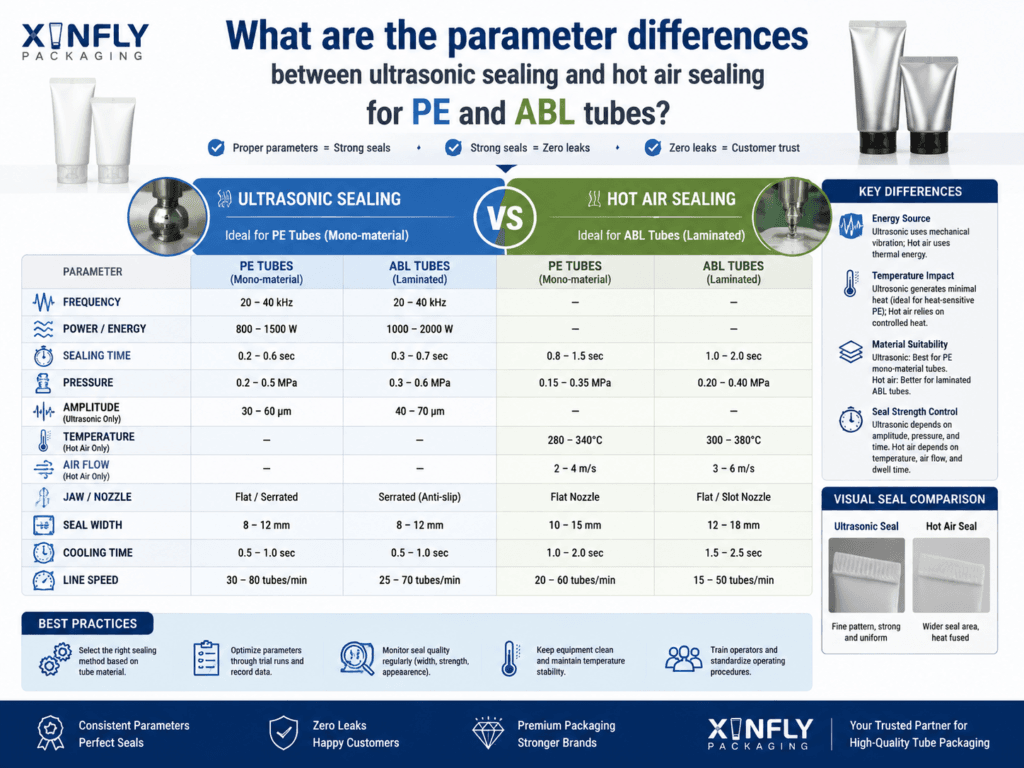
Ultrasonic sealing and hot air sealing use different energy methods to bond cosmetic tube tails. Hot air sealing relies on external heat to melt the tube layers, while ultrasonic sealing uses high-frequency vibration energy to generate localized heat at the sealing interface.
For PE tubes, hot air sealing is commonly used because polyethylene responds well to controlled thermal bonding. For ABL (Aluminum Barrier Laminate) tubes, both methods may be used depending on tube structure, equipment design and required seal performance.
Tail sealing is one of the most critical steps in cosmetic tube filling. A poor sealing process can cause leakage, tube splitting, product contamination and customer complaints.
Choosing between ultrasonic sealing and hot air sealing depends on tube material, production speed, formula characteristics, appearance requirements and filling equipment compatibility.
What Is Hot Air Sealing for Cosmetic Tubes?
Hot air sealing uses heated air to soften the inner polymer layer of the tube tail. After reaching the correct temperature, pressure is applied to bond the tube layers together.
External Heating
Heat is transferred from outside the tube through hot air or heating elements.
Thermal Bonding
The inner sealing layers melt and fuse together under pressure.
Common Application
Widely used for PE cosmetic tubes and high-volume filling lines.
What Is Ultrasonic Sealing for Cosmetic Tubes?
Ultrasonic sealing uses high-frequency mechanical vibration to create frictional heat between polymer layers. The generated energy melts the sealing interface without requiring high external temperature.
Localized Energy
Heat is generated directly at the bonding area.
Lower Surface Heating
The outside appearance may experience less thermal impact.
Precise Control
Energy, pressure and vibration time can be adjusted digitally.
Ultrasonic Sealing vs Hot Air Sealing: Key Parameter Differences
| Parameter | Hot Air Sealing | Ultrasonic Sealing |
|---|---|---|
| Heat Source | External hot air or heating system. | High-frequency vibration energy. |
| Temperature Requirement | Requires controlled heating temperature. | Lower external temperature requirement. |
| Sealing Time | Usually requires heating and cooling stages. | Generally shorter energy activation time. |
| Pressure Control | Mechanical pressure after heating. | Pressure combined with ultrasonic vibration. |
| Energy Transfer | Heat travels through tube material. | Energy concentrates at bonding interface. |
| Equipment Cost | Usually lower initial investment. | Higher equipment investment and maintenance requirements. |
What Parameters Affect Sealing Quality?
| Parameter | Effect on Seal Performance |
|---|---|
| Temperature | Controls polymer melting level in hot air sealing. |
| Ultrasonic Energy Level | Controls vibration energy transferred to sealing layers. |
| Pressure | Ensures sufficient contact between sealing surfaces. |
| Sealing Time | Determines bonding stability and production speed. |
| Tube Material Structure | PE, EVOH, ABL and PBL require different optimization. |
| Tube Wall Thickness | Influences heat transfer and sealing strength. |
Which Sealing Method Is More Suitable for PE Tubes?
PE (Polyethylene) tubes are widely used in cosmetic packaging because of their flexibility, squeeze performance and good heat-sealing characteristics.
PE Tube Considerations
- Hot air sealing is commonly used for standard PE cosmetic tubes.
- Temperature control is important to avoid burning or deformation.
- Sealing pressure must maintain strength without damaging flexibility.
- High-speed filling lines usually require optimized thermal parameters.
What Are the Hot Air Sealing Parameters for PE Cosmetic Tubes?
PE tubes are widely used for skincare, body care, toothpaste and personal care products because polyethylene provides good flexibility and reliable thermal sealing performance.
| Parameter | PE Tube Hot Air Sealing Consideration | Potential Failure |
|---|---|---|
| Heating Temperature | Must be high enough to melt the inner sealing layer but avoid damaging the tube body. | Burning, deformation or brittle seal. |
| Air Flow | Controls how heat is transferred into the tube tail area. | Uneven sealing or inconsistent bonding. |
| Sealing Pressure | Compresses melted PE layers to create bonding. | Weak seal or excessive stress. |
| Heating Time | Controls the amount of thermal energy applied. | Incomplete bonding or overheating. |
| Cooling Time | Allows the seal area to stabilize. | Cracking after production. |
What Are the Sealing Considerations for ABL Tubes?
ABL (Aluminum Barrier Laminate) tubes contain an aluminum barrier layer between polymer layers. This structure provides excellent oxygen, moisture and fragrance protection but requires different sealing considerations compared with PE tubes.
ABL Tube Sealing Characteristics
- The aluminum barrier layer changes heat transfer behavior.
- The sealing process mainly bonds the inner polymer layers.
- Excessive heat may affect laminate structure.
- Correct pressure distribution is important for uniform sealing.
- Tube positioning accuracy is critical for high-speed production.
Hot Air Sealing vs Ultrasonic Sealing for PE and ABL Tubes
| Comparison | Hot Air Sealing | Ultrasonic Sealing |
|---|---|---|
| PE Tubes | Commonly used due to reliable thermal bonding performance. | Possible, but requires suitable equipment and parameter optimization. |
| ABL Tubes | Widely used when thermal sealing conditions are properly controlled. | Can provide precise localized bonding for suitable laminate structures. |
| Energy Source | External heat transfer. | Mechanical vibration energy. |
| Temperature Impact | Higher external heat exposure. | Lower external heating influence. |
| Production Speed | Suitable for high-volume filling lines. | Suitable where precise energy control is required. |
| Equipment Investment | Generally lower equipment cost. | Higher equipment investment. |
Advantages and Limitations of Hot Air Sealing
Advantages
- Suitable for high-speed production.
- Compatible with many PE tube structures.
- Lower equipment investment.
- Easy integration into filling lines.
Limitations
- Requires accurate temperature control.
- Heat may affect sensitive decorations.
- Incorrect settings can cause burning.
- Different materials require parameter adjustment.
Best Applications
- PE cosmetic tubes.
- Body lotion tubes.
- Hand cream tubes.
- Toothpaste tubes.
Advantages and Limitations of Ultrasonic Sealing
Advantages
- Precise energy application.
- Reduced external heat exposure.
- Fast sealing cycle.
- Digital parameter control.
Limitations
- Higher equipment investment.
- Requires skilled parameter adjustment.
- Not suitable for every tube structure.
- Equipment maintenance requirements are higher.
Best Applications
- Special PE structures.
- Certain laminate tubes.
- Premium packaging applications.
- Precision sealing requirements.
How Should Filling Factories Choose Between Ultrasonic and Hot Air Sealing?
| Requirement | Recommended Consideration |
|---|---|
| Large Production Volume | Hot air sealing is often preferred because of mature high-speed integration. |
| Standard PE Tubes | Hot air sealing is commonly selected. |
| Complex Laminate Structures | Evaluate both methods through filling trials. |
| Sensitive Decoration Near Tail Area | Consider sealing method with lower surface heat impact. |
| New Packaging Development | Conduct compatibility testing before final equipment selection. |
What Parameters Should Be Tested Before Mass Production?
Recommended Validation Process
- Confirm tube material structure.
- Test actual cosmetic formula compatibility.
- Optimize sealing temperature or ultrasonic energy.
- Adjust pressure and sealing time.
- Perform leakage testing.
- Check seal strength after aging.
- Approve final production parameters.
Factory Engineer Recommendation
Do not copy sealing parameters from another tube supplier.
Even tubes with the same diameter and capacity may require different sealing settings because resin formulation, wall thickness, barrier layers, decoration and filling conditions can affect sealing performance.
How to Troubleshoot Ultrasonic and Hot Air Sealing Problems?
Both ultrasonic sealing and hot air sealing require accurate parameter control. When sealing defects occur, factories should analyze the relationship between tube material, equipment settings and production conditions.
| Sealing Problem | Possible Cause | Recommended Solution |
|---|---|---|
| Weak Tail Seal | Insufficient temperature, energy, pressure or sealing time. | Increase bonding energy gradually and verify seal strength. |
| Burned Tube Tail | Excessive hot air temperature or excessive heating time. | Reduce heat input and optimize cooling time. |
| Seal Cracking After Cooling | Overheating, excessive pressure or material stress. | Balance sealing parameters and check tube structure. |
| Uneven Seal Line | Incorrect tube positioning or uneven pressure. | Adjust fixture alignment and sealing contact. |
| Leakage During Storage | Formula contamination or insufficient bonding. | Improve filling control and perform leakage testing. |
| Decoration Damage Near Tail | Excessive heat exposure. | Adjust sealing position or select suitable process. |
What Are the Key Quality Tests After Tube Sealing?
Seal Strength Test
Measures whether the sealed area can withstand mechanical forces during handling and transportation.
Leakage Test
Confirms that sealed tubes remain stable during storage and logistics.
Burst Pressure Test
Evaluates the maximum pressure resistance of the tube package.
Aging Test
Checks long-term compatibility between formula and packaging materials.
Transportation Simulation
Tests performance under vibration, compression and temperature changes.
Visual Inspection
Checks seal appearance, deformation and production consistency.
PE Tube vs ABL Tube: Which Sealing Method Is Better?
| Tube Type | Preferred Sealing Consideration | Reason |
|---|---|---|
| Standard PE Cosmetic Tubes | Hot Air Sealing is commonly used. | Reliable thermal bonding and suitability for high-speed production. |
| PCR PE Tubes | Parameter optimization required. | Recycled materials may have different thermal behavior. |
| ABL Tubes | Evaluate hot air or ultrasonic according to structure. | Laminate layers require controlled bonding conditions. |
| Premium Barrier Tubes | Conduct sealing validation before production. | Formula protection and seal reliability are equally important. |
How Should Brands Select the Right Tube Sealing Technology?
Selection Checklist
- Tube Material: Confirm PE, PCR, EVOH, ABL or PBL structure.
- Formula Type: Consider viscosity, oil content and sensitivity.
- Production Speed: Match sealing technology with filling line requirements.
- Appearance Requirement: Consider decoration protection and premium appearance.
- Quality Standard: Define leakage and seal strength requirements.
- Future Scalability: Choose a process suitable for future production volume.
Common Mistakes When Choosing Tube Sealing Technology
- Selecting sealing equipment only based on initial cost.
- Using identical parameters for different tube structures.
- Ignoring formula compatibility testing.
- Changing production speed without revalidation.
- Testing only appearance without mechanical performance.
- Not involving the tube manufacturer during filling line setup.
Factory Engineer Recommendation
The best sealing method is not determined only by the machine type.
A successful cosmetic tube sealing process requires matching:
- Tube material structure.
- Inner sealing layer properties.
- Formula characteristics.
- Filling machine speed.
- Production quality requirements.
Before mass production, always validate the sealing process using the actual tube, formula and filling equipment.
Summary
Ultrasonic sealing and hot air sealing are both effective technologies for cosmetic tube production, but they use different energy methods and require different parameter controls.
Hot air sealing is widely used for PE tubes because of its reliability and suitability for high-speed filling lines. Ultrasonic sealing provides precise localized energy control and may be suitable for specific packaging structures.
For ABL tubes and advanced barrier packaging, the correct sealing method should be selected through compatibility testing rather than equipment preference alone.
A professional cosmetic tube manufacturer should support customers with sealing recommendations, filling compatibility testing and production optimization.
Related Questions
| Topic | Related Resource |
|---|---|
| Tail Seal Troubleshooting | How to Troubleshoot Tail-Sealing Issues in Cosmetic Tube Filling? |
| Tube Cracking During Filling | Why Do Cosmetic Tubes Crack During High-Speed Filling? |
| Cosmetic Tube Leakage | 10 Reasons Cosmetic Tubes Leak During Filling and Shipping |
| ABL Barrier Tubes | EVOH vs ABL Tubes Comparison |
| Tube Material Selection | Single Layer PE vs Multi-layer Cosmetic Tubes |
| Quality Control | Cosmetic Tube QC Standards AQL 2.5/4.0 |
Need Help Selecting The Right Tube Sealing Process?
Xinfly Packaging supports cosmetic brands and filling factories with:
- PE and ABL tube structure recommendations.
- Sealing compatibility testing.
- Filling line technical support.
- Mass production parameter optimization.
- Quality inspection guidance.
Need Technical Support For Cosmetic Tube Sealing?
Xinfly Packaging provides custom PE and barrier cosmetic tubes with engineering support for sealing performance, filling compatibility and production optimization.
Contact Packaging Engineer