
You need to match tube diameter and fill volume by looking at a few things. Product viscosity helps you pick the best filling method. How the tube looks is important, especially if it is clear. The fill level must look the same in every tube. How you use the product helps you choose the tube and cap style. Industry standards help you pick good Cosmetic Tube Sizes. These sizes are usually from 13mm to 50mm wide and 15ml to 200ml in volume.
Xinfly Packaging gives certified choices for custom cosmetic tubes. Their certifications are ISO, RoHS, SGS, and GRS. These make sure the products are safe and high quality.
| Factor | Details |
|---|---|
| Low Viscosity Liquid | Gravity filling machines are easy and work well. |
| Medium Viscosity Liquid | Piston or gear pump fillers are good for shampoos and similar things. |
| High Viscosity Liquid | Rotor pumps and piston fillers are best for thick creams. |
Key Takeaways
- Pick the correct tube diameter and fill volume to make using the product easier. A good tube design helps people use the product and makes them happier.
- Think about how thick or thin your product is when you pick filling methods and tube sizes. If you match the thickness with the right tube, you stop leaks and make filling easy.
- Use the tube sizes and packaging that the industry says are best. Following these rules keeps you out of trouble and helps your product fit in the market.
- Try out your tube and cap together before making a lot of them. This lets you find problems like leaks or hard-to-use parts, so customers get a better product.
- Talk to packaging suppliers early when you start designing. They know a lot and can help you pick the best materials and designs for your cosmetic products.
Why Tube Diameter and Fill Volume Matter
User Experience
When you choose the right tube packaging, you make your product easy to use. The size and shape of the tube affect how people hold and squeeze it. If you pick the wrong size, the tube can feel weak or hard to use. This is important for all cosmetics, especially thick creams and skincare products. Higher-viscosity formulations need a tube with the right diameter and wall thickness. If you get this right, you improve comfort and satisfaction. Here are some ways proper tube packaging helps:
- The tube feels good in your hand and is easy to squeeze.
- You can control how much product comes out.
- The tube does not break or leak during use.
- The product stays fresh and safe for health and skincare needs.
Product Protection
You need to protect your product from air, light, and germs. The right tube packaging creates a strong barrier. This keeps your skincare and personal care products safe. Good packaging stops leaks and keeps out dirt. It also helps your product last longer. You should always check that your tube packaging meets fda rules and industry standards. Proper closures and decoration also help protect your product. Printing on the tube can show important information, like ingredients and instructions. This helps users trust your brand and use the product safely.
Brand Image
The size and design of your tube packaging shape how people see your brand. When you select the best cosmetic tube sizes, you show that you care about quality and user experience. A well-designed tube makes your product look professional and attractive. This can build trust and loyalty. Printing and decoration add style and help your product stand out on the shelf. Customization lets you match your packaging to your brand’s look and feel. When you invest in the right tube packaging solutions, you also control cost and improve your brand’s reputation in the cosmetics market.
Key Factors in Cosmetic Tube Sizes
Product Viscosity
You need to think about how thick or thin your product is. This is called viscosity. Picking the wrong filling machine for your product’s viscosity can cause problems. For example, one vendor tried to fill zinc oxide sunscreen with a viscosity of 180,000 cP. They used a machine that could only handle 50,000 cP. This mistake made production slow and wasted product. You should always check your product’s viscosity before choosing tubes and machines.
- Serums are low-viscosity and flow easily. They need smaller tubes or bottles.
- Lotions are medium-viscosity and fit well in regular tubes.
- Thick creams are high-viscosity. They need wider tubes and special machines.
Matching viscosity with the right tube size and fill volume stops leaks. It also makes filling smooth and keeps your product safe for skin and health.
Fill Volume Selection
You must pick the right fill volume for your product and how people use it. The table below shows common cosmetic products, their viscosity, and the best packaging:
| Product Category | Typical Viscosity (cP) | Recommended Filling Technology | Primary Container Type |
|---|---|---|---|
| Facial Serum / Essence | 1 – 50 | Peristaltic pump, gravity filler | Glass dropper, airless bottle |
| Toner / Micellar Water | 1 – 10 | Gravity / overflow filler | PET or glass bottle |
| Face Lotion / Moisturizer | 500 – 8,000 | Gear pump or small-bore piston | Pump bottle, jar |
| Body Butter / Thick Cream | 50,000 – 500,000 | Large-bore servo piston | Wide-neck jar |
| Sunscreen / SPF Cream | 5,000 – 80,000 | Piston filler + tube sealing machine | Aluminum or plastic tube |
| Shampoo / Conditioner | 500 – 15,000 | Gear pump or piston filler | HDPE bottle |
| Liquid Foundation | 800 – 5,000 | Gear pump with high-precision dosing | Glass or PP bottle |
| Setting Powder / Foundation Powder | N/A (dry) | Auger or volumetric powder filler | Compact, loose powder jar |
You should match fill volume to how often people use the product. A small tube of sunscreen may run out too fast. A big tube for spot treatment may not get used up and feel wasteful. You want to balance ease of use, shelf life, and cost.
Tube Length and Diameter
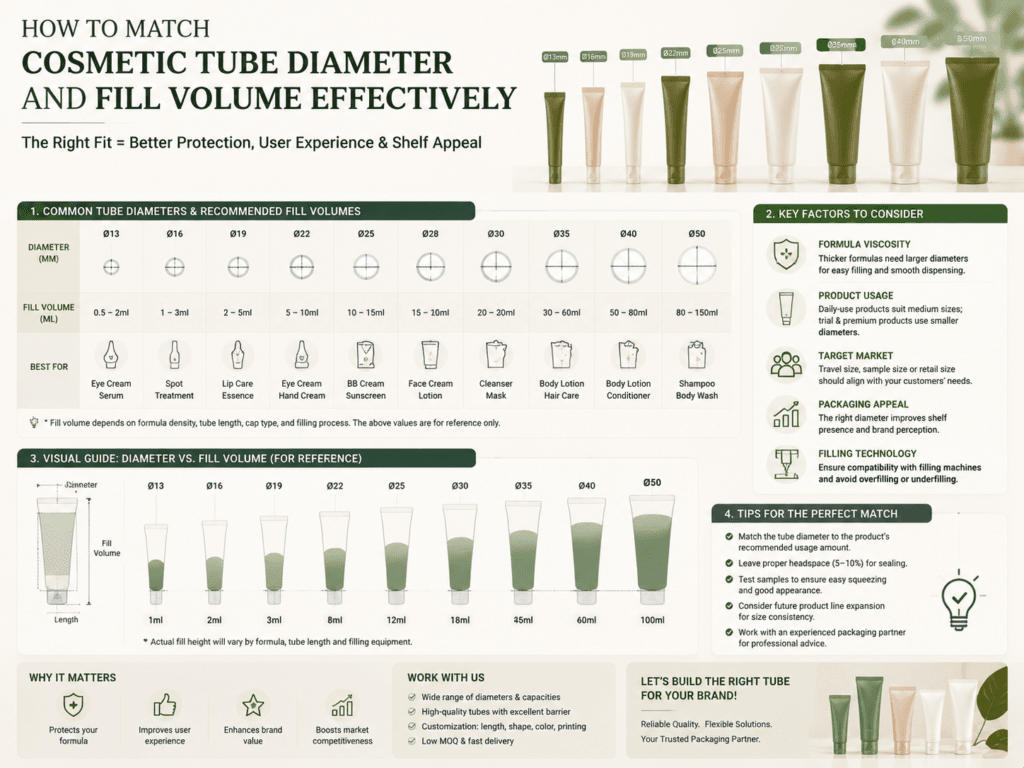
Tube length and diameter decide how much your tube holds and its shape. Most cosmetic tubes are 13mm to 50mm wide and hold 15ml to 200ml. You can pick a short, wide tube for thick creams. Or you can pick a long, slim tube for gels. Standard sizes make production simple and cheaper. Custom sizes look special but can cost more and take longer to make.
When you design your tube, think about how people will use it. A tube that is too small may annoy users because they need to buy more often. A tube that is too big may lead to waste if the product expires before it is finished. You should match tube size to how much people use and how long it lasts. This keeps customers happy.
Industry Size Standards
You should follow industry standards for tube packaging. This helps your product fit well in the market. Most tubes are 13mm to 50mm wide and hold 15ml to 200ml. These standards help you find the right machines, caps, and decoration.
Tube size can change based on:
- Diameter and length
- Shape (round, oval, or custom)
- Head style (flat, slant, or needle)
- Material (PE, PCR, ABL, PBL, aluminum)
- Cap options (flip-top, screw, dual-chamber)
PBL gives a strong barrier to protect important ingredients and make products last longer. Monolayer tubes are good for personal care products that do not need extra protection. Laminate tubes give more protection for special products. Aluminum tubes are 100% recyclable and work well for products that need a strong barrier.
Decoration and printing make your product look nice and stand out. You can use offset printing, silk screen, or hot stamping to show your brand and important details. Customization lets you match your packaging to your brand’s style. Good caps and decoration also help protect your product and meet fda rules.
If you want good tube packaging, you can work with suppliers like Jiangsu Xinfly Packaging Co.,Ltd. They offer custom tubes with certifications like ISO, RoHS, SGS, and GRS. This makes sure your packaging is safe and high quality.
Tube Diameter and Fill Volume Guide
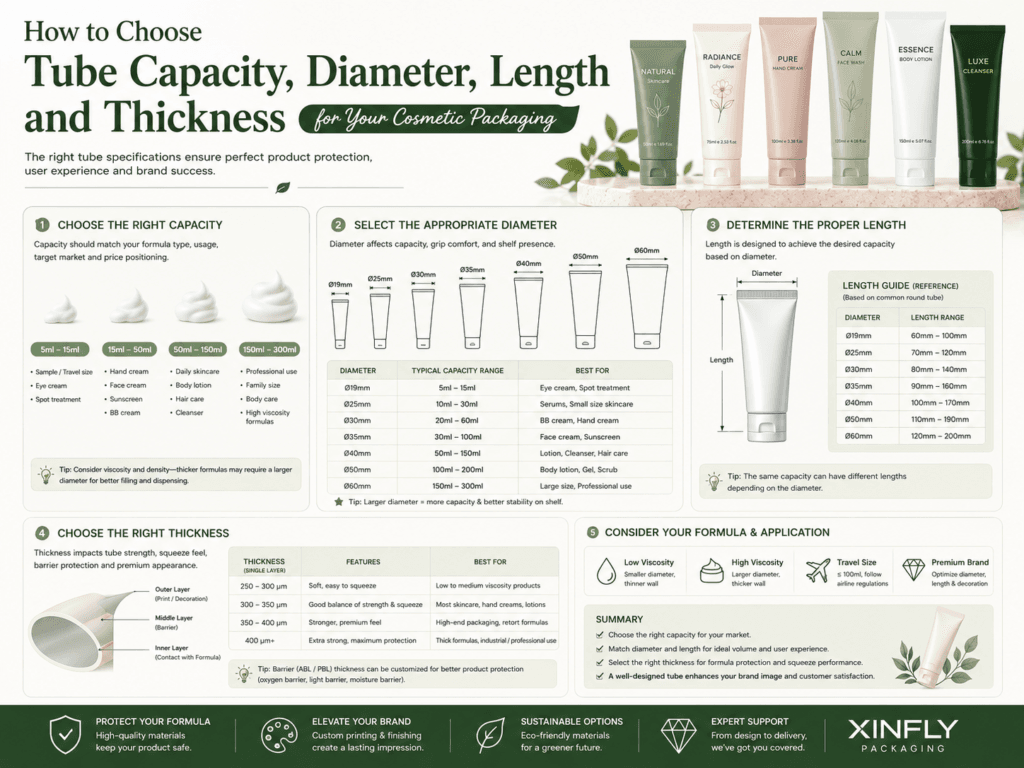
Picking the right tube diameter and fill volume is important. It helps you make good packaging for your cosmetic and personal care products. You can follow these steps to make sure your packaging fits your product, looks nice, and follows industry rules.
Define Fill Volume
First, decide how much product you want in each tube. Measure fill volume in milliliters (ml) or fluid ounces (fl oz). Always put these units on your product label. For example, you might write “4 fl oz (118 ml)” on the tube. Put this information on the front, near the bottom of the label. If you need to change between units, remember one fluid ounce is about 29.57 ml. Round down to the nearest whole number for milliliters. This step helps you follow fda rules and makes things clear for customers.
Choose Tube Diameter
Next, pick a tube diameter that fits your product and fill volume. The diameter changes how the tube feels, how much it holds, and how easy it is to squeeze. You can use this table to compare choices:
| Criteria | Details |
|---|---|
| Diameter Range | Standard range is from 13mm to 50mm. |
| Customization Options | Includes choices for wall thickness, shoulder type (round, oval, flat), and neck thread options. |
| Importance of Design | Customization in tube design is crucial for branding and differentiating products. |
Small diameters (13.5 mm to 19 mm) are good for samples or spot treatments. Medium diameters (22 mm to 25 mm) are used for most skincare products you buy in stores. Large diameters (28 mm to 35 mm and above) are best for family-size or professional products. The right diameter also helps the tube work well with different caps.
Xinfly Packaging has many standard and custom tube diameters and sizes. You can see their choices in the table below:
| Specification | Available Options | Project Recommendation |
|---|---|---|
| Diameter | 19mm–60mm | Travel size to family-size packaging |
| Capacity | 5ml–250ml | Samples, retail products and professional lines |
You can also pick from special diameters and volumes:
| Specification | Available Options | Project Recommendation |
|---|---|---|
| Diameter | 19mm, 22mm, 25mm, 30mm, 35mm, 40mm, 45mm, 50mm and custom sizes | Diameter affects capacity, decoration area, cap matching, squeeze feel and filling efficiency. |
| Capacity | 5ml, 10ml, 15ml, 30ml, 50ml, 60ml, 75ml, 100ml, 150ml, 200ml or custom volume | Match product dosage, travel size, retail format, hotel amenities or family-size packaging. |
Adjust Tube Length
After you choose the diameter, change the tube length to get the fill volume you want. A longer tube holds more product. A shorter tube is better for small amounts. The mix of diameter and length gives you the right size and shape. For thick creams, a wider and shorter tube is easier to squeeze. For liquids or gels, a longer and slimmer tube works better. Always check that your tube fits your filling machines and meets your supplier’s minimum order numbers.
Cap and Applicator Choices
The cap and applicator you pick change how people use your product. The right cap keeps your product safe and easy to use. Here is a table to help you compare cap types:
| Cap Type | Description | Application Area |
|---|---|---|
| Screw caps | Standard, cost-effective, widely used across industries | General cosmetic products |
| Nozzle caps | Designed for precision application, often used in medical or targeted skincare products | Targeted skincare |
| Flip-top caps | Enhance convenience and are popular in consumer-facing cosmetic products | Everyday cosmetic use |
| Stand-up caps | Allow inverted storage, improving product evacuation and shelf presence | Products requiring easy dispensing |
You can also use disc-top tubes for easy one-handed use. The tube’s diameter decides which caps and applicators will fit. Small tubes work best with nozzle or screw caps. Bigger tubes can use flip-top or stand-up caps. Always match the cap to your product’s viscosity and how people will use it.
Tip: The right cap and applicator make your product easier to use and help it stand out on the shelf.
Bringing It All Together
When you match tube diameter and fill volume, you make packaging that protects your product, supports your brand, and helps your customers. You can use laminate tubes for products that need strong protection. Laminate tubes keep active ingredients fresh and safe for health and skincare. Custom tubes let you pick the best design, printing, and decoration for your brand. Digital printing and 360-degree designs make your packaging look special and eye-catching. Always check that your packaging follows fda rules and industry standards.
Jiangsu Xinfly Packaging Co.,Ltd. is a company that makes cosmetic tube packaging. They offer custom PE, PCR, ABL, and PBL tubes for beauty brands around the world. Their certifications include ISO, RoHS, SGS, PCR Plastic GRS, and third-party testing. You can see their SGS test report here and their full certification list here. Xinfly Packaging helps you with custom orders, minimum order numbers, and cost control for your packaging projects.
Common Mistakes to Avoid
Overfilling or Underfilling
You should not put too much or too little in your tubes. Even small changes in how much you fill can cause problems. If you put in too much, you waste product and spend more money. If you put in too little, customers may get upset and you could break rules. Some countries have strict rules about how much goes in each package. If you do not fill enough, you might get fined or have to take products back. Automated filling machines help you fill tubes the right way. These machines use sensors to check every tube. This means fewer mistakes and your tubes all look the same. Filling the right amount also helps you use less material and not waste anything.
Tip: Always check your filling machines and set them for each product. This helps you meet quality rules and keeps your customers happy.
Ignoring Viscosity
You need to think about viscosity when you pick tube packaging. Viscosity is how thick or thin your product is. It changes how your product goes into the tube and comes out. If you forget about viscosity, you might choose the wrong tube or machine. This can slow down your work and cause leaks or clogs. For example, one company used a machine for 50,000 cP to fill a product that was 180,000 cP. This mistake made filling slow and wasted product.
| Parameter | Formula | Explanation |
|---|---|---|
| Flow rate (Q) | ( Q = \frac{(P_2 – P_1) \pi r^4}{8 \eta l} ) | Flow rate gets slower if viscosity is high or the tube is narrow or long. |
| Resistance (R) | ( R = \frac{8 \eta l}{\pi r^4} ) | Resistance gets higher with thick products and longer tubes. |
| Pressure drop | ( P_2 – P_1 = RQ ) | High viscosity makes a bigger pressure drop, so filling is harder. |
You should always match your tube and machine to your product’s viscosity. This helps you avoid filling problems and keeps your packaging safe for skin and personal care products.
Overlooking Standards
You should always follow industry standards when you design packaging. Standards help you follow the law and fit what the market wants. If you ignore them, you could get in trouble or not be able to sell your product. Rules groups may check your packaging more often. You could also lose to other brands if you do not keep up with new standards.
- Not following standards can lead to fines.
- You might not be able to sell your product if you break rules.
- Rules groups may check your packaging more.
- Not updating your packaging can hurt your brand and sales.
Always check the newest standards for tube packaging. This helps you avoid mistakes and keeps your products in stores.
Cap Compatibility
You need to pick the right cap for your tube. If you choose the wrong cap, your product might leak or be hard to use. The right cap helps keep your product safe. It also makes it easier for people to use your cosmetics or skincare. For example, flip-top caps are good for lotions. Nozzle caps are better for spot treatments. The tube and cap must fit together. Good caps also help with printing and decoration, so your packaging looks nice on the shelf.
Note: Always test your caps with your tubes before making a lot. This helps you stop leaks and keeps your packaging safe.
Mistakes in tube packaging can cost more, waste product, and hurt your brand. Planning, talking with suppliers, and checking your work help you avoid these problems. Customization, printing, and decoration should always fit your product and follow industry rules.
Tips for Effective Tube Sizing
Consult Suppliers
You should always talk with your packaging supplier early in your project. Good suppliers help you choose the right tube for your formula. They know how to match diameter and wall thickness to protect your product and give it a good feel. Suppliers can also check if your formula needs a special barrier or structure. They will show you technical drawings and send samples for testing. This step helps you avoid mistakes and saves time.
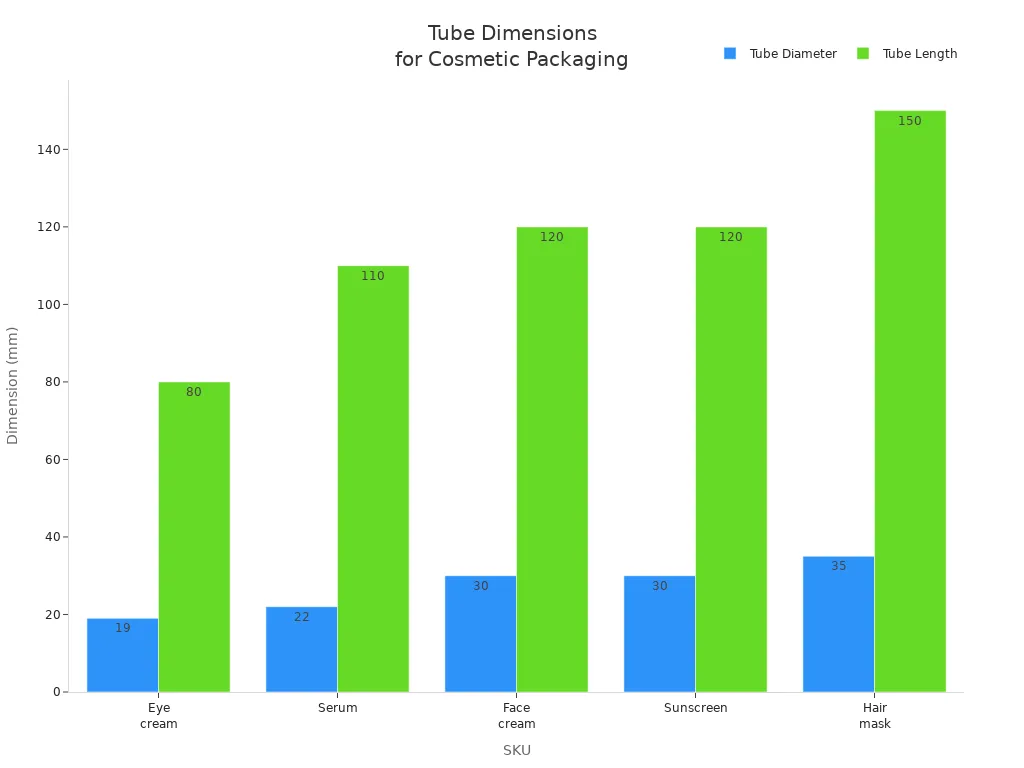
| SKU | Capacity | Category | Diameter | Length (est.) | Structure |
|---|---|---|---|---|---|
| Eye cream | 15 ml | Face | 19 mm | 80 mm | PBL |
| Serum | 30 ml | Face | 22 mm | 110 mm | PE multi |
| Face cream | 50 ml | Face | 30 mm | 120 mm | PE multi |
| Sunscreen | 50 ml | Face | 30 mm | 120 mm | ABL |
| Hair mask | 100 ml | Hair | 35 mm | 150 mm | PE |
Tip: Early teamwork with your supplier helps you get the best tube packaging for filling, shipping, and selling.
Jiangsu Xinfly Packaging Co.,Ltd. offers custom tube packaging solutions and holds certifications like ISO, RoHS, SGS, and GRS. You can trust their advice for your packaging needs.
Test Dispensing
You need to test how your product comes out of the tube. Fill a few sample tubes and try them yourself. Check if the tube is easy to squeeze and if the cap works well. Make sure the product does not leak or clog. Testing helps you see if the tube fits your formula and your customers’ needs. You can also ask your supplier for feedback on the design and decoration.
Note: Testing with real samples helps you find problems before you make a lot of tubes.
Balance Aesthetics and Cost
You want your packaging to look good and not cost too much. Choose a tube size and shape that matches your brand style. Pick colors and decoration that stand out on the shelf. At the same time, watch your budget. Standard tube sizes often cost less and are faster to make. Custom shapes or special decoration may cost more. Work with your supplier to find the best balance for your project.
- Standard tubes save money and time.
- Custom tubes and decoration make your product unique.
- Good packaging design helps your brand and controls cost.
Remember: The right tube packaging protects your product, shows off your brand, and keeps your project on budget.
You can match tube diameter and fill volume by using simple steps. First, figure out what your product is and how people will use it. Think about what the industry expects and what users like. The tube’s shape and size change how it looks and how easy it is to use. Look at different packaging choices for how long the product lasts, how stable it is, and if it follows the rules.
| Tube Type | Benefits | Ideal Use Cases |
|---|---|---|
| Extruded Tubes | Good for many uses and save money | Used for most packaging needs |
| Co-extruded Tubes | Great at keeping products fresh | Best for products that last long |
| Aluminum Tubes | Keep products safe and look classic | Used for fancy cosmetics or medicine |
Keep checking and testing your tube packaging to make it better. Xinfly Packaging offers green materials, custom designs, and checks for quality. Their certifications mean the packaging is safe and you can trust it.
How to Match Cosmetic Tube Diameter and Fill Volume Effectively
A technical guide for cosmetic packaging engineers and beauty brands on how to match tube diameter, fill volume, product viscosity, and packaging structure for optimal performance and cost efficiency.
Why is matching tube diameter and fill volume important?
What happens if tube diameter is too small?
What happens if tube diameter is too large?
How does fill volume relate to tube diameter?
What is the standard cosmetic tube size chart?
Which tube diameter is best for skincare products?
How does viscosity affect tube selection?
Can tube capacity be customized?
What industries use diameter-volume matching?
What materials affect tube volume performance?
How do manufacturers ensure accurate tube filling?
Why choose Xinfly Packaging for cosmetic tube design?
Need Help Matching Tube Size and Fill Volume?
Xinfly Packaging helps beauty brands design precise cosmetic tube structures with optimized diameter, fill volume, barrier performance, and OEM customization.