
Quick Answer
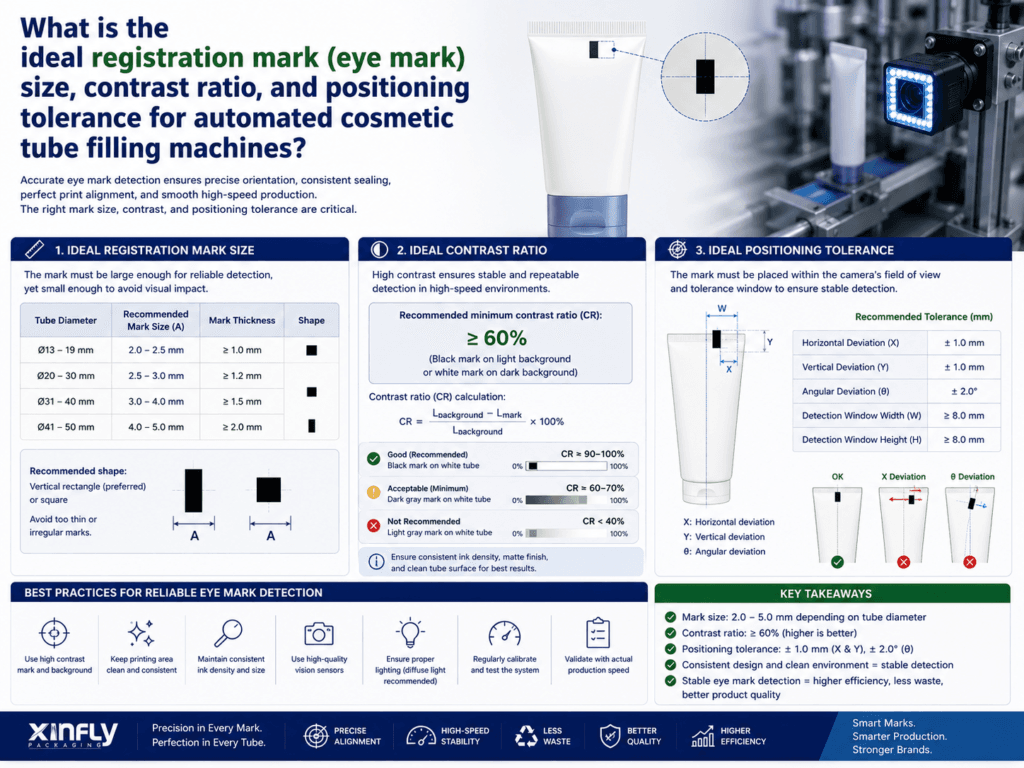
For automated cosmetic tube filling and sealing lines, a practical registration mark, or eye mark, is often designed as a high-contrast rectangular mark approximately 3–5 mm wide and 8–12 mm long, with the final dimensions determined by the filling machine’s photoelectric sensor and printing process.
For reliable detection, the eye mark should normally provide strong contrast against the surrounding artwork, remain visually clean, and be positioned consistently relative to the tube’s longitudinal artwork and sealing reference. A positioning tolerance of around ±0.5 mm is a useful premium-production target, while ±1.0 mm may be acceptable for some applications. The actual tolerance must be validated against the filling machine and required print-to-seal registration.
An eye mark is a small optical registration mark printed on the tube web or laminate material. During automated tube production and filling, a photoelectric or vision sensor detects the mark and uses it as a reference for cutting, indexing, tube positioning, printing registration or sealing alignment.
For cosmetic tubes, the eye mark is especially important when the package contains front-and-back artwork, directional graphics, asymmetric logos or a specific tail-seal orientation.
What Is an Eye Mark on a Cosmetic Tube?
An eye mark, also called a registration mark, registration eye or print mark, is a machine-readable reference printed on the packaging material.
Machine Reference
The sensor detects the eye mark and establishes the position of the printed artwork.
Cutting Reference
The mark can help determine where the tube web should be cut or indexed.
Sealing Reference
Correct registration helps maintain consistent artwork orientation relative to the tail seal.
What Is the Ideal Eye Mark Size for Cosmetic Tubes?
There is no universal eye-mark size that works with every filling or tube-making machine. The sensor’s optical system, detection distance, mark color, substrate, printing method and line speed all affect the required dimensions.
As a practical starting point for cosmetic tube artwork, many projects can evaluate a rectangular mark in the approximate range of:
| Parameter | Practical Starting Range | Engineering Note |
|---|---|---|
| Mark Width | Approx. 3–5 mm | Provides a reasonably large detection area without consuming excessive artwork space. |
| Mark Length | Approx. 8–12 mm | Longer marks can provide a more stable detection window at production speed. |
| Shape | Rectangle or machine-approved standard shape | A simple geometric shape is generally easier for optical detection. |
| Mark Edge | Clean and sharply defined | Blurred or irregular edges can increase detection variation. |
Important: The dimensions above should be treated as engineering starting points rather than a universal machine standard. Always confirm the minimum detectable mark size specified by the actual sensor and filling equipment.
What Contrast Ratio Should an Eye Mark Have?
High contrast is generally more important than simply making the eye mark large. The sensor needs to distinguish the mark from the surrounding substrate and artwork under actual production lighting conditions.
Black on White
Usually provides a strong optical contrast and is one of the easiest configurations for photoelectric sensors to detect.
Dark on Light
A dark mark against a light background generally provides stronger detection than similar-tone colors.
Metallic Background
ABL and metallized structures can require sensor-specific testing because reflection may affect detection.
How Should Contrast Be Specified?
For packaging engineering, it is better to specify the eye mark using measurable optical contrast rather than relying only on a Pantone color description.
Recommended Artwork Requirement
- Use a clearly distinguishable dark mark against a significantly lighter background whenever possible.
- Avoid placing the eye mark over gradients, photographs or highly reflective artwork.
- Keep the surrounding detection zone visually clean.
- Validate the actual printed substrate rather than relying only on screen artwork.
- Confirm sensor performance under the final production lighting conditions.
For applications requiring a numerical contrast specification, the packaging engineer and filling-machine supplier should agree on the optical detection method and measurable contrast requirement. A single universal “contrast ratio” should not be assumed for all photoelectric sensors.
Why Does Eye Mark Positioning Tolerance Matter?
The eye mark establishes a machine reference. If its position varies significantly from one tube blank or printed repeat to another, the equipment may cut, orient or seal the tube at the wrong location.
| Position Variation | Potential Effect |
|---|---|
| Within ±0.5 mm | Suitable as a tight premium-production target for applications requiring accurate artwork-to-seal registration. |
| Around ±1.0 mm | May be acceptable for less demanding artwork applications, depending on machine capability. |
| Greater Than ±1.0 mm | Can become visually noticeable on directional artwork and may increase registration problems. |
Where Should the Eye Mark Be Positioned?
The eye mark should be placed in a dedicated registration zone where the filling or tube-making sensor can detect it without interference from logos, text, gradients or decorative graphics.
How Does Eye Mark Accuracy Affect Tube Artwork?
| Registration Problem | Visible Result |
|---|---|
| Longitudinal Offset | Logo or text may shift relative to the tube shoulder or tail. |
| Circumferential Offset | Front artwork may rotate away from the intended viewing direction. |
| Variable Repeat Length | Artwork position changes from tube to tube. |
| Incorrect Eye Mark Detection | Machine may index the material at the wrong location. |
| Eye Mark Not Detected | Machine may stop, reject the tube or lose registration. |
What Eye Mark Problems Are Common on PE Tubes?
Mono-layer and multi-layer PE tubes are generally less reflective than aluminum-based laminate structures, but printing quality and artwork background can still affect sensor detection.
- Low contrast between mark and background.
- Ink spread or insufficiently defined edges.
- Eye mark partially covered by artwork.
- Variation in printing density.
- Tube web movement during production.
- Incorrect sensor sensitivity.
What Eye Mark Problems Are Common on ABL Tubes?
ABL tubes contain an aluminum barrier layer. Depending on the laminate construction and printing surface, reflections can influence optical sensor performance.
For ABL tubes, do not approve the eye mark only from a digital PDF proof.
The actual printed laminate should be tested using the intended sensor because metallic reflection, ink opacity and surface finish can change detection behavior.
How Does Glossy or Metallic Artwork Affect Eye Mark Detection?
Glossy coatings, metallic inks, foil effects and reflective laminate can create optical noise. The sensor may detect reflections instead of the intended eye mark or experience inconsistent signal strength.
Gloss Varnish
May increase reflected light around the detection zone.
Metallic Ink
Can produce optical characteristics that differ significantly from ordinary CMYK printing.
Aluminum Barrier
Can increase reflectivity and require sensor adjustment or an alternative detection strategy.
Should the Eye Mark Be Black?
Black is often a good starting choice because it provides strong contrast against a white or light-colored background. However, black is not mandatory.
A dark blue, dark green or another sufficiently dark printed mark may also work if the sensor can reliably distinguish it from the surrounding substrate.
Best Practice
Choose the eye-mark color based on measured sensor response, not simply on visual appearance to the human eye.
Can the Eye Mark Be Hidden From Consumers?
Yes. For premium cosmetic packaging, the eye mark is normally positioned in a production-only area or integrated into an area that will be removed, folded, sealed or hidden after tube production.
However, the mark should never be moved or reduced purely for aesthetic reasons without confirming that the machine can still detect it reliably.
What Should the Artwork File Include?
Recommended Artwork Specification
- Finished tube diameter and length.
- Tube material: PE, PBL or ABL.
- Printing method.
- Eye mark dimensions.
- Eye mark color.
- Eye mark position.
- Artwork repeat length.
- Distance from eye mark to key artwork reference.
- Required registration tolerance.
- Final sealing orientation.
How Should the Eye Mark Be Tested Before Mass Production?
A reliable test should use the actual printed tube material and the intended production machine whenever possible.
| Test Stage | What to Check |
|---|---|
| Artwork Proof | Confirm dimensions, position and repeat distance. |
| Printed Proof | Check actual contrast, edge quality and substrate interaction. |
| Sensor Test | Verify stable detection using the intended photoelectric sensor. |
| Machine Trial | Run the actual tube material at production speed. |
| Registration Inspection | Measure artwork position relative to the sealing and cutting reference. |
| Mass Production QC | Monitor registration variation throughout the production batch. |
What Causes False Eye Mark Detection?
Low Contrast
The sensor cannot clearly distinguish the mark from the background.
Reflective Surface
Glossy or metallic material produces unwanted optical signals.
Artwork Interference
Nearby graphics resemble the registration mark.
Sensor Sensitivity
The detection threshold is incorrectly adjusted.
Web Movement
Material vibration or lateral movement changes the sensor position.
Dirty Sensor
Dust or product residue can reduce optical detection reliability.
What Is a Good Eye Mark Specification for a Premium Cosmetic Tube?
Recommended Engineering Starting Specification
- Shape: Simple rectangular registration mark.
- Size: Approximately 3–5 mm × 8–12 mm as an initial design range.
- Contrast: Strong dark/light optical contrast with a clean surrounding zone.
- Position tolerance: Target approximately ±0.5 mm where the production system can support it.
- Acceptable tolerance: Approximately ±1.0 mm may be suitable for some applications.
- Surface: Avoid unnecessary gloss, metallic effects or gradients around the detection zone.
- Validation: Test the actual printed substrate on the actual filling or tube-making machine.
These are engineering starting recommendations, not universal machine specifications.
The final eye-mark dimensions and tolerance should always be confirmed against the filling machine, sensor model, printing process, tube construction and required artwork-to-seal accuracy.
Factory Engineer Recommendation
The eye mark should be treated as a functional machine component of the packaging artwork—not merely as a graphic element.
For a new cosmetic tube project, Xinfly recommends defining the eye mark together with the tube diameter, artwork repeat, tail-seal orientation, printing method and filling-machine requirements before the artwork is finalized.
Summary
A reliable cosmetic tube eye mark should be large enough for the machine sensor to detect consistently, provide strong optical contrast, have clean edges and maintain a stable position relative to the artwork and tube-sealing reference.
As a practical starting point, a 3–5 mm × 8–12 mm rectangular eye mark with strong dark/light contrast can be evaluated. For premium artwork registration, approximately ±0.5 mm positioning control is a useful target, while some applications may tolerate around ±1.0 mm.
However, the final specification must be validated against the actual sensor and filling equipment. This is especially important for ABL tubes, metallic decoration, glossy finishes and high-speed automatic filling lines.
Related Questions
| Topic | Related Resource |
|---|---|
| Tube Artwork Alignment | Why Do Screw Caps Sometimes Fail to Align With Printed Front Artwork? |
| Automated Filling | What Technical Parameters Are Required for an Automated Cosmetic Tube Filling and Sealing Line? |
| Tail Sealing | How to Troubleshoot Tail-Sealing Issues in a Filling Factory? |
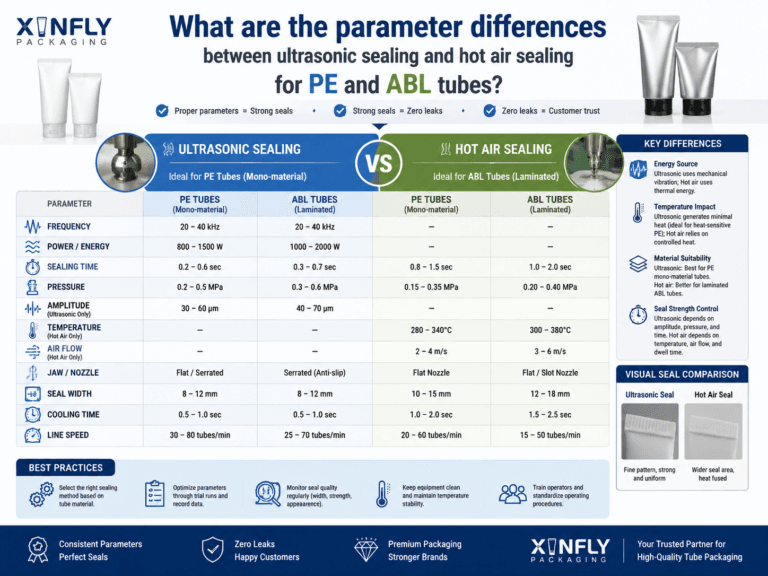
| PE Tube Sealing | Ultrasonic vs Hot Air Sealing for PE and ABL Tubes |
| Tube Printing | How Does Printing Affect Cosmetic Tube Color Accuracy and Registration? |
Need Custom Cosmetic Tubes With Accurate Artwork Registration?
Xinfly Packaging can help brands and filling factories coordinate tube dimensions, artwork registration, eye-mark positioning, printing specifications and filling-line compatibility before mass production.
Request a Packaging Solution Contact Packaging Engineer