
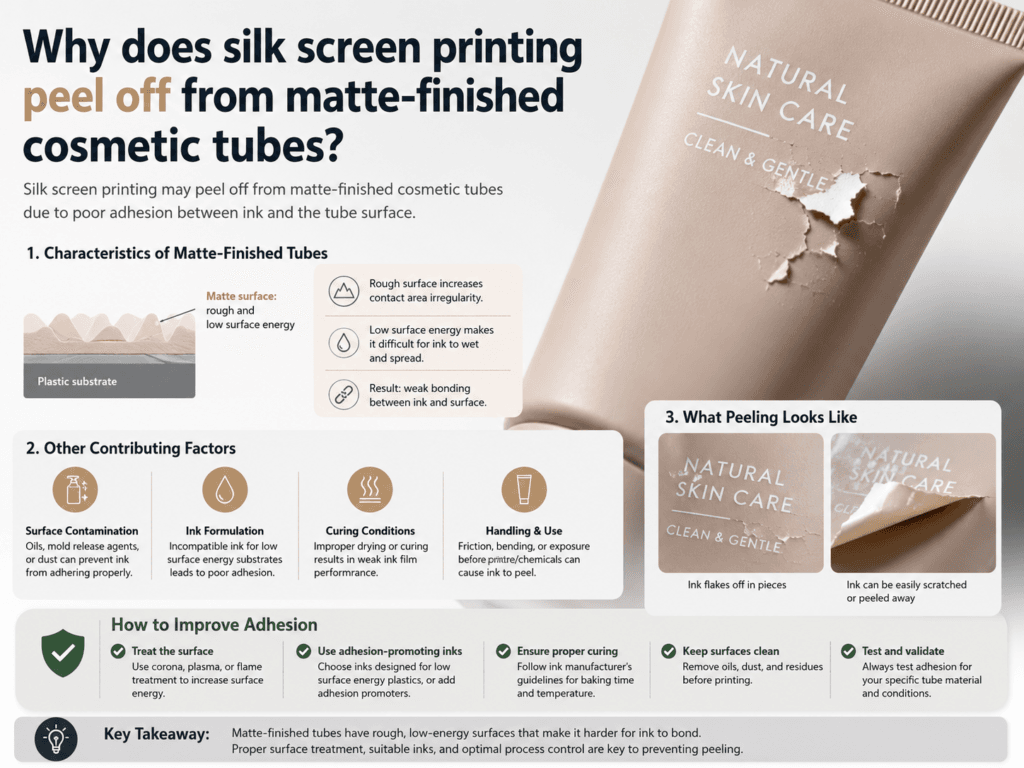
Silk screen printing usually peels off from matte-finished cosmetic tubes because the matte surface makes ink adhesion more difficult. In most cases, the problem is not the silk screen process alone. It is the combination of low surface energy, matte coating texture, poor pretreatment, wrong ink selection, or incomplete curing that causes the printed layer to lose bond strength and peel during tape testing, rubbing, transport, or consumer use.
Matte-finished tubes often look more premium than glossy tubes, but they are also more sensitive to decoration control. If the matte layer is too powdery, too low in surface energy, or not properly treated before printing, the ink may sit on the surface instead of anchoring into it. That is why a tube can look beautiful right after printing but still fail adhesion later.
Most Common Reasons Silk Screen Printing Peels Off Matte Tubes
| Root Cause | What Happens | Result |
|---|---|---|
| Low surface energy | Ink cannot fully wet the tube surface | Weak adhesion and easy peeling |
| Insufficient flame or corona treatment | Surface is not activated enough before printing | Ink layer bonds poorly |
| Matte coating incompatibility | Ink is not matched to the matte varnish or matte resin layer | Print may lift under tape or rubbing |
| Incomplete curing | Ink film does not fully crosslink or dry | Print remains fragile and unstable |
| Dust, silicone, oil, or contamination | Foreign material blocks ink contact with substrate | Local adhesion failure and flaking |
Why Matte-Finished Tubes Are More Difficult Than Glossy Tubes
- Matte surfaces often reduce wet-out: The ink cannot spread and anchor as easily as on a smoother glossy tube.
- Matte coatings may be more delicate: If the matte layer itself has weak cohesion, the ink may pull part of that layer away.
- Surface treatment becomes more critical: Even a good ink can fail if pretreatment is weak or delayed.
- Premium finishes expose defects faster: Peeling, scratching, and edge lift are more visible on a matte premium tube.
Typical Failure Scenarios
| Failure Scenario | Likely Cause |
|---|---|
| Print peels during tape test | Poor surface activation or wrong ink system |
| Print scratches off after transport | Incomplete curing or weak ink/coating compatibility |
| Only some areas peel | Uneven treatment, dust, oil, or handling contamination |
| Peeling after a few days, not immediately | Surface treatment aged out or cure strength was insufficient |
How to Fix the Problem
- Use the correct ink for matte substrates: Ink must be tested against the actual matte tube finish, not just the base plastic type.
- Improve flame or corona treatment: Matte PE and similar low-energy plastics usually need reliable pretreatment before printing.
- Print within the treatment window: Surface activation can decline if printing is delayed too long after treatment.
- Confirm full curing conditions: UV or thermal curing must match the ink supplier’s real process requirement.
- Control contamination: Avoid silicone, dust, skin oil, release agents, and dirty handling before printing.
Best Preventive Strategy for Premium Matte Cosmetic Tubes
| Control Point | Best Practice |
|---|---|
| Tube surface | Validate matte coating quality and surface-energy consistency |
| Pretreatment | Use controlled flame or corona treatment before printing |
| Ink selection | Match silk screen ink to the actual matte-finished substrate |
| Curing | Run adhesion and abrasion tests after full cure, not only visual inspection |
| QC test | Use tape test, scratch test, and transport simulation before mass production |
Silk Screen vs Other Decoration Options on Matte Tubes
If the matte tube finish is difficult to print reliably, brands may also consider offset printing, hot stamping, or different matte decoration structures. In some projects, the better solution is not changing the artwork, but improving the surface-finishing system + printing system together so the decoration and tube body work as one compatible package.
Summary
Silk screen printing peels off from matte-finished cosmetic tubes mainly because matte surfaces are harder for the ink to bond to. The most common causes are low surface energy, weak or delayed pretreatment, poor ink compatibility, incomplete curing, and surface contamination.
To prevent peeling, manufacturers should validate the matte surface, use proper flame or corona treatment, choose ink designed for that exact substrate, and confirm adhesion with real tape, scratch, and transport tests before production.
Learn more: Silk Screen Printing Tubes, Silk Screen Printing vs Offset Printing, Matte Finish vs Glossy vs Soft-Touch Tubes, Surface Finishing, Printing Options, Hot Stamping Tubes.
Need Better Adhesion on Matte Cosmetic Tubes?
Xinfly Packaging helps brands optimize matte tube finishing, pretreatment, ink compatibility, and printing quality control to reduce peeling risk and improve premium decoration performance.