

Labeling vs Direct Tube Printing: Which Method Is Best for Cosmetic Tubes?
Cosmetic tube packaging needs clear product information and appealing branding. Two common decoration methods are labeling and direct printing. Choosing the right method can affect production cost, visual quality, durability and perceived value.
Labeling uses printed sleeves or glue-on labels to wrap or apply artwork, while direct tube printing prints directly on the tube surface using silk screen, offset or other print techniques. Both have pros and cons depending on your tube material, decoration complexity and branding strategy.
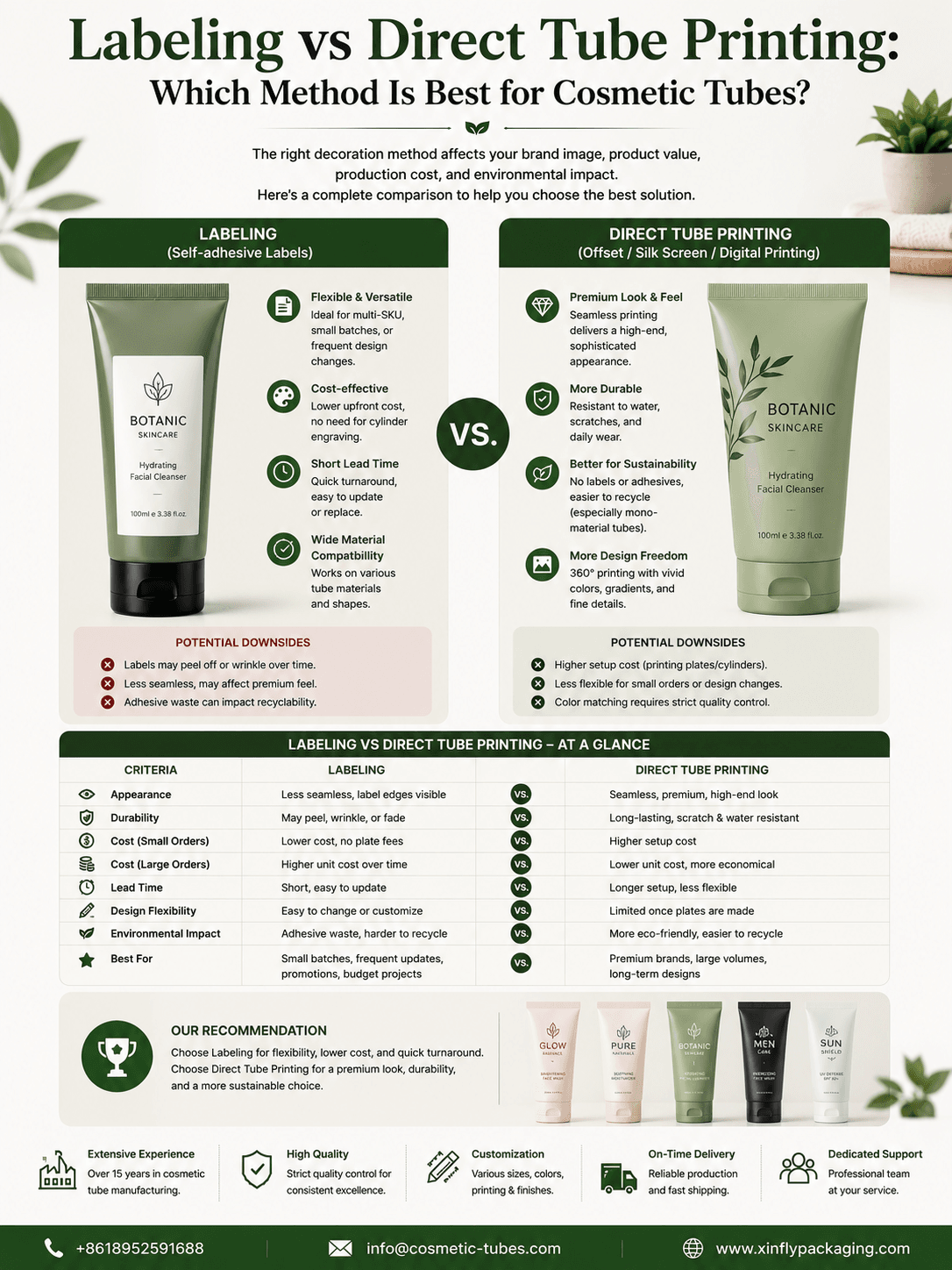
Understanding Labeling and Direct Tube Printing
Both methods have unique strengths. The right choice depends on product application, artwork complexity and branding goals.
What Is Labeling?
Labeling involves applying a pre‑printed sleeve, wrap or glue‑on label onto the tube body. Labels can be digitally printed in full color and often include photos, gradients and special effects.
It’s commonly used for small batch runs, seasonal products, promotions and products with very detailed full‑color artwork where direct printing setup may be costly.
Related resource: Labeling Tubes Guide
What Is Direct Tube Printing?
Direct tube printing prints artwork directly onto the tube surface via silk screen, offset, digital or other printing technologies. This method results in a more durable decoration that integrates seamlessly with the tube body.
Direct printing is ideal for mid‑to‑large volume runs where cost per unit decreases with higher quantities and where printing durability is key.
Helpful links: Silk Screen Printing Tubes, Offset Printing Tubes
Labeling: Flexible for Small Batch and Complex Artwork
Labeling is useful when brands need fast artwork changes, full-color graphics or seasonal packaging without changing the tube printing setup.
Advantages of Labeling
- Good for small batch, trial runs and promotional products
- Supports full-color images, gradients and detailed artwork
- Allows different artwork versions using the same tube base
- Suitable for fast market testing and seasonal product launches
- Can reduce direct printing setup pressure for low quantity projects
Considerations for Labeling
Labels add an extra material layer to the tube. Brands should review label adhesion, edge lifting, water resistance, oil resistance, tube squeeze behavior and recyclability impact before mass production.
Labeling is practical for hand cream, body lotion, hotel amenities, sample tubes and promotional cosmetic packaging where flexibility matters more than a fully integrated printed surface.
Related pages: Labeling Tubes, Hand Cream Tube Packaging
Direct Tube Printing: Durable and Integrated Branding
Direct printing creates a cleaner, more integrated packaging appearance by printing artwork directly onto the tube body.
Advantages of Direct Tube Printing
- More durable decoration for daily handling and squeezing
- Cleaner appearance without label edges
- Better for mid-to-large volume production
- Supports silk screen, offset printing, hot stamping and combined decoration
- Excellent for long-term brand packaging and premium cosmetic tubes
Considerations for Direct Printing
Direct tube printing usually requires better artwork preparation, color confirmation and printing setup. It is more suitable when the brand has finalized artwork and wants a consistent packaging appearance across regular production orders.
For detailed images or gradients, offset printing is suitable. For bold logos and solid text, silk screen printing often performs better. Hot stamping can be added for metallic accents.
Related pages: Silk Screen vs Offset Printing, Hot Stamping vs Silk Screen Printing
Labeling vs Direct Tube Printing: Detailed Comparison
Use this comparison to decide which method fits your artwork, order volume, product category and brand positioning.
| Comparison Point | Labeling | Direct Tube Printing | Xinfly Packaging Recommendation |
|---|---|---|---|
| Best For | Small batch, seasonal items, promotional tubes, multiple artwork versions | Regular production, premium packaging, long-term brand SKUs | Choose labeling for flexibility; choose direct printing for stable brand packaging. |
| Artwork Flexibility | Excellent for photo images, gradients and frequent design changes | Excellent for fixed artwork, logos, text and consistent brand systems | Use labels when artwork changes often; use direct printing when artwork is confirmed. |
| Durability | Depends on label material, adhesive and tube squeeze behavior | Usually stronger because the decoration is integrated with tube surface | Direct printing is better for products handled frequently. |
| Surface Appearance | May show label edge or material difference | Cleaner, seamless and more professional appearance | Direct printing is preferred for premium skincare and sunscreen packaging. |
| Cost Logic | Flexible for low quantity and many designs | More efficient for larger quantities and repeated orders | Compare total cost based on order quantity and artwork versions. |
| Sustainability Consideration | Extra label material may affect recyclability depending on structure | Can reduce extra material layers when printed directly | For recyclable tube projects, review label material and adhesive carefully. |
| Best Applications | Sample tubes, hotel amenities, promotional skincare, seasonal collections | Skincare, sunscreen, toothpaste, hand cream, makeup and personal care tubes | Match the method with product lifecycle and brand positioning. |
Application Scenarios: Which Method Should You Choose?
The right method depends on whether your project needs flexibility, premium appearance, production stability or detailed artwork.
Small Batch and Trial Products
Labeling is often more practical for startups, seasonal launches and trial products because it allows easier artwork changes and lower setup pressure.
Premium Skincare and Sunscreen
Direct printing is usually preferred for premium skincare and sunscreen tubes because it creates a cleaner, more integrated surface and better long-term brand consistency.
Hotel Amenities and Sample Tubes
Labeling can work for hotel amenities and sample projects where artwork changes frequently by hotel, market or promotion.
Long-Term Brand Packaging
Direct printing is better for mature SKUs with stable artwork, larger quantities and consistent brand identity across multiple production runs.
Frequently Asked Questions
Common inquiries about labeling and direct tube printing for cosmetic tubes.
1. What is tube labeling?
Tube labeling is the process of applying pre-printed labels or sleeves onto cosmetic tubes.
2. What is direct tube printing?
Direct tube printing involves printing artwork directly onto the tube surface using methods like silk screen, offset or digital printing.
3. Which method is more cost-effective?
Labeling is more flexible and economical for small batches; direct printing is more cost-effective for mid-to-large volumes.
4. Which method is better for premium skincare tubes?
Direct tube printing is preferred for premium skincare because it provides a clean, durable, integrated appearance.
5. Can labels be used on soft touch tubes?
Yes, but adhesive compatibility and surface performance should be tested.
6. Does direct printing work on ABL/PE/PCR tubes?
Yes, Xinfly Packaging can apply direct printing to all major tube materials, including PE, PCR, ABL, and PBL tubes.
7. Which method is more durable?
Direct printing is generally more durable since the ink is bonded to the tube surface, while labels can peel or wear off over time.
8. Which method is better for small batch runs?
Labeling is usually more practical for small batch runs or frequent artwork changes.
9. Can I combine labeling and direct printing?
Yes, some brands combine a direct printed base with additional labels for seasonal or promotional artwork.
10. Does labeling affect recyclability?
Yes, additional label materials and adhesives can impact tube recyclability. Direct printing is more eco-friendly for sustainable tubes.
11. What is the minimum order quantity for direct printing?
The MOQ depends on tube size, material, and printing complexity. Xinfly can provide flexible options.
12. How long does production take for both methods?
Lead time varies by batch size and decoration method. Typically, labeling can be faster for small batches, while direct printing requires setup but is efficient for larger volumes.
Need Expert Advice on Cosmetic Tube Decoration?
Xinfly Packaging provides complete solutions for labeling and direct tube printing, compatible with all tube materials and applications.
Request Samples & Quote Explore Printing Options