
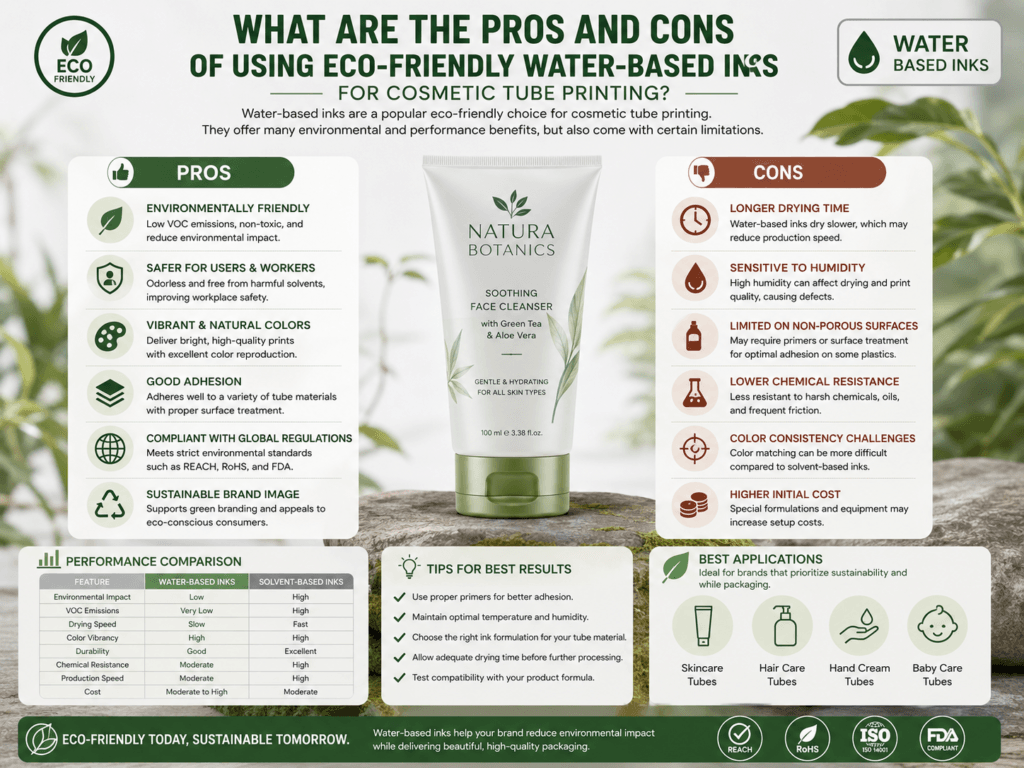
Eco-friendly water-based inks can be a good option for cosmetic tube printing, but they are not automatically the best choice for every tube project. Their biggest advantages are usually lower VOC emissions, lower flammability, and a stronger sustainability story. Their biggest limitations are usually related to adhesion, drying, and durability on non-porous plastic tube surfaces such as PE, laminated, or other flexible packaging substrates.
In simple terms, water-based inks are attractive because they support safer and more environmentally friendly printing operations. However, cosmetic tubes are not easy substrates. They are curved, flexible, often low in surface energy, and expected to maintain a premium look after filling, sealing, shipping, and consumer use. That means the success of water-based inks depends on the tube material, surface treatment, print method, curing conditions, and end-use durability requirements.
Main Pros of Water-Based Inks for Cosmetic Tube Printing
| Advantage | Why It Matters for Brands |
|---|---|
| Lower VOC emissions | Supports a more eco-friendly and regulation-conscious printing process |
| Lower flammability | Improves pressroom safety compared with more solvent-heavy systems |
| Stronger sustainability story | Useful for brands promoting cleaner packaging and environmental responsibility |
| Lower odor profile | Can be helpful in some packaging-production environments |
| Potential compatibility with recyclable packaging goals | Can support broader packaging sustainability positioning when properly selected |
Main Cons of Water-Based Inks for Cosmetic Tubes
| Limitation | Why It Can Be a Problem |
|---|---|
| Adhesion challenges on plastic tubes | PE and other non-porous substrates are harder for water-based systems than porous paper surfaces |
| Drying sensitivity | Water-based inks often need tighter drying control to avoid smudging or slow production |
| Rub and scuff resistance may need enhancement | Cosmetic tubes face handling, filling-line friction, and transport abrasion |
| May require stronger surface treatment | Low-surface-energy substrates often need good pretreatment for stable bonding |
| Not always ideal for every premium effect | Some luxury decorative results may still be easier with other ink or decoration systems |
Why Plastic Cosmetic Tubes Are More Demanding
- Most cosmetic tubes use non-absorbent surfaces: Unlike paper or board, plastic tubes do not naturally absorb the ink vehicle.
- PE is low-surface-energy: This makes adhesion more difficult unless the tube is properly treated.
- Tubes are flexible packages: The printed layer must survive squeezing, filling, sealing, rubbing, and shipping.
- Premium appearance matters: Beauty packaging is judged closely, so any weakness in print durability is easy to notice.
When Water-Based Inks Are a Good Choice
| Project Condition | Why Water-Based Ink Can Work |
|---|---|
| Brand has strong sustainability messaging | Supports lower-VOC and eco-oriented packaging communication |
| Printing system is designed for water-based technology | Better process stability and more predictable performance |
| Substrate and surface treatment are validated | Improves adhesion on plastic tube surfaces |
| Artwork and durability needs are realistic | Reduces risk of overpromising on unsuitable premium effects |
When Water-Based Inks Need Extra Caution
- On untreated or difficult PE tube surfaces
- When high abrasion resistance is essential
- When the line speed is fast and drying time is limited
- When the design requires extremely demanding premium decoration performance
- When the tube will face aggressive filling, sealing, or chemical exposure
How Manufacturers Improve Performance
| Improvement Method | What It Helps |
|---|---|
| Proper surface treatment | Improves wetting and adhesion on PE or other plastic substrates |
| Optimized drying and curing | Reduces smudging and improves print stability |
| Correct ink formulation for the substrate | Improves bonding, durability, and print consistency |
| Rub and abrasion testing | Checks whether the print can survive real handling conditions |
| Real production trials | Confirms performance before full mass production |
Best Practical Advice for Beauty Brands
Eco-friendly water-based inks are usually best viewed as a strategic option, not a universal upgrade. They are strongest when a brand values lower-VOC production and when the converter already has the right technology, surface treatment, and process control for plastic packaging. They are weaker when the project requires maximum adhesion margin on difficult tube surfaces without any process optimization.
Summary
The pros of using eco-friendly water-based inks for cosmetic tube printing include lower VOC emissions, lower flammability, reduced odor, and a stronger sustainability story. The cons usually include more demanding adhesion on plastic substrates, drying sensitivity, and the need for tighter durability control on non-porous tube surfaces.
For cosmetic tubes, water-based inks can work well when the tube material, pretreatment, printing process, and end-use expectations are properly matched. The best decision is usually based on both sustainability goals and real performance testing, not on environmental positioning alone.
Learn more: Printing Options, Tube Decoration, Quality Assurance, How to Choose Sustainable Cosmetic Tubes, PE Tubes, Sustainable Materials.
Need a More Sustainable Printing Solution for Cosmetic Tubes?
Xinfly Packaging helps brands compare water-based inks, conventional ink systems, and decoration methods based on sustainability goals, adhesion performance, and real tube-production conditions.