

Silk Screen Printing vs Offset Printing: Which Method Is Better for Cosmetic Tubes?
Cosmetic tube decoration is more than just transferring art to packaging — it shapes brand perception, visual appeal and product communication. Two of the most commonly used printing methods are silk screen printing and offset printing.
Silk screen is known for thick ink coverage, vibrant color and clear logos, while offset printing excels in rendering complex gradients, photo-like images and high-resolution multi-color graphics. Choosing the right method depends on surface finish, artwork, tube material and branding strategy.
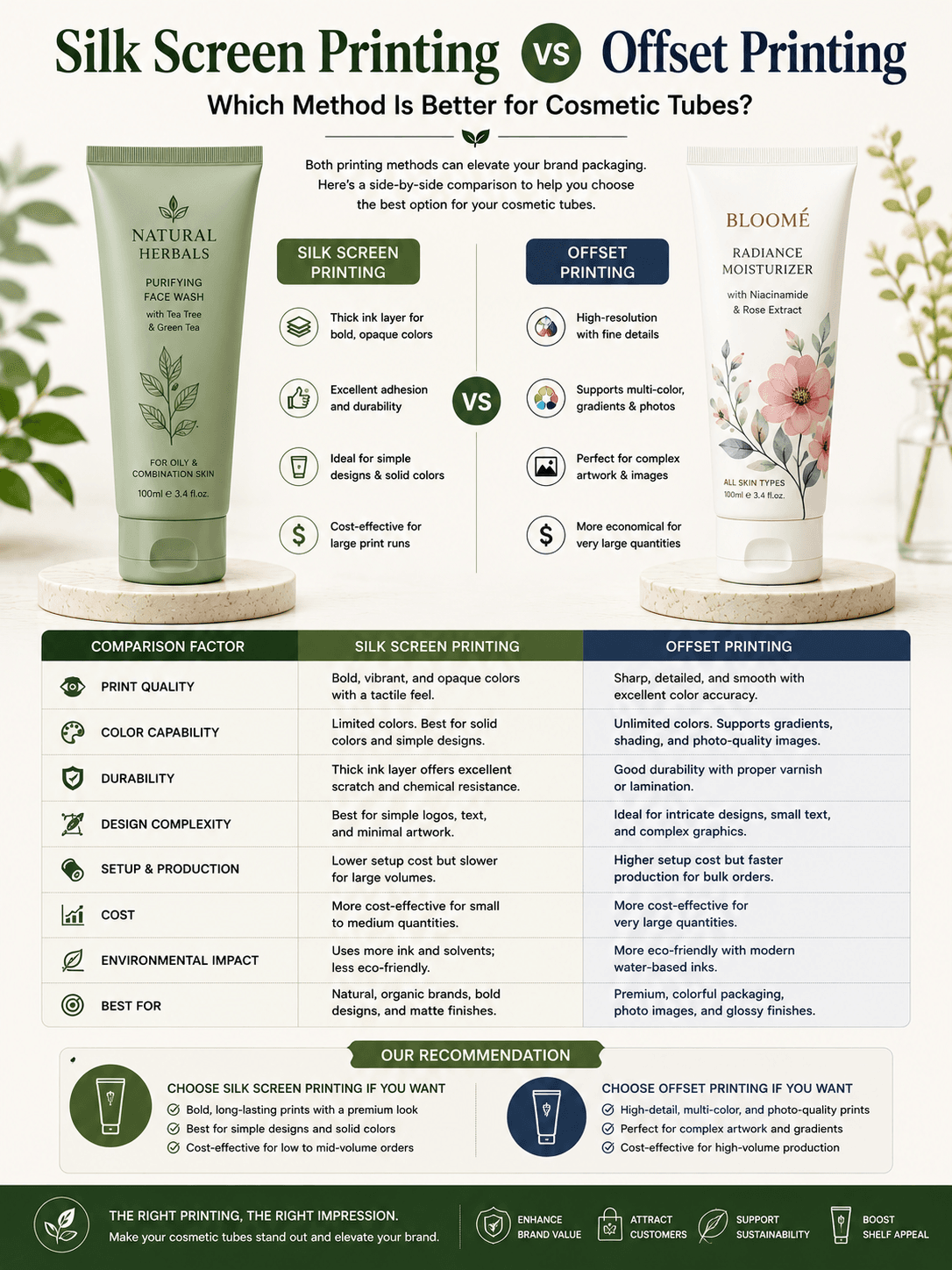
Understanding Printing Methods for Cosmetic Tubes
Printing and decoration contribute significantly to how a cosmetic product is perceived on shelf and in marketing materials. Before choosing between silk screen and offset printing, it’s important to understand how each method interprets ink, surface finish, material compatibility and color performance.
Overview of Silk Screen Printing
Silk screen printing applies ink through a mesh screen to the tube surface. It places thick layers of ink, resulting in strong opacity, bold colors and excellent durability for logos, text and solid graphics.
It works well on most tube surfaces including matte finish, soft-touch and glossy tubes, and is widely used for personal care tubes, skincare tubes, sunscreen tubes and toothpaste tubes.
Overview of Offset Printing
Offset printing transfers the design from a plate to a rubber blanket and then to the tube surface, allowing very high resolution, complex gradients, detailed illustrations and multi-color artwork with photo-like quality.
It’s commonly used for high-end brand packaging, complex graphic labels and projects requiring high-definition visuals where photographic details or gradients are essential.
Advantages of Silk Screen Printing
Thick ink, vibrant colors and high opacity make silk screen ideal for logos, text, and solid color graphics.
Benefits
- High opacity ink coverage
- Works on matte, glossy and soft-touch surfaces
- Durable text and logo printing
- Cost-effective for medium area solid graphics
Best Use Cases
Suitable for hand cream tubes, facial cleanser tubes, toothpaste, sunscreen and personal care tubes where bold color and readable text are essential.
Advantages of Offset Printing
High-resolution, photo-like printing with gradients and detailed illustrations.
Benefits
- High-resolution graphics and photographic detail
- Excellent for gradients and complex multi-color images
- Precise color reproduction for brand logos
- Works well on smooth PE, ABL, PBL tube surfaces
Best Use Cases
Ideal for high-end cosmetic products requiring premium sunscreen tubes, makeup, foundation, and decorative tubes with detailed artwork or photographic images.
Silk Screen vs Offset Printing: Quick Comparison
Side-by-side comparison helps decide the right printing method for your cosmetic tubes.
| Feature | Silk Screen Printing | Offset Printing |
|---|---|---|
| Main Strength | Thick ink, high opacity, vibrant colors | High-resolution, complex gradients, photo-quality images |
| Best Applications | Logos, text, solid graphics on personal care and skincare tubes | Complex illustrations, photographic details on premium and makeup tubes |
| Surface Compatibility | Matte, glossy, soft-touch tubes | Mostly smooth PE, laminated tubes, ABL, PBL |
| Color Coverage | Opaque, strong solid colors | Precise gradients, multi-color images |
| Cost | Medium; efficient for solid color areas | Medium to high; suited for high-definition prints |
Real-World Printing Projects
Examples where Xinfly applied silk screen and offset printing for cosmetic tube decoration.
Frequently Asked Questions
Common questions about silk screen and offset printing for cosmetic tubes.
1. What is silk screen printing?
Silk screen printing applies thick ink layers via a mesh screen for durable logos, text, and solid graphics.
2. What is offset printing?
Offset printing transfers images from a plate to a rubber blanket then onto the tube surface, enabling high-resolution gradients and photo-quality artwork.
3. Which method provides better opacity?
Silk screen printing provides thicker ink layers and higher opacity for text and logos.
4. Which method is better for gradients or photos?
Offset printing is ideal for gradients, photos, and complex multi-color images.
5. Can both methods be combined?
Yes. Many cosmetic tube projects combine silk screen for text and offset for high-resolution imagery.
6. Which method is more cost-effective?
Silk screen is generally more cost-effective for smaller areas; offset is more suitable for detailed artwork requiring high precision.
7. Which tube surfaces are compatible?
Silk screen works on matte, glossy, soft-touch tubes; offset works best on smooth PE, laminated, ABL or PBL tubes.
8. Which method is more durable?
Both methods are durable; silk screen is thick and resilient, offset preserves detail for high-end visuals.
9. Which is better for logos?
Silk screen provides strong visibility for logos, offset is better for detailed logo with gradients.
10. Which method works on glossy surfaces?
Both can work; adhesion and testing are required to ensure quality.
11. Does Xinfly Packaging offer both?
Yes, Xinfly provides silk screen and offset printing for various cosmetic tubes.
12. How to choose between them?
Choose based on artwork complexity, surface finish, tube material, and brand positioning.
Need Professional Cosmetic Tube Printing?
Xinfly Packaging provides silk screen printing and offset printing for all cosmetic tubes, including skincare, hand cream, sunscreen, toothpaste, and makeup tubes. We help select the best method for your product.
Request Free Samples & Quote Explore Printing Options