

Mono Material Tubes vs PCR Tubes: Which Sustainable Packaging Option Is Better?
For skincare, sunscreen, facial cleanser, hand cream, body lotion and personal care packaging, many brands compare mono material tubes and PCR tubes when developing sustainable cosmetic packaging.
Mono material tubes focus on improving recyclability by simplifying the tube structure, usually using one main resin family such as PE or PP. PCR tubes focus on reducing virgin plastic usage by incorporating post-consumer recycled plastic into the tube body. Both options can support sustainability goals, but they solve different packaging problems.
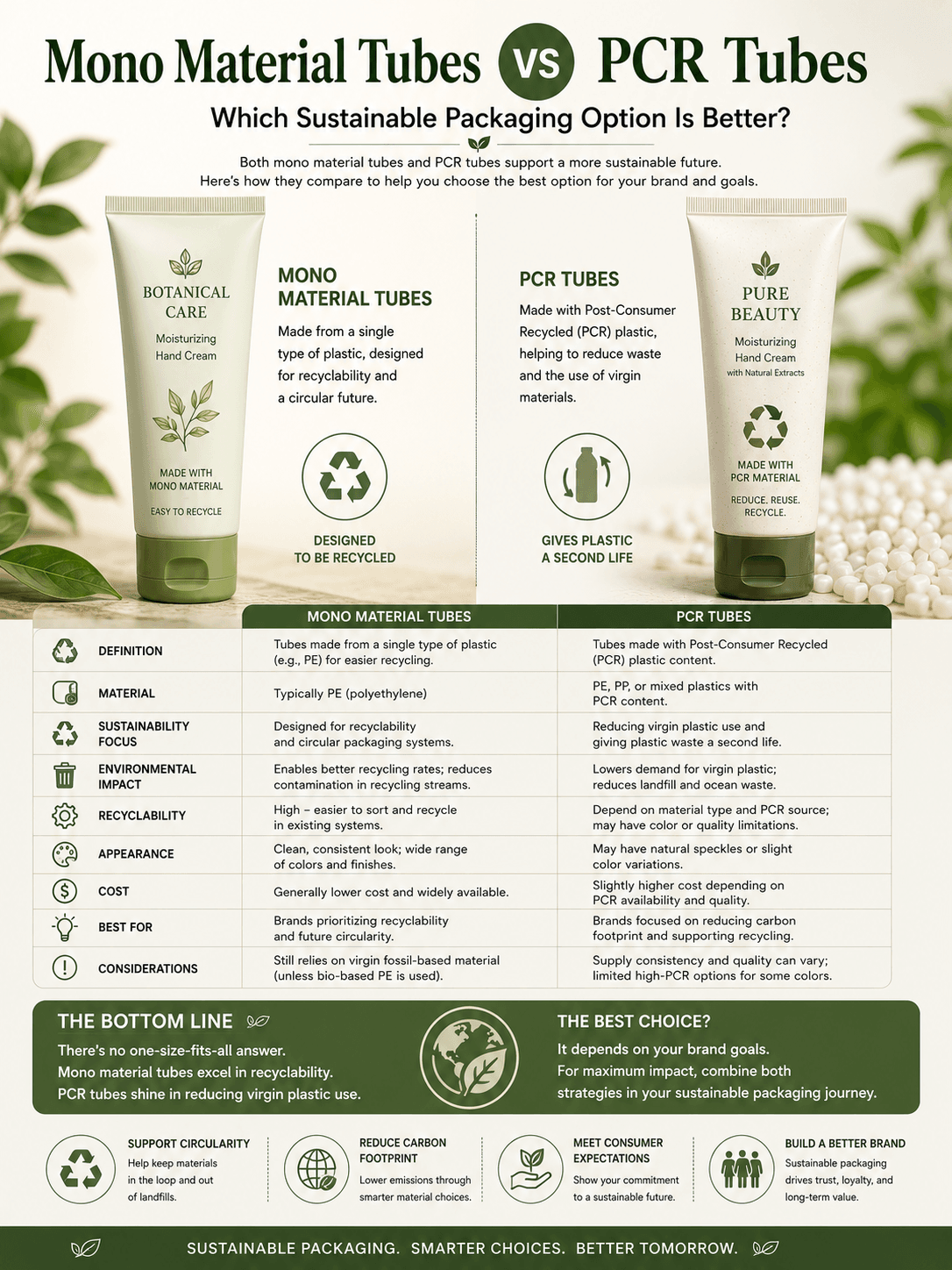
Recyclability vs Recycled Content: What Is the Real Difference?
Mono material tubes and PCR tubes are often discussed together, but their sustainability logic is not the same.
The Real Purchasing Question
A mono material tube is mainly designed to make the package easier to recycle by reducing material complexity. A PCR tube is mainly designed to reduce the use of virgin plastic by adding recycled content. One focuses on the end-of-life recycling pathway, while the other focuses on material sourcing.
For beauty brands, the best choice depends on whether the main sustainability message should be “designed for recyclability” or “made with recycled plastic.”
Xinfly Packaging’s Recommendation Method
Jiangsu Xinfly Packaging Co.,Ltd. helps global beauty brands compare mono material tubes, PCR tubes, recyclable PE tubes, sugarcane tubes, EVOH barrier tubes, ABL tubes and PBL tubes based on actual product requirements.
Related guides: Mono Material Tubes vs Multi-Layer Tubes and PCR Tubes vs Virgin Plastic Tubes
What Are Mono Material Tubes?
Mono material tubes are designed using one primary resin family, such as mono PE or mono PP, to reduce recycling complexity and support recyclable packaging strategies.
Designed for Better Recycling Compatibility
Mono material cosmetic tubes are commonly used when brands want to simplify the packaging structure and improve compatibility with recycling streams. Compared with complex multi-layer or mixed-material structures, mono material tubes make the recycling story easier to communicate.
- Focuses on recyclability and material simplification
- Usually made from mono PE or mono PP structures
- Suitable for stable skincare, cleanser, lotion and hotel amenity formulas
- Helps reduce recycling complexity caused by mixed materials
When Mono Material Tubes Are More Suitable
Choose mono material tubes when your brand wants a recyclable structure and the formula does not require extremely high barrier protection. They are suitable for facial cleanser, hand cream, body lotion, hotel amenities, natural skincare and many daily personal care products.
Useful pages: Recyclable Cosmetic Tubes and Are Cosmetic Tubes Recyclable?
What Are PCR Tubes?
PCR means Post-Consumer Recycled plastic. PCR tubes are made by incorporating recycled plastic material from consumer waste streams into cosmetic tube packaging.
Designed to Reduce Virgin Plastic Usage
PCR cosmetic tubes help brands lower their reliance on virgin plastic and support recycled-content packaging claims. PCR content can often be adjusted according to project needs, such as 30%, 50%, 70% or higher content, depending on appearance, material availability, certification and processing requirements.
- Focuses on recycled content and virgin plastic reduction
- Supports ESG, clean beauty and sustainability claims
- Available in different PCR content levels
- Suitable for skincare, sunscreen, hand cream and body care tubes
When PCR Tubes Are More Suitable
Choose PCR tubes when your brand wants to communicate recycled-content value and reduce virgin plastic usage. PCR tubes are especially suitable for sustainable skincare lines, eco-friendly sunscreen, body care, hand cream and personal care packaging.
Useful pages: PCR Tubes and PCR Cosmetic Tubes Manufacturer
Mono Material Tubes vs PCR Tubes: Detailed Comparison
The right sustainable tube depends on your primary goal: easier recycling, recycled content, formula protection, appearance consistency or cost control.
| Comparison Point | Mono Material Tubes | PCR Tubes | Xinfly Packaging Recommendation |
|---|---|---|---|
| Main Sustainability Goal | Improve recyclability by simplifying material structure | Reduce virgin plastic usage by adding recycled content | Choose mono material for recyclability claims; choose PCR for recycled-content claims. |
| Material Logic | One main resin family, such as mono PE or mono PP | Plastic tube structure containing post-consumer recycled material | Mono material focuses on end-of-life design; PCR focuses on material sourcing. |
| Recyclability Direction | Generally stronger recyclability positioning when designed correctly | Depends on complete tube structure, cap, shoulder and decoration | Mono material is often easier to explain for recycling compatibility. |
| Recycled Content Claim | Not necessarily recycled unless PCR is added | Strong recycled-content communication | Use PCR when your marketing message focuses on recycled plastic content. |
| Appearance Consistency | Usually stable and close to standard PE appearance | May vary depending on PCR percentage and recycled resin source | For strict color matching, test PCR content before production. |
| Best Applications | Facial cleanser, hand cream, body lotion, hotel amenities, stable skincare | Sustainable skincare, eco sunscreen, body care, hand cream, ESG product lines | Match the material claim with product category and formula requirement. |
| Cost Consideration | Depends on structure, resin, MOQ and decoration | Depends on PCR percentage, certification and recycled resin supply | Compare total project value, including sustainability story and production stability. |
Application Scenarios: When to Choose Mono Material or PCR Tubes
Mono material tubes are stronger for recyclability positioning, while PCR tubes are stronger for recycled-content storytelling. The best option depends on the product formula and brand claim.
Facial Cleanser Tubes
Facial cleanser is often suitable for mono material PE structures because many formulas are stable and do not require extremely high barrier protection.
Hand Cream Tubes
Hand cream tubes can use either mono material structures or PCR PE, depending on whether recyclability or recycled-content communication is more important.
Body Lotion Tubes
Body lotion is a practical category for sustainable tube upgrades. Mono material supports recyclable structure, while PCR helps reduce virgin plastic use.
Hotel Amenities Tubes
Hotel amenity tubes are suitable for mono material packaging when hotels want simplified recyclable structures, or PCR packaging when recycled-content claims matter.
Eco-Friendly Sunscreen Tubes
PCR tubes can support sustainable sunscreen packaging, but SPF formulas should be tested for barrier performance, sealing and compatibility before launch.
Skincare Tubes
For skincare products, mono material tubes are suitable for stable formulas, while PCR tubes are suitable for brands with strong recycled-content targets.
Can Mono Material and PCR Be Combined?
Yes. In some projects, a cosmetic tube can be designed with a mono material structure and also contain PCR content.
Mono PE + PCR Content
A mono PE tube can include post-consumer recycled PE content when material supply, appearance tolerance and processing performance are confirmed. This approach may support both recyclability direction and recycled-content claims.
Testing Is Important
When mono material and PCR are combined, testing should check tube forming, sealing, printing, cap matching, squeeze feel, color stability and formula compatibility.
Claims Must Match the Structure
A tube should not be called recyclable or PCR-based unless the actual material composition and documentation support the claim. Recyclability also depends on the complete tube, cap and local systems.
Related Sustainable Packaging Comparisons
These comparison pages help buyers understand the differences between recyclable design, recycled content, renewable materials and high-barrier structures.
| Comparison Topic | What It Helps You Decide | Recommended Page |
|---|---|---|
| Mono Material vs Multi-Layer Tubes | Whether recyclability or barrier performance should be the priority | Read Comparison |
| PCR vs Virgin Plastic Tubes | Whether recycled content or new plastic resin fits your packaging project | Read Comparison |
| Recyclable vs Traditional Tubes | Whether recyclable structures can replace traditional cosmetic tube packaging | Read Comparison |
| Eco-Friendly vs Standard Tubes | How eco-friendly tube options compare with standard cosmetic tubes | Read Comparison |
| Biodegradable vs Recyclable Tubes | Whether degradation or recycling is the better end-of-life strategy | Read Comparison |
Custom Mono Material and PCR Tube Specifications
Xinfly Packaging supports custom sustainable tube development based on product formula, decoration requirements, PCR content, recyclability goals and market positioning.
| Specification | Available Options | Project Recommendation |
|---|---|---|
| Tube Material | Mono PE, mono PP, PCR PE, recyclable PE, virgin PE, sugarcane PE, EVOH, PBL | Select based on recyclability target, recycled-content requirement and formula sensitivity. |
| PCR Content | 10%, 30%, 50%, 70%, 100% or customized recycled content | 30%–50% PCR is often a practical balance between sustainability, appearance and processing stability. |
| Capacity | 5ml, 10ml, 15ml, 30ml, 50ml, 60ml, 75ml, 100ml, 150ml, 200ml or custom volume | Match travel size, retail format, hotel amenity use, sample pack or family-size packaging. |
| Diameter | 19mm, 22mm, 25mm, 30mm, 35mm, 40mm, 45mm, 50mm and custom sizes | Diameter affects capacity, artwork area, cap matching, squeeze feel and filling efficiency. |
| Decoration | Offset printing, silk screen printing, labeling, hot stamping, matte finish, glossy finish, soft-touch coating | For sustainable tubes, decoration should match recyclability goals and material appearance tolerance. |
| Cap Options | Screw cap, flip-top cap, nozzle cap, acrylic cap, airless pump options | Cap material and structure should be reviewed together with the tube body to support sustainability claims. |
| Testing Support | Leakage test, sealing test, compatibility review, drop test, appearance inspection | Testing is recommended before mass production, especially for high PCR content or new mono material structures. |
Certified Support for Sustainable Cosmetic Tube Projects
Xinfly Packaging helps brands prepare material documentation and quality support for international cosmetic tube projects.
Related Sustainable Packaging Projects
Explore real-world packaging projects and see how different sustainable tube structures are selected based on product requirements, environmental goals and commercial feasibility.
PCR Sunscreen Tubes Project
See how PCR materials were integrated into sunscreen tube packaging while balancing sustainability goals, product protection and brand image.
View ProjectFacial Cleanser Tubes Project
Learn how stable skincare formulas can benefit from recyclable-oriented tube structures and optimized packaging design.
View ProjectCustom Moisturizer Tubes Project
Discover how sustainability targets, decoration requirements and production feasibility were balanced in a moisturizer packaging project.
View ProjectPremium Sunscreen Tubes Project
An example showing how high-performance packaging requirements and sustainable material options can be evaluated together.
View ProjectWhy Global Beauty Brands Choose Xinfly Packaging
Choosing sustainable cosmetic packaging requires balancing recyclability, recycled content, appearance, barrier performance and production stability.
Jiangsu Xinfly Packaging Co.,Ltd. is a professional cosmetic tubes supplier providing custom PE, PCR, ABL, PBL and sustainable tube packaging solutions for global beauty brands with certifications such as ISO, RoHS (RoHS No.: NTS2405005R), SGS (Test Report No.: GZHL24050181970T), PCR Plastic GRS (GRS Certificate No.: ITS-TE-00059997-GRS-G) and third-party testing support.
Our engineering team helps customers evaluate mono material tubes, PCR tubes, recyclable tube structures, EVOH barrier tubes, laminate tubes and bio-based materials according to formula compatibility, sustainability objectives, shelf-life requirements, decoration needs and manufacturing feasibility.
Available sustainable packaging solutions include: Recyclable Cosmetic Tubes, PCR Cosmetic Tubes, Sugarcane Tubes, Wheat Straw Tubes, Bioplastic Tubes and Sustainable Packaging Tubes.
For more demanding cosmetic formulations, we also provide EVOH Barrier Tubes, ABL Tubes, PBL Tubes and High Barrier Cosmetic Tubes.
Learn more: Certifications | Factory Tour | OEM & ODM Services | Quality Assurance
Frequently Asked Questions
Common questions about mono material tubes, PCR tubes and sustainable cosmetic packaging.
1. What are mono material tubes?
Mono material tubes are cosmetic tubes designed using one primary resin family, such as mono PE or mono PP, to improve recycling compatibility.
2. What are PCR tubes?
PCR tubes use post-consumer recycled plastic content to reduce dependence on virgin plastic materials.
3. Are mono material tubes recyclable?
Mono material tubes are generally designed to improve recyclability, but actual recycling depends on local recycling systems and the complete package structure.
4. Are PCR tubes recyclable?
PCR tubes can be recyclable depending on the overall structure, cap, decoration and recycling infrastructure available in the target market.
5. Which option is more sustainable?
Mono material tubes focus on recyclability, while PCR tubes focus on reducing virgin plastic use. The best option depends on your sustainability priorities.
6. Can mono material tubes contain PCR content?
Yes. Some projects combine mono material structures with PCR content to support both recyclability and recycled-content objectives.
7. Which option is better for skincare packaging?
Both can be suitable. The decision depends on formula requirements, sustainability goals and market expectations.
8. Which option is better for sunscreen packaging?
PCR tubes are commonly used for sustainable sunscreen projects, but barrier performance and formula compatibility should always be tested.
9. Which option provides better appearance consistency?
Mono material tubes often provide more consistent appearance, while high PCR content may create slight color or texture variation.
10. Which option is more cost-effective?
Cost depends on material supply, PCR percentage, decoration requirements, MOQ and project complexity.
11. Does Xinfly Packaging offer both mono material and PCR tubes?
Yes. Xinfly Packaging supplies mono material tubes, PCR tubes and other sustainable cosmetic packaging solutions.
12. How do I choose between mono material tubes and PCR tubes?
Choose mono material tubes if recyclability is the priority. Choose PCR tubes if reducing virgin plastic usage and increasing recycled content are the primary goals.
Looking for Sustainable Cosmetic Tube Packaging?
Whether you need mono material tubes, PCR cosmetic tubes, recyclable packaging structures, sugarcane tubes or fully customized sustainable cosmetic packaging solutions, Xinfly Packaging can help you select the most suitable material and tube structure for your brand.
Request Free Samples & Quote Explore Sustainable Packaging