

Eco-Friendly Tubes vs Standard Cosmetic Tubes: Which Packaging Solution Is Better?
For skincare, sunscreen, hand cream, facial cleanser, hotel amenities, toothpaste and personal care products, brands often need to decide whether to use eco-friendly tube packaging or standard cosmetic tubes.
Eco-friendly tubes may include PCR tubes, sugarcane tubes, wheat straw tubes, recyclable tubes, bioplastic tubes and mono-material tubes. Standard cosmetic tubes usually include virgin PE tubes, ABL tubes, PBL tubes, EVOH tubes and traditional multi-layer structures. The best choice depends on sustainability goals, formula protection, appearance, cost and market requirements.
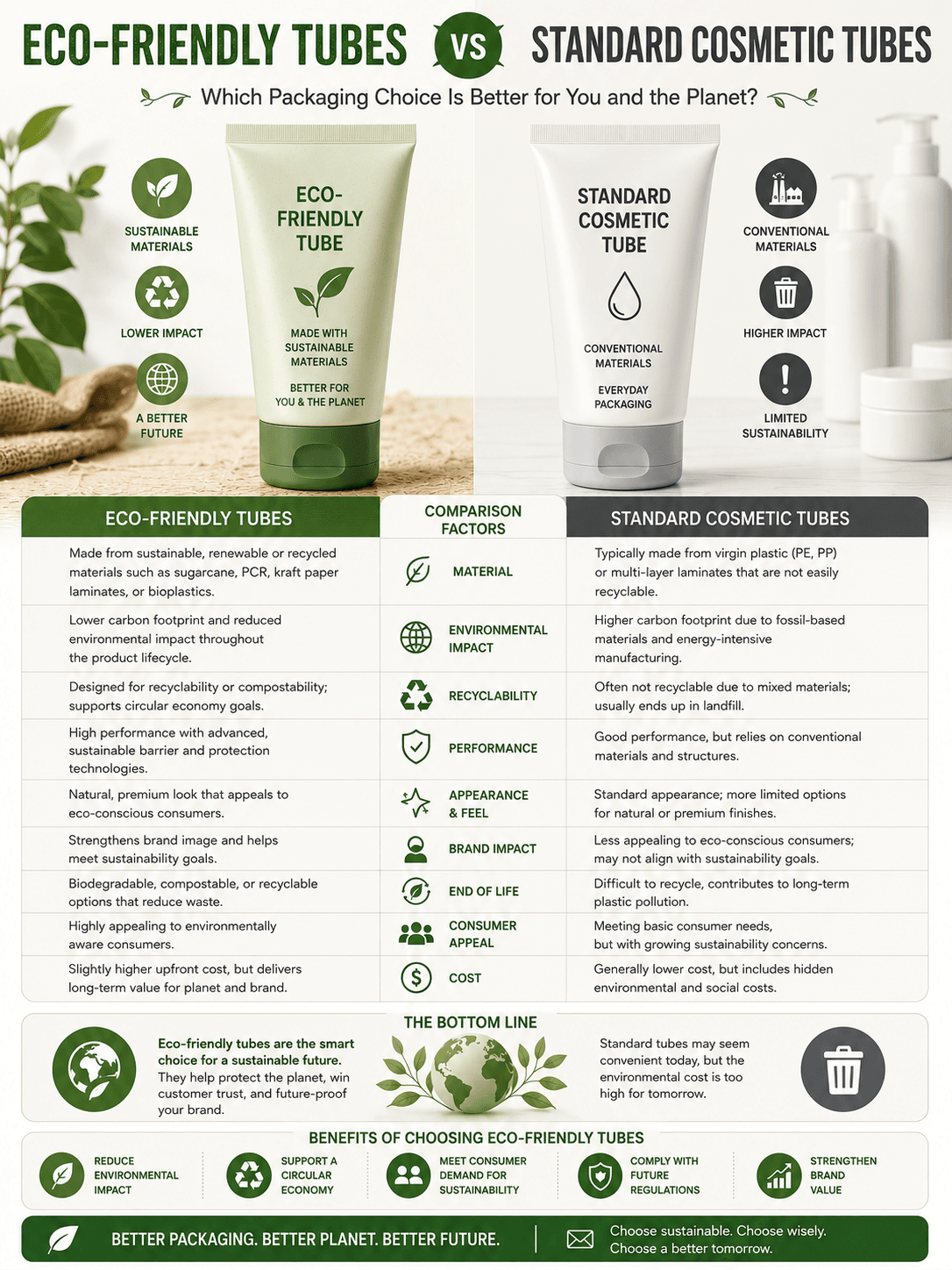
Why Brands Compare Eco-Friendly and Standard Cosmetic Tubes
This comparison is not only about environmental claims. It is about finding the right balance between sustainability, product protection, consumer experience and commercial feasibility.
The Real Purchasing Challenge
Eco-friendly tubes can improve brand sustainability positioning, but not every formula can move directly into a simplified recyclable or bio-based structure. Sunscreen, toothpaste, active skincare and high-fragrance formulas may need stronger barrier protection, while cleanser, lotion, hotel amenities and basic personal care products may be better candidates for eco-friendly tube upgrades.
A good packaging decision should consider formula stability, shelf life, decoration requirements, PCR content, recyclability claims, cap selection, filling method and target market recycling systems.
Xinfly Packaging’s Recommendation Method
Jiangsu Xinfly Packaging Co.,Ltd. helps global beauty brands compare eco-friendly tubes and standard cosmetic tubes based on actual product requirements. We evaluate PE, PCR, sugarcane, wheat straw, bioplastic, EVOH, ABL, PBL and mono-material tube structures before recommending the most practical solution.
Related guides: How to Choose Sustainable Cosmetic Tubes and How to Choose Cosmetic Tube Materials
What Are Eco-Friendly Cosmetic Tubes?
Eco-friendly cosmetic tubes are designed to reduce environmental impact through recycled content, renewable feedstock, simplified structures or improved recyclability.
Designed for Sustainable Brand Positioning
Eco-friendly tubes can use different material strategies. PCR tubes reduce virgin plastic use, sugarcane tubes use renewable bio-based PE, wheat straw tubes create a natural visual identity, recyclable tubes simplify material structure, and mono-material tubes improve recycling compatibility where local systems allow.
- Supports sustainability, ESG and clean beauty packaging goals
- Available in PCR, sugarcane, wheat straw, recyclable and mono-material structures
- Suitable for skincare, hand cream, body lotion, facial cleanser and hotel amenities
- Can be customized with printing, caps, finishes and brand-specific decoration
Useful Eco-Friendly Tube Options
If your brand is building a sustainable packaging line, the material should be selected according to your main claim: recycled content, renewable feedstock, recyclability, reduced plastic complexity or natural appearance.
Useful pages: PCR Tubes, Sugarcane Tubes, Wheat Straw Tubes and Recyclable Cosmetic Tubes
What Are Standard Cosmetic Tubes?
Standard cosmetic tubes are proven packaging structures widely used across skincare, oral care, sunscreen, makeup, hair care and personal care products.
Designed for Stability, Protection and Mass Production
Standard cosmetic tubes may include virgin PE tubes, ABL tubes, PBL tubes, EVOH barrier tubes and traditional multi-layer tubes. These structures are widely used because they provide reliable processability, strong appearance consistency, broad decoration options and better barrier choices for sensitive formulas.
- Reliable choice for high-volume cosmetic tube production
- Strong options for sunscreen, toothpaste, hair color and active skincare
- Supports advanced decoration such as hot stamping, silk screen and soft-touch finish
- Available in PE, EVOH, ABL, PBL and multi-layer barrier structures
Useful Standard Tube Options
Standard tubes are often better when the formula needs higher protection, exact color matching, premium decoration or a stable production process across large-volume orders.
Useful pages: PE Tubes, EVOH Barrier Tubes, ABL Tubes and PBL Tubes
Eco-Friendly Tubes vs Standard Cosmetic Tubes: Detailed Comparison
The right packaging structure should match the product formula, brand positioning, sustainability claim, cost target and production plan.
| Comparison Point | Eco-Friendly Tubes | Standard Cosmetic Tubes | Xinfly Packaging Recommendation |
|---|---|---|---|
| Material Direction | PCR, sugarcane, wheat straw, recyclable PE, bioplastic, mono-material | Virgin PE, EVOH, ABL, PBL, traditional multi-layer structures | Choose eco-friendly tubes for sustainability-driven launches; choose standard tubes for performance-first projects. |
| Sustainability Value | Strong sustainability, ESG, recycled-content or renewable-material story | Standard sustainability value unless optimized with recyclable or lightweight structures | Eco-friendly tubes offer stronger marketing and sustainability communication. |
| Formula Protection | Depends on structure; suitable for many stable formulas | Stronger barrier options available for sensitive formulas | Use standard high-barrier tubes when formula stability is critical. |
| Appearance Consistency | Good, but PCR and wheat straw may have material variation | Excellent, especially virgin PE and mature laminate structures | Choose standard tubes for strict color matching and luxury appearance. |
| Recyclability Direction | Can be improved through mono-material or recyclable structures | Depends on material combination, barrier layer, cap and decoration | Review complete tube structure before making recyclability claims. |
| Best Applications | Natural skincare, body lotion, hand cream, facial cleanser, hotel amenities | Sunscreen, toothpaste, active skincare, hair color, premium cosmetic formulas | Match the tube to product category, shelf-life target and consumer expectations. |
| Cost | May be higher depending on PCR content, bio-based material, certification and testing | Often more predictable for standard PE or mature laminate structures | Compare total project value, including sustainability benefits and formula risk. |
Application Scenarios: When to Choose Eco-Friendly or Standard Tubes
Different product categories need different packaging priorities. Eco-friendly tubes are ideal for sustainability-driven products, while standard cosmetic tubes are still important for high-barrier or high-precision projects.
Skincare Tubes
Eco-friendly tubes are suitable for clean beauty, natural skincare and daily skincare lines. For active ingredients such as vitamin C or retinol, EVOH or multi-layer structures may be safer.
Sunscreen Tubes
Sunscreen usually needs stronger formula protection. Eco-friendly PCR or sugarcane tubes may work for some SPF projects, but EVOH, ABL or PBL structures should be reviewed for high SPF formulas.
Hand Cream Tubes
Hand cream is a strong application for eco-friendly tubes because many formulas are stable and suitable for PCR, sugarcane, recyclable PE or wheat straw packaging.
Hotel Amenities Tubes
Hotel amenity tubes are ideal for eco-friendly packaging because hotels, resorts and spas increasingly prefer recyclable, wheat straw or sugarcane-based tube options.
Toothpaste Tubes
Toothpaste often requires flavor retention and moisture control. Standard laminate structures such as ABL or PBL may be more suitable than simple eco-friendly tube structures.
Hair Color Tubes
Hair color formulas often need strong barrier protection and chemical compatibility, making traditional aluminum, ABL or high-barrier tube structures more practical.
Can Eco-Friendly Tubes Provide High Barrier Protection?
Yes, but the answer depends on the tube structure. Eco-friendly does not automatically mean low barrier, and standard does not always mean better.
PCR + Barrier Structures
PCR materials can sometimes be combined with barrier tube structures for sunscreen, skincare and personal care projects. The final structure should be tested for appearance, sealing, compatibility and shelf-life performance.
EVOH-Based Sustainable Direction
EVOH barrier tubes can provide oxygen protection while maintaining a plastic-based tube structure. They may be considered when brands need better barrier performance without moving directly to aluminum laminate.
Mono-Material Development
Mono-material tubes can improve recyclability direction, but high-barrier performance must be reviewed carefully. Some formulas can move to mono-material tubes, while others still need multi-layer protection.
Related Sustainable Packaging Comparisons
These comparison pages help brands understand the difference between recycled content, renewable materials, recyclability and traditional performance structures.
| Comparison Topic | What It Helps You Decide | Recommended Page |
|---|---|---|
| PCR vs Virgin Plastic Tubes | Whether recycled content or new plastic resin better fits your project | Read Comparison |
| PCR vs Sugarcane Tubes | Whether recycled content or renewable feedstock is better for your brand | Read Comparison |
| PCR vs Wheat Straw Tubes | Whether recycled-content or natural bio-filled appearance is more suitable | Read Comparison |
| Sugarcane vs Bioplastic Tubes | Whether sugarcane PE or broader bioplastic materials fit your packaging goals | Read Comparison |
| Recyclable vs Traditional Tubes | Whether to prioritize recyclable structure or mature traditional performance | Read Comparison |
Custom Eco-Friendly and Standard Tube Specifications
Xinfly Packaging supports both eco-friendly tube development and standard cosmetic tube manufacturing for different market needs.
| Specification | Available Options | Project Recommendation |
|---|---|---|
| Tube Material | PCR PE, sugarcane PE, wheat straw, bioplastic, recyclable PE, virgin PE, EVOH, ABL, PBL | Select by sustainability claim, formula protection, appearance requirement and target market. |
| Capacity | 5ml, 10ml, 15ml, 30ml, 50ml, 60ml, 75ml, 100ml, 150ml, 200ml or custom volume | Match sample size, travel size, retail product, hotel amenity or family-size packaging. |
| Diameter | 19mm, 22mm, 25mm, 30mm, 35mm, 40mm, 45mm, 50mm and custom sizes | Diameter affects capacity, artwork area, cap selection, squeeze feel and filling efficiency. |
| Decoration | Offset printing, silk screen printing, labeling, hot stamping, matte, glossy and soft-touch finish | Eco-friendly materials may require artwork adjustment; standard tubes support broad decoration flexibility. |
| Cap Options | Screw cap, flip-top cap, nozzle cap, acrylic cap, airless pump options | Cap structure should match viscosity, dispensing control, recycling goals and brand appearance. |
| Testing Support | Leakage test, sealing test, compatibility review, drop test, appearance inspection | Testing is recommended before mass production, especially for new eco-friendly material structures. |
Certified Support for Global Cosmetic Tube Projects
Xinfly Packaging helps brands prepare material documentation and quality support for international tube packaging projects.
Related Sustainable Packaging Projects
Explore real-world cosmetic packaging projects and see how different tube materials are selected according to sustainability goals, product protection requirements and branding strategies.
PCR Sunscreen Tubes Project
Discover how PCR materials were integrated into sunscreen packaging while balancing sustainability goals and product performance requirements.
View ProjectCustom Moisturizer Tubes Project
Learn how packaging engineers selected suitable tube structures, capacities and decoration options for a skincare product line.
View ProjectFacial Cleanser Tubes Project
See how tube material, cap selection and production feasibility were optimized for a daily-use skincare formula.
View ProjectCustom Printed Laminated Tubes Project
A high-performance tube packaging project demonstrating premium printing quality and advanced barrier packaging structures.
View ProjectWhy Global Beauty Brands Choose Xinfly Packaging
From sustainable packaging projects to high-barrier cosmetic tube development, Xinfly Packaging supports brands with professional engineering recommendations and manufacturing expertise.
Jiangsu Xinfly Packaging Co.,Ltd. is a professional cosmetic tubes supplier providing custom PE, PCR, ABL, PBL, EVOH, sugarcane, wheat straw and recyclable tube packaging solutions for global beauty brands.
Our engineering team helps customers evaluate packaging materials according to formula compatibility, shelf-life requirements, decoration needs, sustainability objectives, regulatory expectations and production feasibility. Rather than recommending one material for every project, we compare multiple structures to identify the most practical solution.
Available sustainable packaging solutions include PCR Tubes, Sugarcane Tubes, Wheat Straw Tubes, Recyclable Tubes, Bioplastic Tubes and Sustainable Packaging Tubes.
For projects requiring stronger protection, we also supply EVOH Tubes, ABL Tubes, PBL Tubes and Multi-Layer Tubes.
Our manufacturing system supports ISO certification, RoHS compliance (RoHS No.: NTS2405005R), SGS testing (Test Report No.: GZHL24050181970T), PCR Plastic GRS certification (GRS Certificate No.: ITS-TE-00059997-GRS-G) and third-party testing support.
Learn more: Certifications | Factory Tour | OEM & ODM Services | Quality Assurance
Frequently Asked Questions
Common questions about eco-friendly cosmetic tubes and standard cosmetic tube packaging.
1. What are eco-friendly cosmetic tubes?
Eco-friendly cosmetic tubes may include PCR tubes, sugarcane tubes, wheat straw tubes, recyclable tubes, bioplastic tubes and mono-material tube structures designed to reduce environmental impact.
2. What are standard cosmetic tubes?
Standard cosmetic tubes usually include virgin PE tubes, EVOH tubes, ABL tubes, PBL tubes and traditional multi-layer cosmetic tube structures.
3. Are eco-friendly tubes recyclable?
Some eco-friendly tubes are designed to improve recyclability, but recyclability depends on the complete packaging structure and local recycling systems.
4. Are eco-friendly tubes biodegradable?
Not necessarily. Some eco-friendly materials are renewable or recyclable but not biodegradable. Material specifications should always be reviewed carefully.
5. Which option is more sustainable?
Eco-friendly tubes generally provide stronger sustainability benefits through recycled content, renewable materials or improved recyclability.
6. Which option offers better barrier protection?
Standard structures such as EVOH, ABL and PBL tubes often provide stronger barrier protection for sensitive formulas.
7. Are eco-friendly tubes more expensive?
Pricing depends on material type, recycled content level, decoration requirements, MOQ and project complexity.
8. Can eco-friendly tubes be used for sunscreen packaging?
Yes. However, the tube structure should be evaluated carefully to ensure adequate barrier protection and formula stability.
9. Can eco-friendly tubes be used for toothpaste packaging?
Some toothpaste projects may use sustainable materials, but barrier performance and flavor retention requirements must be reviewed first.
10. Does Xinfly Packaging offer eco-friendly cosmetic tubes?
Yes. Xinfly Packaging supplies PCR, sugarcane, wheat straw, recyclable and other sustainable cosmetic tube packaging solutions.
11. What is the MOQ for eco-friendly tubes?
MOQ depends on tube specification, material structure, decoration requirements and production conditions.
12. How do I choose between eco-friendly and standard cosmetic tubes?
The decision should be based on sustainability goals, formula sensitivity, shelf-life expectations, branding requirements and project budget.
Looking for Eco-Friendly or Standard Cosmetic Tubes?
Whether you need PCR tubes, sugarcane tubes, recyclable cosmetic tubes, EVOH barrier tubes, ABL tubes, PBL tubes or fully customized cosmetic packaging solutions, Xinfly Packaging can help you identify the best structure for your product and market.
Request Free Samples & Quote Explore Sustainable Packaging