

Mono Material Tubes vs Multi-Layer Tubes: Which Packaging Structure Is Right for Your Product?
For skincare, sunscreen, toothpaste, hand cream, facial cleanser and personal care packaging, brands often face one key decision: should the tube prioritize recyclability or barrier performance?
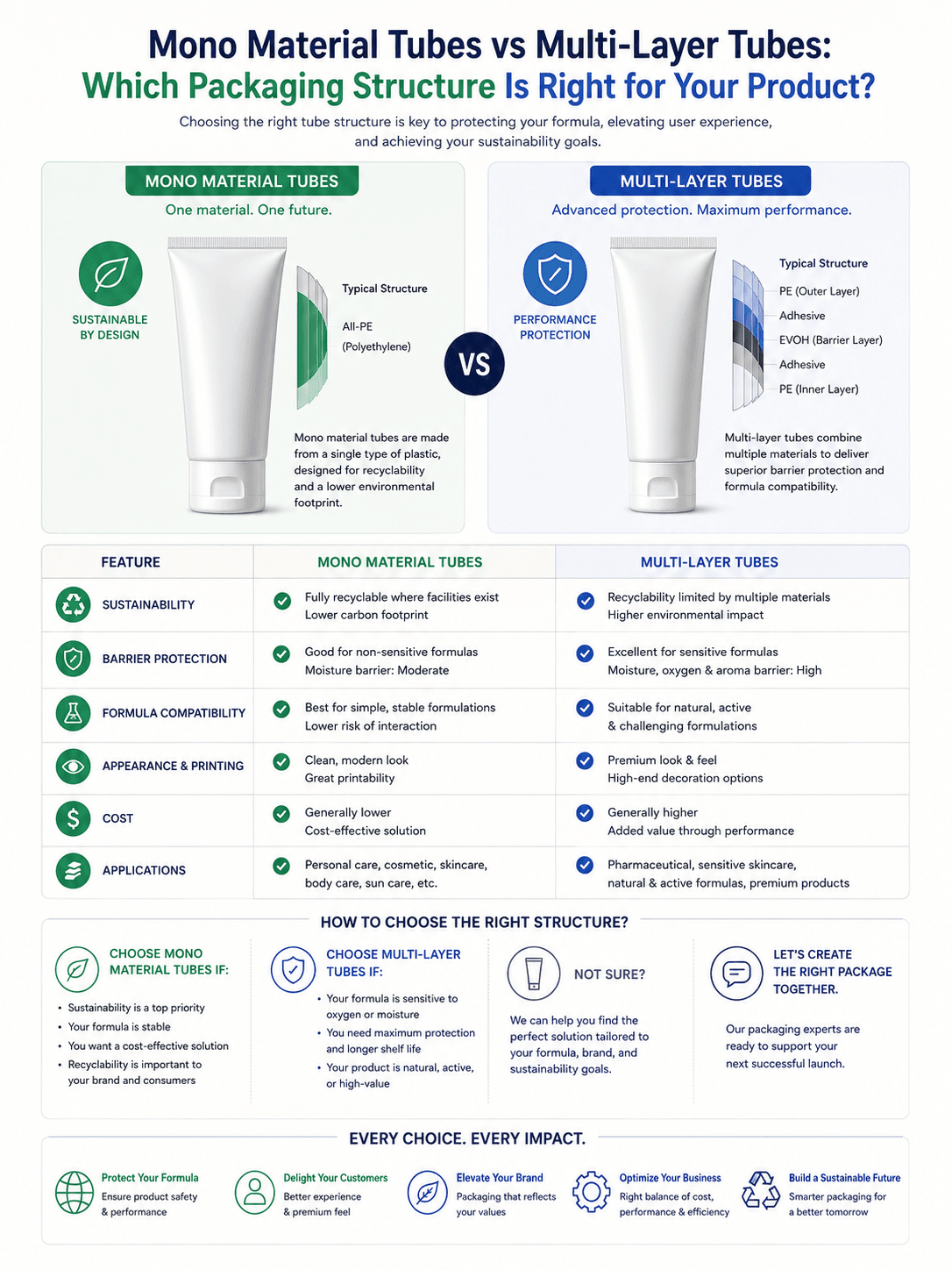
Mono material tubes are designed to simplify recycling and support sustainability communication. Multi-layer tubes are designed to improve oxygen barrier, moisture protection, fragrance retention and formula stability. The right choice depends on your formula risk, shelf-life target, market claims and brand positioning.
Why Brands Compare Mono Material and Multi-Layer Tubes
This is not only a material comparison. It is a purchasing decision between sustainability claims and product protection.
The Real Purchasing Question
Many brands want recyclable tube packaging, but they also need to protect formulas from oxygen, moisture, fragrance loss, light exposure or ingredient degradation. A mono material tube may support better recyclability, but it may not always provide enough barrier for SPF, vitamin skincare, retinol, mineral sunscreen or active oral care formulas.
Multi-layer tubes provide stronger formula protection, but the added barrier layers may increase recycling complexity. That is why the final decision should be made according to formula stability, shelf life, target market and brand sustainability claims.
Xinfly Packaging’s Engineering Approach
Jiangsu Xinfly Packaging Co.,Ltd. helps global beauty and personal care brands compare PE, PCR, mono material, EVOH, ABL, PBL and multi-layer tube structures. We do not recommend one structure for every product. Instead, we evaluate your formula, filling process, decoration design, MOQ, certifications and target market requirements.
Related guide: How to Choose Cosmetic Tube Materials
What Are Mono Material Tubes?
Mono material tubes are designed using one main plastic resin family, such as mono PE or mono PP, to simplify sorting and improve recycling potential.
Designed for Recyclability and Simpler Material Streams
Mono material cosmetic tubes are commonly developed for brands that want to reduce material complexity and support sustainable packaging claims. By avoiding mixed structures such as aluminum foil or complex barrier combinations, mono material tubes can be easier to position for recyclable packaging programs depending on local recycling infrastructure.
- Better recyclability direction than complex mixed-material structures
- Suitable for mono PE or mono PP tube packaging projects
- Good option for facial cleanser, hand cream, body lotion and hotel amenities
- Supports sustainability-focused beauty and personal care packaging
When Mono Material Tubes Are More Suitable
Choose mono material tubes when the formula is relatively stable and recyclability is a major brand priority. They are suitable for many rinse-off products, daily-use skincare, personal care products, lotion tubes and low-to-medium barrier packaging applications.
Useful pages: Recyclable Cosmetic Tubes and Eco-Friendly Cosmetic Tubes
What Are Multi-Layer Tubes?
Multi-layer tubes combine several layers to improve barrier performance, structural strength and formula protection.
Designed for Formula Protection and Longer Shelf Life
Multi-layer tubes may include structures such as PE + EVOH + PE, 5-layer PE tubes, ABL tubes, PBL tubes or other barrier structures. These layers help reduce oxygen transmission, moisture loss, fragrance migration and ingredient degradation, making them valuable for sensitive or high-performance formulas.
- Better oxygen and moisture barrier performance
- Suitable for sunscreen, toothpaste and active skincare formulas
- Supports longer shelf-life requirements
- Can be engineered with EVOH, ABL, PBL or 5-layer plastic structures
When Multi-Layer Tubes Are More Suitable
Choose multi-layer tubes when product protection is more important than material simplicity. They are especially useful for SPF sunscreen, mineral sunscreen, retinol skincare, vitamin C products, toothpaste, derma-care cream and formulas requiring stronger barrier performance.
Useful pages: Multi-Layer Tubes Manufacturer and EVOH Barrier Tubes
Mono Material Tubes vs Multi-Layer Tubes: Detailed Comparison
The right structure should balance recyclability, protection, decoration, cost, MOQ and market requirements.
| Comparison Point | Mono Material Tubes | Multi-Layer Tubes | Xinfly Packaging Recommendation |
|---|---|---|---|
| Structure | One main resin family, such as mono PE or mono PP | Multiple functional layers, such as PE/EVOH/PE, ABL, PBL or 5-layer structures | Choose based on whether recyclability or barrier performance is the top priority. |
| Recyclability Direction | Stronger recyclability positioning due to simplified material stream | More complex recycling depending on barrier layer and material combination | Mono material is better for sustainability-focused claims in many markets. |
| Barrier Performance | Moderate barrier, suitable for stable formulas | Higher barrier performance for oxygen, moisture and fragrance protection | Multi-layer is recommended for sensitive formulas and longer shelf-life needs. |
| Best Applications | Facial cleanser, hand cream, body lotion, hotel amenities, daily-use skincare | Sunscreen, toothpaste, active skincare, mineral formulas, derma-care products | Match product category with formula risk and sustainability targets. |
| Brand Positioning | Eco-friendly, recyclable, clean beauty, sustainability-focused | High-performance, protective, derma-care, SPF, functional packaging | Use mono material for sustainability storytelling and multi-layer for performance protection. |
| Cost | Often simpler, depending on resin and customization | May cost more due to barrier layer, structure and testing requirements | Compare total project cost, including formula risk, shelf-life and possible product returns. |
Application Scenarios: When to Choose Mono Material or Multi-Layer Tubes
Different formulas require different packaging structures. Some products can safely move toward mono material packaging, while others still require multi-layer barrier protection.
Facial Cleanser Tubes
Facial cleanser is often suitable for mono material PE tubes when the formula is stable and the brand wants recyclable packaging. Multi-layer tubes may be used for premium or active cleanser formulas.
Hand Cream Tubes
Hand cream can often use mono PE tubes for sustainability-focused packaging. If the formula contains fragrance oils, active ingredients or requires longer shelf life, multi-layer tubes may be safer.
Lotion Tubes
Body lotion and daily-use moisturizers may work well with mono material tubes, especially for clean beauty brands. Barrier structures are recommended for sensitive or premium formulas.
Sunscreen Tubes
Sunscreen usually needs stronger protection. For SPF and mineral sunscreen, multi-layer tubes such as EVOH or barrier structures are often recommended before considering mono material replacement.
Toothpaste Tubes
Toothpaste formulas may require barrier protection for flavor retention, moisture control and shelf-life stability. Multi-layer or laminate structures are commonly selected.
Hotel Amenities Tubes
For small-capacity shampoo, conditioner, lotion and bath gel tubes, mono material structures can support sustainability-focused hotel amenity programs.
Can Mono Material Tubes Replace Multi-Layer Barrier Tubes?
Sometimes yes — but not always. The answer depends on the formula and the shelf-life requirement.
Mono Material Can Work Well For
Mono material tubes can be a good choice for stable formulas such as facial cleanser, body lotion, hand cream, hotel amenities, basic personal care products and rinse-off applications where the formula is not highly oxygen-sensitive.
Multi-Layer Is Safer For
Multi-layer tubes are usually safer for SPF50 sunscreen, mineral sunscreen, vitamin C skincare, retinol products, toothpaste, derma-care cream and formulas requiring stronger oxygen, moisture or fragrance protection.
Xinfly’s Practical Advice
If your brand wants to switch from multi-layer to mono material, we recommend sample testing with the actual formula, including storage stability, leakage, fragrance retention, viscosity change and appearance evaluation.
Custom Tube Specifications for Mono Material and Multi-Layer Projects
Xinfly Packaging supports both sustainable tube development and high-barrier tube engineering for global beauty and personal care brands.
| Specification | Available Options | Project Recommendation |
|---|---|---|
| Tube Structure | Mono PE, mono PP, PCR PE, PE, EVOH, ABL, PBL, 5-layer plastic tubes | Select based on recyclability target, barrier requirement and formula sensitivity. |
| Capacity | 5ml, 10ml, 15ml, 30ml, 50ml, 60ml, 75ml, 100ml, 150ml, 200ml or custom volume | Match product dosage, retail format, travel size, sample pack or family-size use. |
| Diameter | 19mm, 22mm, 25mm, 30mm, 35mm, 40mm, 45mm, 50mm and custom sizes | Diameter affects capacity, artwork area, filling efficiency and consumer hand feel. |
| Decoration | Offset printing, silk screen printing, hot stamping, labeling, matte finish, glossy finish | Both mono material and multi-layer tubes can support premium decoration depending on structure. |
| Cap Options | Screw cap, flip-top cap, nozzle cap, acrylic cap, airless pump options | Cap selection should match viscosity, outlet control, convenience and retail positioning. |
| Testing Support | Leakage test, sealing test, compatibility review, drop test, appearance inspection | Testing helps verify whether a sustainable structure can safely replace a barrier structure. |
Why Choose Xinfly Packaging for Tube Structure Development?
Jiangsu Xinfly Packaging Co.,Ltd. provides custom PE, PCR, ABL, PBL, EVOH and sustainable tube packaging solutions for global beauty brands.
How to Develop the Right Tube Structure with Xinfly
Our process helps customers avoid choosing a tube that looks sustainable but fails in performance, or a high-barrier structure that is unnecessary for the formula.
Formula Review
Confirm product type, ingredients, viscosity, fragrance, active content and shelf-life target.
Structure Advice
Compare mono material, PCR, EVOH, ABL, PBL and multi-layer structures.
Sample Testing
Test tube feel, leakage, filling compatibility, stability and decoration performance.
Mass Production
Control material consistency, printing, tube forming, cap matching and packing.
Final Inspection
Complete appearance checks, sealing tests, leakage review and shipment verification.
Real Packaging Projects & Structure Selection Examples
Choosing between mono material and multi-layer packaging becomes easier when evaluated through actual product applications and real packaging development projects.
PCR Sunscreen Tubes Solution
A sustainability-focused sunscreen project that required balancing environmental positioning with barrier protection and shelf-life requirements.
View ProjectSPF50 Sunscreen Tube Packaging Project
A practical example showing why high-barrier tube structures are often preferred for SPF formulas requiring stability and protection.
View ProjectFacial Cleanser Tube Packaging Project
A cleanser packaging project where recyclability, appearance, decoration quality and cost-efficiency all influenced material selection.
View ProjectCustom Body Lotion Tubes Project
A body care project demonstrating how mono material and barrier structures may be evaluated depending on formula complexity and sustainability goals.
View ProjectFrequently Asked Questions
Below are answers to the most common questions brands ask when comparing mono material and multi-layer tube packaging structures.
1. What is a mono material tube?
A mono material tube is primarily made from one resin family such as PE or PP. The structure is designed to simplify material sorting and support recyclability initiatives.
2. What is a multi-layer tube?
A multi-layer tube uses multiple functional layers, such as PE, EVOH, PBL or ABL structures, to improve barrier performance and product protection.
3. Are mono material tubes recyclable?
Mono material tubes are generally designed to improve recycling compatibility. Actual recyclability depends on local collection, sorting and recycling infrastructure.
4. Are multi-layer tubes recyclable?
Some multi-layer structures may have recycling pathways, but recycling performance varies depending on material composition and local recycling systems.
5. Which structure provides better barrier protection?
Multi-layer tubes generally provide stronger protection against oxygen, moisture and fragrance loss than mono material structures.
6. Can mono material tubes replace EVOH barrier tubes?
Sometimes. For stable formulas such as facial cleanser or body lotion, mono material tubes may be suitable. For SPF, vitamin C or active skincare products, barrier structures are often preferred.
7. Which option is better for sunscreen packaging?
Multi-layer barrier tubes are usually recommended for sunscreen products because they provide better formula protection and shelf-life support.
8. Which option is better for toothpaste packaging?
Toothpaste often benefits from barrier structures that help protect flavor, moisture content and long-term stability.
9. Which structure is better for skincare products?
The answer depends on the formula. Basic skincare may work with mono material packaging, while active skincare may require multi-layer protection.
10. What is a 5-layer tube?
A 5-layer tube is a type of multi-layer structure designed to provide enhanced barrier performance while maintaining tube flexibility and appearance.
11. Does Xinfly Packaging offer both mono material and multi-layer tubes?
Yes. Xinfly Packaging provides mono PE, PCR, EVOH, PBL, ABL and other customized tube structures for different applications.
12. How do I choose the right tube structure?
The best structure depends on formula sensitivity, shelf-life requirements, sustainability goals, market regulations, branding and budget. Our engineering team can help evaluate the best solution.
Need Help Choosing Between Mono Material and Multi-Layer Tubes?
Whether your priority is recyclability, sustainability, barrier performance, formula stability or retail appearance, Xinfly Packaging can help you compare mono material PE tubes, PCR tubes, EVOH barrier tubes, PBL tubes and other advanced tube structures based on real product requirements.
Request Free Structure Evaluation Explore Sustainable Tubes