

Biodegradable Tubes vs Recyclable Tubes: Which Sustainable Packaging Solution Is Better?
As sustainability becomes a key purchasing factor in the beauty industry, many brands are comparing biodegradable tubes and recyclable tubes when developing new cosmetic packaging.
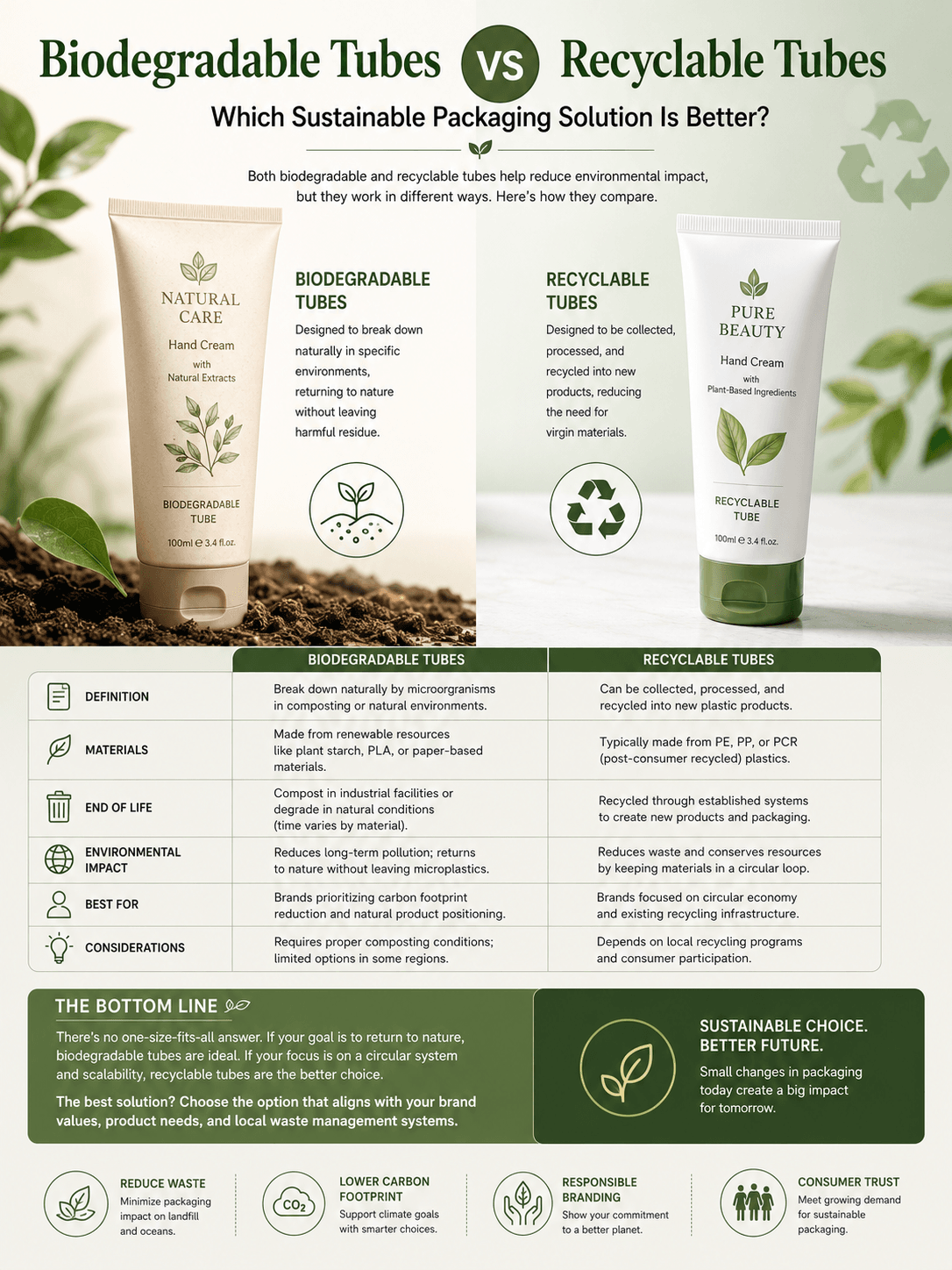
Although both options aim to reduce environmental impact, they follow completely different end-of-life pathways. Biodegradable tubes are designed to break down under specific biological conditions, while recyclable tubes are designed to be collected, sorted and reprocessed into new materials through recycling systems. Understanding this difference is critical when selecting cosmetic packaging for long-term sustainability goals.
What Are Biodegradable Tubes?
Biodegradable tubes are designed to break down through biological activity under specific environmental conditions. Depending on the material, degradation may require industrial composting facilities, controlled temperatures, moisture levels or microbial activity. [oai_citation:1‡eea.europa.eu](https://www.eea.europa.eu/en/analysis/publications/biodegradable-and-compostable-plastics-challenges-and-opportunities?utm_source=chatgpt.com)
Advantages of Biodegradable Tubes
Biodegradable packaging offers a compelling sustainability story for eco-conscious brands seeking alternatives to conventional plastic packaging.
- Reduces long-term waste accumulation
- Strong environmental marketing appeal
- Suitable for natural and organic beauty brands
- Supports sustainability-focused product launches
- Can utilize bio-based or compostable materials
Challenges of Biodegradable Tubes
Biodegradable packaging often requires specific disposal conditions to achieve intended degradation performance. Industrial composting infrastructure is not available everywhere. [oai_citation:2‡eea.europa.eu](https://www.eea.europa.eu/en/analysis/publications/biodegradable-and-compostable-plastics-challenges-and-opportunities?utm_source=chatgpt.com)
- Limited composting infrastructure in many regions
- Higher material costs in some applications
- Formula compatibility requires testing
- Barrier performance may vary by material
- Consumer understanding of disposal requirements may be limited
Related pages: Biodegradable Cosmetic Tubes and Bioplastic Cosmetic Tubes
What Are Recyclable Tubes?
Recyclable tubes are designed to enter recycling streams where materials can be collected, sorted, processed and reused as raw material for future products.
Advantages of Recyclable Tubes
Recyclable cosmetic tubes align with circular economy principles by keeping materials in use for longer rather than directing them toward disposal.
- Compatible with existing recycling initiatives
- Strong market acceptance
- Suitable for many cosmetic formulations
- Supports circular economy goals
- Available with PCR content options
Challenges of Recyclable Tubes
Recyclability depends on the complete packaging structure, consumer participation and local recycling infrastructure.
- Collection systems vary by region
- Tube design affects recyclability
- Caps and decoration may impact recycling compatibility
- Consumer sorting behavior influences outcomes
- Material selection remains important
Related pages: Recyclable Cosmetic Tubes and PCR Cosmetic Tubes
Biodegradable Tubes vs Recyclable Tubes: Key Differences
Although both packaging options aim to reduce environmental impact, their sustainability strategies are fundamentally different.
| Feature | Biodegradable Tubes | Recyclable Tubes |
|---|---|---|
| End-of-Life Strategy | Biological degradation | Material recycling |
| Infrastructure Requirement | Often requires composting facilities | Requires recycling systems |
| Material Recovery | Generally not recovered as material | Designed for material reuse |
| Cosmetic Industry Adoption | Growing | High |
| Formula Compatibility | Depends on material | Generally stronger |
| Decoration Flexibility | Moderate | High |
| Cost Level | Medium to High | Medium |
| Sustainability Marketing Value | Very High | High |
When to Choose Biodegradable Tubes
Biodegradable tubes are more suitable when your brand wants a strong end-of-life sustainability story and can clearly explain the required disposal conditions.
Organic Skincare Tubes
Biodegradable tube concepts can support organic skincare and boutique beauty brands that focus heavily on natural positioning and environmental storytelling.
Bioplastic Cosmetic Tubes
Bioplastic tubes may be suitable for pilot projects using PLA, starch-based materials or other compostable material systems after compatibility testing.
Eco-Friendly Cosmetic Tubes
For eco-conscious product launches, biodegradable concepts may provide strong marketing value when supported by realistic material documentation.
When to Choose Recyclable Tubes
Recyclable tubes are often easier to commercialize because they fit better with existing cosmetic tube manufacturing, filling and retail requirements.
Sunscreen Tubes
For sunscreen packaging, recyclable PE, PCR PE or EVOH-based structures may be easier to evaluate than fully biodegradable structures.
Hand Cream Tubes
Hand cream tubes are a practical application for recyclable packaging because many formulas can work with PE, PCR or mono-material structures.
Toothpaste Tubes
Toothpaste often needs stronger moisture and flavor protection, so recyclable or recyclable-oriented laminate structures may be more practical than biodegradable tubes.
Which Option Is More Sustainable?
The answer depends on disposal infrastructure, consumer behavior, material sourcing, formula protection and regional recycling or composting systems.
Biodegradable Is Not Always Better
If biodegradable tubes are sent to landfill or normal waste streams without proper composting conditions, the expected environmental benefit may not be achieved. Brands should avoid simple claims unless disposal conditions are clear.
Recyclable Is Not Always Guaranteed
A recyclable tube still requires correct collection, sorting and recycling infrastructure. Tube body, cap, shoulder, ink, coating and label choices can affect recycling compatibility.
The Best Choice Is Project-Specific
For mass-market cosmetic packaging, recyclable tubes are often more practical. For niche eco launches with clear disposal communication, biodegradable tubes may be considered.
Related Sustainable Packaging Comparisons
These comparison pages help buyers understand recyclable, biodegradable, recycled-content and bio-based tube packaging more clearly.
| Comparison Topic | What It Helps You Decide | Recommended Page |
|---|---|---|
| Eco-Friendly vs Standard Tubes | Whether sustainability or conventional performance should lead your packaging decision | Read Comparison |
| Recyclable vs Traditional Tubes | Whether recyclable structures can replace traditional cosmetic tubes | Read Comparison |
| Mono Material vs Multi-Layer Tubes | Whether recyclability or barrier performance is more important | Read Comparison |
| Sugarcane vs Bioplastic Tubes | Whether bio-based PE or broader bioplastic systems fit your project | Read Comparison |
| PCR vs Virgin Plastic Tubes | Whether recycled content or standard virgin plastic is better for your product | Read Comparison |
Custom Biodegradable and Recyclable Tube Specifications
Xinfly Packaging supports sustainable tube evaluation from material selection to sample testing, printing, cap matching and mass production planning.
| Specification | Available Options | Project Recommendation |
|---|---|---|
| Tube Material | Bioplastic, biodegradable material, recyclable PE, mono PE, PCR PE, sugarcane PE, EVOH, PBL | Select by sustainability claim, formula compatibility, disposal path and market requirement. |
| Capacity | 5ml, 10ml, 15ml, 30ml, 50ml, 60ml, 100ml, 150ml, 200ml or custom volume | Match product dosage, retail format, sample size, hotel amenity use or family-size packaging. |
| Decoration | Offset printing, silk screen printing, labeling, matte finish, glossy finish, soft-touch coating | Decoration should not conflict with recyclability or biodegradation claims. |
| Cap Options | Screw cap, flip-top cap, nozzle cap and customized cap options | Cap material must be reviewed with the tube body to avoid claim mismatch. |
| Testing Support | Leakage test, sealing test, formula compatibility review, appearance inspection and drop test | Testing is especially important for biodegradable materials and new recyclable structures. |
Certified Support for Sustainable Tube Projects
Jiangsu Xinfly Packaging Co.,Ltd. provides custom PE, PCR, ABL, PBL, EVOH, biodegradable and recyclable tube packaging solutions for global beauty brands.
Related Sustainable Packaging Projects
Explore real cosmetic packaging projects developed by Xinfly Packaging and see how sustainable materials, recyclable structures and performance requirements are balanced in commercial production.
PCR Sunscreen Tubes Project
A sunscreen packaging project demonstrating how recycled-content materials can be integrated while maintaining product protection and brand appearance.
View ProjectCustom Moisturizer Tubes Project
See how tube material, decoration options and sustainability goals were evaluated for a modern skincare packaging project.
View ProjectFacial Cleanser Tubes Project
An example of selecting practical packaging structures for daily-use skincare products with long-term commercial viability.
View ProjectPlastic Paint Tubes Project
Learn how material selection, tube durability and filling performance were optimized for paint packaging applications.
View ProjectWhy Global Brands Choose Xinfly Packaging
Selecting sustainable cosmetic packaging requires more than choosing a material. It requires balancing performance, compliance, sustainability and manufacturing feasibility.
Jiangsu Xinfly Packaging Co.,Ltd. is a professional cosmetic tubes supplier providing custom PE, PCR, ABL, PBL, recyclable tube and sustainable packaging solutions for global beauty brands with certifications, such as ISO, RoHS (RoHS No.: NTS2405005R), SGS (Test Report No.: GZHL24050181970T), PCR Plastic GRS (GRS Certificate No.: ITS-TE-00059997-GRS-G) and third-party testing support.
Our engineering team helps customers evaluate biodegradable materials, recyclable PE structures, PCR materials, mono-material designs and barrier packaging options according to product category, shelf-life expectations, filling process, decoration requirements and sustainability objectives.
Available sustainable packaging solutions include: Biodegradable Tubes, Bioplastic Tubes, Recyclable Tubes, PCR Tubes, Sugarcane Tubes and Wheat Straw Tubes.
You can learn more about our manufacturing capabilities and certifications at: Certifications, Factory Tour, OEM & ODM and Quality Assurance.
Frequently Asked Questions
Answers to common questions about biodegradable tubes, recyclable tubes and sustainable cosmetic packaging.
1. What are biodegradable tubes?
Biodegradable tubes are designed to break down through biological processes under specific environmental conditions.
2. What are recyclable tubes?
Recyclable tubes are designed to be collected, sorted and processed into reusable raw materials through recycling systems.
3. Are biodegradable tubes recyclable?
Some materials may technically be recyclable, but biodegradable products are usually designed for different end-of-life pathways and should be evaluated individually.
4. Are recyclable tubes biodegradable?
Most recyclable cosmetic tubes are not biodegradable. Their sustainability strategy is based on material recovery and reuse.
5. Which option is more sustainable?
The answer depends on local infrastructure, disposal behavior, material sourcing and overall lifecycle considerations.
6. Which option is better for skincare packaging?
Both can be suitable. The choice depends on formula requirements, sustainability goals and commercial feasibility.
7. Which option is better for sunscreen packaging?
Recyclable structures are generally more common because sunscreen products often require stronger packaging performance.
8. Are biodegradable tubes compostable?
Some biodegradable materials are compostable, but compostability depends on the specific material and certification requirements.
9. Are biodegradable tubes more expensive?
Pricing depends on material type, project volume, certification requirements and manufacturing complexity.
10. Does Xinfly Packaging offer biodegradable tubes?
Yes. Xinfly Packaging supports biodegradable and bioplastic cosmetic tube projects depending on project requirements.
11. Does Xinfly Packaging offer recyclable tubes?
Yes. We supply recyclable cosmetic tubes, PCR tubes and other sustainable packaging solutions.
12. How do I choose between biodegradable and recyclable tubes?
The best choice depends on sustainability goals, disposal infrastructure, product requirements, budget and brand positioning.
Looking for Sustainable Cosmetic Tube Packaging?
Whether you need biodegradable tubes, recyclable tubes, PCR tubes, sugarcane tubes or customized sustainable cosmetic packaging solutions, Xinfly Packaging can help you select the most suitable material and tube structure for your project.
Request Free Samples & Quote Explore Sustainable Packaging