

Recyclable Tubes vs Traditional Cosmetic Tubes: Which Packaging Is Better?
For skincare, sunscreen, facial cleanser, hand cream, body lotion and personal care products, many brands are considering whether to move from traditional cosmetic tubes to recyclable tube packaging.
Recyclable tubes are usually designed with mono-material PE, recyclable PE structures, PCR PE or simplified material combinations. Traditional cosmetic tubes may include standard PE tubes, ABL tubes, PBL tubes, multi-layer barrier tubes or decorative structures that provide strong performance but may be more complex to recycle.
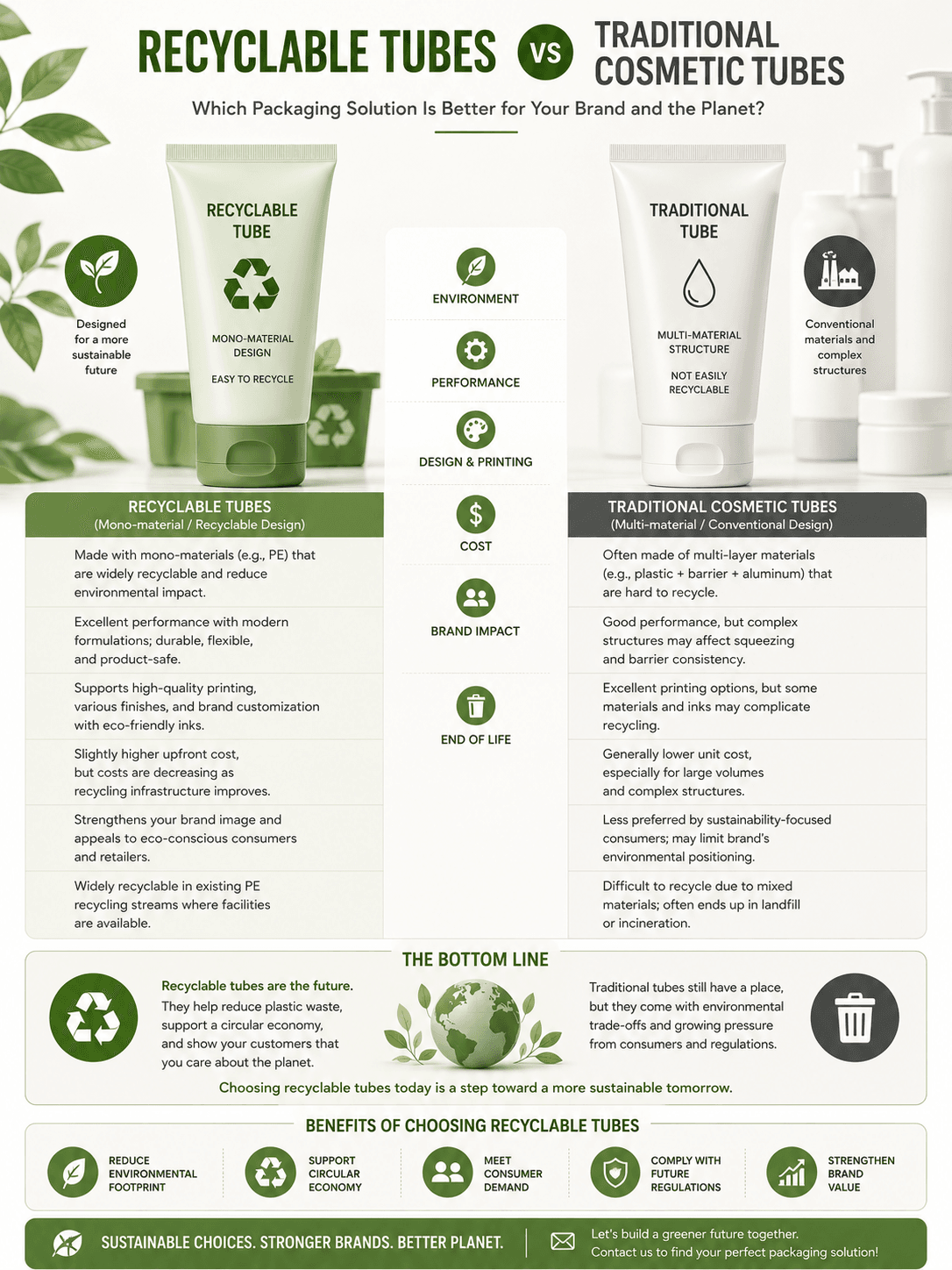
Why Beauty Brands Compare Recyclable and Traditional Tubes
The real question is not simply whether a tube can be recycled. Buyers need to know whether the recyclable structure can still protect the formula, support decoration, pass filling requirements and meet brand expectations.
The Real Purchasing Challenge
Many beauty brands want to use recyclable packaging, but cosmetic formulas often require specific barrier performance, squeeze feel, sealing strength and decoration effects. A recyclable mono-material tube may be ideal for stable formulas, while a traditional multi-layer or laminate tube may still be safer for sunscreen, toothpaste, active skincare or high-barrier products.
This is why tube selection should consider formula risk, shelf life, target market recycling systems, cap structure, artwork design and production feasibility together.
Xinfly Packaging’s Recommendation Method
Jiangsu Xinfly Packaging Co.,Ltd. helps global beauty brands compare recyclable cosmetic tubes, PE tubes, PCR tubes, mono-material tubes, ABL tubes, PBL tubes, EVOH tubes and traditional multi-layer tubes. We recommend structures according to recyclability goals, formula compatibility, decoration needs, MOQ, certification requirements and export market expectations.
Related guides: Are Cosmetic Tubes Recyclable? and How to Choose Sustainable Cosmetic Tubes
What Are Recyclable Cosmetic Tubes?
Recyclable cosmetic tubes are designed to simplify material structure and improve compatibility with recycling systems where suitable collection and sorting infrastructure exists.
Simplified Structures for Better Recycling Direction
Recyclable tubes often use mono-material PE, recyclable PE structures, PCR PE or reduced-complexity packaging designs. The goal is to avoid difficult mixed-material combinations where possible and make the tube easier to identify, sort and process within suitable recycling streams.
- Supports recyclable packaging and sustainability claims
- Can use mono-material PE or PCR PE structures
- Suitable for stable skincare, cleanser, lotion and personal care formulas
- Helps brands reduce packaging complexity and improve sustainability positioning
When Recyclable Tubes Are More Suitable
Choose recyclable tubes when your formula is relatively stable and your brand wants to highlight recyclability, cleaner material structure or sustainable packaging design. They are often suitable for facial cleanser, hand cream, body lotion, hotel amenities, natural skincare and daily personal care products.
Useful pages: Recyclable Cosmetic Tubes Manufacturer and Sustainable Packaging Tubes Manufacturer
What Are Traditional Cosmetic Tubes?
Traditional cosmetic tubes include standard PE tubes, laminated tubes, ABL tubes, PBL tubes, EVOH tubes and multi-layer structures commonly used across beauty and personal care packaging.
Proven Structures for Performance and Protection
Traditional cosmetic tubes are widely used because they provide reliable manufacturing performance, broad decoration options, strong barrier choices and flexible customization. For formulas that require oxygen protection, moisture control, light protection or longer shelf life, traditional multi-layer or laminate structures may still be the safest choice.
- Includes PE, ABL, PBL, EVOH and multi-layer tube structures
- Strong option for sunscreen, toothpaste and active skincare
- Supports advanced decoration such as hot stamping, soft-touch and full-color printing
- Suitable for high-barrier and premium cosmetic packaging projects
When Traditional Tubes Are More Suitable
Choose traditional cosmetic tubes when product protection, decoration complexity, barrier performance or filling compatibility is more important than simplified recyclability. They are often used for SPF sunscreen, toothpaste, retinol skincare, vitamin C formulas, hair color, pharmaceutical-style cream and high-performance cosmetic products.
Useful pages: Multi-Layer Tubes Manufacturer and High Barrier Cosmetic Tubes Manufacturer
Recyclable Tubes vs Traditional Cosmetic Tubes: Detailed Comparison
The best tube structure depends on your recyclability goal, formula sensitivity, decoration requirements, target market and product positioning.
| Comparison Point | Recyclable Tubes | Traditional Cosmetic Tubes | Xinfly Packaging Recommendation |
|---|---|---|---|
| Material Structure | Usually mono-material PE, recyclable PE, PCR PE or simplified plastic structure | May include PE, ABL, PBL, EVOH, laminate or multi-layer structures | Choose recyclable tubes for simpler material streams; choose traditional tubes for broader performance options. |
| Recyclability Direction | Designed to improve recycling compatibility where suitable systems exist | Depends heavily on material combination, barrier layer, cap and decoration | Recyclability must be evaluated by complete tube structure, not by the word “tube” alone. |
| Formula Protection | Suitable for stable formulas with moderate protection needs | Better options for oxygen-sensitive, moisture-sensitive or high-barrier products | Use traditional barrier structures when formula stability is critical. |
| Best Applications | Facial cleanser, hand cream, body lotion, hotel amenities, daily skincare | Sunscreen, toothpaste, active skincare, hair color, OTC-style cream | Match the structure to formula risk and sustainability target. |
| Decoration | Supports printing and finishing, but decoration should avoid reducing recyclability | Supports broad decoration options including premium finishes and complex artwork | For recyclable tubes, keep artwork and material claims aligned with recycling goals. |
| Cost | Depends on material, PCR content, recyclable structure and testing requirements | Depends on tube structure, barrier layer, decoration, cap and MOQ | Compare total project cost, including sustainability value and formula protection risk. |
Application Scenarios: When to Choose Recyclable or Traditional Cosmetic Tubes
Recyclable tubes work best when the formula is stable and the brand wants simplified material structure. Traditional cosmetic tubes remain valuable when stronger barrier protection or complex decoration is required.
Facial Cleanser Tubes
Facial cleanser is often suitable for recyclable PE or mono-material tube structures because many formulas are stable and do not require very high barrier protection.
Hand Cream Tubes
Hand cream brands can consider recyclable tubes when sustainability is a major product message, while traditional PE or laminate tubes may be used for richer formulas.
Body Lotion Tubes
Body lotion tubes can use recyclable structures for daily-use products, especially when the brand wants a cleaner packaging story and reduced material complexity.
Sunscreen Tubes
Sunscreen often requires stronger barrier protection. Traditional EVOH, ABL or PBL tubes may be more suitable for SPF formulas that need extended stability.
Toothpaste Tubes
Toothpaste packaging often uses traditional laminate structures because flavor retention, moisture control and shelf-life stability are important.
Hotel Amenities Tubes
Hotel amenity tubes are a strong application for recyclable or mono-material structures because brands and hotels increasingly prefer simplified sustainable packaging.
Are All Cosmetic Tubes Recyclable?
No. A cosmetic tube should not be called recyclable only because it is made of plastic. The complete structure must be reviewed.
Tube Body Material
Mono-material PE and simplified recyclable PE structures are generally easier to position for recyclability. Tubes with aluminum layers, complex laminates or incompatible barrier structures may be harder to recycle.
Cap, Shoulder and Decoration
Recyclability can also be affected by cap material, shoulder structure, labels, inks, coatings and metallic decoration. A recyclable tube body can lose claim strength if the complete package is not designed carefully.
Local Recycling System
Recycling rules vary by country and region. A tube that is technically recyclable in one market may not be accepted in another local collection and sorting system.
Related Material Comparisons for Sustainable Packaging Decisions
If you are comparing recyclable tubes with traditional cosmetic tubes, these related guides can help you make a more accurate material decision.
| Comparison Topic | What It Helps You Decide | Recommended Page |
|---|---|---|
| Mono Material vs Multi-Layer Tubes | Whether to prioritize recyclability or barrier performance | Read Comparison |
| PCR vs Virgin Plastic Tubes | Whether to use recycled content or new plastic resin | Read Comparison |
| PCR vs Sugarcane Tubes | Whether recycled-content or bio-based material fits your brand better | Read Comparison |
| Sugarcane vs Bioplastic Tubes | Whether sugarcane PE or broader bioplastic materials are suitable | Read Comparison |
| EVOH vs ABL Tubes | Which high-barrier structure is better for sensitive formulas | Read Comparison |
Custom Recyclable and Traditional Tube Specifications
Xinfly Packaging supports both recyclable tube development and traditional cosmetic tube manufacturing for different product categories.
| Specification | Available Options | Project Recommendation |
|---|---|---|
| Tube Material | Recyclable PE, mono PE, PCR PE, virgin PE, EVOH, ABL, PBL, multi-layer structures | Select by recyclability target, formula sensitivity, barrier need and brand positioning. |
| Capacity | 5ml, 10ml, 15ml, 30ml, 50ml, 60ml, 75ml, 100ml, 150ml, 200ml or custom volume | Match product dosage, travel size, retail format, hotel amenities or family-size packaging. |
| Diameter | 19mm, 22mm, 25mm, 30mm, 35mm, 40mm, 45mm, 50mm and custom sizes | Diameter affects capacity, decoration area, cap matching, squeeze feel and filling efficiency. |
| Decoration | Offset printing, silk screen printing, labeling, hot stamping, matte finish, glossy finish, soft-touch coating | For recyclable tubes, decoration should be selected carefully to avoid weakening recyclability claims. |
| Cap Options | Screw cap, flip-top cap, nozzle cap, acrylic cap, airless pump options | Cap material and structure should be reviewed together with tube recyclability and formula dispensing needs. |
| Testing Support | Leakage test, sealing test, compatibility review, drop test, appearance inspection | Testing is recommended before mass production for both recyclable and traditional tube projects. |
Why Choose Xinfly Packaging for Tube Structure Development?
Jiangsu Xinfly Packaging Co.,Ltd. supplies recyclable cosmetic tubes, PE tubes, PCR tubes, EVOH tubes, ABL tubes, PBL tubes and traditional cosmetic tube packaging for global beauty brands.
Related Cosmetic Tube Packaging Projects
Explore real packaging projects developed by Xinfly Packaging and see how different tube structures are selected based on product requirements, sustainability goals and brand positioning.
PCR Sunscreen Tubes Project
A sustainable sunscreen packaging project demonstrating how recycled-content materials can be integrated into cosmetic tube development.
View ProjectCustom Body Lotion Tubes Project
Learn how material structure, decoration requirements and filling performance were balanced in a body care packaging project.
View ProjectFacial Cleanser Tubes Project
See how tube material, cap selection and printing options were optimized for a daily skincare product.
View ProjectCustom Printed Laminated Tubes Project
An example of traditional high-performance tube packaging with advanced printing and barrier requirements.
View ProjectProfessional Support for Recyclable and Traditional Tube Packaging
Selecting the right tube structure requires balancing sustainability, product protection, manufacturing feasibility and branding requirements.
Jiangsu Xinfly Packaging Co.,Ltd. is a professional cosmetic tubes supplier providing custom PE, PCR, ABL, PBL, EVOH, recyclable and sustainable tube packaging solutions for global beauty brands.
Our engineering team assists customers with tube structure evaluation, barrier performance analysis, decoration recommendations, material compatibility review, prototype development and production planning. Whether you need recyclable cosmetic tubes, traditional laminate tubes or high-barrier packaging solutions, we can recommend the most suitable structure based on your formula and marketing objectives.
Available solutions include Recyclable Cosmetic Tubes, PCR Cosmetic Tubes, EVOH Tubes, ABL Tubes, PBL Tubes, Multi-Layer Tubes and Sustainable Packaging Tubes.
Our manufacturing system supports ISO certification, RoHS compliance (RoHS No.: NTS2405005R), SGS testing (Test Report No.: GZHL24050181970T), PCR Plastic GRS certification (GRS Certificate No.: ITS-TE-00059997-GRS-G) and third-party testing support.
Learn more: Factory Tour | Quality Assurance | OEM & ODM Services | Certifications
Frequently Asked Questions
Answers to common questions about recyclable cosmetic tubes and traditional cosmetic tube packaging.
1. What are recyclable cosmetic tubes?
Recyclable cosmetic tubes are designed with material structures intended to improve compatibility with recycling systems where appropriate infrastructure exists.
2. Are all cosmetic tubes recyclable?
No. Recyclability depends on the complete packaging structure, including tube body, shoulder, cap, decoration and local recycling capabilities.
3. What are traditional cosmetic tubes?
Traditional cosmetic tubes include PE tubes, ABL tubes, PBL tubes, EVOH tubes and other multi-layer structures used for product protection and performance.
4. Are PE tubes recyclable?
Some PE tube structures may support recyclability depending on design and local recycling systems.
5. Are ABL tubes recyclable?
ABL tubes contain aluminum barrier layers and may have different recycling considerations compared with mono-material PE structures.
6. Are PBL tubes recyclable?
PBL tubes may offer advantages compared with some laminate structures, but recyclability depends on the complete packaging design and recycling infrastructure.
7. Which tube is better for skincare packaging?
Both can work well. The choice depends on formula sensitivity, sustainability goals, decoration requirements and shelf-life expectations.
8. Which tube is better for sunscreen packaging?
Traditional high-barrier structures such as EVOH, ABL or PBL tubes are often preferred for sunscreen formulas requiring additional protection.
9. Do recyclable tubes support premium printing?
Yes. Many recyclable tube structures can support high-quality printing and decoration when designed correctly.
10. Are recyclable tubes more expensive?
Pricing depends on material selection, tube specification, decoration requirements, MOQ and project complexity.
11. Does Xinfly Packaging offer recyclable cosmetic tubes?
Yes. Xinfly Packaging supplies recyclable cosmetic tubes, PCR tubes and other sustainable packaging solutions.
12. How do I choose between recyclable and traditional tubes?
Evaluate recyclability goals, formula protection needs, decoration requirements, target market expectations and budget before selecting a tube structure.
Looking for the Right Cosmetic Tube Structure?
Whether you need recyclable cosmetic tubes, PCR tubes, EVOH barrier tubes, ABL tubes, PBL tubes or fully customized cosmetic packaging solutions, Xinfly Packaging can help you select the most suitable tube structure for your product and market.
Request Free Samples & Quote Explore Recyclable Tubes