
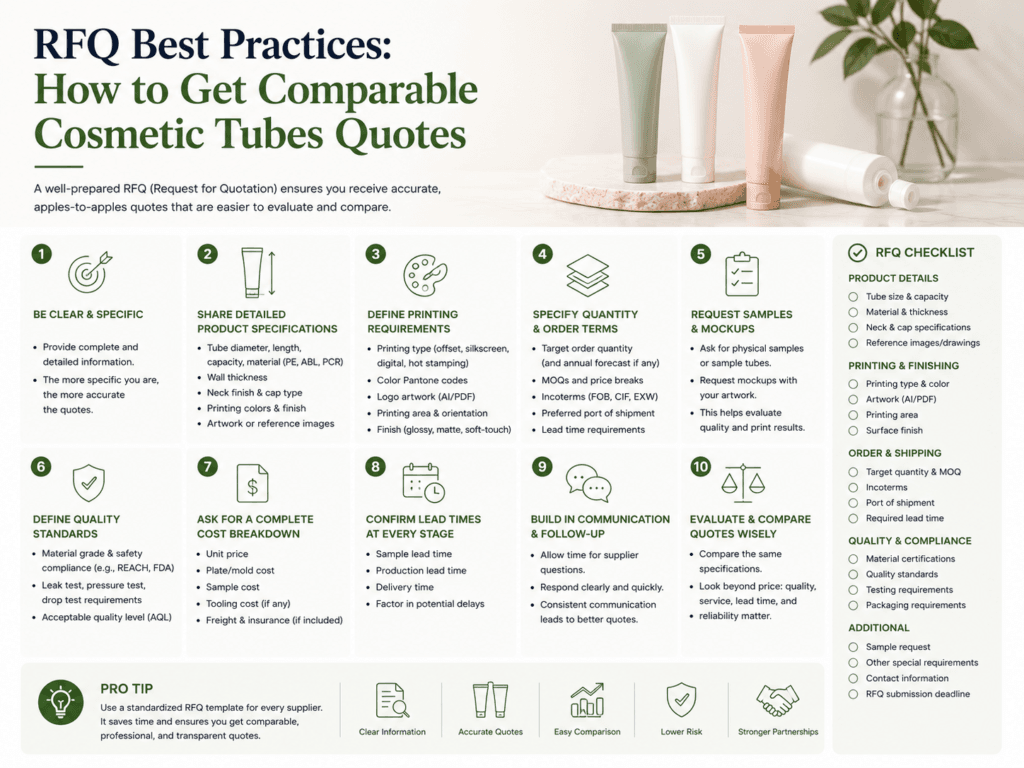
Clear and detailed RFQs help you get quotes you can compare. You may get different quotes if you focus on just one thing. For example, you might care about protection but forget about branding or supply chain performance. If you do not share your brand well, customers may get the wrong idea. Using RFQ Best Practices saves you time and lowers confusion. It also helps you make better choices with suppliers. Being clear and specific in your requests makes buying easier.
Key Takeaways
- Clear RFQs help you get better quotes. Give lots of details so suppliers do not get confused and know what you want.
- Making your RFQ process the same each time saves time and stops mistakes. Use templates to make requests easier and help suppliers trust you.
- List all technical details, like product specs and branding needs. This helps suppliers give the right quotes and meet what you want.
- Set clear delivery times and quality rules. This makes sure things are made on time and follow safety rules.
- Use a comparison chart to look at quotes. This tool helps you check price, quality, and how well suppliers talk to you.
Why Comparable Quotes Matter
Risks of Vague RFQs
You need to make your RFQs clear and detailed. If your RFQ is not clear, suppliers get confused. They may not know what you want. This can lead to quotes that are very different. You might see prices that do not make sense. You could also have trouble with quality or delivery.
- Suppliers often treat unclear RFQs as simple requests. They may guess what you want. This can cause wrong prices, missed deadlines, or products that do not meet your standards.
- If your RFQ does not have enough detail, suppliers use their own ideas. This makes offers different and hard to compare.
- You might pick a supplier just because their price is low. This can hurt product quality and compliance.
- If people misunderstand materials or performance, you can have budget problems.
Tip: Use RFQ Best Practices to avoid these risks. Clear communication helps you get accurate and fair quotes.
Benefits of Standardization
Making your RFQ process the same every time has many benefits. You save time and make fewer mistakes. You also build trust with suppliers. When you use the same format, suppliers know what to expect.
| Benefit | Description |
|---|---|
| Efficiency | Automated RFQ data exchange speeds up response times. |
| Accuracy | Less manual entry means fewer mistakes in your RFQ process. |
| Negotiation Strength | Clear communication builds trust and helps you get better terms. |
- Companies that standardize their RFQs finish packaging tenders 70% faster.
- Teams can handle more tenders each year.
- You can get better deals when you negotiate.
You make better choices when you compare quotes side by side. Standardization helps you buy well and grow your business.
RFQ Best Practices for Cosmetic Tubes
Define Technical Specs
You need to give clear technical specs. This helps suppliers give you the right price and timeline. Add these things in your RFQ:
- Product specs
- Material needs
- Size and volume
- Decoration details
- Cap type
- Order amount
- Compliance needs
- Delivery time
You should also say how many print colors you want. Mention special finishes and custom mold needs. If your design is complex, talk to suppliers early. This helps you avoid extra costs and delays. RFQ Best Practices start with clear needs.
Specify Quantity and Volume
You must tell the exact number and volume for each tube. This helps suppliers plan and give the best price. For example, list how many tubes for each size, like 10ml, 30ml, 50ml, 100ml, or 150ml. If you need different sizes, break down your order by type. Accurate numbers help suppliers check their ability and give a fair quote.
Set Packaging and Branding Needs
Packaging and branding help your product stand out. You should share all your needs in the RFQ. Many buyers ask for things like material, size, cap style, color, and printing effects. Here is a table with common requests:
| Aspect | Details |
|---|---|
| Material Selection | Choices include PE tubes, laminated tubes, and eco-friendly tubes. |
| Tube Size and Capacity | Common sizes are 10ml, 30ml, 50ml, 100ml, and 150ml. |
| Cap and Applicator Choices | Includes flip-top caps, screw caps, and airless pump heads. |
| Color and Finish Customization | Choices of glossy, matte, and metallic finishes. |
| Printing Effects | Techniques like silk screen printing and hot stamping are available. |
You can work with suppliers like Xinfly Packaging to find more options. Share your logo, artwork, and any special finishes you want. This step makes sure your tubes match your brand and attract buyers.
Outline Delivery and Lead Time
You need to set clear delivery and lead time rules. Most tube making takes 4 to 8 weeks from order to delivery. The timeline depends on your design and the supplier’s workload. Reliable supply stops delays and helps you react fast to market changes. A great supplier becomes a true partner and helps your brand grow. RFQ Best Practices include asking for the fastest delivery that fits your needs.
State Quality and Compliance
You must state your quality and compliance rules in the RFQ. This step protects your brand and customers. Ask for certifications like ISO 22716 and GMP. If you sell in the U.S., ask for FDA compliance. For the EU, ask for proof of meeting cosmetic rules. You can also ask for material safety certifications, like BPA-free, and recyclability standards. Clear rules help you avoid problems with product safety and legal issues.
Clarify Payment and Terms
You should explain payment terms, delivery rules, and quote validity times. Flexible payment terms help suppliers manage money and may give better prices. Say if you want to pay by bank transfer, letter of credit, or another way. Set the payment timeline, like 30 days after delivery. Also, ask suppliers to confirm how long their quote lasts. RFQ Best Practices include these details to stop confusion and support smooth business.
Tip: Always check your RFQ for missing details before sending it to suppliers. A complete RFQ saves time and helps you get the best cosmetic tube quotes.
Six-Step RFQ Process
Prepare Requirements
First, collect all the details about your cosmetic tubes. Add a product fill list that shows the tube sizes and how you will use them. Write down the weight and if there is any risk of leftover product. Attach artwork files with your logo, colors, and how you want them printed. Write out any claims about the materials. List what packaging you need, like cards, sleeves, barcodes, or boxes. Set dates for samples, changes, and delivery. These steps help suppliers avoid mistakes and give the right quotes.
| Attachment | What it tells the supplier | Risk if missing |
|---|---|---|
| Product fill list | Shows tube sizes and how they are used | Tubes might be wrong size or too weak |
| Product weight | If lining or coating is needed | Tubes could sag or stain after packing |
| Artwork file | Shows logo size, color, and printing method | Branding could be late or wrong |
| Claim wording | Tells which packaging has material claims | Claims might be too broad to support |
| Packaging scope | Lists cards, sleeves, barcodes, and boxes | Gift packaging costs could be missed |
| Launch date | Shows sample, change, and delivery times | Timeline could be too short for shipping |
Tip: Add photos of your product and packaging. This helps suppliers know what you want and meet store rules.
Draft the RFQ
Next, write your RFQ with all your needs. Use a template to make this step faster and easier. Templates help you remember all the details. Add technical specs, how many you want, branding, delivery, quality, and payment rules. Make your instructions simple and clear. You can find templates and guides online, like the Paper Tube Packaging Template and Paper Tube Guide. These tools save time and help you follow RFQ Best Practices.
- Write all product details and add artwork.
- List packaging and branding needs.
- Set delivery and lead time.
- Write quality and compliance rules.
- Explain payment terms and how long the quote lasts.
Note: Templates help you compare quotes later.
Send to Suppliers
Now, send your RFQ to 5-10 good suppliers. This gives you enough choices but not too much work. Use a business email and keep track of who gets your RFQ. Make sure every supplier gets the same info. This helps you get fair and easy-to-compare quotes.
- Pick suppliers who know about cosmetic tubes.
- Send the full RFQ package.
- Track answers so you can follow up.
Manage Questions
Suppliers might ask questions about your RFQ. Answer them fast and share your answers with everyone. Use the same documents to keep things clear. Give short and clear answers to stop confusion and repeat questions. Give suppliers enough time to reply. This builds trust and helps you get better quotes.
- Answer questions in 24-48 hours.
- Share updates with all suppliers.
- Use simple and clear words.
Tip: Talking early stops delays and mistakes.
Collect Quotes
Get quotes from all your suppliers. Ask them to use the same format. This makes it easy to compare. Use online forms or templates to help with this step. You can use tools like the Get A Quote form for cosmetic tube packaging. Standard formats help you see the total cost, not just the price.
- Get quotes by the deadline.
- Check if anything is missing.
- Put quotes in a table or spreadsheet.
Compare and Decide
Compare the quotes using clear rules. Look at price, quality, how much they can make, and if they follow the rules. Make a chart to help you choose. Think about the smallest order, quality checks, how much they can make, and their certificates. Pick the supplier that fits your needs best. Tell all suppliers what you decide.
| Criteria | Description |
|---|---|
| Minimum Order Quantity (MOQ) | Flexible MOQs help both small and big brands. |
| Quality Control | Walls should be even, tubes should not leak, and should be easy to use. |
| Production Capacity | Lead times should be steady, and they should handle big orders. |
| Manufacturing Capabilities | Can they make custom tools, print well, and use green materials? |
| Industry Experience | Do they know skincare, medicine, or clean beauty? |
| Certifications and Compliance | Do they have ISO, GMP, FDA, or EU certificates for your market? |
Note: Use a chart to make your choice clear and fair.
Follow these six steps to get the best cosmetic tube quotes. Using templates and clear talk helps you follow RFQ Best Practices and saves time.
Common RFQ Mistakes
Incomplete Specs
Some people think short RFQs save time. But missing details can cause big problems. If you leave out technical specs, suppliers have to guess. This means you get quotes that do not fit your needs. Prices might be higher because suppliers add extra costs for safety. You could also wait longer if suppliers need more info.
When you give all the info at the start, things are clear. Suppliers can give better prices when they know what you want. They do not need to add extra costs for unknowns.
The more info you give, the faster and better we can quote. If you only have a sketch, send it! We will help you fill in the rest.
If your RFQ is missing info, it might be delayed or not checked until you send everything.
Always check your RFQ for missing specs before you send it. A complete RFQ helps you get quotes that are fast and correct.
Ignoring Supplier Questions
Suppliers ask questions to understand your needs. If you do not answer, things slow down. Suppliers might stop working or guess wrong. This can lead to products that do not fit your brand. You should answer questions fast and clearly. This builds trust and helps you avoid mistakes.
Overlooking Branding Details
Branding helps your tubes stand out. If you forget branding in your RFQ, the product may not look right. Here is what can happen:
- If you skip branding, the design may not match the use.
- The final product might not meet what buyers want.
- The product may seem less valuable and lose customers.
Always share your logo, colors, and artwork files. Clear branding helps suppliers make tubes that fit your ideas and attract buyers.
Ensuring Clarity and Consistency
Use Standard Terms
You need to use standard terms in your RFQ. This helps suppliers know what you want. Using industry words makes your needs clear. For example, you can say “PE tube,” “laminated tube,” “flip-top cap,” or “hot stamping.” Suppliers understand these terms and know your requests.
- Standard terms help stop mistakes.
- You get answers more quickly.
- Suppliers can give better quotes.
Tip: Make a glossary for your RFQ. This helps new suppliers learn your words and keeps everyone together.
Provide Visuals or Drawings
Pictures make your RFQ stronger. You can add photos, sketches, or 3D mockups. These show your design and help suppliers see your ideas. Drawings help suppliers check the shape, color, and decoration of your tubes.
High-fidelity 3D mockups are important in making tubes. They let you check if the design is right and see how the package looks. You can see how your product will look in stores or online. These pictures help you get better quotes and fewer changes.
| Visual Type | Benefit |
|---|---|
| Photos | Show real-life examples |
| Sketches | Explain custom shapes |
| 3D Mockups | Confirm design and aesthetics |
Note: Pictures help suppliers avoid mistakes and give you what you want.
Request Supplier Confirmation
You should ask suppliers to confirm your needs. This step makes sure they understand your RFQ. When suppliers reply with confirmation, you know they read your specs and can do the job.
- Ask for written confirmation.
- Request a checklist or signed paper.
- Make sure suppliers agree to your terms.
Emoji: ✅ Confirmation builds trust and stops confusion.
If you follow these steps, your RFQ process will be clear and steady. Suppliers can quote faster and give better results.
Reviewing and Comparing Quotes
Build a Comparison Matrix
You need an easy way to look at all your quotes. A comparison matrix lets you see the differences quickly. Make a table with each supplier in a column. Put each important thing in a row. Write down things like price, minimum order quantity, lead time, quality certifications, and special features.
| Criteria | Supplier A | Supplier B | Supplier C |
|---|---|---|---|
| Price per Tube | $0.25 | $0.28 | $0.24 |
| MOQ | 5,000 | 10,000 | 5,000 |
| Lead Time (weeks) | 6 | 8 | 5 |
| Certifications | ISO, GMP | ISO | GMP |
| Custom Printing | Yes | Yes | No |
Tip: Use a spreadsheet to make your matrix. It is easy to change and share with your team.
Evaluate Price and Value
Do not just look at the price. You should check what you get for your money. Sometimes a lower price means you get less or wait longer. Check what each quote gives you. Watch out for extra costs like setup fees, shipping, or charges for custom printing.
Ask yourself these questions:
- Does the price cover all branding and packaging?
- Are there extra costs for samples or changes?
- Will the supplier meet your quality needs?
Note: The best value is a mix of price, quality, and service.
Assess Supplier Communication
Good communication means you can trust the supplier. See how fast and clearly each supplier answers you. Did they follow your RFQ steps? Did they confirm your needs and give all details?
You can use a checklist:
- Answered emails or calls quickly
- Gave clear answers to all questions
- Sent full and neat quotes
- Gave helpful ideas
👍 Good communication helps you avoid mistakes and delays. Pick suppliers who make you feel sure and informed.
You get better cosmetic tube quotes when your RFQs are clear and detailed. Using the same format each time helps you compare quotes easily. Follow the six steps and use RFQ Best Practices to make buying simple. Check your RFQ forms or ask suppliers like Xinfly Packaging for help. Spending time at the start saves work later and gives you better results.
Start now to make stronger supplier partnerships and get the most for your brand.