Published: .
A hotel amenity set can look beautifully coordinated and still make a guest stop to ask, “Which one is the shampoo?” If every tube has the same cap, similar colour and a large hotel logo, the product name may do very little work from its position on the tray. The buying question is whether people can identify the intended product in the arrangement the hotel will actually use.
A hotel amenity tube product identification review connects artwork with the tube’s visible face, tray placement and product range. This guide provides an identification matrix and a sample-review record for procurement teams. It does not prescribe a font size, promise accessibility performance or replace required label-content review. Use representative packaging to answer a specific identification question before releasing the selected design.
Separate the Hotel Brand from the Product Name
Decide Which Information Answers the Guest’s Question
For 30ml squeeze tubes for hotel amenities, distinguish the hotel or collection name from the actual product identity. A large brand mark may create a coordinated set, but it does not tell someone whether a tube contains shampoo, conditioner or body wash. Ask the artwork team to show where the product name appears and which face is intended to be visible.
Keep the product name connected to the item reference used in purchasing and packing. A stock code can help the receiving team identify a carton while remaining unhelpful to a guest reading the tube. Those two forms of identification have different audiences. Record the intended guest-facing wording and the logistics reference without assuming one can replace the other.
Confirm the Exact Approved Wording
Ask the brand’s responsible content reviewers to confirm the product names and any required language versions. Do not let a packaging designer invent or abbreviate wording merely to fit a narrow panel. If the required content does not fit the proposed layout, return the issue to the appropriate reviewers. This article addresses practical identification and layout review, not market-specific labelling requirements.
Make the Range Differences Explicit
Compare the Similar-Looking Items Together
Hotel shampoo and conditioner tubes may share a body, capacity, cap and brand design. Put their references beside each other in the review file. Ask which visible feature distinguishes each product and whether that feature remains visible in the intended display. Do not evaluate each artwork in isolation and assume a coordinated range will be easy to distinguish once assembled.
Keep Colour in Its Supporting Role
A colour can support identification, but ask what information remains when a guest cannot easily distinguish that colour in the actual setting. Product wording, a clearly defined symbol or another approved cue may provide additional information. The appropriate design needs project review. No colour combination is declared sufficient by this guide, and no laboratory or user-study result is claimed.
| Item in the proposed range | Guest-facing name to confirm | Other visual cue to review | Physical reference needed |
|---|---|---|---|
| Shampoo item | Exact approved shampoo wording | Proposed colour or graphic cue | Decorated tube in intended tray position |
| Conditioner item | Exact approved conditioner wording | Distinction from the shampoo item | Both items viewed together |
| Body wash item | Exact approved body-wash wording | Distinction from hair-care products | Complete proposed set |
| Body lotion item | Exact approved lotion wording | Consistency and difference within the range | Tube and any associated presentation pack |
| Receiving record | Applicable item and artwork references | Logistics identification as specified | Outer-pack and item documentation |
The matrix is an information template, not an available set or a product-content declaration. Complete it with the actual proposed range and references. If an item is absent from the order, remove the row. If a product name or visual cue is unresolved, mark it pending rather than allowing a placeholder to become the version sent to print.
Review the Tube in Its Intended Orientation
Identify the Visible Panel
A front artwork file does not establish which face will be visible on a tray. Ask how the tube is positioned, whether its cap or body influences that position, and what nearby items may obscure. The selected closure configuration belongs in this discussion because a different physical pack may present the label differently. Confirm the actual body and cap references rather than relying on a generic mock-up.
Include the Tray and Surrounding Items
The hotel shampoo packaging guide provides broader context for amenity presentation. For your project, use the relevant tray, holder or representative arrangement when the question concerns visibility. A product name that is obvious on a white artwork canvas may be partly hidden by another tube, a divider or the intended display position. Record the actual context reviewed.
Keep the Evaluation Conditions Traceable
Ask the hotel and design reviewers to agree the viewing arrangement relevant to the question, including lighting and product placement. Record those conditions with the observation. This guide does not set an inspection distance, illuminance or readability threshold. The responsible participants should select and interpret a review appropriate to their property, packaging and intended use.
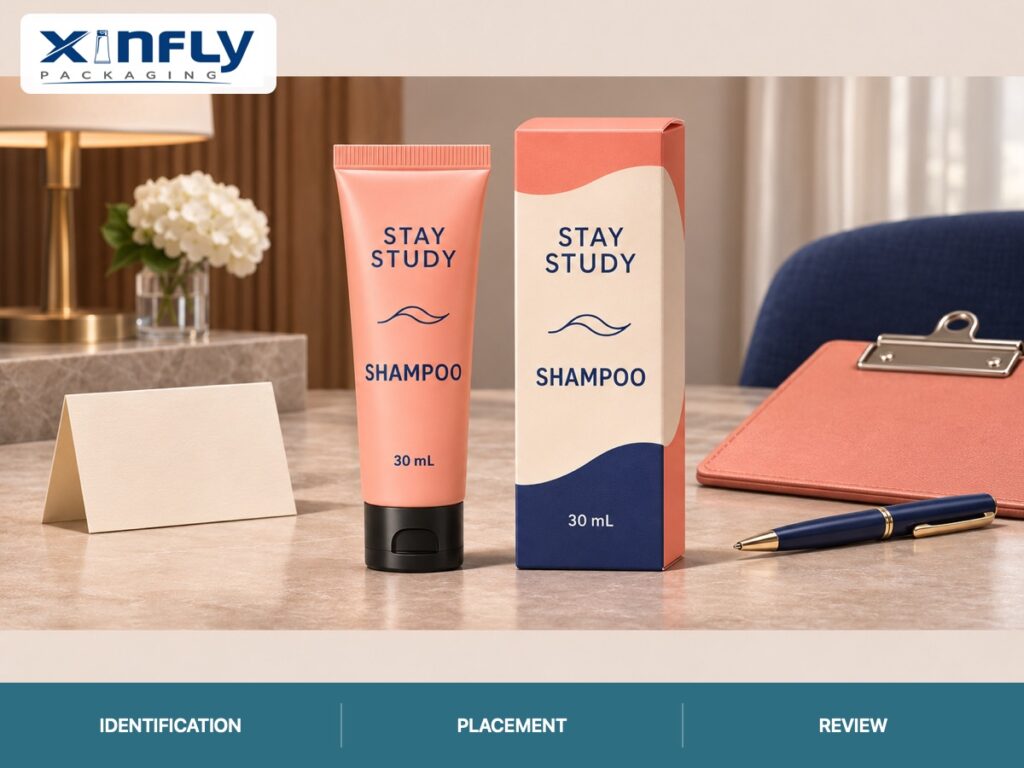
Check the Product Name on a Representative Print
Do Not Approve from a Zoomed Screen Alone
Artwork can be enlarged until tiny wording looks comfortable. A representative decorated tube gives the reviewers a different question to assess: what do they observe on the actual proposed pack? Ask the supplier to identify the specimen’s scale, structure, print and development role. Do not treat a convenient resized image as evidence that the final wording has been reviewed physically.
Keep Print Review and Content Review Distinct
The printing and design process should connect the artwork to the relevant layout and proposed decoration. Content reviewers confirm the approved wording; print reviewers assess the applicable physical output against the agreed reference. One participant may contribute to both tasks, but the record should say what was actually reviewed. A colour approval alone does not approve every product-name detail.
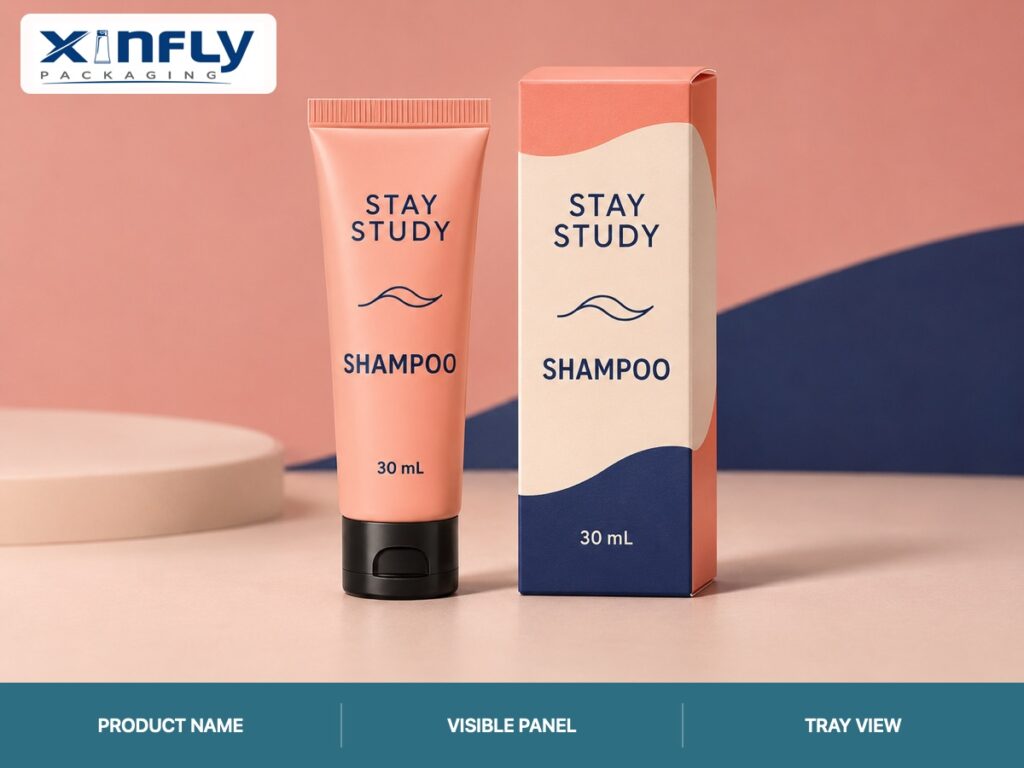
The illustrations use one fictional STAY STUDY shampoo design: a coral PE-style tube with moulded shoulder, straight crimped display tail and black round flip-top cap. Navy single-colour screen-print-style wording and a wave coordinate with the printed carton. They show one product concept, not a tested shampoo-and-conditioner set. The image lettering is not evidence of an actual guest-identification result.
Give the Physical Review a Clear Question
Ask for Identification, Not Just Preference
“Do you like this design?” invites a different response from “Which product do you think this item is?” Ask the responsible project reviewers to define the question they need answered. Record their observations in the agreed context. Do not convert a small informal review into a numerical performance claim or assume it represents every guest, language or viewing condition.
Record What Caused an Unclear Answer
If a reviewer cannot identify an item confidently, document what was visible and which cue they used. Was the product name obscured? Did the brand name dominate? Were similar products placed together? Preserve the observation without guessing that font size, colour or tray position must be the cause. The design team can then propose a defined change and the appropriate follow-up.
| Observation to review | Context to retain | Follow-up question |
|---|---|---|
| Product name partly hidden | Tube orientation, tray and surrounding items | Which placement or panel needs review? |
| Shampoo and conditioner confused | Exact pair of item and artwork references | Which visible difference should the team reassess? |
| Only the cap colour was used | Range design and viewing arrangement | What other approved cue remains available? |
| Small wording difficult to interpret | Representative print and recorded conditions | Which layout or print feature needs a focused review? |
| Artwork wording differs from the approved copy | Content and artwork revisions | Which reference should be corrected before release? |
| Receiving team cannot reconcile an item | Item code and pack documentation | Does the logistics record identify the correct product? |
| A later component changes presentation | Old and new body or cap references | Which visibility checks should be repeated? |
These fields do not supply pass limits or establish that a defect exists. Agree the applicable requirements, review procedure and decision authority through the project’s quality assurance discussion. A clear observation helps the responsible team choose the next action; it should not be expanded into an unsupported claim about the whole range.
Keep Logistics Identification Connected to the Design
Confirm What Purchasing Is Ordering
For hotel shampoo tubes, connect the quotation line with the body, closure, product-name artwork and quantity. Similar packaging can make a swapped reference hard to notice in a long email chain. Ask for a written acknowledgement that identifies the intended item rather than relying only on a thumbnail. Keep any difference between empty packaging and a filled amenity product explicit in the commercial scope.
Identify Components Supplied Separately
If cartons or another presentation component are part of the request, ask the supplier to state their scope and references. A matching carton in an illustration does not establish that it is included in a tube quote. Use the cosmetic packaging box discussion to identify proposed printed components, and keep each item connected to the correct product wording and quantity.
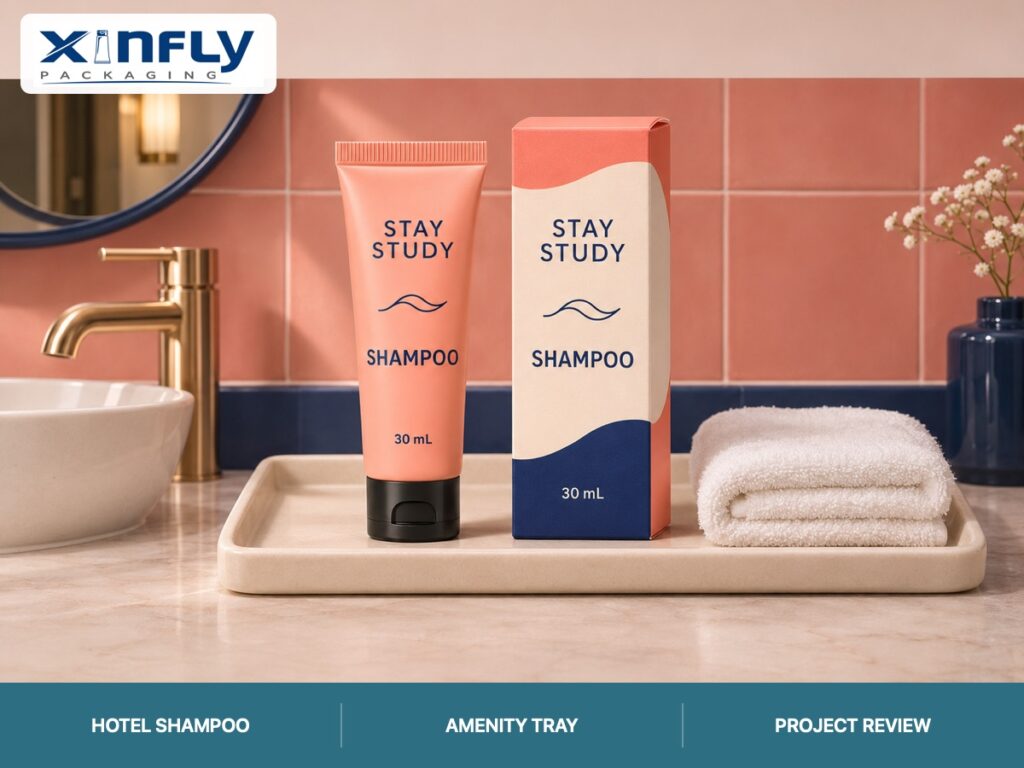
Request Samples That Represent the Identification Question
Use sample development to request the relevant decorated configuration. If the concern is confusion between two products, explain that the reviewers need the proposed pair or set together. If the concern is a name hidden by a tray, provide the tray reference or agreed representative arrangement. A useful sample request says which question the specimen should answer, not simply that the buyer wants something to approve.
A concise request can read: “Please provide the proposed hotel amenity tube references and representative decoration for reviewing product identification in the attached tray arrangement. Identify the product-name artwork revision for each item and any sample limitations. We need to compare visible wording and range differentiation before print release.” Add capacity, quantity, intended supply scope and destination for the quotation.
Record the Decision at Its Actual Scope
State which products, artwork revisions and viewing arrangements were reviewed. Identify the actual participants and their decisions, with unresolved content or technical questions left visible. If the range changes later, ask which previous conclusions remain applicable. A signed appearance approval should not silently become a claim about accessibility, every language version or guest behaviour that was never evaluated.
Frequently Asked Questions
Is a different cap colour enough to distinguish hotel products?
That needs review in the intended context. Ask what approved information remains visible when the colour cue is not clear to the viewer. Compare the actual proposed range and record observations; this guide does not declare a universal colour-based identification rule.
Should the hotel logo or product name be larger?
There is no single layout prescribed here. Ask the design and hotel reviewers to define the intended information hierarchy and assess representative packaging. The guest’s product-identification question should be addressed alongside the brand’s presentation and approved content requirements.
Can I approve the range from separate PDF pages?
PDFs support artwork review, but they may not answer a physical visibility or range-confusion question. Identify the purpose of the review and request the appropriate representative specimens and arrangement. Record which decisions were made from files and which from physical packaging.
Do these observations prove that all guests can read the pack?
No. Keep any conclusion within the participants, specimens, question and conditions actually reviewed. Do not describe an informal packaging check as a broad accessibility or user-performance result. A wider claim needs its own appropriate evidence and responsible assessment.
What should I send Xinfly Packaging first?
Send the intended amenity range, capacity, body and cap preferences, approved product wording, artwork and tray reference. Identify any confusion or visibility question and the required supply scope. Ask for a quotation and representative sample plan that addresses those specific requirements.
Conclusion: Let the Product Identity Survive the Presentation
A coordinated hotel set needs a clear connection between product wording, visible panels and the arrangement used on site. Review the actual range together, preserve the observations and keep content, print and logistics references aligned. Contact Xinfly Packaging with your amenity artwork and presentation requirements to discuss a focused quotation and sample-review plan.