
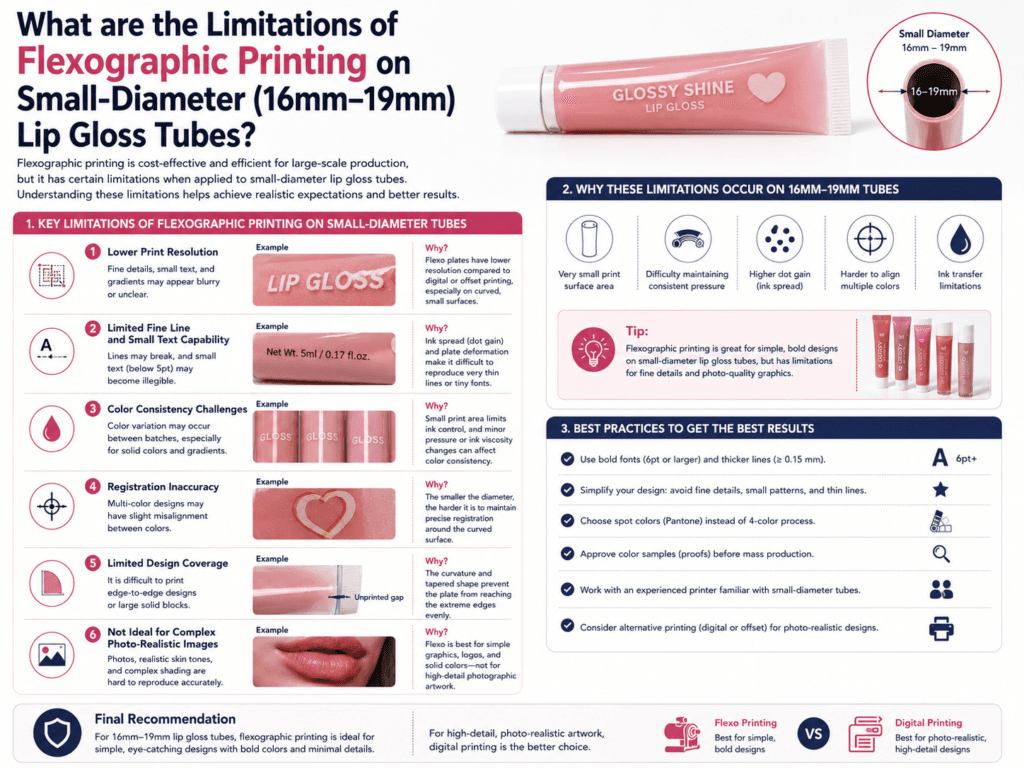
The main limitations of flexographic printing on small-diameter 16mm–19mm lip gloss tubes are reduced fine-detail performance, higher registration difficulty, and a greater risk of visible print defects on the curved surface. On very small tubes, the printable area is narrow, the curvature is stronger, and the artwork wraps faster around the body. That makes flexographic printing more sensitive to pressure, dot gain, ink transfer, and plate distortion than on larger cosmetic tubes. Common flexo defects such as dot gain, halo, feathering, filling-in, misregister, and mottling are well documented in industry troubleshooting guides, and these risks become more noticeable when the printable area is extremely small.
For lip gloss tubes in the 16mm–19mm range, flexographic printing can still work well for simple spot-color branding, clean logos, and basic text layouts. But it is usually less ideal for micro text, high-detail beauty artwork, soft gradients, or packaging designs that need a very precise luxury finish. This is because flexo print quality depends heavily on print pressure, plate behavior, line screen, and dot control, and higher line screens tend to increase dot-gain sensitivity.
Main Limitations of Flexographic Printing on 16mm–19mm Lip Gloss Tubes
| Limitation | What It Means on Small Tubes | Visual Risk |
|---|---|---|
| Limited fine-detail control | Small text and delicate lines are harder to keep sharp | Blurry edges or filled-in details |
| Higher registration difficulty | Multi-color alignment becomes harder on narrow curved bodies | Color shift or outline shadowing |
| Dot gain sensitivity | Printed dots can spread beyond intended size under pressure | Loss of contrast and detail |
| Curvature distortion | Artwork wraps rapidly around the tube circumference | Image compression or uneven visual balance |
| Reduced effective print area | There is less front-facing space for artwork hierarchy | Design can look crowded quickly |
Why Small-Diameter Tubes Are More Challenging for Flexo
- Tighter curvature: A 16mm–19mm tube has a more curved print surface than larger skincare or lotion tubes, which increases image distortion risk.
- Less room for registration error: On a very small format, even a minor multi-color shift becomes highly visible.
- Higher pressure sensitivity: Flexo quality can change noticeably when plate pressure, ink transfer, or substrate contact is slightly off. Industry troubleshooting guides repeatedly link excessive pressure with dot gain, halo effects, and inaccurate screen-dot reproduction.
- Screen-dot limitations: Higher line screens can improve image refinement, but also increase dot gain sensitivity and reduce print stability.
Most Common Flexo Print Problems on Small Lip Gloss Tubes
| Print Problem | Typical Cause | Effect on Lip Gloss Tube Artwork |
|---|---|---|
| Dot gain | Too much pressure, unsuitable plate, line screen issues | Fine graphics appear thicker and softer |
| Misregister | Mechanical variation or unstable multi-color alignment | Colors do not align cleanly |
| Halo / squeezed edge | Excessive pressure or anilox mismatch | Printed edges look ringed or over-spread |
| Filling-in / bridging | Too much ink or poor dot control | Negative spaces or tiny openings disappear |
| Mottling / uneven density | Ink transfer inconsistency | Image looks patchy or unstable |
What Type of Artwork Is Most Affected?
- Very small ingredient or brand text
- Gradient-heavy or photographic-style graphics
- Fine decorative line art
- Multi-color metallic simulation
- Dense beauty artwork with little negative space
What Flexo Still Does Well on Small Lip Gloss Tubes
| Best Use Case | Why Flexo Works |
|---|---|
| Simple logos | Strong spot-color performance |
| Basic text layouts | Good when font size and spacing are realistic |
| Few-color branding | Lower registration complexity |
| Cost-sensitive volume runs | Efficient for repeatable simple graphics |
How Manufacturers Reduce Flexo Limitations
- Increase font size and line thickness for small-diameter layouts
- Reduce the number of colors where possible
- Avoid highly detailed gradients on the smallest tubes
- Optimize plate hardness, tape, pressure, and anilox specification
- Use prepress compensation to manage dot gain and small-format distortion
- Approve real production samples, not only flat digital artwork
When Another Printing Method May Be Better
If the design requires photo-like detail, very sharp micro text, complex multi-color artwork, or a luxury-clean visual finish, offset printing or digital printing may be more suitable than flexographic printing on 16mm–19mm lip gloss tubes. Flexo is strongest when the design is simplified and adapted to the physical limitations of the substrate and press behavior.
Summary
The main limitations of flexographic printing on small-diameter 16mm–19mm lip gloss tubes are reduced fine-detail capability, higher registration risk, stronger dot-gain sensitivity, and a much tighter usable print area. This makes flexo less suitable for highly complex or photo-realistic artwork on tiny lip gloss formats. Industry flexo guidance consistently highlights dot gain, misregister, halo, filling-in, and ink-transfer instability as core quality risks, and these become more critical as the printable format gets smaller.
Learn more: Lip Gloss Tubes, Lip Gloss Tubes Manufacturer, Printing Options, Silk Screen Printing vs. Offset Printing, Labeling vs Direct Tube Printing, Lip Gloss Squeeze Tube Packaging.
Need the Right Printing Method for Small Lip Gloss Tubes?
Xinfly Packaging helps beauty brands match artwork complexity, tube diameter, and printing technology to achieve better print clarity, stronger branding, and more reliable production on small cosmetic tubes.