

How to Choose PE Cosmetic Tubes: Differences Between LDPE, HDPE, and LLDPE
PE cosmetic tubes are widely used for skincare, sunscreen, facial cleanser, hand cream, body lotion, shampoo, conditioner and personal care products. However, not all PE tubes feel the same. LDPE, HDPE and LLDPE have different softness, stiffness, rebound, crack resistance and squeeze performance. This guide helps brands and purchasing teams choose the right PE material blend before sampling and mass production.
Common Purchasing Pain Points When Choosing PE Cosmetic Tubes
Many buyers only specify “PE tube” during quotation, but different PE blends can produce very different results in squeeze force, tube recovery, printing quality, filling stability and transport performance.
The tube is too hard or too soft
A facial cleanser tube may need a soft squeeze feel, while a large body lotion tube may need stronger structure. Wrong PE blend can create poor user experience.
The tube collapses after repeated use
Some soft tubes are easy to squeeze but do not recover well. LLDPE and HDPE balance can help improve rebound and shape retention.
Shoulder or sidewall cracks during transport
Low-temperature shipping, repeated squeezing and carton pressure may cause cracks if the tube blend lacks toughness or the wall thickness is not suitable.
Large tubes deform or fall over
High-capacity body lotion or shampoo tubes often require more stiffness. HDPE can improve body support, but too much HDPE may reduce softness.
Surface finish affects decoration quality
PE material blend, surface treatment and tube hardness can affect offset printing, silk screen printing, hot stamping and label adhesion.
Not every PE tube suits every formula
Oil-rich, fragrance-heavy, alcohol-containing or active formulas may need multi-layer PE, EVOH barrier or laminate structures instead of standard PE only.
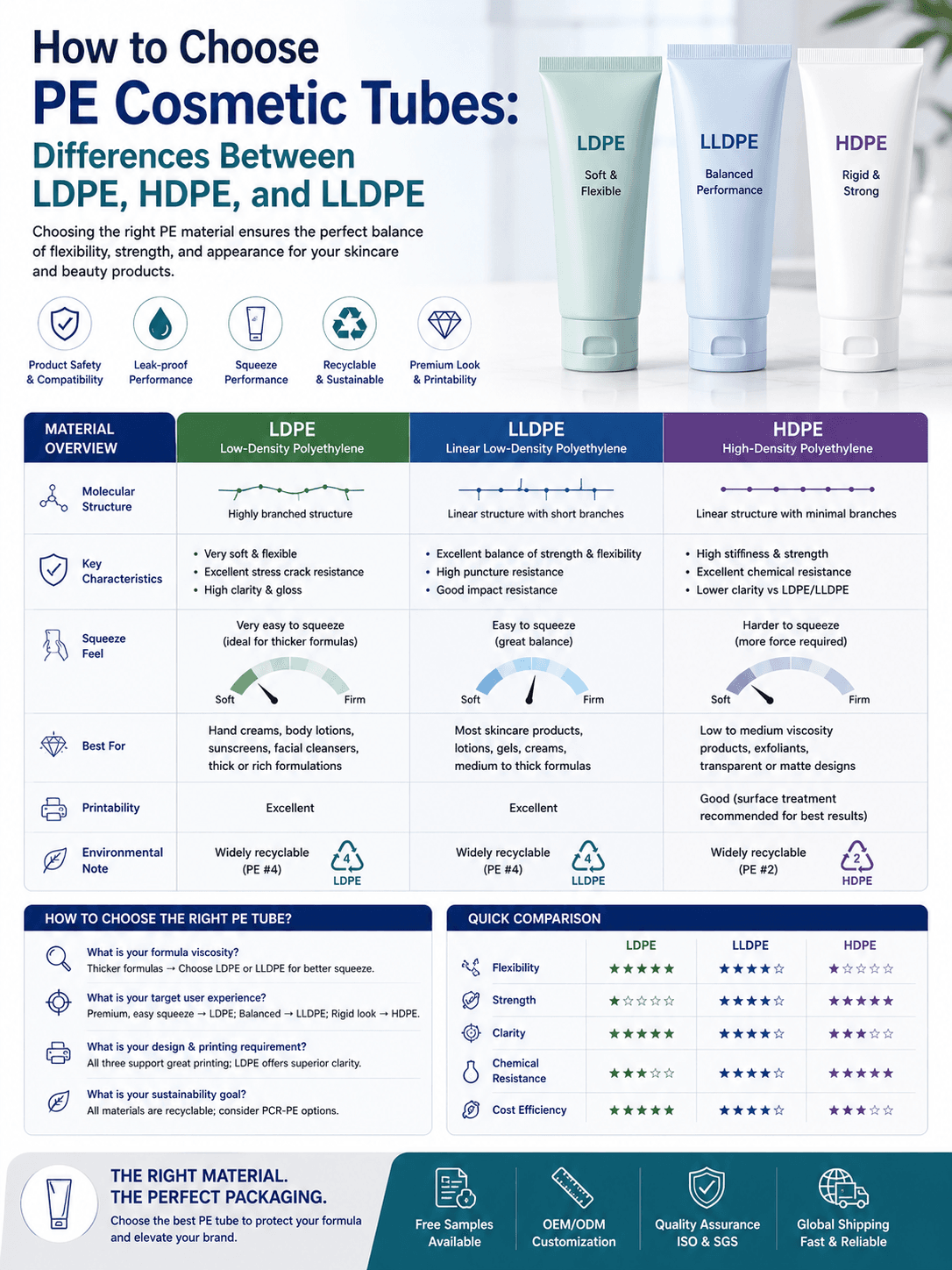
LDPE vs. HDPE vs. LLDPE: Key Differences for Cosmetic Tubes
LDPE, HDPE and LLDPE are often blended to create the final tube performance. The best PE cosmetic tube is usually not made from only one material, but from a controlled blend based on product use.
| PE Material | Main Character | Advantages for Cosmetic Tubes | Potential Limitation | Best Use Case |
|---|---|---|---|---|
| LDPE Low-Density Polyethylene | Soft, flexible, easy to squeeze | Good hand feel, suitable for small and medium skincare tubes, comfortable daily use | Too much LDPE may reduce standing stability and shape recovery | Hand cream, facial cleanser, eye cream, soft skincare tubes, travel-size tubes |
| HDPE High-Density Polyethylene | Stiffer, stronger, more structured | Improves body support, shoulder strength, standing stability and deformation resistance | Too much HDPE may make the tube hard to squeeze and less premium in hand feel | Large lotion tubes, shampoo tubes, conditioner tubes, body care tubes, stand-up tubes |
| LLDPE Linear Low-Density Polyethylene | Flexible, tough, good crack resistance | Improves toughness, rebound, stress crack resistance and squeeze durability | Needs proper blending; alone may not provide enough body stiffness for large tubes | Sunscreen tubes, thick cream tubes, travel tubes, tubes needing better toughness and recovery |
Choose PE Tube Blend Based on Cosmetic Formula and Application
Xinfly engineers usually review formula viscosity, filling volume, tube diameter, cap type, squeeze force target, shipping conditions and surface decoration before recommending LDPE, HDPE and LLDPE blend direction.
| Application | Main Packaging Requirement | Suggested PE Blend Direction | Factory Engineer’s Suggestion |
|---|---|---|---|
| Hand cream tubes | Soft squeeze, portable, good recovery, premium hand feel | Higher LDPE + balanced LLDPE | Use soft tube feel but avoid excessive collapse after repeated squeezing. |
| Facial cleanser tubes | Wet bathroom use, gel dispensing, controlled squeeze | LDPE + LLDPE with moderate stiffness | Match tube softness with cleanser viscosity and cap orifice size. |
| Sunscreen tubes | Outdoor use, travel pressure, thick formula, leakage control | LDPE + LLDPE, plus EVOH if barrier is needed | Use toughness and squeeze recovery, then add barrier layer for oil-rich SPF formulas. |
| Body lotion tubes | Large capacity, standing stability, anti-deformation | More HDPE + LLDPE balance | Use enough body support for 150ml–250ml tubes without making squeezing too hard. |
| Shampoo & conditioner tubes | Bathroom use, larger volume, different viscosity | HDPE + LDPE + LLDPE balanced blend | Use slightly softer blend for conditioner and more structured blend for large shampoo tubes. |
| Eye cream / premium small tubes | Small dose, premium feel, decoration quality | LDPE-based soft blend with controlled wall thickness | Small tubes should feel premium and controlled, not too rigid or cheap. |
Factory Engineer + Packaging Designer Solutions
A good PE cosmetic tube should balance softness, strength, recovery, wall thickness, cap fit, formula compatibility and brand appearance.
Engineer’s Solution for LDPE, HDPE and LLDPE Blending
From a production engineering view, PE tube material should be selected by application performance, not only by material name.
- Use more LDPE when soft squeeze feel is the priority.
- Use more HDPE when body stiffness, standing stability and anti-deformation are important.
- Use LLDPE to improve toughness, recovery and stress crack resistance.
- Adjust wall thickness together with material blend instead of changing material alone.
- Run squeeze force, drop, compression, leakage, compatibility and printing adhesion tests before bulk production.
Designer’s Solution for PE Cosmetic Tube Appearance
Material blend can affect tube surface feel and decoration result. The design team should choose artwork and finish according to the tube’s softness, color and product positioning.
- For soft skincare tubes: matte or soft-touch finish, gentle colors and minimal premium layout.
- For body care tubes: glossy or matte finish, larger front claim and strong product category recognition.
- For sunscreen tubes: high-contrast SPF number, outdoor color system and durable coating.
- For natural products: PCR or sugarcane PE color tone, recyclable message and botanical graphics.
- For e-commerce: scratch-resistant varnish, large product name and strong front-facing brand block.
Quick Recommendation: Which PE Material Should You Choose?
The best PE tube material depends on tube size, formula viscosity, user squeeze experience, standing stability and transport requirements.
You want soft and comfortable squeezing
LDPE is suitable for hand cream, facial cleanser, eye cream and small skincare tubes where soft hand feel and easy dispensing are more important than rigid structure.
You need stronger shape and standing support
HDPE is useful for large body lotion, shampoo and conditioner tubes where the tube must stand well, resist deformation and support a larger capacity.
You need toughness and crack resistance
LLDPE helps improve tube flexibility, rebound and stress crack resistance, making it useful for travel products, sunscreen tubes and thick cream formulas.
How Tube Size Affects PE Material Selection
Small tubes can use softer blends, while large tubes usually need more structure. Diameter, wall thickness and cap size should be considered together with the PE blend.
| Tube Size | Common Capacity | Material Priority | Suggested Direction | Best For |
|---|---|---|---|---|
| Small PE tubes | 5ml, 10ml, 15ml, 30ml | Soft feel, precise control, premium appearance | LDPE-based blend with controlled wall thickness | Eye cream, travel cream, sample tubes, mini skincare tubes |
| Medium PE tubes | 50ml, 60ml, 80ml, 100ml | Squeeze comfort, recovery, cap sealing | LDPE + LLDPE balanced blend | Hand cream, sunscreen, facial cleanser, moisturizer |
| Large PE tubes | 120ml, 150ml, 200ml | Standing stability, wall strength, anti-deformation | HDPE + LLDPE + LDPE balanced structure | Body lotion, shampoo, conditioner, body wash |
| High-capacity PE tubes | 250ml, 300ml | Strong body support, carton stacking, controlled squeezing | Higher HDPE content with toughness support from LLDPE | Family body care, salon products, professional personal care tubes |
6-Step Process to Choose PE Cosmetic Tubes
This process helps brands avoid wrong tube softness, weak recovery, deformation, cracking and poor user experience.
Check Formula
Confirm viscosity, oil level, fragrance, active ingredients, filling temperature and shelf-life target.
Define Use Case
Choose skincare, sunscreen, cleanser, body lotion, shampoo, hotel amenity or professional product scenario.
Set Squeeze Feel
Decide whether the tube should feel very soft, balanced, structured or high-recovery.
Select Blend
Adjust LDPE, HDPE and LLDPE direction according to softness, stiffness and toughness needs.
Confirm Decoration
Prepare AI/PDF files, color, finish, printing method, logo position and tail sealing allowance.
Test Samples
Run squeeze force, recovery, drop, compression, leakage, compatibility and printing adhesion tests.
Mass Production
Xinfly controls tube extrusion, material blending, printing, cap matching, inspection and export packing.
Final Inspection
Check tube size, wall thickness, softness, printing quality, cap fit, sealing area and carton protection.
Build Your How to Choose Packaging Knowledge Cluster
Continue reading related Xinfly guides to compare PE squeeze tubes, PCR tubes, barrier materials, surface finishes and private label customization options.
FAQ: Choosing PE Cosmetic Tubes with LDPE, HDPE and LLDPE
These questions help cosmetic brands quickly confirm PE tube softness, stiffness, recovery, material blend and testing before requesting samples.
What is the difference between LDPE, HDPE and LLDPE in cosmetic tubes?
LDPE provides softness and easy squeezing, HDPE provides stiffness and shape support, while LLDPE improves toughness, recovery and crack resistance. Most PE cosmetic tubes use a controlled blend rather than only one material.
Which PE material is best for soft squeeze cosmetic tubes?
LDPE-rich blends are usually better for soft squeeze cosmetic tubes such as hand cream, facial cleanser, eye cream and small skincare tubes. LLDPE can be added to improve recovery and toughness.
Which PE material is best for large body lotion or shampoo tubes?
Large tubes usually need more structure, so HDPE can be used to improve standing stability and anti-deformation strength. LLDPE helps maintain toughness and reduce cracking risk.
Does LLDPE make cosmetic tubes better?
LLDPE can improve flexibility, rebound and stress crack resistance, but it should be blended properly with LDPE and HDPE according to tube size, formula viscosity and squeeze feel target.
Can PE tubes be used for active or fragrance-rich formulas?
Standard PE tubes can be used for many formulas, but active, oil-rich or fragrance-heavy formulas may require EVOH barrier layers, ABL tubes or PBL tubes after compatibility testing.
What tests should be done before producing PE cosmetic tubes?
Recommended tests include squeeze force, tube recovery, drop testing, compression testing, leakage testing, formula compatibility, cap sealing, tail sealing and printing adhesion testing with actual filled samples.
Need Help Choosing LDPE, HDPE or LLDPE Cosmetic Tubes?
Share your formula viscosity, filling volume, target tube softness, diameter, cap preference, artwork style and expected order quantity. Xinfly Packaging can recommend suitable LDPE, HDPE, LLDPE, PCR PE, EVOH or multi-layer PE cosmetic tube solutions with engineering and artwork support.