
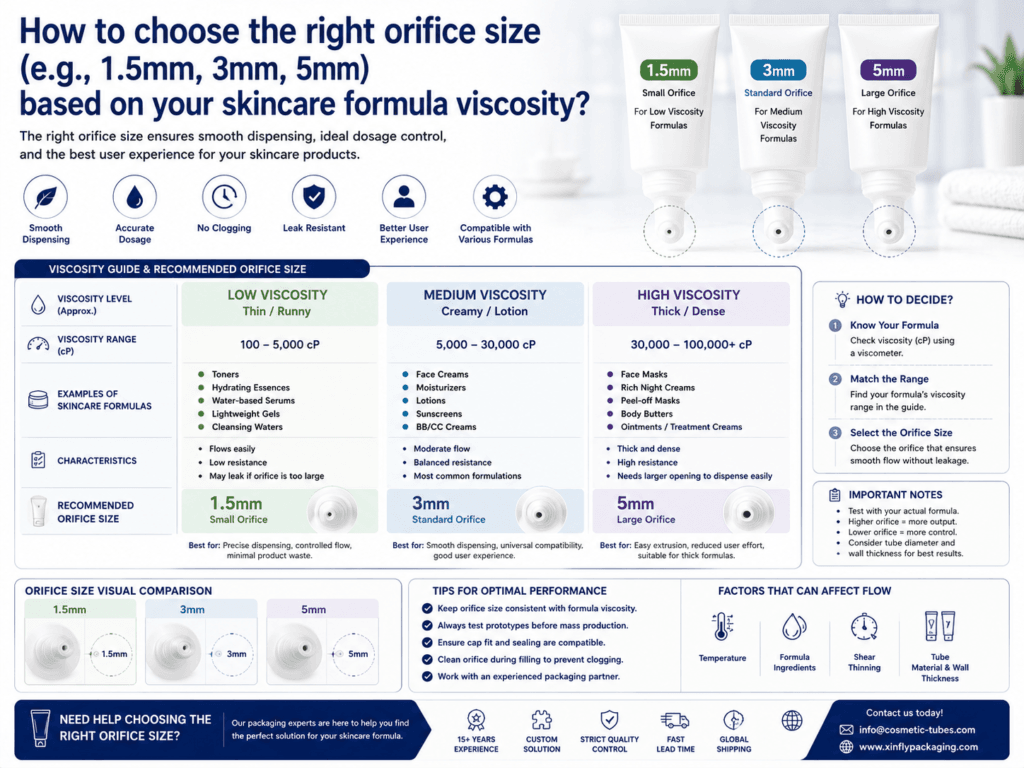
To choose the right orifice size for a skincare tube, start from the formula viscosity, then adjust based on tube softness, squeeze force, dosage control, cap seal, filling accuracy, and consumer application habit. A 1.5mm orifice is usually better for serums, eye creams, and low-dose formulas; a 3mm orifice works well for many creams and lotions; a 5mm orifice is more suitable for thick sunscreen, masks, balms, cleansers, and paste-like formulas.
The orifice is a small detail, but it directly affects user experience. If the opening is too small, the product is difficult to squeeze out, and the tube may deform under pressure. If the opening is too large, the formula may overflow, leak, dispense too much product, or create a messy cap area.
Quick Answer
| Orifice Size | Best Formula Type | Main Benefit | Main Risk |
|---|---|---|---|
| 1.5mm | Serum, eye cream, essence, low-dose active skincare | Precise dosage and clean dispensing | May clog or feel hard to squeeze for thick formulas |
| 3mm | Medium creams, lotions, moisturizers, facial cleanser gel | Balanced flow and dosage control | May be too large for very thin formulas or too small for paste |
| 5mm | Thick sunscreen, clay mask, balm, scrub, hair mask, paste cleanser | Easier dispensing for high-viscosity formulas | May cause over-dispensing or leakage for low-viscosity formulas |
Why Formula Viscosity Determines Orifice Size
Viscosity describes how easily a formula flows. A watery serum flows quickly and needs a small outlet to control dosage. A thick cream or sunscreen paste flows slowly and needs a larger outlet to reduce squeeze force. The tube body, cap, and orifice must work together so the consumer can dispense the right amount without excessive pressure.
| Formula Flow Behavior | Orifice Direction | Reason |
|---|---|---|
| Very thin and runny | Small orifice, around 1.5mm | Prevents sudden overflow, dripping, and messy dispensing |
| Light lotion | 1.5mm–3mm | Depends on target dosage and tube softness |
| Medium cream | Around 3mm | Balanced between control and easy squeezing |
| Thick cream or gel | 3mm–5mm | Reduces squeeze force and improves product flow |
| Paste, scrub, balm, clay mask | 5mm or larger project-specific outlet | Prevents clogging and excessive squeezing pressure |
Recommended Orifice Size by Skincare Application
| Product Type | Common Formula Texture | Recommended Orifice Direction | Packaging Note |
|---|---|---|---|
| Eye cream | Light to medium cream | 1.5mm–2.5mm | Small dosage and precise application are important |
| Face serum / essence | Low-viscosity liquid or gel | 1.5mm | Use a nozzle, long tip, or airless structure if precision is required |
| Moisturizer | Medium cream | 3mm | Good balance for daily skincare use |
| Hand cream | Medium to thick cream | 3mm–5mm | Match outlet to tube softness and cap type |
| Facial cleanser | Gel, cream, foam base, scrub | 3mm–5mm | Scrub particles may need larger orifice to prevent clogging |
| Sunscreen | Medium cream to thick paste | 3mm–5mm | High-viscosity mineral sunscreen often needs a larger outlet |
| Clay mask / sleeping mask | Thick cream, gel, or paste | 5mm | Larger outlet reduces squeeze force and improves consumer use |
1.5mm Orifice: Best for Precision Dosage
A 1.5mm orifice is useful when the product should be dispensed in small amounts. It is common for eye cream, serum, essence, spot treatment, active skincare, and sample-size tubes. It improves dosage control but is not suitable for very thick formulas unless the tube body is very soft and the formula flows smoothly.
- Best for: eye cream, serum, essence, treatment cream, low-dose formulas.
- Main advantage: clean, controlled, premium dispensing.
- Main risk: difficult squeezing, clogging, formula stringing, or consumer frustration.
- Design tip: pair with a soft tube body, long nozzle, metal applicator, or precision cap if needed.
3mm Orifice: The Balanced Choice
A 3mm orifice is often the most practical starting point for many skincare tubes. It can handle medium creams, moisturizers, facial cleanser gels, light sunscreen, and daily-use lotions. It provides better flow than 1.5mm while still controlling the amount dispensed.
| Why 3mm Works Well | Packaging Benefit |
|---|---|
| Balanced flow | Suitable for many medium-viscosity skincare formulas |
| Moderate dosage | Prevents over-dispensing better than a large 5mm outlet |
| Good cap compatibility | Works with many screw caps and flip-top caps |
| Lower clogging risk than 1.5mm | Better for creams and gels with moderate thickness |
5mm Orifice: Best for Thick or Particle-Containing Formulas
A 5mm orifice is suitable for formulas that are difficult to squeeze through smaller openings. Thick sunscreen, clay masks, body lotion, hair mask, exfoliating cleanser, scrub, and paste-like formulas often need a larger outlet to prevent high squeeze force and clogging.
- Best for: thick cream, paste, scrub, clay mask, sunscreen, hair mask, body lotion.
- Main advantage: smoother dispensing for high-viscosity formulas.
- Main risk: too much product may come out if the formula is thin.
- Design tip: use a secure cap plug, controlled tube softness, and leakage testing.
How Tube Softness Changes the Orifice Decision
The same formula may need different orifice sizes depending on tube softness. A very soft LDPE-rich tube can push product out more easily, so the orifice may not need to be too large. A rigid HDPE-rich tube may require a larger outlet because the consumer cannot apply as much squeeze force comfortably.
| Tube Body Feel | Effect on Dispensing | Orifice Adjustment |
|---|---|---|
| Very soft tube | Product comes out easily with low pressure | Use smaller or moderate orifice to prevent overflow |
| Balanced flexible tube | Good control and recovery | Use viscosity-based standard size |
| Semi-rigid tube | Consumer applies more force to dispense | Consider larger orifice for thick formulas |
| Thick wall large tube | Higher squeeze force required | Increase orifice or adjust PE blend ratio |
Cap Type and Plug Seal Matter
The cap must be designed to seal the chosen orifice. A larger outlet requires a stronger plug seal, especially for low-viscosity or oil-rich formulas. A flip-top cap is convenient, but the inner plug must fit tightly. A screw cap often provides stronger sealing for leakage-sensitive formulas.
| Cap Type | Orifice Consideration | Best Use |
|---|---|---|
| Screw cap | Good sealing control, especially with inner plug or liner | Travel tubes, premium skincare, leakage-sensitive formulas |
| Flip-top cap | Needs accurate plug fit and strong snap closure | Facial cleanser, hand cream, daily-use skincare |
| Nozzle cap | Good for small or precision dispensing | Eye cream, serum, spot treatment, essence |
| Applicator head | Orifice must match applicator flow path | Eye cream metal tip, rollerball serum, lip care applicator |
Common Problems From the Wrong Orifice Size
| Problem | Likely Cause | Adjustment Direction |
|---|---|---|
| Product is hard to squeeze out | Orifice too small, tube too rigid, formula too thick | Increase orifice size, soften tube body, or adjust outlet shape |
| Formula leaks into cap | Orifice too large, cap plug weak, formula too thin | Reduce orifice size or improve plug seal |
| Too much product comes out | Outlet too large for viscosity and dosage target | Use smaller orifice or firmer tube body |
| Outlet clogs | Orifice too small for particles, scrub, wax, or thick paste | Increase orifice size and review formula particle size |
| Tube body deforms during squeezing | High dispensing resistance from small outlet | Increase orifice, reduce viscosity stress, or adjust wall thickness |
| Messy cap area | Formula strings, drips, or remains around the outlet | Use anti-drip design, smaller outlet, or better cut-off geometry |
Formula Particle Size and Orifice Design
For exfoliating cleansers, scrub masks, mineral sunscreen, pigment-rich formulas, or products with beads and particles, orifice size must consider the largest particle size. If the outlet is too small, particles may clog the opening and cause sudden product bursts after the consumer squeezes harder.
| Formula Feature | Orifice Risk | Design Recommendation |
|---|---|---|
| Fine powder or pigment | May increase viscosity and friction | Use 3mm–5mm depending on formula flow |
| Scrub particles | May block small outlets | Use larger orifice and test particle flow |
| Mineral sunscreen | Thicker texture and high dispensing resistance | Usually 3mm–5mm with soft tube body |
| Wax or balm texture | May clog when cold | Use larger outlet and temperature cycling test |
Testing Before Finalizing the Orifice
The final orifice size should be tested with the real formula, real tube material, real cap, and real filling condition. Empty package review is not enough because formula viscosity can change with temperature, storage time, and shear during filling.
| Test | Purpose | What to Check |
|---|---|---|
| Dispensing force test | Measures how much squeeze force is needed | Consumer comfort, tube deformation, flow control |
| Dosage control test | Checks amount dispensed per squeeze | Over-dispensing, under-dispensing, repeatability |
| Leakage test | Confirms cap plug and outlet sealing | Formula residue, cap leakage, travel leakage |
| Clogging test | Checks outlet performance after repeated use | Dried formula, particles, paste buildup, blocked orifice |
| Temperature cycling test | Checks viscosity change in hot and cold conditions | Dripping when hot, clogging when cold, cap contamination |
| Repeated-use test | Simulates daily consumer use | Clean opening, stable flow, no cap mess, no sudden bursts |
Recommended Development Process
- Step 1: Classify the formula as low, medium, or high viscosity.
- Step 2: Confirm whether the formula contains particles, powders, waxes, oils, or actives.
- Step 3: Choose a starting orifice size: 1.5mm for precision, 3mm for balanced cream, 5mm for thick paste.
- Step 4: Match the cap plug, sealing land, and tube softness to the orifice.
- Step 5: Fill real samples and test squeeze force, dosage, leakage, clogging, and cap cleanliness.
- Step 6: Adjust the orifice, tube PE blend, wall thickness, or cap seal before mass production.
Common Mistakes to Avoid
- Choosing 1.5mm only for a premium look: It may be too small for thick skincare creams.
- Choosing 5mm only for easy flow: Thin formulas may leak or dispense too much product.
- Ignoring tube softness: A rigid tube with a small orifice can feel impossible to squeeze.
- Ignoring cap plug fit: A large outlet needs a stronger plug seal to prevent leakage.
- Testing at only one temperature: Skincare viscosity changes in hot and cold conditions.
- Skipping particle flow testing: Scrubs, mineral formulas, and masks can clog small openings.
Best Practical Recommendation
For most skincare tube projects, use 1.5mm for precision serum or eye cream, 3mm for balanced creams and moisturizers, and 5mm for thick sunscreen, masks, scrubs, balms, or high-viscosity formulas. Then adjust based on tube softness, cap sealing, outlet cleanliness, consumer squeeze force, and formula behavior after aging.
The safest way is to test 2–3 orifice options with filled samples before mass production. This prevents common problems such as over-dispensing, hard squeezing, cap leakage, clogging, and messy product residue around the closure.
Summary
The right orifice size depends on skincare formula viscosity, particle content, tube softness, wall thickness, cap type, plug seal design, dosage target, and consumer use scenario. A 1.5mm orifice is best for precise low-dose formulas, a 3mm orifice is the most balanced option for many creams and lotions, and a 5mm orifice is better for thick or particle-containing formulas.
Final selection should always be validated through real formula dispensing, squeeze force, leakage, clogging, temperature cycling, and repeated-use tests before mass production.
Learn more: Caps & Closures, Screw Cap Tubes, Flip Cap Tubes, Cosmetic Tube Squeeze Force Design, LDPE, LLDPE and HDPE Blend Ratio, Quality Assurance.
Need the Right Orifice Size for Your Skincare Tube?
Xinfly Packaging helps brands match formula viscosity, tube softness, cap plug design, orifice size, filling process, and leakage testing to create clean, controlled, and consumer-friendly skincare tube packaging.