
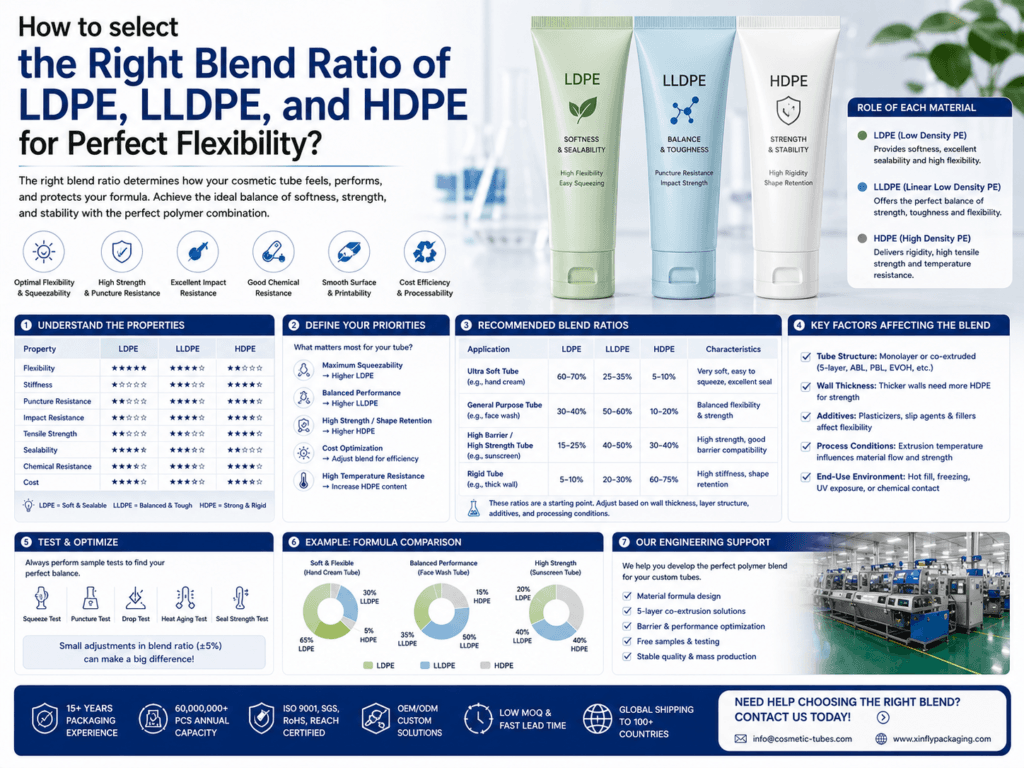
To select the right blend ratio of LDPE, LLDPE, and HDPE for perfect cosmetic tube flexibility, brands must balance softness, squeeze recovery, body strength, stress-crack resistance, standing stability, and formula dispensing behavior. There is no universal “best” ratio because a hand cream tube, sunscreen tube, lip balm tube, and large body lotion tube may all require different squeeze feel and structural performance.
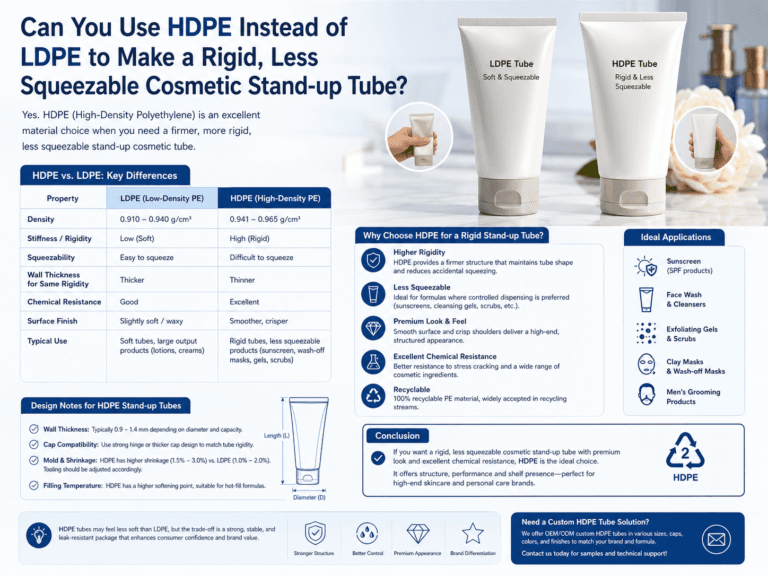
In cosmetic tube production, LDPE usually improves softness and easy squeezing, LLDPE improves toughness and puncture resistance, while HDPE improves stiffness and shape retention. The best blend is normally developed through trial extrusion, filled squeeze testing, wall thickness adjustment, and formula compatibility evaluation.
What Each PE Material Contributes
| Material | Main Character | Effect on Cosmetic Tube |
|---|---|---|
| LDPE | Soft, flexible, easy to squeeze | Improves hand feel, dispensing comfort, and soft cosmetic touch |
| LLDPE | Tough, elastic, good resistance to cracking | Improves durability, squeeze recovery, and impact resistance |
| HDPE | Stiffer, stronger, better shape retention | Improves stand-up performance, body support, and anti-collapse structure |
Quick Blend Ratio Direction
The following ratios are practical starting points only. The final blend must be adjusted based on tube diameter, wall thickness, capacity, formula viscosity, cap type, filling process, and desired user experience.
| Target Tube Feel | LDPE | LLDPE | HDPE | Best Application |
|---|---|---|---|---|
| Very soft squeeze | 60% – 80% | 15% – 30% | 0% – 10% | Hand cream, lip care, small skincare tubes |
| Balanced flexibility | 45% – 65% | 20% – 35% | 10% – 20% | Facial cleanser, sunscreen, daily lotion tubes |
| Semi-rigid stand-up tube | 30% – 50% | 20% – 35% | 20% – 40% | Body lotion, men’s grooming, large-capacity tubes |
| Rigid premium body | 20% – 40% | 15% – 30% | 35% – 55% | Structured stand-up packaging, low-squeeze formulas |
Engineer’s note: “Perfect flexibility” should not mean only soft. A good cosmetic tube must squeeze comfortably, recover well, stand properly, survive transport, and protect the formula without cracking or deformation.
How to Define “Perfect Flexibility” First
Before choosing the LDPE, LLDPE, and HDPE ratio, the brand should define the real performance target. For example, a tube for elderly-friendly hand cream should be soft and easy to squeeze, while a 200ml body lotion tube should be strong enough to stand upright and resist paneling during shipping.
| Performance Target | Material Direction | Why |
|---|---|---|
| Easy squeeze | Increase LDPE | Softens the tube wall and reduces compression force |
| Better recovery after squeezing | Increase LLDPE | Improves elasticity and reduces permanent creasing |
| Better stand-up stability | Increase HDPE carefully | Adds stiffness and body support |
| Better drop and transport resistance | Use balanced LLDPE + suitable wall thickness | Improves toughness without making the tube too hard |
| Premium soft hand feel | LDPE-rich blend with controlled LLDPE | Creates soft squeeze while maintaining body integrity |
How Formula Viscosity Affects Blend Ratio
Formula viscosity is one of the most important factors. A low-viscosity lotion can flow easily, so the tube can be slightly more rigid. A thick cream, balm, sunscreen paste, or hair mask needs a softer tube body or larger outlet because the consumer must apply more pressure to dispense the formula.
| Formula Type | Blend Direction | Packaging Advice |
|---|---|---|
| Light lotion | More HDPE can be acceptable | Useful for stand-up tubes and retail display stability |
| Medium cream | Balanced LDPE / LLDPE / HDPE | Good squeeze feel and stable tube body |
| Thick sunscreen | Higher LDPE + LLDPE, lower HDPE | Reduces squeeze force and improves dispensing control |
| Balm or paste | Soft blend with larger outlet | A rigid tube may make dispensing difficult |
| Foaming cleanser or gel | Balanced blend with good recovery | Prevents excessive paneling and improves user experience |
How Tube Size Changes the Blend Decision
Small tubes can use softer blends because the body area is limited and collapse risk is lower. Large tubes often require more structural support because the filled weight is higher and the body wall is under more stress during shipping, display, and squeezing.
| Tube Capacity | Flexibility Requirement | Blend Direction |
|---|---|---|
| 5ml – 30ml | Soft squeeze and precise dosage | LDPE-rich with moderate LLDPE |
| 50ml – 100ml | Balanced softness and recovery | LDPE + LLDPE with small to moderate HDPE |
| 120ml – 150ml | Better body stability and squeeze comfort | Balanced three-resin structure |
| 200ml – 250ml+ | Stronger wall and stand-up support | Increase HDPE or wall thickness, but keep enough LDPE for usability |
Wall Thickness and Blend Ratio Must Work Together
The blend ratio cannot be selected separately from wall thickness. A soft LDPE-rich tube can still feel firm if the wall is thick. A high-HDPE tube can become too hard if the wall thickness is not reduced or the outlet is too small. The final squeeze feel depends on both material blend and tube structure.
| Design Combination | Result | Recommendation |
|---|---|---|
| High LDPE + thin wall | Very soft, easy to squeeze, but may panel or deform | Use for small tubes or low-stress formulas |
| High LDPE + moderate wall | Soft but more stable | Good for premium hand cream and skincare tubes |
| Balanced blend + moderate wall | Best all-around flexibility and recovery | Recommended starting point for most cosmetic tubes |
| High HDPE + thick wall | Very rigid and difficult to squeeze | Use carefully only for easy-flow formulas or strong stand-up needs |
Material Blend Direction by Application
| Application | Suggested Material Direction | Key Requirement |
|---|---|---|
| Hand cream tube | LDPE-rich with LLDPE support | Soft squeeze, portable use, comfortable grip |
| Sunscreen tube | Balanced LDPE / LLDPE / HDPE | Squeeze control, outdoor durability, cap stability |
| Facial cleanser tube | Balanced blend with good recovery | Wet-hand grip, controlled dispensing, body stability |
| Body lotion tube | More HDPE or stronger wall, with enough LDPE | Large-capacity support and stand-up performance |
| Eye cream tube | Soft to medium blend | Precise dosage and comfortable squeeze force |
| Poly gel or thick paste tube | Soft blend with suitable outlet size | Lower dispensing force for high-viscosity formula |
Common Problems From the Wrong Blend Ratio
| Problem | Likely Cause | Adjustment Direction |
|---|---|---|
| Tube is too hard to squeeze | Too much HDPE, wall too thick, outlet too small | Increase LDPE, adjust LLDPE, reduce HDPE, review orifice size |
| Tube collapses or panels after filling | Too soft, wall too thin, poor headspace or formula shrinkage | Increase HDPE or wall thickness; check filling and headspace |
| Tube has poor recovery after squeezing | Insufficient elasticity or weak structure | Increase LLDPE and optimize wall thickness |
| Tube shows stress whitening | Too rigid or poor flex-fatigue resistance | Reduce HDPE and improve LLDPE balance |
| Tail seal cracks or leaks | Material too rigid or sealing conditions not optimized | Adjust HDPE level and tail-sealing parameters |
How to Test the Best Blend Ratio
The best blend ratio should be confirmed through physical testing, not only by resin data. A tube that feels good when empty may behave differently after filling, sealing, aging, shipping, and repeated squeezing by consumers.
| Test | Purpose | What to Check |
|---|---|---|
| Squeeze force test | Measures how much force is needed to dispense formula | Initial force, continuous force, consumer comfort |
| Shape recovery test | Checks how the tube recovers after squeezing | Permanent dents, creases, paneling, recovery speed |
| Drop test | Checks impact resistance during transport | Cracking, cap damage, shoulder failure, leakage |
| Tail-seal strength test | Confirms that the blend can be sealed reliably | Seal peeling, cracking, leakage, heat-seal window |
| Aging and compatibility test | Checks formula effect on the tube over time | Softening, swelling, stress whitening, deformation |
| Filled display test | Checks retail shelf performance | Standing stability, front-panel appearance, body collapse |
Recommended Development Process
- Step 1: Confirm formula viscosity, fill volume, tube diameter, and cap type.
- Step 2: Define the target squeeze feel: soft, balanced, semi-rigid, or rigid.
- Step 3: Select a starting LDPE / LLDPE / HDPE ratio based on application.
- Step 4: Produce trial tubes with 2–3 blend options if the project is high-value or technically sensitive.
- Step 5: Fill real formula and test squeeze force, recovery, leakage, and display stability.
- Step 6: Adjust resin ratio, wall thickness, or outlet size before mass production.
Common Mistakes to Avoid
- Choosing the blend only by softness: Too-soft tubes may collapse, panel, or look cheap after filling.
- Using too much HDPE: The tube may stand well but become difficult to squeeze.
- Ignoring LLDPE: LLDPE is important for toughness, recovery, and stress resistance.
- Testing empty tubes only: Real squeeze feel must be tested with the filled formula.
- Forgetting wall thickness: Material ratio and wall thickness work together.
- Using one formula for all tube sizes: A 30ml tube and a 250ml tube need different flexibility strategies.
Best Practical Recommendation
For most cosmetic squeeze tubes, start with a balanced LDPE / LLDPE / HDPE blend rather than using only one PE type. Use more LDPE for soft squeeze, more LLDPE for toughness and recovery, and more HDPE for stiffness and stand-up support. Then fine-tune the wall thickness and outlet size according to the actual formula.
For premium skincare and hand cream tubes, an LDPE-rich blend with enough LLDPE support usually provides a soft and comfortable feel. For larger lotion or stand-up tubes, add HDPE carefully to improve structure without making the tube too rigid. The final blend should always be validated with real filled-tube testing.
Summary
The right blend ratio of LDPE, LLDPE, and HDPE depends on the desired flexibility, formula viscosity, tube size, wall thickness, cap type, filling process, and retail requirements. LDPE improves softness, LLDPE improves toughness and recovery, and HDPE improves stiffness and shape retention.
A practical starting direction is LDPE-rich for soft squeeze tubes, balanced LDPE / LLDPE / HDPE for daily-use cosmetic tubes, and higher HDPE for semi-rigid stand-up tubes. However, the best ratio must be confirmed by extrusion trials, filled squeeze testing, recovery testing, tail-seal testing, and formula compatibility evaluation before mass production.
Learn more: PE Tubes, 2-Layer Plastic Tubes, 5-Layer Plastic Tubes, Cosmetic Tube Squeeze Force Design, HDPE vs LDPE for Rigid Stand-Up Tubes, Quality Assurance.
Need the Right PE Blend for Cosmetic Tube Flexibility?
Xinfly Packaging helps beauty brands adjust LDPE, LLDPE, and HDPE blend ratios, wall thickness, tube diameter, cap structure, and outlet size to achieve the ideal balance of squeeze comfort, recovery, strength, and shelf appearance.