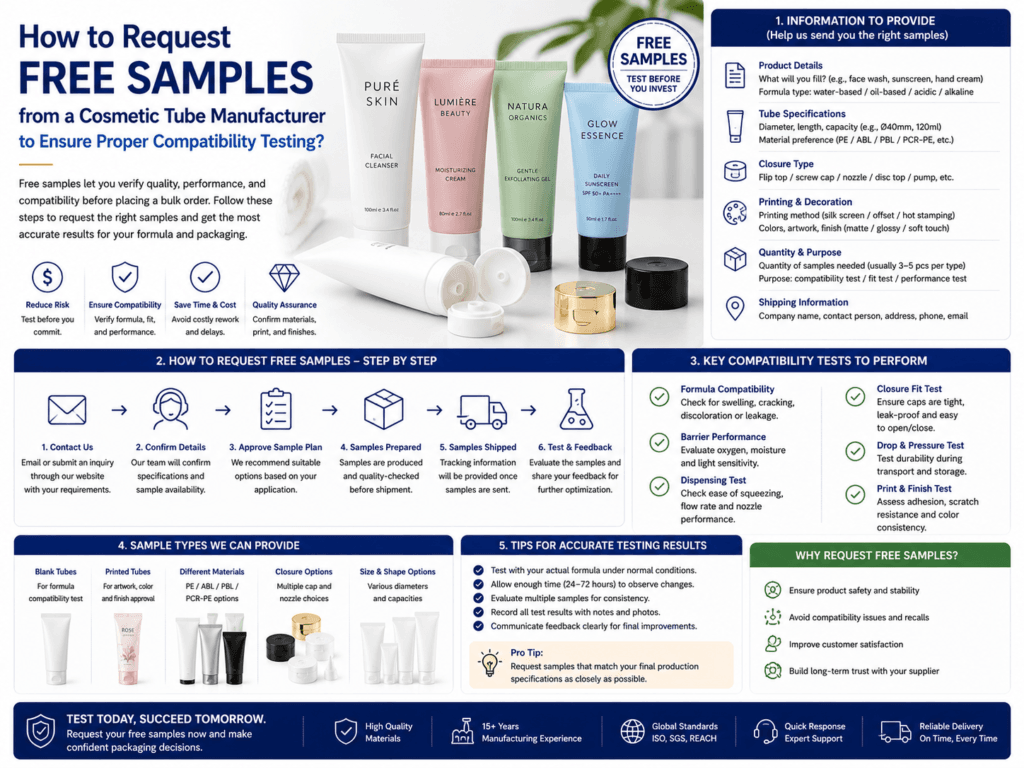
To request free samples from a cosmetic tube manufacturer for proper compatibility testing, buyers should provide clear formula information, target fill volume, tube material preference, cap type, decoration requirements, filling method, and testing purpose. A sample request should not only ask for “some tubes.” It should help the manufacturer select the right tube structure, cap system, orifice size, wall thickness, and material barrier for the actual product.
Free stock samples are useful for checking tube hand feel, cap function, color reference, size comparison, and basic filling trials. However, for formula compatibility, leakage resistance, oxygen barrier, printing adhesion, or custom applicator testing, buyers may need custom samples or pre-production samples made according to the final packaging specification.
Quick Answer
The best way to request free samples is to send the cosmetic tube manufacturer a structured sample request that includes product category, formula type, viscosity, pH if available, oil or alcohol content, target capacity, tube diameter, tube material, cap style, orifice size, decoration method, estimated order quantity, destination country, and the exact tests you plan to run. This allows the factory to recommend suitable samples instead of sending random tubes that may not match your formula.
| Information to Provide | Why It Matters | Example |
|---|---|---|
| Product category | Helps select application-specific tube structure | Sunscreen, eye cream, facial cleanser, hand cream, toothpaste |
| Formula type | Determines material compatibility and barrier needs | Oil-rich cream, gel cleanser, SPF lotion, essential-oil balm |
| Viscosity | Affects orifice size, squeeze force, and cap selection | Low, medium, high viscosity; flowable gel or thick paste |
| Target fill volume | Determines tube diameter, length, and headspace | 15ml, 30ml, 50ml, 100ml, 200ml |
| Cap type | Affects leakage, usability, and filling-line compatibility | Screw cap, flip-top cap, long nozzle, rollerball, airless pump |
| Testing purpose | Helps factory send the right sample type | Leakage, barrier, compatibility, drop, filling, printing adhesion |
Why Compatibility Testing Matters Before Bulk Orders
Cosmetic formulas can interact with packaging materials in different ways. A tube that works well for a basic hand cream may fail with a high-SPF sunscreen, essential-oil formula, retinol cream, strong alkaline hair removal cream, or surfactant-rich cleanser. Compatibility testing helps prevent leakage, tube swelling, paneling, odor transfer, formula discoloration, cap cracking, printing failure, and poor dispensing.
- Formula stability: Confirms whether the formula changes color, odor, viscosity, or texture inside the tube.
- Material resistance: Checks whether PE, PCR, EVOH, ABL, PBL, or cap materials react with the formula.
- Leakage control: Verifies cap seal, tube neck, orifice, shoulder, and tail-seal performance.
- Dispensing performance: Confirms squeeze force, dosage, orifice size, and user comfort.
- Decoration durability: Checks whether printing, hot stamping, matte finish, or soft-touch coating survives handling and filling.
Free Stock Samples vs. Custom Samples
Buyers should understand the difference between free stock samples and custom samples. Stock samples are existing tubes from the factory’s sample room. They are useful for early evaluation, but they may not match the final color, artwork, material, cap, or exact formula requirement. Custom samples are closer to the final project but may require sample fees, setup fees, or more development time.
| Sample Type | Best For | Limitations |
|---|---|---|
| Free stock samples | Checking tube size, shape, cap style, squeeze feel, general material options | May not match final color, printing, finish, or formula requirement |
| Similar project samples | Reviewing factory quality, decoration ability, and cap options | Cannot replace final compatibility testing |
| Blank custom samples | Testing tube size, cap fit, filling, leakage, and formula compatibility | No final artwork or decoration confirmation |
| Printed custom samples | Checking artwork, color, finish, printing adhesion, and shelf appearance | Requires more time and possible sample setup cost |
| Pre-production samples | Final approval before bulk production | Should be made with final material, cap, color, artwork, and process |
What Sample Quantity Should You Request?
For serious compatibility testing, one or two tubes are usually not enough. Buyers should request enough samples to test different conditions such as upright storage, inverted storage, heat aging, cold storage, drop testing, filling-line simulation, and consumer-use trials.
| Testing Purpose | Suggested Sample Quantity | Reason |
|---|---|---|
| Size and appearance review | 3–5 pcs | Enough for basic hand-feel and visual review |
| Formula filling trial | 10–20 pcs | Allows filling, sealing, and storage checks |
| Leakage and shipping test | 20–50 pcs | Supports drop, compression, inverted, and carton tests |
| Filling-line compatibility | 50–100 pcs | Useful for semi-automatic or automatic filling machine setup |
| Full pre-production validation | Project-specific | Depends on SKU count, formula risk, and retail requirements |
Formula Information to Share With the Manufacturer
The factory does not need the full confidential formula, but it does need key packaging-relevant information. This helps engineers recommend the correct material structure, cap, orifice, barrier layer, and testing plan.
| Formula Information | Why It Helps | Example |
|---|---|---|
| Viscosity | Determines orifice size and tube softness | Thin serum, medium cream, thick paste |
| Oil content | Checks risk of plastic swelling, scalping, or cap cracking | Essential oils, mineral oils, ester emollients |
| Alcohol or solvent content | May affect PE, PP, coatings, and printing adhesion | Alcohol-based gel or solvent-containing formula |
| pH value | Important for acidic or alkaline formulas | AHA cream, hair removal cream, cleansing gel |
| Active ingredients | May require barrier or light protection | Retinol, Vitamin C, SPF filters, benzoyl peroxide |
| Filling temperature | Prevents tube deformation and sealing problems | Cold fill, warm fill, hot fill under controlled temperature |
Engineer’s note: If the formula contains sunscreen filters, essential oils, high fragrance, retinol, Vitamin C, strong surfactants, or alkaline ingredients, do not rely only on appearance samples. Ask for compatibility-focused samples and run filled aging tests before confirming bulk production.
Tube Specification Details to Include
A clear tube specification allows the manufacturer to send the most relevant samples. If the buyer only says “50ml tube,” the factory still needs to know the material, diameter, cap style, printing method, and expected use case.
| Specification | Options to Mention | Why It Matters |
|---|---|---|
| Capacity | 10ml, 15ml, 30ml, 50ml, 100ml, 150ml, 200ml | Determines tube diameter, length, and carton size |
| Material | PE, PCR PE, sugarcane PE, 5-layer EVOH, ABL, PBL | Controls barrier, flexibility, cost, and sustainability claim |
| Cap type | Screw cap, flip-top cap, nozzle cap, rollerball, airless pump | Affects leakage, dosage, and consumer use |
| Orifice size | 1.5mm, 3mm, 5mm, or formula-specific | Controls dispensing and clogging risk |
| Surface finish | Matte, glossy, pearlized, soft-touch, metallic | Affects brand appearance and scratch resistance |
| Decoration | Silk screen, offset, hot stamping, label, spot UV | Affects lead time, cost, and adhesion testing |
Recommended Compatibility Tests After Receiving Samples
Once the samples arrive, the buyer should test them with the real formula under realistic conditions. Compatibility testing should not be limited to filling one tube and checking it the next day. Some failures appear only after heat aging, pressure, shipping vibration, or repeated use.
| Test | Purpose | What to Check |
|---|---|---|
| Filled storage test | Checks formula and tube interaction over time | Swelling, paneling, odor, color change, softening |
| Inverted leakage test | Checks cap, orifice, and neck sealing | Leakage inside cap, thread leakage, product residue |
| Heat aging test | Accelerates formula-packaging interaction | Deformation, leakage, printing damage, cap cracking |
| Cold storage test | Checks brittleness and dispensing at low temperature | Hard squeeze, cap cracking, formula thickening |
| Drop and compression test | Simulates shipping and e-commerce handling | Cap breakage, tail leakage, tube dents, carton damage |
| Printing adhesion test | Checks artwork durability | Ink peeling, hot stamping loss, coating scratches |
| Filling-line trial | Confirms compatibility with filling and sealing equipment | Tube loading, filling accuracy, tail sealing, coding position |
How to Write a Professional Free Sample Request
A good sample request should be specific, concise, and useful for engineering review. Below is a structure procurement managers can use when contacting a cosmetic tube manufacturer.
| Request Section | What to Include |
|---|---|
| Company and product | Brand name, product category, launch market, estimated order quantity |
| Formula details | Viscosity, pH if available, oil/alcohol/surfactant content, filling temperature |
| Tube requirements | Capacity, material, diameter, cap type, orifice, surface finish, decoration |
| Testing purpose | Leakage, formula compatibility, barrier, filling-line, drop, compression, printing adhesion |
| Sample request | Quantity, preferred sample type, shipping address, courier account if available |
| Project timeline | Sample deadline, expected bulk order date, target launch date |
Sample Request Email Template
Subject: Free Sample Request for Compatibility Testing – Custom Cosmetic Tubes
Hello,
We are developing a new cosmetic product and would like to request tube samples for compatibility testing. Our product is a [product category], with a [cream / gel / lotion / oil / paste] formula. The estimated fill volume is [xx ml / xx g], and the formula viscosity is [low / medium / high]. It contains [oils / surfactants / alcohol / fragrance / SPF filters / actives], and the filling temperature is approximately [xx°C] if available.
We are interested in [PE / PCR PE / 5-layer EVOH / ABL / PBL] tubes with [screw cap / flip-top cap / nozzle / applicator / airless pump], preferably in [capacity and diameter]. We plan to test leakage, formula compatibility, dispensing, cap fit, drop resistance, and filling-line compatibility.
Could you please recommend suitable free stock samples or similar samples for our testing? Please also let us know the available sample quantity, sample lead time, shipping cost, and whether custom samples can be developed after initial evaluation.
Thank you.
What Manufacturers Usually Provide as Free Samples
Most cosmetic tube manufacturers can provide free stock samples when similar tubes are available. However, buyers usually need to pay courier freight or provide a courier account. For custom printed samples, sample fees may apply because the factory needs material preparation, printing setup, color matching, cap production, and labor.
| Sample Item | Usually Free? | Buyer May Pay |
|---|---|---|
| Existing blank tube samples | Often yes | Courier freight |
| Existing printed reference samples | Often yes if available | Courier freight |
| Custom color samples | Sometimes charged | Color trial and material setup |
| Custom printed samples | Usually charged | Printing setup, proofing, plates or screens |
| Custom mold samples | Usually charged | Tooling, mold trial, engineering development |
Common Mistakes to Avoid
- Requesting samples without formula information: The factory may send tubes that look good but are not compatible.
- Testing only empty tubes: Filled testing is necessary for leakage, swelling, paneling, and cap performance.
- Using one sample for all tests: Multiple samples are needed for heat, cold, drop, leakage, and filling trials.
- Ignoring cap and orifice size: The tube body may be correct, but dispensing may fail if the cap system is wrong.
- Skipping printing adhesion tests: Filling, sealing, and transport can damage weak printing or coatings.
- Assuming stock samples equal final production: Final pre-production samples should match the approved material, cap, color, artwork, and finish.
Best Practical Recommendation
Start with free stock samples to evaluate tube size, material feel, cap options, and general quality. Then request custom or pre-production samples for the final formula compatibility test. For high-risk formulas such as sunscreen, retinol cream, Vitamin C cream, essential-oil products, hair removal cream, or strong cleanser formulas, compatibility testing should be treated as a required step before bulk production.
A professional sample request should help the manufacturer understand not only what tube you want, but also what problem the sample must help solve: leakage, barrier protection, formula stability, printing durability, filling-line fit, or consumer-use performance.
Summary
To request free samples from a cosmetic tube manufacturer, provide product category, formula type, viscosity, key ingredients, target capacity, tube material, cap style, orifice size, decoration requirements, estimated order quantity, destination country, and testing purpose. This allows the manufacturer to recommend useful samples for compatibility testing instead of sending random available tubes.
For proper compatibility testing, buyers should fill samples with the real formula and run storage, leakage, heat aging, cold storage, drop, compression, printing adhesion, cap fit, and filling-line tests. Free samples are a good starting point, but final approval should be based on samples that match the actual production specification.
Learn more: Sample Development, Custom Cosmetic Tubes, Quality Assurance, Choose the Right Orifice Size, Custom Printed Tube Lead Time, Contact Xinfly Packaging.
Need Free Samples for Cosmetic Tube Compatibility Testing?
Xinfly Packaging helps skincare and personal care brands select suitable tube samples, material structures, cap systems, orifice sizes, applicators, and testing plans for formula compatibility, leakage control, filling-line trials, and custom cosmetic tube development.