
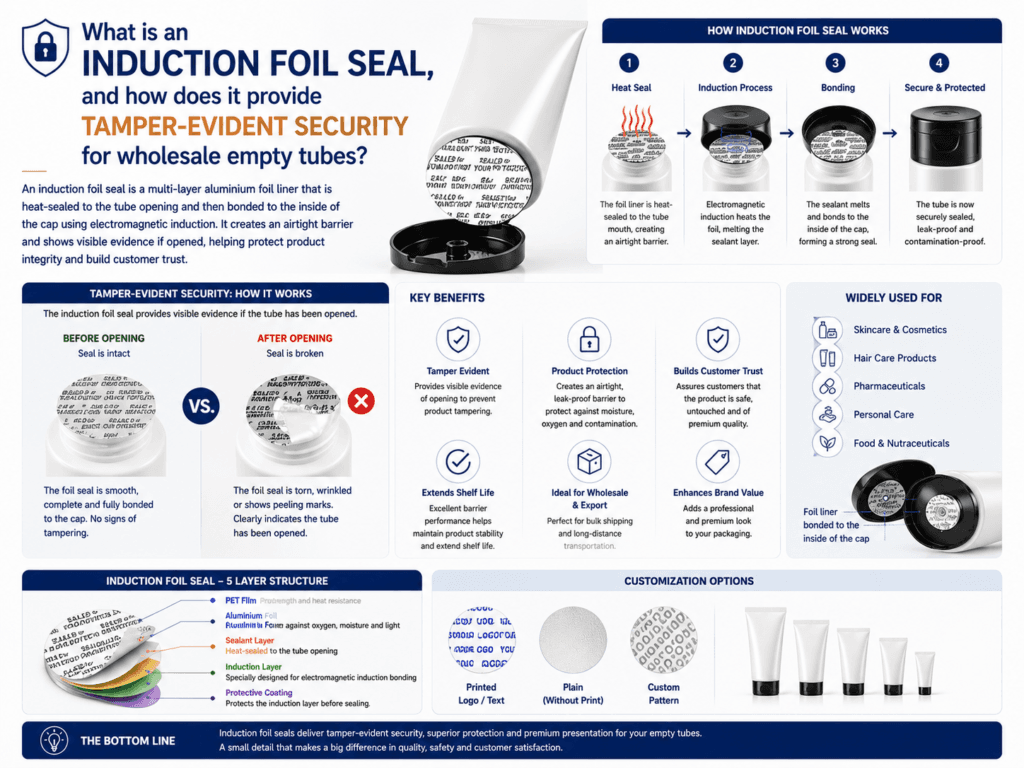
An induction foil seal is a thin aluminum-based sealing liner that is bonded to the tube neck by electromagnetic induction heating, creating a visible tamper-evident barrier over the tube opening. For wholesale empty tubes, it helps brands prove that the tube has not been opened, contaminated, or interfered with before the end customer removes the seal.
Induction foil seals are commonly used for cosmetic, skincare, pharmaceutical, toothpaste, personal care, and chemical tube packaging when brands need extra security, leakage resistance, freshness protection, and consumer trust. The seal is usually applied after filling, before or during cap assembly, depending on the filling line and closure system.
Quick Answer
An induction foil seal provides tamper-evident security because it forms a sealed membrane across the tube orifice. If the tube has been opened, the foil must be punctured, peeled, torn, or visibly damaged. This gives consumers and retailers a clear sign that the product has been accessed.
| Function | How It Works | Packaging Benefit |
|---|---|---|
| Tamper evidence | Foil must be removed or broken before first use | Shows whether the product has been opened |
| Leakage control | Seals the tube opening before consumer use | Reduces leakage during shipping and storage |
| Freshness protection | Blocks exposure to air, dust, and external contamination | Improves product integrity and consumer confidence |
| Retail security | Provides a visible first-opening barrier | Useful for e-commerce, wholesale, and retail display |
What Is an Induction Foil Seal?
An induction foil seal is usually a multi-layer liner made with aluminum foil, heat-seal coating, paper or foam backing, and sometimes a printed pull-tab or easy-peel layer. During sealing, the induction machine heats the foil layer. The heat activates the sealing layer and bonds the foil to the tube neck or sealing land.
| Seal Layer | Purpose | Why It Matters |
|---|---|---|
| Aluminum foil layer | Heats during induction sealing and provides barrier performance | Creates the main tamper-evident membrane |
| Heat-seal layer | Bonds the foil to the tube neck | Must match PE, PP, laminate, or tube-neck material |
| Backing layer | Supports the liner inside the cap before sealing | Helps liner handling and cap assembly |
| Peel layer or pull-tab | Allows consumers to remove the seal | Improves user experience and opening comfort |
How Does It Provide Tamper-Evident Security?
The security function is simple: the foil covers the tube opening completely. Before the first use, the consumer must break, peel, or puncture the foil. If the foil is missing, torn, lifted, wrinkled, or partially detached before purchase, the product may have been opened or mishandled.
- Visible first-opening barrier: Consumers can see whether the tube has been accessed.
- Hard to reapply perfectly: Once removed, the seal cannot usually be restored to its original factory condition.
- Protects the orifice: Prevents direct contact with the product outlet before first use.
- Supports retailer trust: Useful for wholesale, retail shelves, and online sales.
- Reduces contamination concern: Helps protect sensitive skincare, toothpaste, and personal care formulas.
Induction Seal vs. Ordinary Cap Seal
| Feature | Induction Foil Seal | Ordinary Cap Seal |
|---|---|---|
| Tamper evidence | Strong; missing or broken foil is visible | Limited; cap may be opened and closed again |
| Leak prevention before first use | High if properly sealed | Depends on cap plug, thread, and torque |
| Freshness protection | Better barrier before opening | Lower barrier if cap is not perfectly sealed |
| Consumer confidence | Higher for hygiene-sensitive products | Acceptable for standard low-risk products |
| Production complexity | Requires liner, induction equipment, and process control | Simpler cap assembly |
Why Wholesale Empty Tubes May Need Induction Foil Seals
Wholesale empty tubes are often supplied to brands, contract fillers, private-label skincare companies, toothpaste manufacturers, and personal care producers. When the final product will be distributed through retail shelves, e-commerce, hotel amenities, pharmacies, or international shipping, tamper-evident protection may become important.
| Wholesale Use Case | Why Foil Seal Helps | Typical Product Type |
|---|---|---|
| Private label skincare | Improves first-use trust and perceived hygiene | Eye cream, moisturizer, serum cream, sunscreen |
| Toothpaste and oral care | Protects formula and provides clear first-opening evidence | Toothpaste, gel toothpaste, medicated oral care |
| E-commerce sales | Reduces leakage and tampering concern during shipping | Hand cream, cleanser, lotion, treatment cream |
| Hotel amenities | Supports hygiene perception for guest-use products | Shampoo, conditioner, body wash, lotion tubes |
| Functional or OTC-style products | May help meet stronger packaging security expectations | Medicated cream, acne cream, specialty toothpaste |
Tube and Cap Requirements for Induction Sealing
Induction sealing only works reliably when the tube neck, cap, liner, and sealing machine are compatible. The tube must have a flat and clean sealing land. The cap must hold the liner in the correct position. The liner’s heat-seal layer must match the tube-neck material.
| Requirement | What to Confirm | Risk If Incorrect |
|---|---|---|
| Tube neck material | PE, PP, laminate head, or other material | Seal may not bond or may peel too easily |
| Sealing land | Flat, clean, uniform surface around the orifice | Partial sealing, leakage, wrinkles, pinholes |
| Cap design | Cap must hold liner evenly during induction sealing | Liner shifts, overheats, or seals unevenly |
| Liner diameter | Must match tube neck and cap inner structure | Poor coverage, edge leakage, difficult peeling |
| Formula compatibility | Seal must resist oils, actives, surfactants, and fragrance | Seal lifting, delamination, odor, leakage |
Which Tube Materials Can Use Induction Foil Seals?
| Tube Type | Induction Seal Suitability | Engineering Note |
|---|---|---|
| PE cosmetic tubes | Often suitable with matching PE-compatible liner | Neck flatness and heat control are important |
| ABL laminate tubes | Can be suitable depending on tube head and liner structure | Confirm sealing layer compatibility with the tube neck |
| PBL laminate tubes | Often suitable with correct liner selection | Useful for toothpaste, skincare, and barrier packaging |
| PCR PE tubes | Needs additional testing | PCR content may affect sealing consistency and neck surface quality |
| Special applicator tubes | Project-specific | Nozzle, rollerball, and applicator heads may not support standard foil sealing |
Engineer’s note: Induction foil sealing should be tested with the final tube, cap, liner, formula, and filling process. A liner that works on one tube neck may fail on another if the sealing land, material, or cap pressure is different.
How the Induction Sealing Process Works
| Step | Process | Control Point |
|---|---|---|
| 1. Liner placement | Foil liner is placed inside the cap or applied to the opening | Liner must be centered and clean |
| 2. Cap application | Cap is tightened onto the filled tube | Correct torque ensures contact between liner and sealing land |
| 3. Induction heating | Electromagnetic field heats the aluminum foil layer | Power, speed, and time must be controlled |
| 4. Heat-seal bonding | Heat activates the seal layer and bonds foil to the tube neck | Bond must be continuous around the opening |
| 5. Cooling | Seal cools and stabilizes before handling | Early movement may weaken seal quality |
| 6. Inspection | Seal is checked for adhesion, wrinkles, leakage, and peel strength | Reject weak, burnt, shifted, or incomplete seals |
Common Induction Seal Defects
| Defect | Possible Cause | Solution Direction |
|---|---|---|
| Seal does not stick | Wrong liner material, low power, poor neck surface | Use compatible liner and adjust induction settings |
| Partial seal | Uneven neck surface, tilted cap, liner not centered | Improve neck flatness, cap torque, and liner placement |
| Burnt or melted seal | Excessive induction power or slow conveyor speed | Reduce power or increase line speed |
| Wrinkled foil | Liner shift, cap pressure issue, overheating | Improve liner centering and cap fit |
| Hard to peel | Seal layer too aggressive or overheating | Select easy-peel liner and optimize heating |
| Seal peels too easily | Weak bonding or wrong liner type | Increase sealing strength and verify material compatibility |
Benefits for Wholesale and Private Label Buyers
- Improves tamper evidence: Consumers can see whether the tube has been opened.
- Reduces leakage risk: Helps protect tubes during shipping and storage before first use.
- Supports hygiene positioning: Useful for skincare, toothpaste, eye cream, and hotel amenities.
- Improves retailer confidence: Especially helpful for e-commerce and shelf display products.
- Protects formula freshness: Helps reduce exposure to air, dust, and handling contamination.
- Adds premium perception: A clean foil seal makes the package feel safer and more professional.
Testing Before Mass Production
| Test | Purpose | What to Check |
|---|---|---|
| Seal adhesion test | Confirms the foil bonds properly to the tube neck | Complete bonding, no weak edges, no lifting |
| Peel strength test | Checks consumer opening and tamper-evident function | Not too easy, not too difficult to remove |
| Leakage test | Confirms seal prevents product leakage | Inverted storage, compression, pressure, and shipping simulation |
| Formula compatibility test | Checks whether formula attacks liner or seal layer | Seal lifting, delamination, odor change, discoloration |
| Heat aging test | Checks long-term stability in hot storage | Seal softening, leakage, adhesive failure |
| Cap torque test | Ensures liner receives proper pressure during sealing | Loose cap, overtightening, uneven seal pressure |
When Is an Induction Foil Seal Recommended?
| Product Scenario | Recommended? | Reason |
|---|---|---|
| Toothpaste tubes | Yes, often recommended | Improves hygiene, freshness, and tamper evidence |
| Eye cream and skincare tubes | Recommended for premium or hygiene-sensitive products | Protects first-use confidence and formula integrity |
| Hand cream and lotion tubes | Project-specific | Useful for e-commerce, travel, or retailer requirements |
| Hotel amenity tubes | Recommended for hygiene-focused hotel programs | Shows guests the product is unopened |
| Nozzle or applicator tubes | Often difficult or not suitable | Special head structures may not support standard foil sealing |
Common Mistakes to Avoid
- Choosing the liner only by diameter: The liner material must match the tube-neck material.
- Ignoring cap torque: Poor cap pressure can cause partial or weak sealing.
- Using a non-flat sealing land: Uneven neck surfaces create leakage paths.
- Skipping formula compatibility tests: Oils, surfactants, actives, and fragrance may affect liner performance.
- Overheating the foil: Too much induction power can burn, wrinkle, or weaken the seal.
- Assuming all tube heads can be sealed: Applicator, nozzle, and special heads need project-specific review.
Best Practical Recommendation
For wholesale empty tubes, induction foil sealing is a good choice when the final product needs visible tamper evidence, improved hygiene, leakage protection, and stronger consumer trust. It is especially useful for toothpaste, skincare, eye cream, sunscreen, hand cream, hotel amenities, and e-commerce personal care products.
Before mass production, confirm the tube neck material, sealing land design, cap structure, liner type, formula compatibility, cap torque, induction power, conveyor speed, peel strength, and leakage performance. The foil seal should be tested as part of the complete filled package, not as a separate component.
Summary
An induction foil seal is an aluminum-based liner that bonds to the tube neck through electromagnetic induction heating. It creates a sealed membrane over the tube opening, helping provide tamper-evident security because the foil must be visibly broken, peeled, or removed before first use.
For wholesale empty tubes, induction foil seals can improve product safety perception, reduce leakage, support hygiene claims, protect formula freshness, and increase retailer and consumer confidence. The final design must be validated through seal adhesion, peel strength, leakage, formula compatibility, heat aging, and cap torque testing.
Learn more: Toothpaste Tubes, Empty Cosmetic Tubes Manufacturer, Laminate Tubes, Caps & Closures, Customization, Quality Assurance.
Need Wholesale Empty Tubes with Tamper-Evident Sealing Options?
Xinfly Packaging helps brands develop wholesale empty tubes with suitable tube materials, cap systems, induction foil seal compatibility, leakage testing, formula compatibility, and tamper-evident packaging solutions for skincare, toothpaste, personal care, and hotel amenity products.