

About This Ranking
This Top 10 list is based on publicly available information collected from the internet, manufacturer websites and online cosmetic packaging resources.
The article is an editorial sourcing guide for skincare brands, private-label companies, contract manufacturers and procurement teams looking for custom hand cream tube suppliers in China.
Manufacturers were reviewed using publicly available information relating to cosmetic tube manufacturing, hand cream and skincare applications, tube materials, decoration, closures, sustainability, OEM / ODM capability and market presence.
This list is not an official industry ranking and does not represent audited market share, certification, endorsement or independent factory auditing. Buyers should verify current MOQ, production capability, certifications, materials, samples and commercial terms directly with each supplier.
Version 2026.08 · Last Reviewed: August 15, 2026What Are Hand Cream Tubes?
Hand cream tubes are compact squeeze packages designed for moisturizing creams, repair balms, barrier creams, rich hand butters and other hand-care formulas.
Unlike high-capacity lotion packaging, hand cream tubes are often carried in handbags, travel kits, workplaces and gift sets. This means portability, closure reliability, squeeze comfort and decoration durability are particularly important.
Common hand cream tube capacities range from approximately 10ml travel formats to 100ml retail formats, with 30ml, 50ml and 75ml being especially useful for portable and premium skincare applications.
Hand Cream Packaging Must Balance Softness And Durability
A tube that is too stiff can be uncomfortable to squeeze, while an overly soft tube can dent, panel or look inexpensive. PE formulation, wall thickness, diameter and recycled-content percentage should therefore be considered together.
Common Hand Cream Applications
- Light to medium viscosity
- 30ml–75ml retail sizes
- PE squeeze tubes
- Rich high-viscosity formula
- Barrier-support formulas
- Larger dispensing opening
- Soft-touch finishes
- Hot stamping
- Premium closures
- PCR PE tubes
- Sugarcane PE
- Recyclability-focused structures
How To Choose Hand Cream Tube Materials
Hand cream packaging can use several material structures. The best choice depends on formula viscosity, oils, fragrance, required barrier performance, brand positioning, sustainability objectives and target price.
PE is a common option for everyday hand creams because it provides good squeeze flexibility, tube recovery, color customization and cost efficiency.
Explore PE Tubes →PCR PE can reduce virgin plastic consumption for sustainability-focused hand cream brands. PCR percentage should be balanced against appearance, mechanical strength and squeeze feel.
Explore PCR Tubes →Barrier structures may be considered for formulas containing essential oils, strong fragrance or ingredients requiring additional oxygen or migration protection.
Explore EVOH Tubes →Aluminum provides strong barrier performance and a distinctive pharmacy or premium aesthetic. It behaves differently from flexible PE because the tube generally retains creases after squeezing.
Explore Aluminum Tubes →Sugarcane-based PE can support renewable-feedstock positioning while providing many of the functional characteristics of PE.
Explore Sugarcane Tubes →Soft-touch finishing is popular for premium hand cream because it creates a tactile, velvety feel while supporting upscale branding.
Explore Soft-Touch Tubes →| Hand Cream Type | Recommended Packaging Direction | Main Priority |
|---|---|---|
| Everyday Hand Cream | PE Squeeze Tube | Soft squeeze + cost efficiency |
| Premium Hand Cream | PE + Soft Touch | Tactile feel + shelf appearance |
| Rich Hand Butter | PE + Larger Orifice | Easy dispensing |
| Essential-Oil Hand Cream | 5-Layer / EVOH | Migration + fragrance protection |
| Sustainable Hand Cream | PCR PE / Sugarcane PE | Reduced virgin fossil-based material |
| Pharmacy-Style Repair Cream | Aluminum / Barrier Tube | High barrier + clinical appearance |
| Travel Hand Cream | 10–30ml PE + Screw Cap | Portability + leakage control |
For a deeper comparison, see Aluminum vs Plastic Hand Cream Tubes and How To Balance Softness & Durability in a 50ml PCR Hand Cream Tube .
Hand Cream Packaging Resources
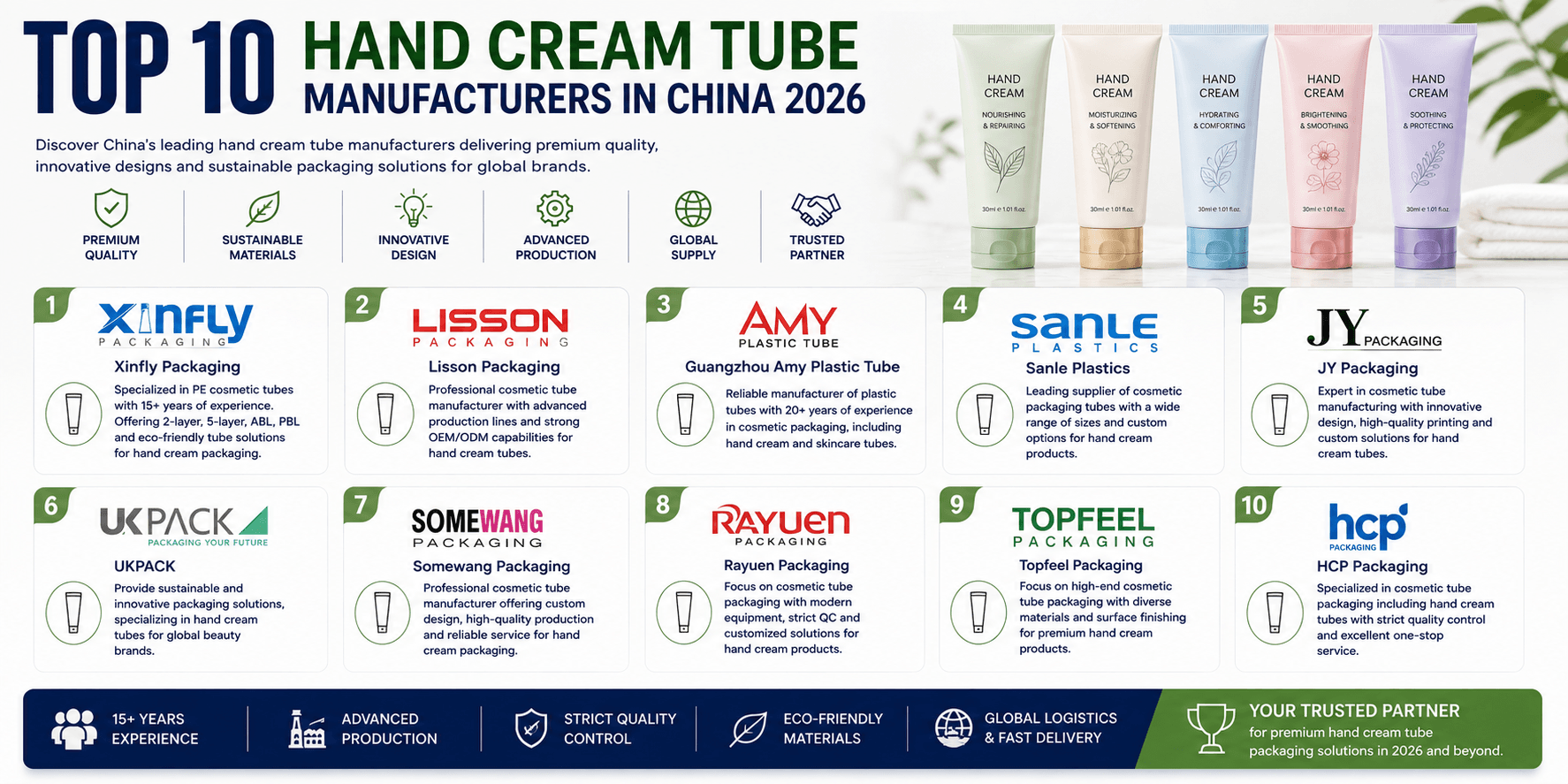
Top 10 Hand Cream Tube Manufacturers in China 2026
The following manufacturers represent different sourcing options for hand cream and skincare tube packaging in China. The order is an editorial procurement shortlist based on publicly available online information, not an audited industry market-share ranking.
Xinfly Packaging
Xinfly Packaging manufactures custom hand cream and skincare squeeze tubes for beauty, personal-care and private-label brands. Available options include PE, PCR, multi-layer barrier, sugarcane PE and specialty surface finishes.
Hand cream projects can be customized by tube capacity, diameter, material, cap, color, printing and surface finish, with OEM / ODM support from sample development through mass production.
- PE squeeze tubes
- PCR cosmetic tubes
- 5-layer barrier tubes
- EVOH structures
- Sugarcane PE tubes
- Soft-touch tubes
- 10ml–20ml sample / travel
- 30ml portable hand cream
- 50ml retail hand cream
- 75ml standard retail
- 100ml larger formats
- Offset printing
- Silk screen printing
- Hot stamping
- Matte varnish
- Soft-touch finish
- Pearlized effects
- Skincare brands
- Private-label companies
- Natural beauty brands
- OEM / ODM projects
- Travel and gift-set programs
Lisson Packaging
Lisson Packaging supplies custom cosmetic tube and beauty packaging solutions for skincare and personal-care products, including packaging suitable for hand cream applications.
- Custom cosmetic tubes
- Skincare packaging
- Custom colors
- Printing and decoration
- OEM support
- Private-label hand cream
- Skincare collections
- Multi-SKU projects
- Custom appearance development
Guangzhou Amy Plastic Tube
Guangzhou Amy Plastic Tube provides customized plastic tube packaging for cosmetic and personal-care applications, including compact squeeze tube formats suited to hand creams.
- PE cosmetic tubes
- Custom tube colors
- Printing options
- Closure customization
- OEM projects
- Hand cream tubes
- Skincare creams
- Travel cosmetics
- Private-label products
Sanle Plastics
Sanle Plastics supplies plastic tube packaging for cosmetics and personal-care products and can be considered for standard PE hand cream tube projects where cost control and dependable tube production are important.
- PE extrusion capability
- Custom tube sizes
- Printing support
- Standard closure options
- Daily hand cream
- Skincare creams
- Personal-care products
- Standard retail programs
JY Packaging
JY Packaging provides customized cosmetic tube packaging for skincare and personal-care applications, with support for colors, artwork, closures and private-label projects.
- Custom tube colors
- Decoration options
- Closure selection
- OEM packaging support
- Emerging skincare brands
- Private-label hand cream
- Custom appearance projects
UKPACK
UKPACK offers a broad range of skincare and beauty packaging solutions and may be relevant for brands sourcing hand cream tubes together with bottles, jars and other product formats.
- Broad skincare packaging range
- OEM / ODM support
- Custom decoration
- International export experience
- Multi-category brands
- Private-label skincare
- Coordinated packaging projects
Somewang Packaging
Somewang Packaging supplies cosmetic and personal-care packaging with custom design, decoration and OEM support. It may suit hand cream projects requiring coordinated brand presentation.
- Custom packaging development
- Printing and surface finishing
- Private-label support
- Export-oriented service
- Hand cream collections
- Skincare sets
- Travel-size packaging
Rayuen Packaging
Rayuen Packaging supplies cosmetic packaging for skincare and beauty applications and can be considered for flexible sourcing and customized hand cream packaging development.
- Custom cosmetic packaging
- Color matching
- Printing options
- Private-label support
- Emerging brands
- New product launches
- Flexible sourcing projects
Topfeel Packaging
Topfeel Packaging offers skincare and cosmetic packaging across multiple formats and may be relevant for premium hand cream programs or coordinated skincare collections.
- Skincare packaging development
- Custom appearance
- OEM / ODM projects
- Multi-category packaging
- Premium skincare
- Coordinated product collections
- Design-led brands
HCP Packaging
HCP Packaging serves premium global beauty brands and can be considered where hand cream packaging is part of a larger luxury skincare or beauty portfolio.
- Premium beauty packaging
- High-end decoration
- Global customer experience
- Custom component development
- Luxury beauty brands
- Premium hand-care collections
- International launches
30ml vs 50ml vs 75ml vs 100ml Hand Cream Tubes
Capacity affects portability, tube diameter, artwork space, closure size and perceived value. Choosing the right format should reflect how and where consumers will use the product.
| Capacity | Typical Positioning | Recommended Use | Buyer Consideration |
|---|---|---|---|
| 10–20ml | Mini / Sample | Hotels, gifts, samples | Limited artwork area |
| 30ml | Travel / Premium Portable | Handbags, travel kits | Small diameter and print legibility |
| 50ml | Mainstream Retail | Daily-use hand cream | Balance portability and branding |
| 75ml | Standard / Value | Frequent-use hand care | Tube stiffness and closure size |
| 100ml | Large Retail | Home use / intensive repair | Wall thickness and paneling |
Practical Recommendation
For premium portable hand cream, 30ml–50ml is often a strong balance between consumer convenience and branding space. For larger 75ml–100ml formats, pay more attention to tube stiffness, wall thickness and closure stability.
Screw Cap vs Flip-Top Cap For Hand Cream Tubes
Both closure styles can work well. The best option depends on portability, consumer convenience, tube size and brand design.
| Factor | Screw Cap | Flip-Top Cap |
|---|---|---|
| Portable Use | Excellent | Good |
| One-Hand Operation | Limited | Excellent |
| Premium Appearance | Very flexible | Good |
| Travel Security | Strong when correctly torqued | Depends on snap design |
| Daily Convenience | Good | Excellent |
| Common Hand Cream Use | 30ml–50ml portable formats | 50ml–100ml daily-use formats |
For broader closure comparison, see Screw Cap vs Flip Cap vs Airless Pump .
Matte vs Soft Touch vs Glossy Hand Cream Tubes
Surface finish changes not only visual appearance, but also tactile feel, scratch visibility, decoration behavior and brand positioning.
| Finish | Visual Character | Best For | Buyer Should Check |
|---|---|---|---|
| Glossy | Bright, clean, high color saturation | Mass-market and colorful brands | Scratch visibility |
| Matte | Modern, understated | Premium skincare | Ink adhesion |
| Soft Touch | Velvety tactile feel | Luxury hand cream | Abrasion and coating durability |
| Pearlized | Subtle premium sheen | Beauty and gift sets | Color consistency |
Useful comparisons: Matte vs Glossy Tubes and Matte vs Soft Touch Tubes .
Hand Cream Tube Manufacturer Comparison
The right supplier depends on the type of hand cream project. A direct tube factory may suit custom OEM development, while a broader beauty packaging supplier may be useful for coordinated multi-category programs.
| Supplier Type | Main Advantage | Best For | Buyer Should Verify |
|---|---|---|---|
| Direct Cosmetic Tube Factory | Production control + technical customization | OEM hand cream programs | MOQ, QC, tube structure |
| General Packaging Supplier | Multiple packaging categories | Multi-SKU beauty brands | Actual tube-manufacturing depth |
| Premium Beauty Packaging Supplier | Decoration and design | Luxury hand cream | Surface durability + total cost |
| Sustainable Packaging Supplier | PCR / bio-based options | Eco-focused brands | Material documentation + appearance tolerance |
How to Choose a Reliable Hand Cream Tube Manufacturer in China
Choosing a hand cream tube supplier should not be based on unit price alone. The tube must protect the formula, remain comfortable to squeeze, survive filling and transportation, maintain decoration quality and deliver a consistent consumer experience throughout its shelf life.
For international skincare brands, a useful supplier evaluation should cover manufacturing capability, material knowledge, closure engineering, decoration, quality control, sampling, production consistency and export support.
Determine whether the supplier directly controls tube extrusion, head injection, printing, decoration, assembly and inspection.
A capable supplier should explain the practical differences among PE, PCR, EVOH barrier structures, sugarcane PE and aluminum tubes.
Rich creams, essential oils, fragrances and active ingredients may require different tube structures or compatibility testing.
Check thread tolerances, plug fit, snap force, cap torque and leakage performance instead of evaluating appearance alone.
Request information about Pantone matching, offset printing, silk screen, hot stamping, varnish and soft-touch finishing.
Confirm whether MOQ applies per artwork, tube size, color, closure or total order rather than assuming one MOQ covers every variation.
Physical samples help verify color, dimensions, printing, closure fit and squeeze feel before mass production.
Define cosmetic defects, functional defects, leakage, dimensions and sampling standards before signing the order.
Procurement Tip
Send the same RFQ specification to shortlisted manufacturers. Comparing quotations without identical material, diameter, wall structure, closure, decoration and quantity specifications can produce misleading price differences.
Read: RFQ Best Practices: How to Get Comparable Cosmetic Tube Quotes .
Major Hand Cream Tube Procurement Pain Points
Many packaging failures do not originate from one obvious defect. They result from a mismatch between the formula, tube structure, closure, decoration, filling process and transportation environment.
| Procurement Pain Point | Possible Cause | What Buyers Should Request |
|---|---|---|
| Tube price looks attractive but final cost increases | Tooling, printing plates, freight or setup costs excluded | Complete landed-cost quotation |
| Tube feels too hard | PE blend or wall thickness unsuitable | Squeeze-force samples |
| Tube becomes too soft | Material structure insufficient for diameter | Wall-thickness and recovery test |
| PCR tube appearance varies | Recycled resin batch variation | Approved appearance tolerance |
| Cap leaks during shipping | Closure fit, torque or plug tolerance | Inverted and transport leakage tests |
| Printing peels | Surface energy or ink/coating mismatch | Tape adhesion test |
| Hot foil cracks near tail | Artwork positioned too close to sealing zone | Artwork safe-zone drawing |
| Production color differs from sample | No defined color tolerance | Golden sample + Pantone standard |
| Tube fails on filling line | Dimensional or sealing incompatibility | Filling-line trial before mass production |
Common Hand Cream Tube Problems and How to Prevent Them
1. The Hand Cream Tube Is Too Hard to Squeeze
Hand cream packaging should dispense comfortably without requiring excessive force. A tube may feel too rigid when HDPE content, wall thickness or the overall tube structure is too stiff for the selected diameter.
Recommended actions:- Review LDPE / LLDPE / HDPE formulation.
- Evaluate wall thickness.
- Test filled tubes rather than empty tubes only.
- Perform consumer squeeze-force testing.
Technical guide: LDPE, LLDPE and HDPE Blend Ratio for Cosmetic Tube Flexibility .
2. PCR Hand Cream Tubes Are Too Soft or Inconsistent
Increasing recycled content can influence surface appearance, mechanical properties and squeeze behavior. A high PCR percentage should therefore not be selected solely for a sustainability claim.
Recommended actions:- Evaluate several PCR percentages.
- Adjust the PE structure and wall thickness.
- Define acceptable color and surface variation.
- Perform filled-product squeeze and drop testing.
Read: How to Balance Softness and Durability in a 50% PCR Hand Cream Tube .
3. Hand Cream Leaks Around the Cap
Leakage can result from thread mismatch, insufficient cap torque, plug-to-orifice fit, damaged sealing surfaces or formula viscosity changes during high-temperature transportation.
Recommended actions:- Perform inverted storage tests.
- Check cap torque.
- Inspect neck and closure dimensions.
- Test at elevated temperatures.
- Perform transportation simulation where appropriate.
Related: 10 Reasons Cosmetic Tubes Leak During Filling and Shipping .
4. Rich Hand Cream Is Difficult to Dispense
Thick repair creams and hand butters can require excessive squeeze force when the orifice is too small.
Recommended actions:- Provide viscosity information to the tube manufacturer.
- Test different orifice diameters.
- Evaluate tube flexibility.
- Test dispensing at lower temperatures.
See: How to Choose Cosmetic Tube Orifice Size by Formula Viscosity .
5. Printing Peels from Matte Hand Cream Tubes
Matte surfaces can create adhesion challenges when surface treatment, ink chemistry and varnish systems are not properly matched.
Recommended actions:- Control corona treatment.
- Perform tape peel testing.
- Check ink and coating compatibility.
- Test after aging and filling.
Read: Why Silk Screen Printing Peels from Matte Cosmetic Tubes .
6. Hot Stamping Cracks Near the Tail Seal
Foil positioned too close to the tail sealing area can be subjected to heat, compression and deformation during filling and sealing.
Recommended actions:- Keep critical artwork away from the tail sealing zone.
- Confirm the printable safe area before artwork approval.
- Test finished decorated tubes on the intended filling line.
Technical reference: Why Hot Stamping Foil Cracks Near Cosmetic Tube Sealing Areas .
What Should Be Tested Before Mass Production?
A hand cream tube should be evaluated as a complete packaging system, not merely as an empty decorated component.
Check swelling, discoloration, odor transfer, migration and formula changes.
Evaluate cap, neck, orifice and tail seal under relevant storage orientations.
Confirm the filled tube is comfortable to dispense and maintains acceptable appearance.
Test inks, coatings and foil for rubbing, tape adhesion and handling resistance.
Check torque, snap engagement, hinge cycles and repeated opening performance.
Verify tube dimensions and tail sealing behavior on the intended equipment.
For quality planning, see AQL 2.5 / 4.0 QC Standards for Cosmetic Packaging .
Why Choose Xinfly Packaging for Custom Hand Cream Tubes?
Xinfly Packaging supports custom hand cream packaging development from material and tube-size selection through decoration, sampling, quality inspection and mass production.
Multiple tube structures can be evaluated according to squeeze feel, formula requirements and brand positioning.
View Tube Materials →PCR, sugarcane PE and other sustainability-focused tube options can be evaluated for suitable projects.
Sustainable Materials →Offset, silk screen, hot stamping, matte, glossy, soft-touch and other decoration options are available.
Tube Decoration →Projects can progress from specification review and sampling through production and international shipment.
OEM & ODM Services →Recommended Hand Cream Tube Development Process
Formula Review → Capacity → Diameter → Material Structure → Orifice → Closure → Decoration → Sample → Compatibility Test → Filling Trial → Golden Sample → Mass Production → QC → Shipping
See a real application example: Custom Moisturizing Hand Cream Tube Packaging Project .
Hand Cream Tube RFQ Checklist
Providing the following information can help a manufacturer recommend the correct packaging and prepare a more accurate quotation.
- Formula type: moisturizing cream, repair cream, balm, butter or medicated-style cream.
- Formula characteristics: viscosity, oils, fragrance, active ingredients and particles.
- Fill volume: for example 30ml, 50ml, 75ml or 100ml.
- Preferred diameter: or ask the supplier to recommend one.
- Material: PE, PCR, EVOH, sugarcane PE, aluminum or supplier recommendation.
- PCR percentage: if recycled content is required.
- Closure: screw cap, flip-top or specialty closure.
- Orifice: required dispensing opening or formula viscosity.
- Tube color: Pantone reference if available.
- Decoration: offset, silk screen, foil, matte, glossy or soft touch.
- Artwork: preferably editable AI/PDF vector artwork.
- Quantity: units required per SKU and artwork.
- Filling conditions: filling temperature and sealing method.
- Target market: destination country or region.
- Required documents: specify certification or material documentation requirements.
- Launch date: target sample approval and production deadline.
Need Custom Hand Cream Tubes for Your Skincare Brand?
Send your formula type, capacity, preferred material, cap, artwork and order quantity. Xinfly Packaging can help evaluate PE, PCR, barrier and sustainable hand cream tube options before sampling.
Frequently Asked Questions About Hand Cream Tube Manufacturers
1. What is the best material for hand cream tubes?
PE is widely used because it provides good squeeze flexibility and decoration options. PCR or sugarcane PE can support sustainability objectives, while EVOH or other barrier structures may be considered for formulas requiring additional protection.
2. What is the most common size for a hand cream tube?
30ml, 50ml and 75ml are common portable retail formats. A 50ml tube often provides a useful balance between portability, product quantity and artwork space.
3. Can hand cream tubes use PCR plastic?
Yes. PCR PE can be used for suitable hand cream packaging. The recycled-content percentage should be evaluated together with appearance, flexibility, wall structure and formula compatibility.
4. Is a screw cap or flip-top cap better for hand cream?
Screw caps are popular for compact portable tubes, while flip-top caps offer convenient one-handed dispensing. The best choice depends on tube size, brand positioning and intended use.
5. Can hand cream tubes have a soft-touch finish?
Yes. Soft-touch coatings are commonly used to create a premium tactile appearance. Abrasion resistance and printing compatibility should be tested before production.
6. Can thick hand butter be packed in squeeze tubes?
Yes, but tube flexibility and orifice size should be matched to the formula viscosity to ensure comfortable dispensing.
7. When should a barrier tube be considered?
A barrier structure may be worth evaluating when the formula contains sensitive active ingredients, essential oils or fragrance components that require improved oxygen or migration protection.
8. How can brands prevent hand cream tubes from leaking?
Verify neck and cap compatibility, closure torque, orifice fit, tail-seal quality, filling headspace and formula behavior under relevant transportation temperatures.
9. What information should I send for a hand cream tube quotation?
Provide formula type, fill volume, tube material, diameter, closure, orifice, decoration, artwork, quantity, destination and target launch date.
10. How should I compare hand cream tube manufacturers in China?
Compare actual manufacturing capability, material knowledge, formula compatibility support, closure engineering, decoration, MOQ, sampling, quality control, export experience and total cost.
Related Hand Cream Packaging Guides
The order presented above is not an official industry ranking, audited market-share ranking, third-party certification or endorsement. Xinfly Packaging is included in this article and is also the publisher of this guide; readers should therefore treat the list as a sourcing reference rather than an independent third-party ranking.
Buyers should independently verify current manufacturing capability, factory status, MOQ, certifications, material specifications, samples, pricing and commercial terms directly with each supplier before making a purchasing decision.
Edition: 2026 | Version: 2026.08 | Last Updated: August 15, 2026