
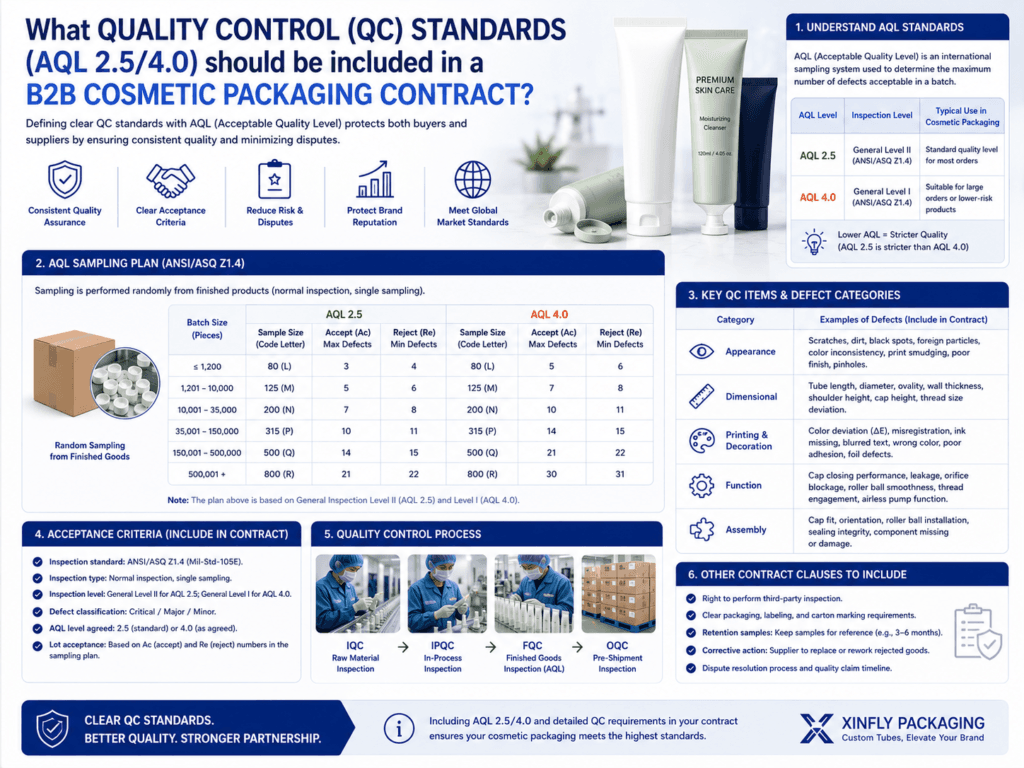
A B2B cosmetic packaging contract should not state only “inspection according to AQL 2.5/4.0.” It should define the applicable sampling standard, inspection level, lot definition, random-sampling method, Critical/Major/Minor defect classifications, acceptance and rejection rules, approved specifications, functional tests, inspection timing, reinspection procedures, and the supplier’s responsibility when a lot fails.
A common starting point for custom cosmetic tubes, caps, bottles, jars, pumps, and applicators is Critical defects: Ac=0; Major defects: AQL 2.5; Minor defects: AQL 4.0. However, the final limits should reflect product risk, formula type, regulatory requirements, distribution channel, brand positioning, and the potential consequences of a packaging failure.
Quick Answer
The contract should require inspection under an agreed version of ISO 2859-1 or ANSI/ASQ Z1.4, normally using General Inspection Level II unless another level is specified. Defects should be classified as Critical, Major, or Minor, with clear photographic examples and measurable tolerances.
| Defect Class | Recommended Starting Rule | Typical Cosmetic Packaging Example | Lot Decision |
|---|---|---|---|
| Critical | Ac=0 / Re=1 | Contamination, sharp edge, wrong regulated marking, hazardous material, foreign matter inside package | Reject when one critical defect is found |
| Major | AQL 2.5 | Leakage, incorrect component, unreadable artwork, cap failure, wrong dimensions affecting filling | Accept or reject according to selected sampling table |
| Minor | AQL 4.0 | Small cosmetic mark, slight color variation, minor printing imperfection not affecting saleability | Accept or reject according to selected sampling table |
What Does AQL 2.5/4.0 Mean?
AQL is an index used to select an acceptance-sampling plan. It is not a blanket permission for the supplier to deliver 2.5% Major defects or 4.0% Minor defects. The actual sample size and acceptance/rejection numbers depend on the lot size, selected inspection level, sampling method, and AQL table.
| Term | Contract Meaning | What It Does Not Mean |
|---|---|---|
| AQL 2.5 | Common sampling index for Major defects | The supplier may intentionally ship 2.5% defective products |
| AQL 4.0 | Common sampling index for Minor defects | Every shipment automatically accepts 4% cosmetic defects |
| Ac | Maximum nonconforming units allowed in the inspected sample | A guaranteed defect percentage in the complete lot |
| Re | Number of nonconforming units that causes lot rejection | A supplier-wide annual quality target |
Important: The contract should identify the exact sampling standard and edition used. Writing only “AQL inspection” can create disputes because different inspectors may select different inspection levels, sample sizes, or acceptance tables.
1. Specify the Sampling Standard
The quality clause should identify the sampling system used for lot-by-lot inspection. It should also state which contract document controls if the purchase order, specification sheet, approved PPS, inspection manual, and supplier quotation contain conflicting requirements.
| Contract Item | Recommended Requirement |
|---|---|
| Sampling standard | ISO 2859-1 or ANSI/ASQ Z1.4, with edition identified |
| Inspection type | Single normal sampling unless otherwise agreed |
| General inspection level | Level II as a common default |
| Special inspection levels | S-1 to S-4 for selected destructive, time-consuming, or functional tests where agreed |
| Switching rules | Normal, tightened, or reduced inspection rules should be stated if they will be used |
| Rounding and table selection | Follow the selected standard without inventing intermediate acceptance numbers |
2. Define the Inspection Lot
AQL sampling cannot work properly unless the contract defines what constitutes one lot. Different sizes, materials, body colors, cap colors, artwork versions, molds, production dates, and manufacturing lines should not automatically be combined into one inspection lot.
| Lot Factor | Recommended Contract Definition |
|---|---|
| SKU | Each size, capacity, artwork, color, material, and closure combination is a separate SKU |
| Production batch | Products made from the same approved materials under substantially identical conditions |
| Cap batch | Different cap molds, colors, or resin batches may require separate traceability |
| Printing batch | Different artwork setups or printing dates should remain traceable |
| Mixed cartons | Mixed SKUs should not be sampled as one homogeneous lot unless expressly approved |
3. Use General Inspection Level II as the Default
General Inspection Level II is commonly selected as the default balance between inspection effort and statistical coverage. Level I may reduce sample size when the buyer accepts more sampling risk, while Level III increases the sample size for higher-risk projects.
| Inspection Level | Typical Use | Contract Consideration |
|---|---|---|
| General Level I | Lower-risk or well-established repeat orders | Smaller sample and lower inspection cost |
| General Level II | Normal commercial inspection | Recommended default for many B2B cosmetic packaging orders |
| General Level III | New supplier, high-value launch, previous quality failure | Larger sample and stronger detection ability |
| Special S-level | Destructive or lengthy functional tests | Must identify which tests use the smaller sample |
4. Define Critical Defects Clearly
Critical defects can create a safety, contamination, legal, regulatory, or serious consumer-harm risk. A common contractual rule is zero acceptance: one Critical defect in the inspected sample rejects the lot and triggers containment or expanded investigation.
| Critical Defect Example | Why It Is Critical |
|---|---|
| Foreign matter or visible contamination inside the package | May contaminate the cosmetic formula |
| Sharp metal edge, burr, or broken applicator surface | May injure the user |
| Prohibited or unapproved material substitution | May breach safety, compliance, or formula-compatibility requirements |
| Incorrect mandatory or regulated information supplied by the packaging manufacturer | May create a regulatory or traceability failure |
| Severe closure failure that exposes or contaminates the product | May make the finished product unsafe or unfit for sale |
| Incorrect product mixed into the lot | May create filling, labeling, or consumer-use risk |
5. Define Major Defects at AQL 2.5
A Major defect materially affects packaging function, filling-line performance, leakage resistance, usability, saleability, or compliance with the approved specification. Major defects normally cause consumer complaints, filling losses, retailer rejection, or significant rework.
| Major Defect Example | Why It Is Major |
|---|---|
| Tube, bottle, jar, or closure leakage | Product may escape during filling, transport, or use |
| Incorrect tube diameter, length, neck, or orifice | May not fit the filling line or deliver the correct dosage |
| Cap cannot close, opens accidentally, or strips the thread | Closure system does not perform its intended function |
| Flip-top hinge breaks during required cycle test | Package cannot survive normal consumer use |
| Unreadable, missing, or materially misplaced artwork | Packaging may be unsaleable or noncompliant |
| Severe printing peeling, smudging, or hot-stamping loss | Retail appearance and brand information are affected |
| Wrong material, body color, cap color, or component | Product does not match the approved order specification |
| Tube deformation that prevents filling or retail display | Packaging function or saleability is materially reduced |
6. Define Minor Defects at AQL 4.0
A Minor defect is a workmanship or cosmetic imperfection that does not materially affect packaging safety, filling, sealing, usability, regulatory information, or normal saleability. The contract should still include measurable visual standards so inspectors do not classify defects subjectively.
| Minor Defect Example | Recommended Boundary |
|---|---|
| Small surface mark | Visible only within the agreed inspection distance or lighting condition |
| Slight print-position variation | Within the approved registration tolerance and not affecting readability |
| Small color variation | Within approved master sample or measured color tolerance |
| Minor molding line | No sharp edge and no effect on closure or appearance at normal viewing distance |
| Slight cosmetic dent | Recovers naturally and does not affect filling or display |
7. Include an Approved Defect Classification Manual
The contract should attach or reference a defect manual containing photographs, drawings, measurement points, acceptance boundaries, and defect classifications. Verbal descriptions such as “good printing” or “no obvious scratches” are too subjective for a commercial dispute.
- Photographic examples: Show acceptable and unacceptable printing, dents, flash, scratches, and contamination.
- Viewing conditions: Define inspection distance, lighting, viewing time, and whether magnification is permitted.
- Measurement method: Identify tools, reference points, and tolerance units.
- Golden sample: Retain a signed master sample for visual and functional comparison.
- Revision control: Record the document number, version, approval date, and authorized approvers.
8. Include Dimensional and Capacity Specifications
AQL inspection should be used together with engineering specifications. Some dimensional requirements may be checked using a smaller special-level sample, but critical fit dimensions may require process records, cavity checks, or additional measurement.
| Inspection Item | Contract Requirement |
|---|---|
| Tube diameter and length | Nominal dimension, tolerance, measurement location, and method |
| Wall thickness | Minimum, maximum, average, and measuring points if applicable |
| Neck and thread | Drawing, thread profile, gauges, and cap-fit requirement |
| Orifice diameter | Nominal diameter, tolerance, and obstruction requirement |
| Nominal capacity | Overflow or usable capacity method and test condition |
| Component weight | Target and tolerance where weight affects strength or PCR claims |
9. Include Functional Performance Tests
Visual AQL alone is not sufficient for cosmetic packaging. The contract should include functional tests matched to the component and formula. Some tests may be performed during production, before shipment, or as part of package-compatibility validation.
| Functional Test | What It Verifies | Suggested Contract Detail |
|---|---|---|
| Leakage test | Closure, tube head, shoulder, pump, or tail-seal integrity | Test medium, orientation, pressure, time, temperature, and pass criteria |
| Application/removal torque | Cap assembly and consumer opening performance | Torque range, equipment, conditioning, and test speed |
| Flip-top cycle test | Living-hinge and snap durability | Cycle count and failure definition |
| Drop test | Resistance to handling and e-commerce impacts | Filled or empty condition, drop height, surfaces, and orientations |
| Compression test | Carton and packaging resistance during stacking | Load, duration, carton configuration, and allowable deformation |
| Printing adhesion test | Ink, coating, foil, or label durability | Tape type, dwell time, peel direction, and acceptance standard |
| Dispensing test | Orifice, pump, rollerball, nozzle, and formula-flow performance | Formula or simulant, dosage range, clogging, and residue criteria |
10. Separate AQL Inspection From Compatibility Testing
AQL inspection determines whether a production lot is accepted based on sampled workmanship and conformance. Formula compatibility testing determines whether the complete packaging system remains suitable after exposure to the actual cosmetic formula over time. One does not replace the other.
| Quality Activity | AQL Lot Inspection | Compatibility Testing |
|---|---|---|
| Primary purpose | Accept or reject a production lot | Validate package and formula interaction |
| Timing | During production or before shipment | Before mass production and during stability program |
| Typical checks | Appearance, dimensions, assembly, workmanship, functional sampling | Swelling, migration, cracking, leakage, discoloration, odor, stability |
| Responsible party | Supplier, buyer, or third-party inspector as agreed | Usually brand/formulator with supplier technical support |
11. Define Random Sampling Requirements
The contract should prevent inspectors from selecting only the easiest cartons or the most accessible top-layer units. Samples should represent the complete lot, including different cartons, pallet locations, production times, molds, cavities, and printing positions where relevant.
- Select samples from multiple cartons and pallet positions.
- Include early, middle, and late production where traceability permits.
- Sample different mold cavities or production lines where applicable.
- Do not allow the supplier to preselect the inspection samples.
- Record sampled carton numbers, batch codes, and quantities.
- Replace damaged sampling units only when the damage was caused by inspection handling and is documented.
12. Define Inspection Timing and Access
| Inspection Stage | Contract Purpose |
|---|---|
| Incoming material inspection | Verify resin, laminate, cap, pigment, foil, ink, and purchased components |
| First-article inspection | Approve setup before continuous production |
| In-process inspection | Detect drift before the full batch is completed |
| Pre-shipment inspection | Accept or reject the finished lot before dispatch |
| Container-loading inspection | Check quantity, carton condition, labels, loading, and seal number |
13. State What Happens When a Lot Fails
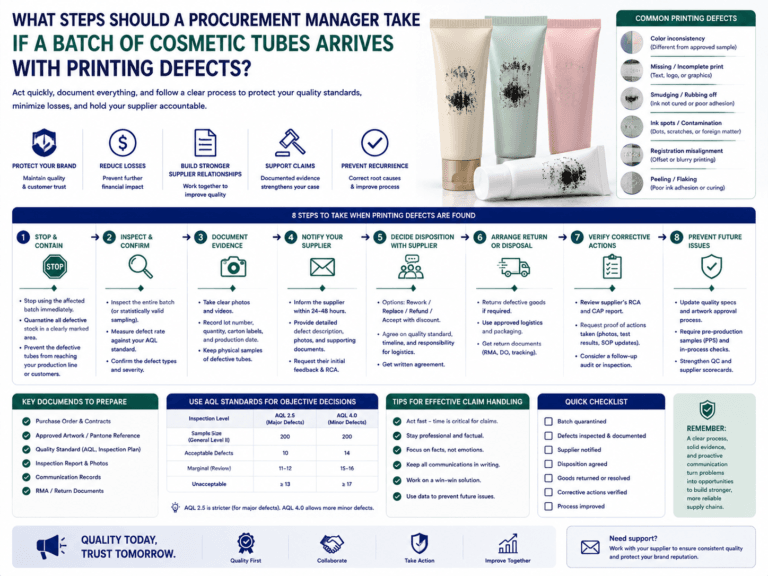
A strong contract defines the corrective process before a failure occurs. The supplier should not automatically sort or rework rejected products without buyer approval, because rework may create new scratches, contamination, mixed batches, or traceability problems.
| Failed-Lot Requirement | Recommended Contract Rule |
|---|---|
| Immediate containment | Stop shipment and segregate the affected lot |
| Failure notice | Notify the buyer within an agreed number of hours or working days |
| Root-cause analysis | Provide documented investigation and corrective action |
| Sorting or rework | Require written buyer approval and documented work instructions |
| Replacement | Specify replacement lead time and responsibility for urgent production |
| Reinspection | Use a newly selected random sample after completed corrective action |
| Costs | Allocate inspection, reinspection, sorting, replacement, disposal, and freight costs |
14. Define Reinspection Rules
After a lot fails, the supplier may propose 100% sorting, rework, replacement, or complete remanufacture. The contract should require a new inspection after corrective action rather than accepting the supplier’s internal statement that the defect was removed.
- New sample: Reinspection should use newly and randomly selected units.
- No defect removal from original sample: Replacing failed sample pieces does not convert a rejected result into an accepted result.
- Documented sorting: Supplier records should show quantity inspected, quantity rejected, personnel, date, and method.
- Traceability: Reworked goods should remain identifiable.
- Buyer approval: Shipment should remain blocked until written release.
15. Include Tightened Inspection After Repeated Failures
The agreement should permit stronger controls when a supplier has repeated failures. Possible measures include General Level III, tightened sampling, larger functional-test samples, 100% sorting of selected characteristics, third-party inspection, or temporary shipment hold.
| Quality History | Possible Contract Response |
|---|---|
| Stable approved repeat orders | Continue normal inspection or consider reduced inspection if agreed |
| One failed lot | Corrective action, reinspection, and enhanced next-lot review |
| Repeated Major defects | Tightened inspection, Level III, or additional in-process inspection |
| Critical defect | Immediate containment, investigation, and possible 100% inspection |
| Unresolved recurring defect | Supplier corrective-action plan, production suspension, or requalification |
16. Define Color and Appearance Standards
Color and decoration disputes are common in cosmetic packaging. The contract should not rely only on screen images or verbal descriptions. It should define the approved physical standard and inspection conditions.
| Appearance Control | Recommended Requirement |
|---|---|
| Color reference | Signed physical master sample, Pantone reference, or agreed instrumental tolerance |
| Lighting | Specified light source or controlled viewing environment |
| Viewing distance | Define normal inspection distance and viewing duration |
| Printing registration | State positional tolerance relative to centerline, shoulder, tail, or cap |
| Surface defects | Use defect-size limits, location zones, and photographic examples |
| Golden sample hierarchy | State whether signed PPS, color plaque, or technical drawing controls |
17. Define Packaging, Quantity, and Label Inspection
| Packing Requirement | Inspection Standard |
|---|---|
| Quantity per carton | Exact count or agreed weighing/counting method |
| Carton dimensions | Approved dimensions and allowable tolerance |
| Inner protection | Correct bags, dividers, trays, sleeves, and cleanliness controls |
| Carton strength | Approved board specification and transport-test requirement |
| Shipping marks | Correct SKU, quantity, batch, PO, country, and handling information |
| Pallet or loading plan | Approved pallet pattern, height, wrapping, and container loading |
18. Include Documentation and Traceability
- Raw-material batch numbers and supplier records.
- Production date, machine, line, shift, and mold or cavity identification where practical.
- Cap and tube-body batch linkage.
- Approved artwork and revision number.
- In-process and final inspection records.
- Functional test reports and calibration status.
- Certificate of conformity where required.
- Retention-sample quantity and retention period.
19. Recommended Contract Clause Structure
Example QC and AQL Clause
Inspection Standard: Finished cosmetic packaging shall be inspected by attributes in accordance with the edition of ISO 2859-1 or ANSI/ASQ Z1.4 identified in the purchase specification. Unless otherwise stated, single normal sampling and General Inspection Level II shall apply.
Defect Classification: Critical defects shall be subject to Ac=0/Re=1. Major defects shall be inspected at AQL 2.5. Minor defects shall be inspected at AQL 4.0. Defect classification shall follow the approved defect manual, drawings, signed PPS, technical specifications, and approved artwork.
Lot Definition: Each combination of SKU, size, material, body color, cap color, artwork, and production batch shall constitute a separate inspection lot unless the buyer provides written approval to combine lots.
Sampling: Samples shall be randomly selected from multiple cartons and representative positions throughout the lot. The supplier shall not preselect inspection samples.
Lot Rejection: If the number of nonconforming units reaches the rejection number for any defect class, the complete lot shall be considered rejected. A Critical defect shall cause immediate lot rejection and containment.
Corrective Action: Rejected lots shall not be shipped, sorted, reworked, replaced, or destroyed without written buyer authorization. The supplier shall provide root-cause analysis, corrective action, disposition proposal, and traceability records.
Reinspection: Corrected lots shall be subject to reinspection using newly selected random samples. Unless otherwise agreed, costs for failed inspection, sorting, rework, replacement, reinspection, and supplier-caused urgent freight shall be borne by the supplier.
Reservation of Rights: Acceptance under sampling inspection does not waive the supplier’s obligation to deliver all goods in conformity with the contract, approved specification, applicable law, and agreed warranties. Latent defects remain subject to the contract’s warranty and claim provisions.
20. Should Critical Defects Use AQL 0.0?
Contracts often describe Critical defects as “AQL 0” or “AQL 0.0,” but a clearer commercial clause is usually Ac=0/Re=1 for the selected sample. This means no Critical defect is accepted in the inspection sample. The contract should separately state that finding one Critical defect may trigger lot rejection, containment, expanded inspection, and root-cause investigation.
21. Are AQL 2.5 and 4.0 Suitable for Every Product?
No. AQL 2.5/4.0 is a common commercial starting point, not a universal rule. Lower AQL values or stricter functional controls may be appropriate when a packaging defect could cause formula contamination, regulatory noncompliance, leakage of an aggressive formula, user injury, high retailer penalties, or expensive product recalls.
| Project Risk | Possible Quality Adjustment |
|---|---|
| Standard rinse-off cosmetic packaging | Critical Ac=0, Major 2.5, Minor 4.0 may be a practical starting point |
| Premium luxury packaging | Consider stricter Minor-defect limits or detailed cosmetic zones |
| Eye-area applicator | Stricter controls for sharp edges, contamination, applicator security, and smoothness |
| OTC-style or regulated product | Use product-specific legal, safety, and tamper-evidence requirements |
| Aggressive or oil-rich formula | Add compatibility, stress-cracking, leakage, and aging requirements |
| E-commerce distribution | Add stronger drop, compression, cap-opening, and leakage tests |
Common Contract Mistakes
- Writing only “AQL 2.5/4.0”: This omits the standard, inspection level, defect definitions, and sampling method.
- Using subjective defect descriptions: Terms such as “obvious,” “serious,” or “acceptable color” need measurable boundaries.
- Combining unrelated SKUs into one lot: A good result for one design can hide a problem in another.
- Using AQL for every test: Compatibility and some engineering validations require separate protocols.
- Not defining rejected-lot costs: Disputes arise over sorting, reinspection, replacement, disposal, and urgent freight.
- Allowing silent material substitutions: All resin, PCR ratio, colorant, adhesive, coating, ink, and component changes should require approval.
- Assuming inspection acceptance removes warranty responsibility: Sampling cannot reveal every latent or future-use defect.
Best Practical Recommendation
For a typical B2B cosmetic packaging contract, start with Critical Ac=0/Re=1, Major AQL 2.5, Minor AQL 4.0, single normal sampling, and General Inspection Level II. Then attach a product-specific defect manual, signed PPS, technical drawings, artwork standards, functional test methods, packing requirements, and rejected-lot procedures.
Before signing, have the final contract reviewed by qualified legal and quality professionals in the relevant manufacturing and destination markets. AQL controls lot acceptance, but it does not replace product specifications, regulatory compliance, compatibility testing, supplier warranties, or corrective-action obligations.
Summary
A B2B cosmetic packaging contract should define much more than AQL numbers. It should state the sampling standard, inspection level, lot definition, Critical/Major/Minor classifications, acceptance and rejection rules, approved samples, dimensional tolerances, functional tests, inspection access, documentation, reinspection, corrective action, and cost responsibility.
AQL 2.5 for Major defects and AQL 4.0 for Minor defects are common starting points. Critical defects should normally have zero acceptance in the inspected sample. The final standard should always be adjusted to the product’s safety, regulatory, functional, commercial, and brand risks.
Learn more: Quality Assurance, Sample Development, PPS vs. Digital Layout Proof, Request Samples for Compatibility Testing, Custom Cosmetic Tubes, Contact Xinfly Packaging.
Need Clear QC Standards for a Cosmetic Packaging Order?
Xinfly Packaging helps B2B buyers define tube specifications, defect classifications, approved samples, dimensional tolerances, printing standards, cap tests, leakage requirements, packaging inspections, and pre-shipment QC plans for custom cosmetic tube projects.