
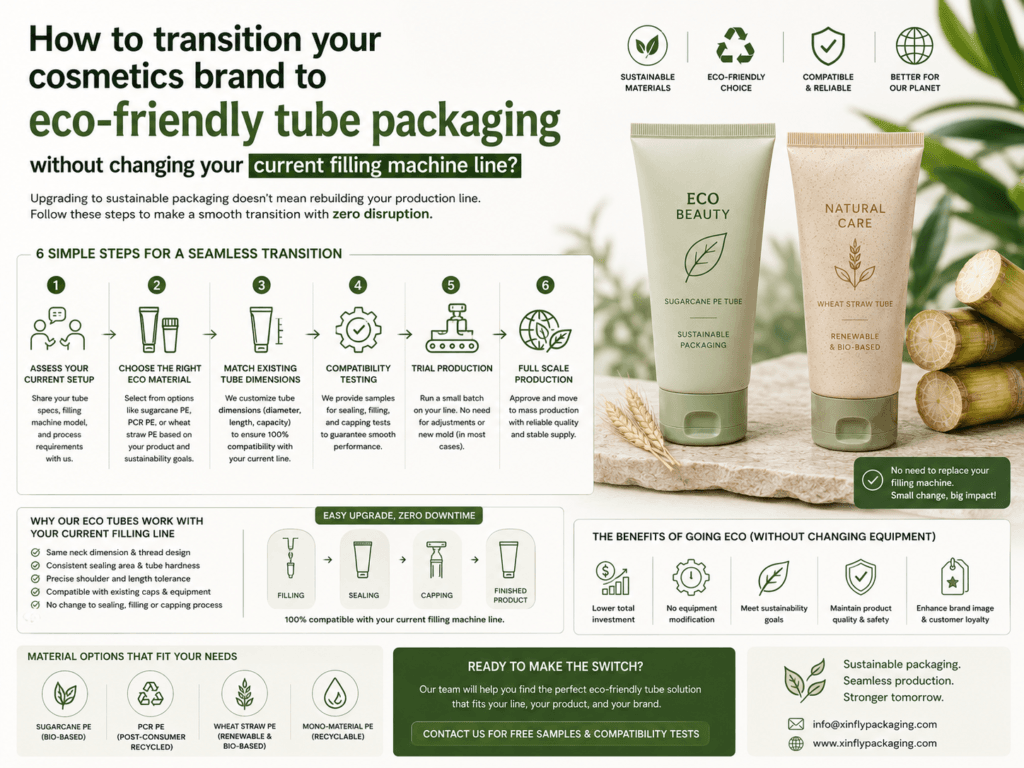
Yes, many cosmetics brands can transition to eco-friendly tube packaging without changing their current filling machine line, as long as the new tube structure is selected carefully. In most projects, the key is not the “eco” claim itself, but whether the sustainable tube keeps the same diameter, shoulder design, sealing style, cap format, wall feel, and filling behavior as the current tube.
The most practical upgrade path is usually to start with PCR PE tubes, sugarcane PE tubes, or mono-material PE tubes, because these options are closer to standard PE processing than more radical biodegradable materials. This helps brands improve sustainability without turning a packaging upgrade into a full production-line reengineering project.
Why Some Eco Tube Projects Do Not Require Machine Changes
| Machine-Related Factor | Why It Matters | How to Keep It Stable |
|---|---|---|
| Tube diameter | Affects nozzle fit, conveyor handling, and capping alignment | Keep the same diameter as the current tube |
| Shoulder and head design | Affects filling positioning and closure performance | Use the same or compatible head structure |
| Tail sealing structure | Affects sealing temperature and seal consistency | Stay within the same PE-based sealing family |
| Tube stiffness / rebound | Affects line stability, clamping, and post-fill appearance | Select eco material with similar mechanical behavior |
| Cap type and torque | Affects downstream assembly and transport security | Keep the same closure logic whenever possible |
Best Eco-Friendly Tube Options for a Smooth Transition
- 30%–50% PCR PE tubes: Often the easiest upgrade from standard PE with limited machine risk.
- Sugarcane PE tubes: Chemically equivalent to traditional PE, so they are usually highly compatible with existing PE tube filling lines.
- Mono-material PE tubes: Useful when recyclability goals matter but process continuity is still the priority.
- High-PCR or 100% PCR tubes: Possible, but may require tighter validation for rebound, appearance, and sealing consistency.
Materials That Usually Need More Caution
| Material Type | Transition Difficulty | Main Risk |
|---|---|---|
| Standard PE to 30% PCR PE | Low | Usually minor validation only |
| Standard PE to 50% PCR PE | Low to medium | May slightly affect rebound or color consistency |
| Standard PE to sugarcane PE | Very low | Mainly documentation and sample approval |
| Standard PE to PLA / some biodegradable tubes | Medium to high | Different stiffness, brittleness, and sealing behavior |
How to Transition Without Disrupting Production
- Keep the geometry the same: Do not change diameter, shoulder, cap, and material all at once.
- Start with PE-family eco materials: PCR PE and sugarcane PE are usually the safest first step.
- Run line trials with the real formula: Filling tests should use your actual cream, lotion, sunscreen, or cleanser.
- Check sealing and leakage performance: Sustainable tubes must pass the same commercial quality standards as your current packaging.
- Validate transport and consumer use: Test squeeze feel, rebound, drop resistance, and shelf appearance after filling.
Recommended Transition Path for Beauty Brands
| Brand Goal | Suggested First Step | Reason |
|---|---|---|
| Quick sustainability upgrade | 30% PCR PE tube | Low process risk and manageable cost premium |
| Premium renewable material story | Sugarcane PE tube | Very strong machine compatibility with PE filling lines |
| Recyclability-focused strategy | Mono-material PE tube | Keeps the PE process family while supporting recycling claims |
| Higher recycled-content target | 50% PCR tube | Balanced option for ESG and production continuity |
Common Mistakes to Avoid
- Changing tube material and tube design at the same time
- Choosing biodegradable tubes first without machine validation
- Skipping pilot-line testing with the actual cosmetic formula
- Ignoring cap torque, tail sealing, and rebound performance
- Using sustainability claims as the only decision factor
Summary
To transition your cosmetics brand to eco-friendly tube packaging without changing your current filling machine line, the best strategy is to choose sustainable materials that stay close to your current PE tube structure. In most cases, PCR PE, sugarcane PE, or mono-material PE tubes are the most practical options because they protect line compatibility while improving sustainability.
The safest route is to keep the same tube geometry, run real filling trials, validate sealing and transport performance, and upgrade in phases rather than making a full packaging-system change all at once.
Learn more: Sustainable Packaging, How to Choose Sustainable Cosmetic Tubes, PCR Cosmetic Tubes, Sugarcane Plastic Tubes, How to Choose Cosmetic Tube Packaging.
Need Eco-Friendly Tubes That Fit Your Current Filling Line?
Xinfly Packaging helps beauty brands upgrade to PCR, sugarcane, and other sustainable cosmetic tubes while keeping current filling-machine compatibility, sealing logic, and pack-out efficiency as stable as possible.