Published: .
Use a sunscreen tube temperature trial brief to separate the conditions you requested from the exposure that the samples actually received. A report headed “temperature test completed” can leave several questions unanswered: when did exposure begin, what temperature was recorded, when were the packs removed and when were they inspected? Those details determine whether the responsible reviewer can interpret the observations for the proposed packaging project.
This guide provides two purchasing tools: a protocol-input checklist and an exposure-event record. It does not prescribe a temperature, duration, sample quantity or acceptance limit. The responsible product manufacturer and technical reviewer must select and justify the actual protocol. Buyers can make that review easier by requesting clearly identified samples, retrievable condition records and an inspection time linked to each observation.
Define the question before arranging the trial
Separate filling conditions from later storage exposure
A short exposure during filling and a later storage programme are different questions. State which stage your request addresses. Do not turn a filling-line temperature statement into approval for an extended storage condition, or treat a storage observation as a filling-process limit. If both questions matter, give them separate references and ask the responsible teams which evidence each requires.
When sourcing sunscreen tube packaging, identify the actual formula and proposed assembly. The commercial product category is a starting point for the enquiry. It does not define the required protocol or establish that a particular tube protects the formula under every temperature condition.
State what the reviewer will decide
Identify the decision that the evidence should support, such as reviewing a proposed filled-pack assembly under an approved exposure programme. List the observations that the technical team wants recorded and the applicable assessment criteria where these have been agreed. Do not let a purchasing worksheet become an unreviewed test specification simply because it contains convenient blank fields.
Identify exactly what will be exposed
Record the tube construction reference, shoulder or neck reference, closure identifier, decoration revision and sample status. State whether the specimen is an empty component or a filled, sealed pack. If it is filled, connect it to the formula and preparation record. A loose cap and a complete filled assembly should not share an ambiguous sample description. Even an enquiry for 50ml sunscreen tubes with flip-top caps needs an exact component reference: capacity and cap family alone do not identify the assembly sent for exposure.
For custom sunscreen squeeze tubes, also identify the proposed body colour and decoration process. These fields help the reviewer establish which samples the observations describe. A different cap, material revision or artwork finish should be visible in the record rather than hidden behind the same generic product name.
Keep sample identity through each handling step
Use a specimen identifier that remains connected to the handling record and final observations. Ask how identification will be maintained if a pack is moved between locations or separated from its shipping carton. The method should suit the agreed work without changing the specimen in a way that compromises the assessment. Let the technical team decide the appropriate identification arrangement.
Agree the protocol inputs in writing
The public abstract of ISO/TR 18811:2018 describes a framework for cosmetic stability assessment and leaves the selection and justification of methods, specifications and conditions to the manufacturer. It does not supply a universal temperature or duration for this enquiry. The checklist below is an original coordination tool, not a claim that a particular ISO procedure has been performed.
| Field to agree | Information to identify | Approval or evidence reference |
|---|---|---|
| Assessment question | Filling stage, storage exposure or another defined purpose | Responsible technical owner |
| Specimen identity | Tube, closure, formula and preparation references | Current sample specification |
| Exposure programme | Conditions, sequence and planned duration | Approved protocol revision |
| Start-of-exposure definition | Event from which the relevant interval is counted | Protocol instruction |
| Condition measurement | Quantity measured, location and record method | Technical team's measurement plan |
| Handling between stages | Movement and any agreed recovery step | Approved handling instruction |
| Inspection timing | When observations are to be made | Assessment plan |
| Acceptance decision | Applicable criteria and reviewer | Authorised review record |
Give unresolved fields an owner
A field marked “supplier to confirm” is a pending task. Assign the question to the person responsible for the protocol, sample preparation or equipment record. Keep the response with the brief. Buyers should be able to distinguish an agreed input from a suggestion included for discussion, especially when several suppliers receive the same enquiry.
Distinguish the setpoint from the measured condition
Ask what the temperature value represents
A programme setting, an air measurement near the specimen and a measurement of the specimen itself are different records. Ask which quantity the reported value represents and where it was obtained. Do not relabel a chamber setting as a measured product temperature. The technical team should establish which measurements are appropriate to the actual assessment.
Keep the instrument or record identifier where it is relevant to traceability. Ask what equipment status and supporting information the reviewer needs. A screenshot showing one temperature at one moment cannot by itself establish the entire exposure history. Request the condition record defined by the approved method and identify any gaps that need explanation.
Retain the actual record beside the planned programme
Preserve the programme reference and the actual condition log as separate items. If the recorded conditions depart from the plan, retain that information and the responsible team's disposition. Do not replace the actual log with the intended settings to make a summary look complete. Purchasing can flag the discrepancy without deciding its technical significance.
Connect exposure events to the specimen record
Use event labels that your technical team has defined. Loading, the start of a timed interval, removal and inspection may occur at different times. Ask which event begins the relevant exposure interval and how any transition period is treated. Record the agreed meaning rather than assuming that the time a cabinet door closes is the required start for every method.
The following event worksheet illustrates the distinctions to clarify. It is not a mandatory sequence or a completed test record. Add or remove events to match the approved protocol, and retain the date, time and time zone or other agreed time basis where they are needed to interpret the record.
| Event or record | Information to retain | Question it should resolve |
|---|---|---|
| Specimen prepared | Identity and preparation reference | Which assembly entered the programme? |
| Specimen loaded | Actual event time and location | When did handling into exposure occur? |
| Defined interval starts | Event time and protocol basis | From which event is duration counted? |
| Conditions recorded | Log reference and measurement meaning | What exposure information was actually captured? |
| Specimen removed | Actual event time and any deviation | When did that exposure stage end? |
| Any agreed recovery step | Conditions and interval as actually followed | What happened before inspection? |
| Specimen inspected | Actual inspection time and observations | At what stage were the observations made? |
| Technical review | Reviewer, scope and disposition | What conclusion is authorised for these specimens? |
Keep exposure duration and inspection delay distinct
A statement such as “inspected after the trial” leaves the delay unclear. Request the removal time and the inspection time separately when the method needs that distinction. If an agreed recovery step exists, identify it. If it does not, avoid adding an undocumented recovery period merely because another project used one.
Describe observations without assigning an unsupported cause
Record what was observed, where on the pack it appeared and which specimen it concerns. Ask the technical team how to document appearance, closure or other specified observations. A change observed after exposure should be retained for review. The timing alone does not prove which component, formula interaction or handling event caused it.
Connect any photographs to specimen and observation identifiers. A general photograph of similar tubes is not a substitute for the actual assessment record. Where a comparison sample is part of the approved plan, identify its history as carefully as the exposed specimen. Do not invent a control arrangement after the observations have already been made.
Keep the decision within the tested scope
An appearance observation on identified packs does not automatically establish formula stability, SPF performance, shelf life or suitability for other assemblies. Ask the responsible reviewer to state what the evidence supports and what remains unresolved. Keep that scope beside the decision so a later buyer does not extend a narrow result into a broad product claim.
Make the sample request match the exposure brief
When discussing 50ml sunscreen tubes with flip-top caps, confirm the actual capacity, cap reference and sample configuration proposed for the project. The phrase describes a sourcing option, not an approved test specimen. Changes to those items should be assessed for their relevance to the planned work before another sample is substituted.
Through packaging sample development, ask what can be supplied, which preparation steps are included and which information must come from the buyer or filler. Confirm the sample identifiers that will accompany delivery. Keep the supplied specimen description consistent with the protocol-input checklist.
Request a reviewable result package
Ask for the approved brief, specimen list, relevant preparation record, actual exposure record, observation record and technical disposition. State the file references that should connect them. An executive summary is useful when the underlying records remain retrievable and its limitations are clear.
Use the quality assurance discussion to identify the project records and responsible contacts. Ask the supplier to distinguish completed work from work proposed for the next stage. If a specialist review has not occurred, keep it pending rather than adding an assumed approval to the purchasing summary.
Use the visual as packaging context
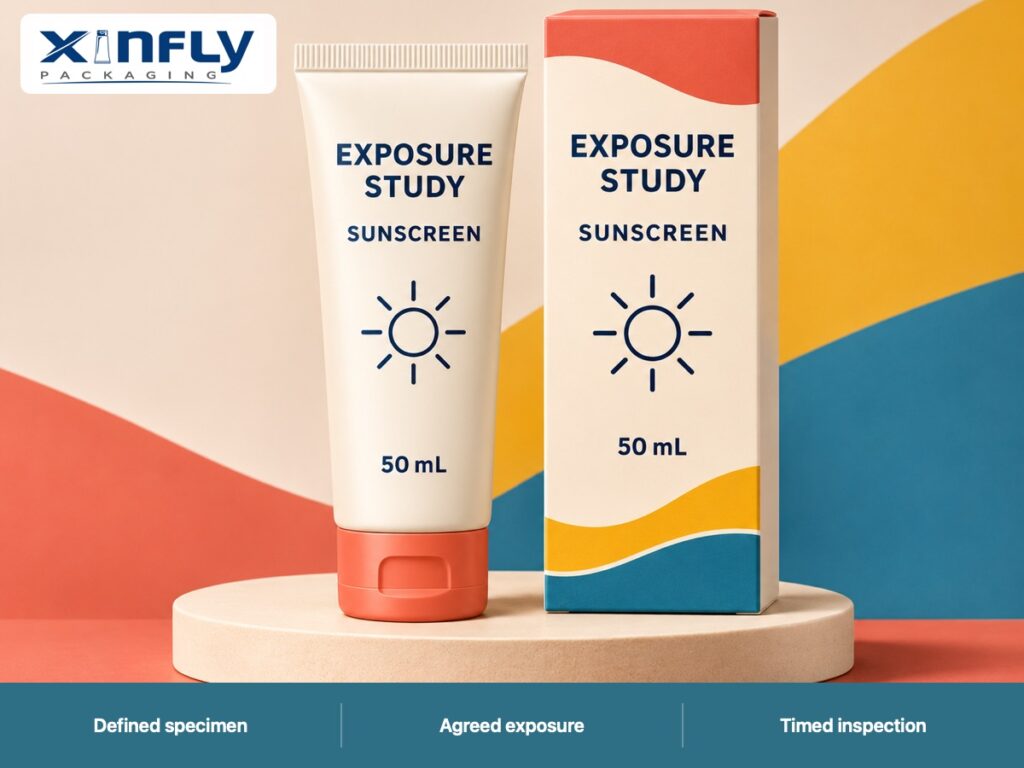
The EXPOSURE STUDY posters show a warm-white PE-style tube, moulded shoulder, straight crimped tail, closed coral flip cap and navy single-colour screen-print-style artwork. The printed carton repeats the same original product identity. They illustrate a coordinated sun-care pack and an exposure-brief discussion, not an actual temperature trial or a demonstrated SPF result.
Send the completed record fields with your OEM or ODM packaging enquiry. Identify the decision you need to make and the questions still awaiting technical input. Current sample availability, costs and timing should be confirmed for that defined scope rather than inferred from an illustration or an earlier project.
Frequently Asked Questions
Can a temperature setting be reported as product temperature?
Only describe the quantity that was actually measured or set. Ask where the measurement was taken and what the method requires. Keep a programme setting, a local air reading and a specimen measurement clearly identified instead of treating them as interchangeable.
When should exposure duration start?
Use the event defined in the approved protocol. Ask how loading and any transition period are handled. Purchasing should preserve the stated definition and actual event times rather than choosing a universal start rule for different methods.
Does the inspection time need its own field?
Where timing matters to the assessment, keep inspection and removal times separate. Identify any agreed recovery step and its record. This lets the reviewer understand when the observations were made without reconstructing the sequence from informal messages.
Does an unchanged tube prove sunscreen stability?
An appearance observation has the scope of the actual assessment. It does not by itself establish formula stability, SPF performance or shelf life. Request the responsible team's interpretation and the evidence required for the specific product claim or packaging decision.
What should accompany a supplier sample request?
Send the proposed assembly and formula references, assessment purpose, approved or pending protocol fields and the records you expect to receive. Identify the technical owner for unresolved conditions. Ask the supplier to confirm what is included in the sample supply and what remains a separate activity.
Conclusion
A useful temperature trial brief connects the proposed assembly to an approved programme, the actual exposure record and a clearly timed inspection. Keep settings, measurements and observations distinct, and preserve the responsible reviewer's limited conclusion. Share the checklist with Xinfly Packaging to coordinate samples and identify the remaining technical inputs before authorising the next sourcing step.