Published: .
Two laboratories receive the same face wash and the same tube. One stores its filled samples on their caps. The other lays them in a tray. Both send back photographs labelled “after storage.” Can you compare the observations? Only if you know what happened between filling and photography, including which way each pack was positioned.
A face wash tube storage orientation brief gives your supplier, filler and formulation team a shared description of that position. It also records when the pack moved. This guide provides a practical way to request and document those conditions. Your responsible technical team still needs to choose the evaluation method, duration, environment and acceptance criteria for the actual formula and assembly.
Begin with the Question You Need Answered
Separate Formula Contact from Pack Appearance
When sourcing facial cleanser tube packaging, explain whether the review concerns the formula, the package, dispensing after storage or a particular interface. An appearance photograph, an opening observation and an assessment of formula compatibility answer different questions. Give each question a named owner so the purchasing team knows which result it is waiting for.
Imagine a review intended to examine the closure after storage. If the sample spends most of its time lying sideways and is turned cap-down only before the photograph, the photograph does not establish continuous cap-down storage. The record should describe the actual sequence. That detail lets the technical reviewer decide what the observation can support.
Identify the Actual Assembly
Record the body reference, shoulder or neck reference, closure reference and relevant revisions. Include the formula identity and filling or sealing reference when specimens are filled. “100 mL flip-top tube” describes a category, not a unique assembly. A design mock-up with a display seal may be appropriate for artwork approval while being unsuitable for a filled-pack investigation.
Name Directions Without Relying on Upright
Describe the Closure and Tail Positions
The word “upright” can mean different things to different readers. A tube displayed on its cap has the closure below the body. Another person may describe a specimen supported with its closure above the body as upright. Use descriptions such as closure-down, closure-up or horizontal, with a photograph or simple approved sketch where useful.
Specify the position of the entire assembly rather than the orientation of the printed front alone. “Logo facing the camera” does not tell the reviewer whether the closure was above or below the filled body during storage. If front-facing orientation also matters, record it as an additional field. Keep the two descriptions separate.
State How the Sample Is Supported
Some packs need a suitable holder to maintain the requested position. Ask the technical team to specify a support that does not introduce an unintended load, deformation or restraint. Do not balance a tube precariously on its sealed tail just to satisfy an ambiguous instruction. Record the holder and any relevant contact with the pack.
| Field | Information to agree | What it makes clear |
|---|---|---|
| Assembly identity | Body, shoulder, closure and revisions | Which packaging configuration was evaluated |
| Formula state | Formula reference, fill and preparation record | What the assembly contained |
| Direction | Closure-down, closure-up or horizontal | Where closure and tail were positioned |
| Support | Holder, tray and relevant contact points | How the position was maintained |
| Environment | Agreed storage conditions and actual records | Which exposure accompanied that position |
| Timing | Start, removal and observation times | When each state applied |
| Handling | Movement, opening and dispensing sequence | What happened before the observation |
Match the Position to a Defined Evaluation
Ask Which Surfaces Need Consideration
Orientation can affect where a mobile formula sits inside a pack, but do not infer the complete contact pattern from the outside. Formula consistency, fill, air space, internal geometry and handling may matter. Ask the formulation and packaging reviewers which interfaces their evaluation needs to address. They should decide whether the proposed specimen arrangement answers that question.
For PE tube constructions, the material name alone does not define the shoulder, closure or complete formula-contact arrangement. A position brief should connect to the actual assembly information. If the supplier proposes another construction, ask the team which parts of the planned review remain applicable and which need reconsideration.
Avoid Prescribing a Universal Storage Recipe
There is no temperature, duration or orientation sequence prescribed by this article. Those conditions require a basis appropriate to the product and intended market. Purchasing can request a written protocol and preserve its version. It should not convert an illustrative set of photographs into a stability method or announce a shelf-life conclusion from a short informal observation.
Keep Handling Visible in the Record
Photograph the Position Before Moving the Pack
Where the agreed method permits, a photograph taken before removal can document the storage arrangement. Give the photograph a specimen reference and time. Capture enough context to distinguish the holder and direction. Then record any movement needed for the next observation. The image supports the written record; it does not prove unrecorded conditions throughout the storage period.
Record Opening and Dispensing as Separate Events
Opening a pack to inspect it changes its state. Dispensing changes the remaining fill and may change the subsequent contact situation. Ask whether the evaluation uses separate specimens, repeated observations on the same specimen or another defined approach. Record what actually occurred. A sample repeatedly opened for photography should not silently share the identity of an unopened retained specimen.
Note Unplanned Movement
If a tray is relocated or a specimen falls out of position, record the event and refer it to the responsible reviewer. Preserve the original observation rather than rewriting the history to match the intended plan. The reviewer can decide whether to continue, qualify the result or request a replacement specimen. An exception is useful information when its timing and extent are clear.
Compare Observations on Matching Conditions
Build a Small Condition Matrix
A comparison matrix links each specimen group to its actual conditions and review question. It can include different orientations when the technical team requests them. Do not describe those groups as interchangeable repeats if their exposure differs. Likewise, a filled specimen and an empty reference can play useful but different roles. Identify those roles before anyone pools the observations.
Through sample development, request specimens whose construction and preparation match the agreed purpose. Ask the supplier to identify any differences from the proposed production pack. This is particularly useful when an early appearance sample arrives before the intended closure or final material is available. Clear limitations help you use an early sample without granting it a later approval role.
Distinguish Planned and Observed Conditions
Keep two fields: what the protocol requested and what the operator recorded. If both say closure-down, the relationship is straightforward. If the planned condition says closure-down but the operator reports horizontal storage, flag that difference. Do not resolve it by choosing whichever label makes the comparison look tidier. Have the technical reviewer determine whether a meaningful comparison remains possible.
Connect the Sample to Everyday Use Carefully
Describe the Intended Retail and Bathroom Arrangement
A buyer considering 100ml face wash tubes with flip-top caps may expect the pack to stand closure-down on a bathroom shelf. Describe that intended use to the project team. Also identify relevant transport or storage arrangements separately. A bathroom illustration can communicate a placement idea, but it does not establish actual consumer behaviour or replace a defined package evaluation.
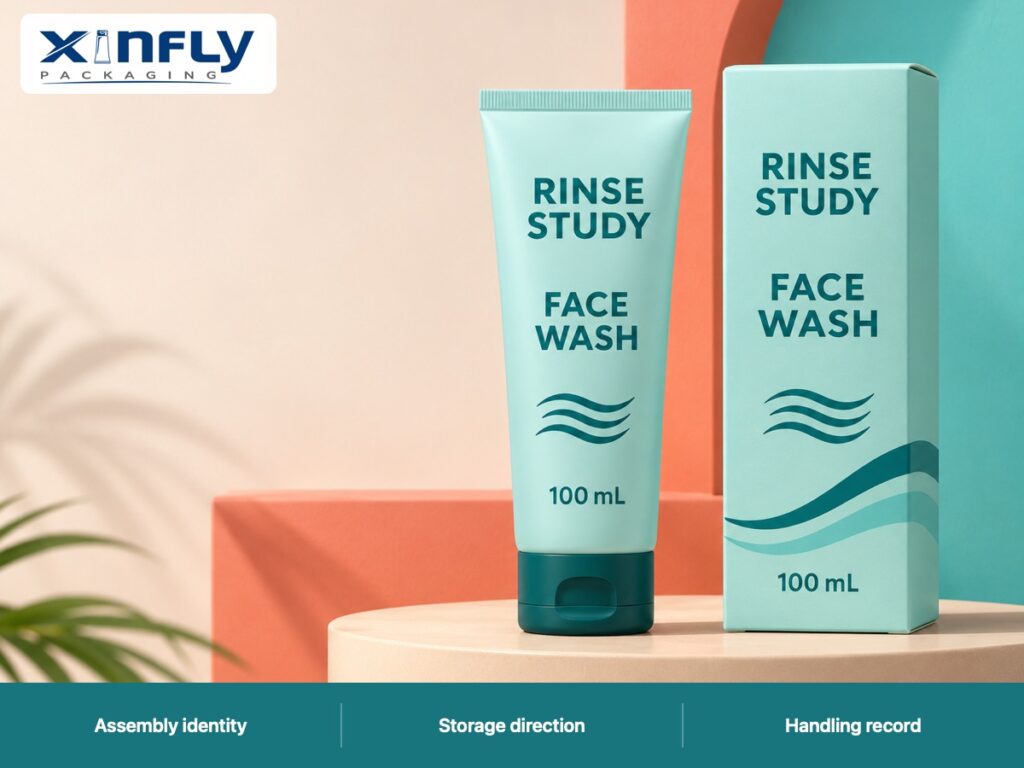
The illustrations show a fictional RINSE STUDY design with an aqua PE-style round body, moulded shoulder, straight crimped display tail and dark teal round flip cap. Dark teal single-colour screen-print-style wording and waves coordinate with an aqua printed carton. These appearance illustrations identify a consistent design. They contain no measured storage results or evidence of formula compatibility.
Turn the Record into a Purchasing Decision
| Recorded situation | Question for the responsible reviewer | Purchasing action to record |
|---|---|---|
| Conditions match the approved plan | What does the observation establish within its scope? | File the authorised interpretation |
| Orientation changed unexpectedly | Does the event affect the intended comparison? | Record disposition and any replacement request |
| Sample was opened between observations | Is that sequence permitted by the method? | Preserve the actual opening history |
| Closure differs from the proposal | Which findings apply to the proposed assembly? | Request a representative configuration if needed |
| Storage history is missing | Can the result support the planned decision? | Request clarification rather than assume equivalence |
| Formula or fill changed | Does the prior evaluation remain relevant? | Refer the change for technical assessment |
Request a Scoped Interpretation
An observation such as “no visible change recorded at removal” should retain its conditions and limitations. It is narrower than a claim that a package is compatible throughout its intended life. Ask who has authority to interpret the result and which decision that interpretation supports. Keep procurement release, formula approval and packaging approval connected without treating them as identical decisions.
Preserve the Reference for a Reorder
File the approved protocol, assembly references, specimen preparation, actual conditions, observations and authorised disposition together. On a reorder, compare the proposed assembly and formula with that record. Ask the responsible team whether changes affect its applicability. Avoid carrying forward a broad approval label after its supporting configuration has become unclear.
Send Xinfly Packaging a Useful Sample Brief
Send the proposed capacity, formula type, body and closure preferences, destination market and the specific review question. Include your agreed orientation description and ask what sample construction can represent the proposed pack. For empty face wash tubes, distinguish the packaging supply from any filling or evaluation services you need to arrange. Confirm responsibilities and quotations for the actual project.
Use the quality review contact to discuss the evidence and technical questions that should accompany the packaging request. Ask for clarification where a sample or document has limited scope. A useful response identifies what can be supplied, what needs confirmation and which party owns the next step. It does not turn a general catalogue description into a completed compatibility assessment.
Frequently Asked Questions
Is Closure-Down the Correct Position for Every Face Wash Tube Review?
No universal position is specified here. Tell the technical team the intended use and review question, then have it choose and document the relevant conditions. A closure-down display preference does not automatically define a complete storage or compatibility protocol.
Can I Compare Two Reports That Say Upright?
First establish what each report means by upright. Ask for the closure and tail positions, support, environment, timing and handling history. Compare the actual conditions and specimen configurations before asking the reviewer to interpret their results together.
Does a Photograph Show the Full Formula-Contact Pattern?
An external photograph shows the visible arrangement at that moment. It does not reveal every internal interface or prove uninterrupted storage history. Use it with the preparation and condition records, and let the technical reviewer determine what additional information is needed.
Should I Open Every Sample at Each Observation?
Follow the agreed method. Opening or dispensing can change a specimen’s state. The responsible team should determine whether to use separate specimens or a defined repeated-observation sequence, and the operator should record the actual handling.
What Should Accompany a Request for Replacement Samples?
Send the assembly and formula references, the reason for replacement, the intended review and the conditions that the new specimens must represent. Identify any differences from earlier samples so the recipient can preserve a clear comparison history.
Conclusion
A useful storage record tells you which pack was evaluated, how it was prepared, where its closure sat and what happened before observation. Agree those fields before sending samples. Xinfly Packaging can discuss the proposed tube configuration and sample request while your responsible technical team establishes the evaluation and interprets the evidence for the intended purchasing decision.